On this page
- How to Retire in This Country
- Financial and Pension Requirements
- Medical Coverage for Retirees
- The Application Process
- How Retirement Income Is Taxed
- What Retirees Struggle With
- Where Retirees Live
- How Long You Can Stay
- Path to Permanent Residence
- What Other Retirees Did
- Visa options for this goal
- Guides for Mexico
- Other goals for Mexico
How to Retire in This Country
#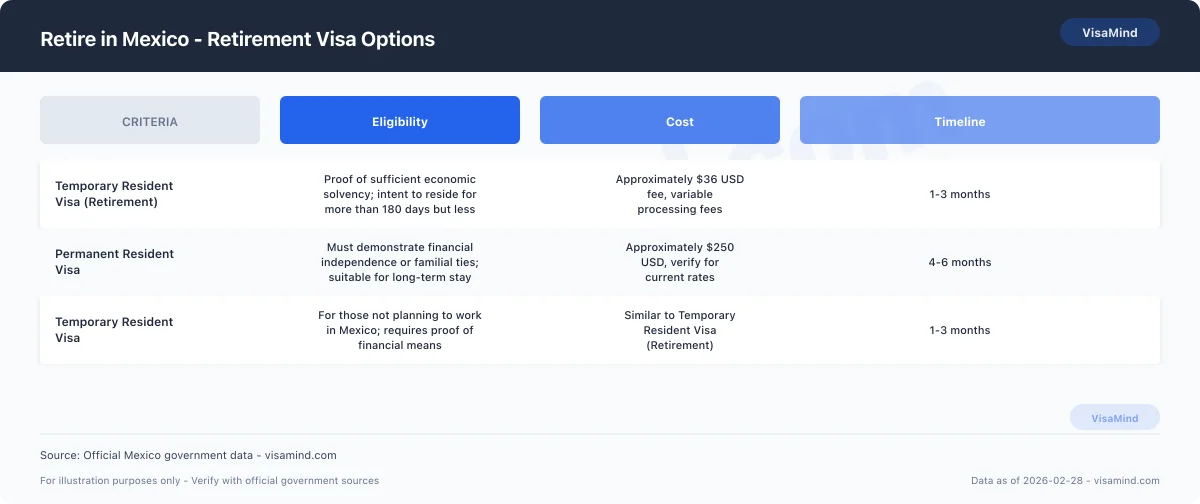
To retire in Mexico, you have several visa options tailored to retirees, each with distinct eligibility criteria and benefits. The Instituto Nacional de Migración (INM) manages these visas, offering pathways for both temporary and permanent residence.
Visa Options for Retirees
| Visa Type | Eligibility | Cost | Timeline |
|---|---|---|---|
| Temporary Resident Visa (Retirement) | Must demonstrate financial solvency, often through monthly income or savings | Varies by consulate, typically around $40 (verify the current fee on the official website) USD | Valid for up to 4 years, renewable annually |
| Permanent Resident Visa | Requires higher financial thresholds or family connections | Varies by consulate, typically around $60 (verify the current fee on the official website) USD | Indefinite stay with no need for renewal |
Understanding Eligibility Requirements
For retirees, the Temporary Resident Visa (Retirement) is a popular choice due to its flexibility. To qualify, you must:
- Provide proof of a steady income, such as a pension or retirement savings.
- Have a valid passport and one copy.
- Not seek employment within Mexico.
The Permanent Resident Visa requires demonstrating a higher level of financial independence or having close family ties in Mexico. This visa allows you to live in Mexico indefinitely without needing to renew your status annually.
Tip: If you plan to apply for a visa, check the financial thresholds for each category on the official INM website, as these can vary annually.
Application Process Overview
- Gather Documents: Collect all necessary documentation, including financial proof, passport, and any additional supporting materials specified by the INM.
- Lodge an Application: Submit your application through a Mexican consulate if you are outside Mexico, or at an INM office if you are already in the country.
- Await Approval: Processing times can vary. Typically, it takes several weeks to a few months, depending on the consulate or INM office workload.
For further guidance on the application process and required documentation, visit the How To Apply and Documents Checklist pages.
Important Considerations
- Financial Requirements: Ensure you meet the financial criteria, which can include proving a specific monthly income or maintaining a certain balance in savings. For detailed figures and updates, refer to the Financial Requirements.
- Length of Stay: The Temporary Resident Visa allows you to stay in Mexico for up to 4 years, while the Permanent Resident Visa offers long-term residency without renewal requirements.
By understanding these visa options and preparing the necessary documents, you can embark on your retirement in Mexico with confidence. For more insights into the lifestyle and logistics of retiring in Mexico, explore the Retirement Guide.
Financial and Pension Requirements
#Financial stability is a key requirement for obtaining the appropriate visa status. The Instituto Nacional de Migración (INM) requires proof of sufficient income or savings to ensure that retirees can support themselves without needing to work in Mexico. Here's a breakdown of the financial and pension requirements you need to meet:
Financial Requirements for Retirement Visas
To retire in Mexico, you will typically need to apply for either a Temporary Resident Visa (Retirement) or a Permanent Resident Visa. Each of these visa categories comes with its own set of financial criteria:
| Visa Type | Minimum Monthly Income | Minimum Savings/Investments |
|---|---|---|
| Temporary Resident Visa (Retirement) | Approx. $4,200 USD | Approx. $84,000 (verify the current fee on the official website) USD |
| Permanent Resident Visa | Approx. $4,200 USD | Approx. $108,000 (verify the current fee on the official website) USD |
Important: These amounts are subject to change and should be verified on the official INM website as they may vary based on the Mexican minimum wage.
Evidence of Income and Savings
For both visa types, you will need to provide evidence of your financial stability. This typically includes:
- Bank Statements: Recent bank statements showing your account balance and transactions.
- Pension Statements: If applicable, official statements from your pension provider detailing your monthly income.
- Investment Statements: Documentation of any investments, including stocks, bonds, or mutual funds.
Regular Income Proof
To satisfy the income requirements, you must demonstrate a consistent and reliable source of income. This may involve:
- Providing pension payment records for the last 6-12 months.
- Showing evidence of rental income or dividends if these contribute to your regular income.
- If working remotely, a letter from your employer confirming your employment status and income, along with the last 6 months of paystubs, is necessary for those planning to work remotely in Mexico.
Tip: Consider consulting with a financial advisor to ensure your documents meet the INM standards and to explore the best financial strategies for maintaining your eligibility.
For more detailed information on how to prepare your financial documents, check the Documents Checklist and the Financial Requirements Guide.
By understanding these financial requirements, you can better prepare your application and increase your chances of successfully retiring in Mexico.
Medical Coverage for Retirees
#Mexico offers a robust healthcare system for retirees, with options ranging from public healthcare to private insurance. Understanding the distinctions and requirements can help ensure you receive the medical coverage you need during your retirement.
Public vs. Private Healthcare
In Mexico, healthcare services are provided through both public and private systems. The public healthcare system, Instituto Mexicano del Seguro Social (IMSS), is available to Mexican citizens and residents, including retirees who qualify. IMSS offers a wide range of medical services, including general practitioner visits, specialist care, and hospital treatments at a relatively low cost.
On the other hand, private healthcare facilities in Mexico are known for their high-quality services and modern equipment. They often cater to expatriates and those who prefer shorter wait times and more personalized care. Private health insurance is usually required to access these facilities, as the cost of services can be significantly higher than in the public system.
Important: Private health insurance is highly recommended for retirees to ensure access to a wider range of healthcare services and facilities.
Mandatory Insurance for Retirees
While having health insurance is not legally mandatory for retirees in Mexico, it is highly advisable. Many retirees opt for private health insurance policies that cover major medical expenses, which can be particularly beneficial in case of emergencies or serious health issues. Some international health insurance policies may also cover services in Mexico, but it's crucial to verify the extent of coverage and any potential limitations.
Benefits of Private Health Insurance:
- Access to a broader network of private hospitals and clinics
- Shorter waiting times for consultations and procedures
- Higher standards of care and comfort in private facilities
Quality of Medical Facilities
Mexico boasts an impressive array of medical facilities, particularly in larger cities and popular retirement destinations like Mexico City, Guadalajara, and Cancún. Many doctors and healthcare professionals have been trained internationally, ensuring a high standard of medical care.
Key features of medical facilities in Mexico:
- Accreditation: Many hospitals are internationally accredited, meeting global healthcare standards.
- Bilingual Staff: In tourist and expatriate-heavy areas, medical staff often speak English, making communication easier for retirees.
- Advanced Technology: Private hospitals are equipped with state-of-the-art medical technology.
For more detailed information on retiring in Mexico, consider reviewing the Retirement Guide and exploring the Temporary Resident Retirement Visa options that could suit your needs. Additionally, understanding the Financial Requirements can help you plan your healthcare and living expenses effectively.
The Application Process
#Determine Your Eligibility
Before starting the application process to retire in Mexico, it's crucial to ensure you meet the eligibility requirements. Generally, retirees must demonstrate sufficient financial resources to support themselves without working in Mexico. This often includes providing proof of pension or other income sources. For those planning to work remotely, a letter confirming permission to work from abroad and the last six months of paystubs showing a minimum income of $4,200 is required.
Gather Necessary Documents
Collect all necessary documents before submitting your application to the Instituto Nacional de Migración (INM). You'll need:
- A valid passport and a copy of it.
- A valid visa or ESTA for the United States, if applicable.
- Proof of financial means, such as pension statements or bank statements.
- If applicable, a letter and paystubs for remote work permission.
- If you are under 18, ensure that both parents accompany you.
Tip: Use the Documents Checklist to ensure you have all required documents.
Submit Your Application
Applications for retiring in Mexico are processed by the Instituto Nacional de Migración (INM). You must lodge your application at your nearest Mexican consulate if you are applying from abroad. If you are already in Mexico, you can apply directly through the INM.
- Begin by reviewing the instructions specific to your eligibility category.
- Ensure that all sections of the application are complete and accurate.
- Attach all required documents as evidence of your eligibility.
Understand the Processing Timelines
The processing time for a retirement visa can vary, so it is important to lodge your application well in advance of your intended move. Typically, processing may take several weeks.
Important: Processing times can fluctuate based on demand and specific consulate locations. Check the Processing Times guide for the most current estimates.
Await Notification and Next Steps
After submitting your application, you will receive a notification from the INM or the Mexican consulate regarding the status of your application. If approved, you will be guided on the next steps, including obtaining your Temporary Resident Card if applicable.
Tip: Keep a copy of all submitted documents and correspondence for your records in case you need to reference them later.
By following these steps and ensuring all requirements are met, you can successfully navigate the process of obtaining the necessary immigration status to retire in Mexico. For more detailed guidance, refer to the Retirement Guide.
How Retirement Income Is Taxed
#Understanding how your retirement income will be taxed is an important aspect of planning. Mexico's tax system offers several considerations for retirees, particularly concerning pension taxation, tax treaties, and worldwide income rules.
Pension Taxation in Mexico
In Mexico, pensions are generally considered taxable income. This means that if you are receiving a pension from your home country while residing in Mexico, you may be subject to Mexican income tax on these funds. However, the specifics can vary depending on your situation and the source of your pension.
- Local Pension Income: If you receive pension income directly from Mexican sources, this income is subject to Mexican taxation rules.
- Foreign Pension Income: Foreign pensions, such as Social Security from the United States, may also be subject to Mexican taxes, depending on existing tax treaties.
International Tax Treaties
Mexico has entered into tax treaties with several countries to prevent double taxation, which can benefit retirees receiving income from abroad. These treaties often provide relief by allowing individuals to pay taxes in one country rather than both.
- Common Treaty Benefits:
- Reduced tax rates on certain types of income.
- Provisions to avoid double taxation.
- Clarification on where income is taxable.
Tip: Review the specific tax treaty between Mexico and your home country to understand your tax obligations better. These treaties can significantly impact how your income is taxed.
Worldwide Income Rules
As a resident of Mexico, you are generally required to report your worldwide income. This means all income, no matter where it is earned, should be included in your Mexican tax return. Here are some key points to consider:
- Reporting Requirements: You must report all global income, including pensions, dividends, and rental income.
- Tax Rates: Mexican tax rates on personal income can vary, so it's important to determine your tax bracket based on total worldwide income.
Practical Considerations
When planning your retirement and considering tax obligations, it's wise to consult with a tax professional familiar with both Mexican and international tax regulations. They can provide guidance specific to your circumstances and help ensure compliance with Mexican tax laws.
For more information on related visa options, consider exploring the Permanent Resident Visa and the Temporary Resident Retirement options. Additionally, check the Financial Requirements guide for more details on the financial criteria you may need to meet.
Important: Always verify the latest tax rates and rules on the official Mexican government website or through a certified tax advisor, as tax laws and treaties are subject to change.
What Retirees Struggle With
#Retiring in Mexico can be an appealing option, but there are some common challenges that retirees might face. Understanding these can help you better prepare for a smooth transition and compliance with Mexican immigration requirements.
Financial Proof Issues
- Income Verification: Retirees often need to demonstrate a stable income that meets a certain threshold. This can be challenging if your income sources are diverse or fluctuate. It's crucial to ensure that your documentation clearly shows consistent income.
- Exchange Rate Fluctuations: The value of your retirement funds may vary due to changes in exchange rates, which can impact your ability to meet financial requirements. Keeping an eye on currency trends and planning accordingly is advisable.
Healthcare Gaps
- Access to Services: While Mexico offers various healthcare options, some retirees may struggle with understanding how to access these services or dealing with coverage limitations. Knowing the Medical Coverage for Retirees can help you navigate this.
- Insurance Requirements: Securing adequate health insurance that is recognized in Mexico is essential. Some insurance plans may not cover you abroad, so verifying your coverage specifics is important.
Annual Reporting
- Visa Renewals: If you hold a Temporary Resident Visa, you need to renew it annually. This process requires timely and accurate submission of your documents to the Instituto Nacional de Migración (INM). Processing Times can vary, so plan ahead.
- Change in Circumstances: Any significant change in your financial situation or personal circumstances may need to be reported to the INM, which could affect your visa status.
Language Barriers
- Communication Challenges: Many retirees find it difficult to navigate official processes and daily life in Mexico if they do not speak Spanish. Consider taking language classes to improve your communication skills.
- Understanding Legal Terminology: Legal and bureaucratic language can be complex, and misunderstanding terms can lead to complications. It's often beneficial to seek assistance from a bilingual advisor or lawyer.
Tip: To better manage these challenges, make use of available resources like the Retirement Guide and consult with experts familiar with Mexico’s immigration processes.
Where Retirees Live
#Important: When considering retirement in Mexico, it's crucial to explore various locations and living options that suit your lifestyle and budget. Each region offers different amenities and community vibes, which can significantly impact your retirement experience.
Popular Retirement Destinations
Mexico boasts several popular destinations for retirees, each offering a unique blend of culture, climate, and community. Some of the most sought-after areas include:
-
Lake Chapala: Known for its large expat community, Lake Chapala offers a tranquil lakeside setting with mild weather year-round. Its proximity to Guadalajara provides easy access to urban amenities.
-
San Miguel de Allende: Famous for its colonial architecture and vibrant arts scene, this UNESCO World Heritage site is home to a sizable expat community. The cost of living is generally higher here compared to other regions.
-
Puerto Vallarta: This coastal city is popular for its beautiful beaches and active social scene. It offers a mix of affordable living and luxury options, making it a versatile choice for retirees.
-
Mérida: Located in the Yucatán Peninsula, Mérida is known for its rich cultural heritage and low cost of living. It is ideal for those looking for a more traditional Mexican lifestyle.
Cost Comparisons
The cost of living in Mexico can vary widely depending on the location. Here's a general comparison of monthly expenses (in USD, as of 2023, verify on the official website):
| Location | Housing (Rent) | Utilities | Dining Out | Healthcare |
|---|---|---|---|---|
| Lake Chapala | $500 (verify the current fee on the official website)-$1,200 (verify the current fee on the official website) | $50 (verify the current fee on the official website)-$100 (verify the current fee on the official website) | $5 (verify the current fee on the official website)-$15 (verify the current fee on the official website) | $30 (verify the current fee on the official website)-$100 (verify the current fee on the official website) |
| San Miguel de Allende | $700 (verify the current fee on the official website)-$1,500 (verify the current fee on the official website) | $70 (verify the current fee on the official website)-$120 (verify the current fee on the official website) | $10 (verify the current fee on the official website)-$20 (verify the current fee on the official website) | $40 (verify the current fee on the official website)-$120 (verify the current fee on the official website) |
| Puerto Vallarta | $600 (verify the current fee on the official website)-$1,300 (verify the current fee on the official website) | $60 (verify the current fee on the official website)-$110 (verify the current fee on the official website) | $8 (verify the current fee on the official website)-$18 (verify the current fee on the official website) | $35 (verify the current fee on the official website)-$110 (verify the current fee on the official website) |
| Mérida | $400 (verify the current fee on the official website)-$900 (verify the current fee on the official website) | $40 (verify the current fee on the official website)-$90 (verify the current fee on the official website) | $6 (verify the current fee on the official website)-$12 (verify the current fee on the official website) | $25 (verify the current fee on the official website)-$90 (verify the current fee on the official website) |
Tip: Consider visiting potential retirement locations before making a decision. This will give you a realistic view of daily life and help you decide which community fits your lifestyle best.
Expat Communities
Mexico's expat communities provide a support network for retirees adjusting to a new country. Engaging with these communities can offer valuable insights into local culture, services, and lifestyle. The Permanent Resident Points path may interest those planning long-term stays, as it allows for deeper integration over time. Additionally, the Temporary Resident Visa can be a stepping stone for retirees testing the waters in Mexico.
Whether you prefer a bustling city or a quiet village, Mexico has a place for every retiree. Explore your options, connect with communities, and plan your retirement in this vibrant country.
How Long You Can Stay
#One of your primary concerns will likely be how long you can stay and the process for maintaining your immigration status. Here’s a breakdown of what to expect regarding the duration of your stay, renewal procedures, and any reporting requirements.
Visa Validity and Duration of Stay
The Temporary Resident Visa (Retirement) allows you to reside in Mexico for a period ranging from 180 days up to four years. Initially, the visa is granted for one year. If you wish to continue living in Mexico beyond this period, you can apply for renewal annually.
- Initial Validity: 1 year
- Renewal: Annually, up to 4 years total
After four years, you may be eligible to apply for a Permanent Resident Visa, which offers an indefinite stay in Mexico.
Tip: Consider applying for a Permanent Resident Visa after holding a temporary resident status for four years to avoid annual renewals.
Renewal Process
To renew your Temporary Resident Visa, you must approach the Instituto Nacional de Migración (INM) before your current permit expires. It's recommended to begin the renewal process 30 days before the expiration of your current visa. The renewal process generally involves:
- Gathering Documents: Collect necessary documentation such as a valid passport, proof of financial means, and any other supporting documents required by INM.
- Lodging Application: Submit your renewal application in person at an INM office in Mexico.
- Paying Fees: Ensure to pay the relevant fees associated with the renewal process.
Annual Reporting Requirements
While residing in Mexico on a Temporary Resident Visa, you are required to keep your immigration status updated. This involves reporting any significant changes in your personal circumstances, such as marital status or address, to the INM.
Important: Failing to report changes can result in fines or complications with your visa status.
For more details on the renewal process and required documentation, refer to the Visa Extension Guide.
By understanding these steps and requirements, you'll be better prepared to enjoy your retirement in Mexico without any disruptions related to your immigration status.
Path to Permanent Residence
#It's essential to understand how a retirement visa can pave the way to permanent residence or even citizenship. The National Immigration Institute (INM) manages the path to these long-term immigration statuses.
Temporary to Permanent Residence
Initially, most retirees opt for a Temporary Resident Visa, which allows you to stay in Mexico for more than 180 days but less than four years. After four consecutive years of holding this visa, you may be eligible to apply for a Permanent Resident Visa. This transition is managed by the INM and requires demonstrating continued financial solvency, among other criteria.
Tip: Start your application for permanent residence before your temporary status expires to ensure a seamless transition.
Path to Citizenship
Once you have obtained a Permanent Resident Visa, you can consider applying for Mexican citizenship. To do so, you must have resided in Mexico as a permanent resident for at least five years. This period is cumulative, meaning it includes the time spent under temporary residency.
Here's a summarized timeline:
| Status | Duration | Eligibility for Next Step |
|---|---|---|
| Temporary Resident Visa | Up to 4 years | Apply for Permanent Residence |
| Permanent Resident Visa | 5 years of residency | Apply for Citizenship |
Benefits of Permanent Residence
Permanent residency offers several advantages, including the ability to live and work without restrictions, and access to national healthcare systems. Unlike temporary residency, permanent residents are not required to renew their immigration status periodically, providing peace of mind for long-term settlers.
For more on the specific visa requirements, see the Permanent Resident Visa and Mexican Citizenship pages.
Important: Verify the latest requirements and processes on the official INM website, as they can change.
What Other Retirees Did
#A remote worker named Carlos, originally from the United States, decided to retire in Mexico while continuing his remote job initially. He was concerned about maintaining his income while living abroad and wanted to ensure that working remotely would not affect his immigration status. Carlos discovered that he needed to present a letter from his employer granting him permission to work from Mexico and provide six months of pay stubs showing a minimum income of $4,200. He consulted the Instituto Nacional de Migración (INM) to confirm these requirements. After submitting the necessary documents, Carlos successfully obtained a Temporary Resident Visa. This visa allowed him to live in Mexico for up to four years while working remotely.
Scenario: Retiree Seeking Permanent Residency
Maria, a retired teacher from Canada, aimed to make Mexico her permanent home. She initially entered Mexico on a Temporary Resident Visa and enjoyed the culture and climate so much that she decided to apply for permanent residency. Maria visited the local INM office to learn about the available options. She found that transitioning from a temporary to a Permanent Resident Visa required demonstrating financial solvency and a continuous legal stay in Mexico. After fulfilling these conditions and providing the necessary documentation, Maria lodged her application through the INM and, within a few months, received her permanent residency. This status allowed her to enjoy the benefits of living in Mexico indefinitely without the need for further renewals.
FAQs
What are the pension requirements for retiring in Mexico?
What medical coverage can retirees access in Mexico?
How long can retirees initially stay in Mexico with a Temporary Resident Visa?
Can retirees work remotely while living in Mexico?
What is the process to apply for a Permanent Resident Visa for retirees in Mexico?
What challenges do retirees face when relocating to Mexico?
Where do most retirees choose to live in Mexico?
Sources
Last reviewed: March 1, 2026
VisaMind provides informational guidance only and is not a government agency. This is not legal advice. Requirements can change and eligibility depends on your specific facts. If your case is complex or high-stakes, consult a licensed immigration attorney.
Next steps
Requirements vary by nationality, purpose, timeline, and case details. Use Find My Visa to get a personalized checklist for Mexico with official sources and deadlines.
Find my visa