On this page
- Your Work Visa Options
- Employer Sponsorship Requirements
- How to Apply for a Work Visa
- What You Can and Cannot Do
- From Work Visa to PR
- What Goes Wrong
- Credential Requirements
- Salary Thresholds and Fees
- Tax Rules for Foreign Workers
- Real Scenarios
- Visa options for this goal
- Guides for Mexico
- Other goals for Mexico
Your Work Visa Options
#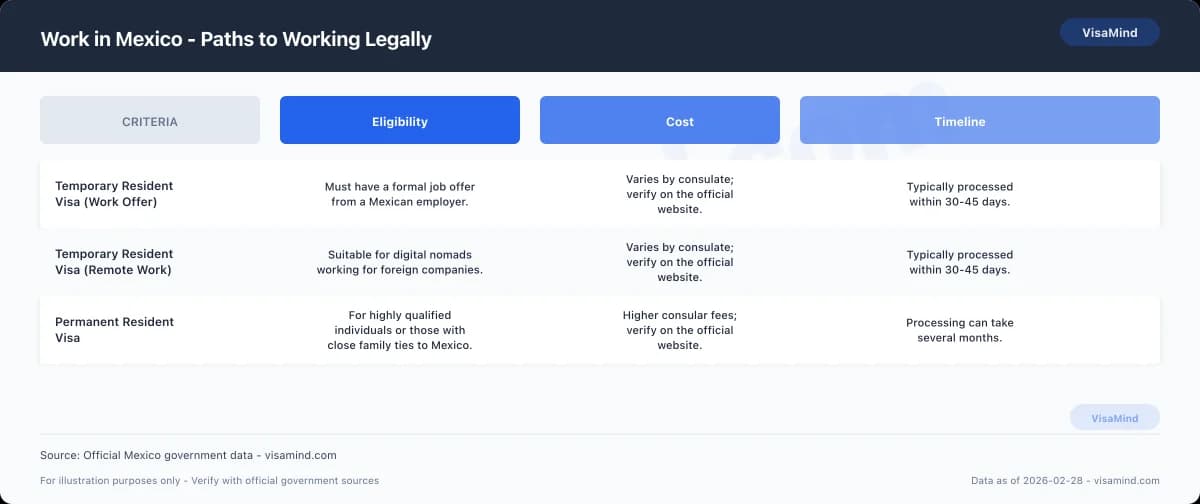
If you're planning to work in Mexico, understanding your visa options is a crucial first step. As of 2023, there are multiple work visa categories available that cater to different professional circumstances. Here's a concise overview of the primary work visa options you can consider:
| Visa Type | Eligibility | Cost | Timeline |
|---|---|---|---|
| Temporary Resident Visa (Work Offer) | For those with a job offer from a Mexican employer | Varies by consulate | Typically 2-4 weeks |
| Temporary Resident Visa (Remote Work) | For digital nomads working for foreign employers | Varies by consulate | Typically 2-4 weeks |
| Visitor Business Visa | For short-term business activities | Varies by consulate | Typically 1-2 weeks |
| Permanent Resident Visa | For individuals with significant ties or contributions to Mexico | Varies by consulate | Typically 4-8 weeks |
Temporary Resident Visa (Work Offer)
This visa is ideal if you have secured a job offer from a Mexican company. Your employer must initiate the process with the Instituto Nacional de Migración (INM) in Mexico, and you will need to complete the application at a Mexican consulate in your home country. This visa allows you to live and work in Mexico for more than 180 days and less than four years, providing a pathway to Permanent Residence if certain conditions are met.
Temporary Resident Visa (Remote Work)
For those working remotely for a non-Mexican employer, the Temporary Resident Visa for Remote Work is a fitting choice. Often referred to as a "digital nomad" visa, it enables professionals to reside in Mexico while continuing their work remotely. You can find more details in our Digital Nomad Guide.
Important: Ensure that you have sufficient financial means to support yourself during your stay, as this is a key requirement for approval.
Visitor Business Visa
If your work in Mexico is short-term and business-related, a Visitor Business Visa might be appropriate. This visa is intended for activities such as attending meetings, conferences, or conducting business negotiations. It does not permit employment or receiving salary from a Mexican source.
Permanent Resident Visa
If you have strong ties to Mexico or meet specific criteria, applying for a Permanent Resident Visa could be beneficial. It allows indefinite stay and work rights in Mexico. This option is generally pursued by individuals who have long-term plans in Mexico or have family connections. More information can be found in our Permanent Resident section.
Tip: The consular fee for visa applications is non-refundable, so ensure that all your documentation is complete and accurate before submitting.
For more detailed information on how to apply for these visas, including document requirements, visit our How To Apply page. Always verify the latest requirements and fees on the official INM website, as these can vary by consulate and are subject to change.
Employer Sponsorship Requirements
#It's crucial for employers to understand the sponsorship requirements set by the Instituto Nacional de Migración (INM). Employers play a significant role in facilitating the immigration process for prospective foreign employees, particularly regarding the Temporary Resident Visa for work purposes. Below, we outline the essential elements of employer sponsorship.
Employer Requirements for Sponsorship
To sponsor a foreign worker, a Mexican employer must be registered with the INM as an accredited entity to hire foreign personnel. This involves obtaining an Employer Registration Certificate (Constancia de Inscripción de Empleador), which verifies that the employer is authorized to extend job offers to foreign nationals. The registration process typically requires:
- Proof of legal establishment in Mexico, such as a Federal Taxpayers Registry (Registro Federal de Contribuyentes, RFC).
- Recent tax compliance documents.
- Details of the company's legal representative.
- A valid address and contact information.
Financial Documentation
Employers inviting foreign workers must provide extensive financial documentation to demonstrate their ability to support the employment. This includes:
- Invitation Letter: An official letter stating the job offer, role, and responsibilities.
- Bank Statements: The last 12 months of bank statements showing an average balance of at least 140,000 USD. This financial stability reassures the INM of the employer's capacity to honor the employment contract.
Important: Failure to maintain the required financial balance can lead to denial of the sponsorship request by the INM.
Steps for Employers
- Register with INM: Complete the Employer Registration process to be eligible to hire foreign workers.
- Prepare Documentation: Gather all necessary financial and legal documents, including the invitation letter and bank statements.
- Lodge Application: Submit the sponsorship application along with supporting documents to the INM.
Can Employers Change Sponsored Workers?
Employers in Mexico are generally able to change the foreign workers they sponsor, but this process requires notifying the INM and updating the necessary records. This includes ensuring the new employee meets all the eligibility criteria and that the employer’s financial and registration status remains valid.
For detailed guidance on visa types related to work in Mexico, consider exploring the Temporary Resident Visa (Work Offer) and Temporary Resident Digital Nomad options. Additionally, the How To Apply guide provides comprehensive instructions on the application process.
Tip: Regularly verify the latest requirements and updates on the INM website to ensure compliance with current immigration laws.
How to Apply for a Work Visa
#To work in Mexico, you must secure the appropriate work visa. The process involves several steps and requires coordination with both the Mexican consulate abroad and the National Immigration Institute (INM) once you are in Mexico.
Steps to Apply for a Work Visa
-
Determine Eligibility and Gather Required Documents
Begin by confirming that you meet the eligibility criteria for the work visa you intend to apply for. If you are planning to stay in Mexico for more than 180 days and less than four years, you might consider a Temporary Resident Visa with a work offer. You will need to gather essential documents, including:
- A valid passport
- A passport-size photo
- Proof of employment or a job offer from a Mexican company
- Invitation letter and the last 12 bank statements of the sponsoring organization, if applicable
-
Lodge Your Application at a Mexican Consulate
Submit your visa application at a Mexican consulate in your country of residence. You will be required to present your documents and pay a non-refundable consular fee. Keep in mind that paying the fee does not guarantee visa approval.
Important: Ensure all documents are complete and accurate to avoid delays in processing.
-
Attend an Interview
Depending on the consulate, you may be required to attend an interview. During the interview, you will discuss your work plans in Mexico and submit any additional documentation if requested.
-
Receive Your Visa and Travel to Mexico
Once your application is approved, you will receive a visa that allows you to enter Mexico. Upon arrival, you must visit the INM to complete the next steps of your immigration process.
-
Register with the INM
After arriving in Mexico, you have 30 days to register with the INM to obtain your Temporary Resident Card. This step is crucial to finalize your legal status as a worker in Mexico.
Tip: Use the Documents Checklist to ensure you have all necessary paperwork when registering with the INM.
Fees and Processing Times
Fees for the work visa process can vary depending on the specific type of visa and your nationality. It's important to verify the current fees and processing times on the official INM website as they are subject to change.
For those considering remote work or freelance projects, the Temporary Resident Digital Nomad visa may be an alternative option. This visa is designed for individuals who wish to work remotely for non-Mexican companies while residing in Mexico.
By following these steps and understanding the requirements, you can successfully navigate the application process for working in Mexico. Always refer to the official INM resources for the most up-to-date information and guidance.
What You Can and Cannot Do
#When working in Mexico under a work permit granted by the Instituto Nacional de Migración (INM), changing employers is possible but requires following specific procedures. You must:
- Obtain a new job offer from a Mexican employer.
- Notify the INM about the change and submit a Cambio de Condición application.
- Provide documentation from your new employer, such as a job offer letter and proof of the company's financial standing.
Important: You cannot start working for a new employer until the INM approves the change.
Can Family Join You?
Family members can accompany you to Mexico if you hold a work permit, but they must apply for the appropriate visa.
- Spouse and Children: Eligible for a Temporary Resident Family visa, allowing them to live in Mexico for the duration of your work permit.
- Parents and Other Relatives: May apply for a visitor visa, but this typically doesn't allow long-term stays.
Tip: Ensure your family members start their visa applications early to accommodate any processing delays.
Can You Study While Working?
If you wish to study while holding a work permit in Mexico, you can do so under certain conditions:
- Enroll in courses or programs that don't interfere with your employment.
- Consider applying for a Temporary Resident Student visa if you plan to pursue formal education alongside work.
Studying part-time usually doesn't require additional permits, but full-time studies may necessitate a change in your visa status. Always check specific requirements with the INM or your educational institution.
From Work Visa to PR
#For foreign nationals working in Mexico, transitioning from a work visa to Permanent Residence (PR) is a structured journey that involves meeting specific criteria and timelines. Here’s how you can make that transition.
Pathway to Permanent Residence
To move from a work visa to Permanent Residence, you typically begin with a Temporary Resident Visa (Work Offer), which is valid for up to four years. This visa allows you to live and work in Mexico legally. After four consecutive years holding this visa, you may apply for Permanent Residency.
- Temporary Resident Visa (Work Offer): Starts as a one-year permit that can be renewed up to three times.
- Permanent Resident: You become eligible to apply after four years of temporary residency.
Timeline and Process
1. Initial Application: Begin with a Temporary Resident Visa through a Mexican consulate if you are outside Mexico. You'll need an employment offer from a Mexican company.
2. Renewals: Each year, you must renew your Temporary Resident status with the Instituto Nacional de Migración (INM), providing updated employment documentation and proof of continuous legal stay.
3. Eligibility for PR: After four years on a Temporary Resident Visa, you can apply for Permanent Residence.
4. PR Application: Submit your application for Permanent Residence to the INM. This process includes providing biometric data, financial records, and proof of residency.
Tip: Start preparing your Permanent Residence application at least six months before your Temporary Residence expires to ensure a seamless transition.
Key Documents for Transition
When preparing for Permanent Residence, ensure you have the following:
- Proof of Employment: Contracts and employment verification from your Mexican employer.
- Financial Statements: To demonstrate financial stability.
- Residency History: Records of your Temporary Resident status renewals.
- Identity Documentation: Valid passport and any existing residency cards.
Important Considerations
- Non-refundable Fees: Consular fees are non-refundable, so ensure all documents are in order before submission.
- No Employment Changes: Changing employers during your Temporary Resident period can complicate the path to PR. Consult with INM if employment changes are necessary.
For more detailed guidance, you can refer to the Permanent Resident and Temporary Resident Work visa pages. If your situation is unique, consider reviewing the Permanent Residence section for additional insights.
What Goes Wrong
#Important: A non-refundable consular fee applies to visa applications and does not guarantee approval. Ensure you meet all requirements before proceeding.
Understanding potential pitfalls when applying for work authorization through the Instituto Nacional de Migración (INM) in Mexico is crucial. Here are some common reasons for refusals and tips on how to avoid them:
Financial and Documentation Errors
-
Incomplete Financial Documentation: If you are invited by an organization, ensure the invitation letter is accompanied by the last 12 months of bank statements showing an average balance of 140,000 USD. Missing or incomplete documentation can lead to refusal.
-
Incorrect Document Submission: Double-check that all documents are correctly submitted according to your specific eligibility category. Refer to the Documents Checklist to ensure completeness.
Eligibility and Consistency Issues
-
Misalignment with Visa Purpose: Applying for a Temporary Resident Visa under the incorrect category, such as the Temporary Resident Visa (Work Offer) instead of the appropriate one for your situation, can result in refusal. Ensure the visa type aligns with your intended activities in Mexico.
-
Inconsistent Information: Any discrepancies between the information provided in your application and your supporting documents can lead to rejection. Consistency is key in presenting your case to the INM.
Employer and Invitation Letter Considerations
-
Insufficient Employer Support: If your work in Mexico is supported by an employer, ensure they provide all necessary documentation, including proof of their ability to sponsor you. This includes financial stability as demonstrated through bank statements.
-
Invitation Letter Issues: The invitation letter must clearly outline the purpose and duration of your stay. Any ambiguity or lack of detail can cause delays or refusal.
Tip: Always review the Visa Refusal Reasons for insights into common application pitfalls and how to avoid them.
By carefully reviewing these potential issues and ensuring all documentation is accurate and complete, you can improve your chances of a successful application. If you're uncertain about any aspects of your application, consulting with an immigration professional or legal advisor familiar with Mexican immigration laws can be beneficial.
Credential Requirements
#When seeking to work in Mexico, your professional skills and qualifications may need to be assessed depending on the industry and job type. While Mexico does not have a centralized skills assessment authority like some other countries, the following points are essential:
-
Professional Associations: Certain professions, such as engineering or law, may require registration or certification from relevant Mexican professional associations. Verify which associations pertain to your field and if membership or certification is necessary.
-
Employer Verification: Often, your prospective employer in Mexico will conduct a verification of your credentials. This can include checking your educational background, previous work experience, and any professional licenses you hold.
Important: If your profession is regulated in Mexico, ensure you meet the local credential requirements before accepting a job offer.
Qualification Recognition
Your educational qualifications may need to be recognized by Mexican authorities or your potential employer. Here’s what you should know:
-
Equivalence Certificates: If you're applying for a position that requires a specific level of education, you might need to obtain an equivalence certificate. This can be done through the Mexican Ministry of Education (SEP), which evaluates foreign academic credentials to determine their equivalence to Mexican qualifications.
-
Language Proficiency: While not directly related to qualifications, proficiency in Spanish can be a crucial factor in securing employment. Consider taking a language proficiency test if required by the employer.
Degree Requirements
Specific degrees are sometimes required for roles in Mexico, particularly in specialized fields. Ensure you have the necessary documentation:
-
Degree Authentication: Your degree certificates may need to be authenticated or apostilled, depending on your country of origin. This process verifies the legitimacy of your documents.
-
Translation Services: Documents may need to be translated into Spanish by a certified translator if they are in another language. Ensure the translation is accurate and certified.
Tip: Check with your employer or the Temporary Resident Work visa requirements to understand if particular documents need translation or certification.
Additional Considerations
-
Professional Experience: Some roles might require you to demonstrate a certain number of years of professional experience. Have your resume and any supporting documents, such as letters of reference, ready.
-
Sector-Specific Requirements: Industries like healthcare, education, and engineering may have unique requirements. Consult sector-specific guidelines or your employer for detailed information.
For more comprehensive guidance, review the Documents Checklist to ensure you have all necessary paperwork prepared. Understanding these credential requirements can streamline your process of working legally in Mexico.
Salary Thresholds and Fees
#Important: The consular fee paid during the application process is non-refundable, regardless of the outcome of your visa application.
Salary Thresholds for Work in Mexico
To work legally in Mexico, you must meet specific financial thresholds as part of your visa application. For those applying for a Temporary Resident Visa with a work offer, it's essential to demonstrate financial stability either through a job offer with a salary that meets the minimum wage threshold or through sufficient personal savings.
Application Fees and Costs
Understanding the costs associated with your work visa application is crucial for planning. Below is a comparison of costs and requirements for different visa types related to working in Mexico:
| Visa Type | Eligibility Criteria | Application Fee | Minimum Income Requirement |
|---|---|---|---|
| Temporary Resident (Work Offer) | Job offer from a Mexican employer | Approximately 5,000 MXN | Meets Mexican minimum wage |
| Temporary Resident (Remote Work) | Employment by a foreign company | Approximately 5,000 MXN | Demonstrate stable income |
| Visitor Business | Short-term business activities | Approximately 2,500 MXN | Not applicable |
Tip: Check the Financial Requirements guide for up-to-date information on income thresholds and necessary documentation.
Additional Considerations
- Invitation Letters: If invited by an organization, ensure you have an invitation letter and the last 12 bank statements of the sponsoring organization, showing an average balance of 140,000 USD.
- Documentation and Fees: Ensure all required documents are prepared and fees are paid. For detailed steps, consult the How To Apply guide.
For further assistance, consider exploring other visa options such as the Visitor Tourist or Permanent Resident to see what best fits your situation and long-term goals in Mexico. Always verify the latest requirements and fees on the official Instituto Nacional de Migración (INM) website as they are subject to change.
Tax Rules for Foreign Workers
#Foreign workers in Mexico must be aware of their tax obligations and social security contributions. Understanding these responsibilities will help you comply with local laws and potentially benefit from relevant international agreements.
Income Tax Obligations
If you are working in Mexico, you are generally subject to paying Mexican income tax. The tax rate depends on your residency status and the amount you earn. As a foreign worker:
- Resident taxpayers are taxed on worldwide income, while non-residents are taxed only on Mexican-sourced income.
- Mexico has a progressive tax rate ranging from 1.92% to 35% for residents.
- Non-residents may face a fixed rate for employment income, typically around 15% to 30%.
Important: Verify the current tax rates on the official Mexican government website, as these rates are subject to change.
Social Security Contributions
In Mexico, employers and employees must make contributions to the Mexican Social Security Institute (IMSS). These contributions provide access to healthcare, retirement benefits, and other social services.
- Employers contribute approximately 21% to 28% of the employee’s salary.
- Employees contribute around 2.5% to 10% of their salary.
Tip: Check with your employer or the IMSS for the most accurate contribution rates and benefits.
Double Taxation Treaties
Mexico has established double taxation treaties with over 50 countries to avoid taxing the same income twice. If your home country has a treaty with Mexico, you may be eligible for tax relief.
- These treaties typically allow foreign workers to claim tax credits or exemptions.
- Double taxation treaties often address issues like tax residency, income categories, and mutual administrative assistance.
Key Considerations
- Ensure you determine your tax residency status correctly to understand your obligations.
- Keep detailed records of your income and tax payments for both Mexican and home country tax authorities.
- Consult with a tax advisor familiar with Mexican tax laws and international treaties to optimize your tax situation.
For more information on related visas, you might want to explore options like the Temporary Resident Digital Nomad or Temporary Resident Work. These could suit your working arrangements in Mexico.
Real Scenarios
#A freelance photographer from Canada wanted to work on a project in Mexico for several months. The photographer needed to understand how to navigate the work visa process, given their freelance status. After consulting with the Instituto Nacional de Migración (INM), they learned that the Temporary Resident Visa (Remote Work) was suitable for their situation. To meet the financial requirements, the photographer provided proof of consistent freelance income and documentation of ongoing contracts. They submitted an invitation letter from a Mexican gallery, along with the gallery's last 12 bank statements showing an average balance of 140,000 USD. Within two months of lodging their application, they received approval from the Mexican consulate in Canada, allowing them to legally work on their project in Mexico.
Scenario: IT Consultant Securing a Remote Work Visa
An IT consultant from India had been working remotely for a U.S.-based company and wanted to relocate to Mexico to experience a new culture while continuing their remote work. They opted for the Temporary Resident Visa (Remote Work). Understanding the importance of financial stability, they gathered bank statements showing their income met the required thresholds. The consultant also included a contract from their employer confirming their remote working arrangement. By following the specific instructions on the INM website and applying through their local Mexican consulate, the consultant successfully secured their visa. Within approximately three months, they were able to settle in Mexico and continue their work seamlessly.
Scenario: NGO Employee Transitioning to Permanent Residency
An employee of an international NGO based in Mexico City was approaching the end of their Temporary Resident Visa (Work Offer). They desired to transition to Permanent Residency due to their long-term employment and commitment to their work in Mexico. The employee compiled documentation of their extended work contract and contributions to the NGO's mission in Mexico. They applied through the INM, providing evidence of their consistent financial stability and integration into the local community. After a review process that lasted around four months, they were granted Permanent Residency, allowing them to continue their impactful work without the need for future visa renewals.
Important: Transitioning from a temporary to a permanent status requires careful documentation of your employment and contributions, so maintain thorough records throughout your stay.
FAQs
What are the salary thresholds for obtaining a work visa in Mexico?
Are there any tax rules for foreign workers in Mexico?
What are the key credential requirements for working in Mexico?
Can I apply for a Temporary Resident Visa for remote work in Mexico?
What can go wrong when applying for a work visa in Mexico?
What should I know about the National Immigration Institute (INM) process for work in Mexico?
Can I combine a work visa with a study visa in Mexico?
Sources
Last reviewed: March 1, 2026
VisaMind provides informational guidance only and is not a government agency. This is not legal advice. Requirements can change and eligibility depends on your specific facts. If your case is complex or high-stakes, consult a licensed immigration attorney.
Next steps
Requirements vary by nationality, purpose, timeline, and case details. Use Find My Visa to get a personalized checklist for Mexico with official sources and deadlines.
Find my visa