On this page
- What the P-3 Culturally Unique Artist Visa Covers
- Bringing Your Spouse and Children
- Fees and Processing Times
- Check Current Processing Times
- Renewal and Extension
- From Work Visa to PR
- How to Apply
- Changing Employers
- When to Get Professional Help
- Eligibility Requirements
- What Your Employer Must Do
- Common Petition Challenges
- Prepare Your Documents
- Fees
- Required forms
- Related visa types
- Related guides
- Related goals
- Next steps
What the P-3 Culturally Unique Artist Visa Covers
#
The P-3 visa allows you to enter the United States temporarily to perform, teach, or coach in a culturally unique program. A U.S. petitioner must file with USCIS on your behalf, and approval depends on meeting the program’s requirements.
Who it’s for
The P-3 classification applies to artists and entertainers who will participate in a program that is culturally unique. Your work in the United States must relate directly to that cultural program.
You can’t file for yourself. A U.S. petitioner must submit Form I-129, Petition for a Nonimmigrant Worker, to USCIS on your behalf.
You may qualify if:
- You are an artist or entertainer.
- You will take part in a program that is culturally unique.
- Your stay in the United States is temporary.
- A U.S. petitioner agrees to sponsor your petition.
USCIS reviews the petition to determine whether the program meets the culturally unique standard. Filing Form I-129 does not guarantee approval.
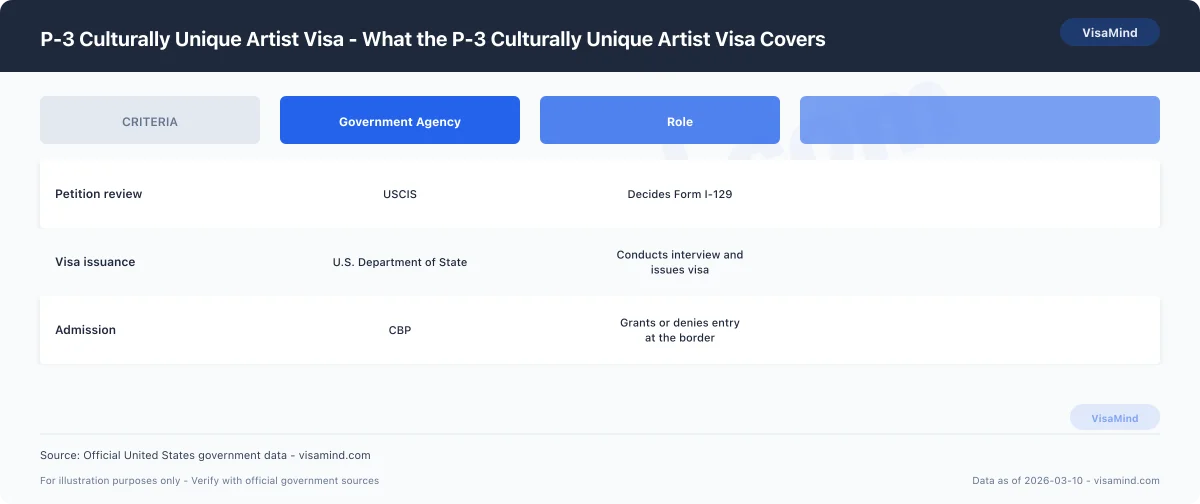
If USCIS approves the petition and you are outside the United States, you apply for a visa through the U.S. Department of State. A consular officer decides whether to issue the visa.
U.S. Customs and Border Protection (CBP) determines admission at the port of entry.
| Stage | Government Agency | Role |
|---|---|---|
| Petition review | USCIS | Decides Form I-129 |
| Visa issuance | U.S. Department of State | Conducts interview and issues visa |
| Admission | CBP | Grants or denies entry at the border |
Scope of work and status
Your approved petition limits you to the specific culturally unique program described in Form I-
- You must perform or work only as authorized.
The P-3 visa covers temporary work in the United States tied directly to the approved program. It does not provide permanent immigration status.
Your status remains valid only for the period approved by USCIS. If your program changes, ends early, or expands beyond what the petition described, your petitioner may need to take further action with USCIS.
You must:
- Work only in the activities listed in the petition.
- Maintain valid nonimmigrant status.
- Follow all conditions listed in your approval notice.
If you seek to extend your stay or change the terms of your work, your petitioner must file the appropriate request with USCIS before your authorized period expires.
Approval limits and notes
USCIS evaluates each P-3 petition individually. Approval depends on whether the petition demonstrates that the program is culturally unique and temporary.
- Filing Form I-129 does not ensure approval.
- Approval applies only to the specific artist or entertainer named in the petition.
- Your visa application is separate from the USCIS petition process.
- Admission to the United States is never automatic.
You must comply with every condition attached to your approval to avoid status violations.
Bringing Your Spouse and Children
#Your spouse and unmarried children can request dependent status to stay in the United States with you. You must file the correct forms with USCIS and follow specific procedures to keep their status valid.
Dependent visa options
Your spouse and unmarried children qualify as dependents. They must apply for dependent classification to remain in the United States with you.
If they are inside the United States and need to extend or change status, they use Form I-539, Application to Extend/Change Nonimmigrant Status. USCIS may review their application at the same time as your Form I-129 if you submit both forms together in the same package and to the correct filing location.
If they apply for a visa abroad, the U.S. Department of State handles visa interviews and issuance. USCIS does not issue visas.
| Situation | Agency | Form |
|---|---|---|
| Change or extend status in the U.S. | USCIS | Form I-539 |
| Initial worker petition | USCIS | Form I-129 |
| Visa issuance abroad | U.S. Department of State | Visa application process |
If you previously received approval through Form I-129S (if applicable to your case), include the approved Form I-129S with the dependent filing when required.
Work authorization for dependents
Dependent status does not automatically grant permission to work. You must confirm whether your spouse needs separate employment authorization before starting work.
USCIS determines whether employment authorization is required for your classification. Some dependent categories are employment authorized incident to status, while others must apply separately before beginning work.
You should:
- Review the USCIS webpage for your visa classification
- Confirm whether employment authorization is automatic or requires an application
- Wait for proper authorization before your spouse begins any employment
Do not allow your spouse to start work unless USCIS rules clearly permit it. Unauthorized employment can affect immigration status.
Filing together with dependents
You can submit your dependents’ Form I-539 together with your Form I-
- When you properly file both forms at the same time and in the same package, USCIS may adjudicate them together.
This approach can streamline processing because USCIS reviews the family’s applications at the same time.
To file together:
-
Prepare Form I-129 for your P-3 petition.
-
Prepare Form I-539 for each dependent (or as permitted on one application).
-
Include all required supporting documents, including any previously approved Form I-129S if applicable.
-
Submit the complete package to the correct USCIS filing location listed in the form instructions.
If you file separately or at different times, USCIS will adjudicate the applications independently.
Fees and Processing Times
#You must pay specific government filing fees when you submit a P-3 petition to USCIS. processing times vary, and incorrect payments can delay or reject your case.
Required filing fees
You file Form I-129, Petition for a Nonimmigrant Worker, with USCIS to request P-3 classification. As of February 2026, the filing fee for Form I-129 is $780.
If USCIS requires biometrics, you must also pay an $85 biometrics services fee. USCIS will issue instructions if biometrics are necessary.
| Fee Type | Amount (USD) | When Paid |
|---|---|---|
| Form I-129 filing fee | $780 | With petition submission |
| Biometrics services fee | $85 | If requested by USCIS |
You must submit the correct fee amount and the correct edition of Form I-
- USCIS will reject your petition if you underpay, overpay, or use an outdated form.
Standard processing times for P-3 petitions typically range from 3 to 6 months. Processing times can change.
Premium processing and special fees
USCIS offers premium processing for certain employment-based petitions through Form I-907, Request for Premium Processing Service. If you request premium processing, you must include a separate premium processing fee in addition to the Form I-129 filing fee.
If you submit a premium processing request that is postmarked on or after March 1, 2026, you must pay the updated premium processing fee that applies to your specific benefit request. Confirm the exact amount before mailing your packet.
You must file Form I-907 correctly and include the proper fee. USCIS will not begin premium processing until it receives both the request and the required payment.
Some filings submitted on or after March 1, 2025, may require an additional $100,000 payment as a condition of eligibility. Review the USCIS instructions to determine whether this applies to your case.
Other payment pitfalls
Most delays occur because applicants submit the wrong fee or combine fees incorrectly. USCIS rejects petitions with inaccurate payments.
Avoid these common mistakes:
- Submitting an outdated fee amount
- Forgetting the separate premium processing fee
- Using an outdated edition of Form I-129
- Combining fees improperly when separate payments are required
Before filing:
-
Confirm the current Form I-129 edition.
-
Verify each required fee using the USCIS fee schedule or fee calculator.
-
Prepare separate payments if premium processing applies.
You remain responsible for paying the correct amounts even if a preparer assists you. USCIS will not process your petition until it receives the proper forms and fees.
Check Current Processing Times
#USCIS processing times for Form I-129 depend on the visa classification and the service center handling your petition. P-3 petitions fall within the broader P category, and timelines can differ from other work classifications filed on the same form.
P-category and related I-129 tracks
USCIS groups P-3 petitions under “P – Athletes, artists, and entertainers” for Form I-129 processing time purposes. As of January 2026, reported processing times for this track range from 9 to 12.5 months.
| I-129 Classification | Reported Processing Time (Jan 2026) |
|---|---|
| P – Athletes, artists, entertainers | 9 to 12.5 months |
| O – Extraordinary ability | 9.5 to 14 months |
| Q – Cultural exchange visitors | 19.5 to 33 months |
If you file for a P-3 culturally unique artist or entertainer, USCIS places your petition in the P category shown above. Use the USCIS processing times tool and select Form I-129 with the correct classification to see current estimates for your service center.
These timelines reflect USCIS petition adjudication only. If you apply for a visa abroad, the U.S. Department of State controls interview scheduling and visa issuance.
Other I-129 eligibility categories
Form I-129 covers many temporary work classifications, each with different adjudication times. Your timeline depends entirely on the eligibility category you select.
As of January 2026, USCIS reports the following ranges:
| I-129 Category | Reported Processing Time (Jan 2026) |
|---|---|
| H-1b visa – Specialty occupation (visa abroad) | 6.5 to 7.5 months |
| H-1B – change of status (U.S.) | 5 to 5.5 months |
| H-1B – Extension of stay | 7.5 to 8 months |
| H-2b visa – Temporary nonagricultural workers | 4.5 to 6.5 months |
| L – Intracompany transferees | 6 to 8 months |
| R – Religious occupation | 5 to 6.5 months |
| TN – USMCA professional | 3.5 to 6 months |
| E – Treaty traders and investors | 10.5 to 15 months |
| H-3 visa – Temporary trainees | 12.5 to 16.5 months |
You must select the exact classification when checking times. Even small differences, such as change of status versus visa issuance abroad, affect the estimate.
How times vary by center
Processing times vary by USCIS service center. Two applicants filing identical P-3 petitions can receive different timelines based on where USCIS routes the case.
You cannot choose your service center. USCIS assigns the location based on internal workload rules and the filing details on your Form I-129.
To check your case type:
-
Visit the USCIS processing times tool.
-
Select Form I-129.
-
Choose your specific classification, such as “P – Athletes, artists, and entertainers.”
-
Select the service center listed on your receipt notice.
USCIS updates posted times regularly. Always rely on the most recent data shown before planning travel, contracts, or performance dates.
Renewal and Extension
#You can continue your P-3 stay only if your sponsor files the correct petition on time and includes required evidence. USCIS controls extensions of stay and changes of status through Form I-129, and you must follow its filing and submission rules carefully.
Extending stay or changing status
You can't extend your P-3 status by yourself. Your U.S. petitioner must file Form I-129, Petition for a Nonimmigrant Worker, with U.S. Citizenship and Immigration Services (USCIS) before your current stay ends.
Use the same form if you want either:
- An extension of stay in P-3 status
- A change of status to P-3 from another eligible nonimmigrant category
Your petitioner needs to fill out all required sections of Form I-129 and sign it. USCIS won't approve a petition that's incomplete or unsigned.
If you plan to keep working with the same group or continue the same cultural program, the extension request should make that clear. If you want to change status, the petition must accurately describe the new classification and include all supporting evidence listed in the form instructions.
If you're outside the United States, USCIS approval alone doesn't let you enter. The U.S. Department of State issues visas, and U.S. Customs and Border Protection (CBP) makes the final call at the port of entry.
Filing documents and timing
File early. The petitioner should submit Form I-129 before your current authorized stay ends.
At minimum, the filing package should have:
- A completed Form I-129
- The required signature
- Supporting evidence described in the form instructions
- The correct filing fee in USD ($) as shown by the USCIS fee calculator
Only some Form I-129 classifications are eligible for online filing. If yours isn't, your petitioner must file by mail at the address in the official form instructions.
Here's a checklist to help avoid delays:
| Requirement | Why It Matters |
|---|---|
| All required sections completed | USCIS may reject incomplete forms |
| Original signature (if filing by mail) | USCIS requires a valid signature |
| Correct fee | Incorrect payment can result in rejection |
| Required evidence attached | Missing documents can delay or prevent approval |
Online filing considerations
USCIS allows online filing for only certain Form I-129 classifications. Confirm on the USCIS site whether your P-3 filing type is eligible.
If you file online, you must:
-
Complete all required fields in the electronic system.
-
Upload all required supporting documents.
-
Submit the petition with the required fee in USD ($).
Online filing can make submission easier, but it doesn't change eligibility standards. USCIS reviews electronic and paper filings using the same criteria.
If your classification isn't eligible for online filing, you must file a paper Form I-129 by mail using the latest instructions. Always use the current USCIS form page for the correct filing method and requirements.
From Work Visa to PR
#A P-3 visa lets you work in the United States for a specific cultural program. It doesn't provide permanent resident status.
If you want to stay longer, you'll need to pursue separate immigration steps and meet additional requirements set by USCIS.
When permanent steps are needed
Permanent residence is required if you want to live in the United States past the end of your P-3 activities.
Your P-3 classification is tied to the approved Form I-129, Petition for a Nonimmigrant Worker and the specific cultural work described in that petition. There's no automatic path to a green card.
Common reasons to consider permanent steps include:
- You want to keep working in the United States without being limited to a specific P-3 event or program.
- Your long-term career plans involve ongoing U.S.-based work.
- You're seeking more stability than temporary, petition-based status allows.
USCIS treats permanent residence as a separate benefit. You must qualify under an appropriate immigrant category and follow that category’s filing process.
Common prerequisites
Before pursuing permanent residence, make sure your current status is valid and documented.
Check that:
- Your P-3 status is valid and tied to an approved Form I-129.
- You've complied with all terms of your authorized work.
- All required filings and approvals are complete and documented.
Here's a checklist to help you prepare:
| Requirement | Why It Matters |
|---|---|
| Valid approval notice for Form I-129 | Shows lawful P-3 classification |
| Evidence of authorized work only | Demonstrates compliance with status |
| Complete filing history | Helps avoid gaps or inconsistencies |
If you missed a required step in your petition process, correct it before moving forward. USCIS will review your immigration history closely when you apply for permanent benefits.
Confirm the correct immigrant petition and filing sequence for your situation using official USCIS resources. Fee amounts change, so check the latest using the USCIS fee calculator.
What can cause rejections
USCIS may reject or deny filings when required approvals or documentation are missing.
A common error is filing for a new immigration benefit without the necessary prerequisites. For example:
- Submitting an application without proof of an approved petition.
- Failing to include required supporting evidence.
- Omitting required forms or signatures.
Compare these scenarios:
| Proper Filing | Problem Filing |
|---|---|
| All required forms included | Missing required form |
| Evidence of prior approvals attached | No proof of approval |
| Signatures and documentation complete | Incomplete or unsigned forms |
Review the official form instructions before you file. Incomplete submissions are rejected by USCIS, which can delay your case and affect your ability to continue authorized work.
How to Apply
#You apply for a P-3 visa by filing the correct petition form with USCIS, completing it accurately, and submitting it with supporting evidence. Careful preparation helps avoid delays and requests for more information.
Download the form and instructions
Start by locating Form I-129, Petition for a Nonimmigrant Worker on the USCIS website. The P-3 classification is part of this petition.
Download:
- The current Form I-129
- The corresponding form instructions
Use only the latest edition. Older versions may be rejected.
Read the instructions before you start. Pay attention to the sections that apply to the P-3 category and the type of work you'll perform. The instructions explain who files, how to organize materials, and where to send the petition.
| Item | Where to Get It | Why It Matters |
|---|---|---|
| Form I-129 | USCIS website | Required petition for P-3 classification |
| Form Instructions | USCIS website | Explains filing steps and required documentation |
Complete and sign
Fill out all required sections of Form I-129 clearly and accurately. Include complete info about the petitioner, the beneficiary, and the P-3 work.
Answer every applicable question. If a question doesn’t apply, follow the form instructions for how to respond.
Pay close attention to:
- The classification requested (P-3)
- Dates of intended work
- Contact information
- Signature sections
Review the form before signing. Errors, missing answers, or unsigned pages can cause rejection or delays.
The authorized petitioner must sign in the required place. USCIS does not accept unsigned petitions.
Use this checklist before moving forward:
- ✅ All required fields completed
- ✅ Correct classification selected
- ✅ Form signed in the proper place
- ✅ Information matches supporting documents
Submit with supporting evidence
Send Form I-129 together with all required documentation. USCIS reviews the form and supporting evidence to determine eligibility for P-3 classification.
Organize your submission so the form comes first, followed by supporting documents, then the required fee. Confirm the correct fee amount using the USCIS fee calculator.
Your package should generally include:
- Completed and signed Form I-129
- Supporting documentation as required by the instructions
- Correct filing fee, if applicable
Mail the petition to the filing address listed in the current Form I-129 instructions. Filing locations can change, so check the address before you send anything.
After USCIS receives the petition, you'll get a receipt notice. USCIS reviews your materials and decides whether the P-3 petition is approved.
Changing Employers
#You can't start work for a new employer until USCIS approves a new petition. The new employer must file Form I-129 with the right classification, accurate dates, and a consistent job description to avoid delays or rejection.
Classification and supplement accuracy
Your new employer must file a separate Form I-129 before you start work. USCIS will reject or delay the case if the petition lists the wrong nonimmigrant classification or uses the wrong supplement.
The classification on Form I-129 must match:
- The duties you'll perform
- The description in the supporting documents
- The classification requested on the form and supplement
If the employer selects the wrong category or attaches the wrong supplement, USCIS may reject the filing outright. A mismatch between the job description and the requested classification can also trigger a Request for Evidence (RFE).
| Item to Check | Why It Matters | Risk if Incorrect |
|---|---|---|
| Visa classification | Determines eligibility and standards | Rejection or RFE |
| I-129 supplement | Confirms category-specific details | Filing rejection |
| Job description consistency | Supports classification accuracy | RFE for inconsistency |
Review the petition before filing to confirm your duties align with the selected classification.
Verify petition dates and validity
The requested validity period on Form I-129 must match the dates in the supporting documents. USCIS compares the form, contract dates, and any written explanations for consistency.
Pay attention to:
- Start and end dates on Form I-129
- Dates in contracts or engagement letters
- Any itinerary or supporting timeline
If dates don't match, USCIS may issue an RFE asking the employer to clarify. Even small discrepancies can delay adjudication.
| Document | Dates Must Match | Common Issue |
|---|---|---|
| Form I-129 | Requested employment period | Typographical errors |
| Contract or agreement | Actual engagement period | Shorter or longer term than petition |
| Supporting letter | Explanation of work period | Inconsistent timeline |
Check that every document reflects the same employment window before filing.
RFE risks when roles change
USCIS often issues RFEs when the job description changes and doesn't align with the requested classification. If your new role is significantly different, the petition must clearly explain the new responsibilities.
Common RFE triggers:
- Duties that don't match the stated classification
- Vague or overly broad job descriptions
- Inconsistent explanations across documents
The employer should describe your duties specifically. Avoid general language that could fit multiple visa categories.
| Change in Role | Required Action | Risk Level |
|---|---|---|
| Minor duty adjustments | Clarify in support letter | Moderate |
| Significant shift in responsibilities | Fully document and justify classification | High |
| Different type of work | Ensure correct classification selected | Very High |
USCIS looks at whether the actual work matches the requested classification. Clear documentation helps reduce delays and extra scrutiny.
When to Get Professional Help
#You might not need an attorney for every P-3 petition. The main issue is who prepares and files Form I-129 with USCIS and how complex your case is.
USCIS will review the petition and take action: approval, denial, Request for Evidence (RFE), Notice of Intent to Deny (NOID), or sometimes referring the case for investigation. Your preparation level affects the outcome.
When employer handles filing vs. when to consult
In most P-3 cases, your U.S. employer or sponsoring group files Form I-129 with USCIS. Some employers regularly handle these petitions and have staff who prepare documents and track status.
You can usually rely on your employer’s filing if:
- The organization has experience submitting Form I-129
- All documentation is complete and organized
- The terms of your work are clearly defined
- There are no prior immigration issues in your record
If your employer prepares the petition, review the final submission before filing. Errors or omissions can lead to an RFE or NOID from USCIS.
| Filing Scenario | Risk Level | Professional Help Recommended |
|---|---|---|
| Experienced employer, clean record | Lower | Often optional |
| First-time filer | Moderate | Strongly consider |
| Prior case complications | Higher | Yes |
Situations that often need a lawyer
Consider consulting an attorney if your case involves factors that could draw extra scrutiny from USCIS. Adjudicative review can delay or negatively affect your case if documentation isn't clear.
Get legal help if:
- You received a denial, RFE, or NOID previously
- USCIS referred a prior matter for investigation
- Your petition involves unusual work arrangements
- There are inconsistencies in prior immigration filings
An attorney can organize evidence, respond to RFEs, and address issues raised in a NOID. If USCIS denies the petition, professional guidance is especially important before taking further action.
Legal review helps reduce errors in Form I-129 and ensures a complete and consistent record for USCIS.
Eligibility Requirements
#You must show that you'll take part in a culturally unique program and have the background to perform in it. USCIS reviews Form I-129 and supporting evidence to confirm both the nature of the program and your role.
Who qualifies
You qualify if you’re an artist or entertainer planning to participate in a program in the United States that’s considered culturally unique.
To meet the standard, you need to show:
- You’ll take part in a specific program in the United States.
- The program is culturally unique in nature.
Your participation must directly relate to that culturally unique program.
You’re expected to perform or present work consistent with the program’s focus.
USCIS reviews whether your planned work in the United States matches the cultural focus described in the petition.
General artistic ability isn’t enough; your role has to connect directly to the unique cultural aspects of the program.
The petitioner files Form I-129, Petition for a Nonimmigrant Worker, on your behalf.
USCIS must approve the petition before you can apply for a visa through the U.S. Department of State, if a visa is required.
Program-specific requirements
The program itself has to qualify as culturally unique.
The petition must describe:
- The cultural tradition, style, or heritage involved.
- The specific activities you’ll perform.
It should also outline the schedule or structure of the program.
The petition needs to explain how the program maintains or promotes that cultural tradition.
USCIS looks at the substance of the program, not just the label.
Descriptions should show that the activities are rooted in a distinct cultural practice rather than general entertainment.
Your intended work must match what’s in the Form I-129 petition.
If the program involves performances, workshops, or presentations, the petition must explain how each activity reflects the culturally unique aspect.
If the documentation is vague or lacks detail about the cultural component, USCIS may question whether the program meets P-3 standards.
Evidence of role and qualifications
You need to provide documentation showing you’re qualified to participate in the culturally unique program.
The petition should include evidence such as:
- Proof that you are an artist or entertainer.
- Documentation confirming your role in the specific program.
Materials should demonstrate that your work relates to the culturally unique theme.
USCIS expects a clear connection between your experience and the proposed activities in the United States.
Your background should show that you can perform in or contribute to the culturally unique program.
The evidence must tie together these points:
| Requirement | What You Must Show |
|---|---|
| Artist or entertainer status | You actively work in the relevant artistic or entertainment field |
| Program participation | You have a defined role in the specific U.S. program |
| Cultural relevance | Your work reflects and supports the culturally unique nature of the program |
If the documentation doesn’t clearly establish these elements, USCIS may deny the Form I-129 petition.
What Your Employer Must Do
#Your employer must complete specific labor steps when required, prepare a complete Form I-129 petition for U.S. Citizenship and Immigration Services (USCIS), and include all required wage documentation.
Missing labor certifications or wage evidence can lead to rejection.
Prerequisite labor steps
Some employment-based filings require certified labor documentation before your employer files Form I-129 with USCIS.
When a Labor Condition Application (LCA) applies, your employer must obtain certification before submitting the petition.
If a prevailing wage requirement applies, your employer must secure and document that wage determination in advance.
Filing without required wage documentation often results in rejection.
For immigrant categories like EB-2 visa or EB-3 visa that require the PERM labor certification process, the employer must complete that process before filing Form I-140.
Although this step applies to immigrant petitions, it reflects the same principle: complete labor requirements first, then file.
Key sequence when required:
-
Obtain certified LCA (for categories that require it).
-
Secure prevailing wage documentation (if required).
-
File Form I-129 with USCIS, including proof of certification.
Failure to follow this order can delay or block your ability to work.
| Labor Step | When It Must Be Done | Filed With |
|---|---|---|
| LCA certification | Before Form I-129 (if required) | USCIS (with I-129) |
| Prevailing wage documentation | Before filing (if required) | USCIS (as evidence) |
| PERM labor certification | Before Form I-140 (if applicable) | USCIS (with I-140) |
Documentation employer should provide
Your employer must submit a properly completed Form I-129 to USCIS.
The petition must include all required supporting evidence, including certified labor documentation when applicable.
If an LCA applies, your employer must attach the certified LCA to the petition.
Submitting Form I-129 without the certified LCA leads to rejection rather than a request for evidence.
If a prevailing wage requirement applies, your employer must include documentation that shows compliance with that wage requirement.
USCIS expects clear evidence, not informal statements.
Your employer should confirm that:
- The LCA is certified before filing (if required).
- Prevailing wage documentation is included (when required).
- The petition package is complete at the time of filing.
Incomplete filings delay your ability to begin work.
Compliance reminders
USCIS reviews filings for required labor certifications and wage documentation at intake.
If required items are missing, USCIS can reject the petition.
A common mistake is filing without the certified LCA or without prevailing wage documentation when the category requires it.
Your employer must verify all labor prerequisites before submitting Form I-129.
You should confirm with your employer that:
- Any required LCA is certified.
- Required wage documentation is attached.
- The filing matches the correct employment category.
You cannot begin authorized work until USCIS approves the petition and grants the requested classification.
Common Petition Challenges
#USCIS denies or rejects many P-3 petitions due to preventable filing errors and weak documentation.
You must show cultural uniqueness clearly, file the correct Form I-129, and organize the petition so adjudicators can review it without confusion.
Rejections and their causes
USCIS rejects Form I-129 when required fields are left blank, the form isn’t signed, or an outdated edition is used.
An unsigned form leads to automatic rejection.
Denial also occurs if you don’t prove the program is culturally unique.
USCIS expects evidence that the performances or activities represent a specific cultural tradition.
Common evidence problems include:
- No documentation confirming the beneficiary’s participation in the program
- Vague descriptions of the cultural event or performance
- Missing supporting materials referenced in the petition
Use this checklist before filing:
| Issue | Result |
|---|---|
| Missing signature on I-129 | Rejection |
| Outdated form edition | Rejection |
| No proof of cultural uniqueness | Denial |
| No proof of participation | Denial or RFE |
Each piece of evidence should connect directly to the claimed cultural program and the beneficiary’s role in the work.
RFE patterns to avoid
USCIS issues Requests for Evidence (RFEs) when your initial filing lacks specific documentation.
Most RFEs in P-3 cases focus on the cultural uniqueness of the program and the beneficiary’s actual involvement.
You trigger RFEs when you:
- Describe the program in general terms without explaining its cultural basis
- Fail to document how the beneficiary will participate
- Reference documents that you do not include
Avoid broad statements.
Instead, match each claim with supporting evidence and label your exhibits clearly.
If USCIS can’t determine from your I-129 and attachments that the work qualifies as culturally unique, it will pause adjudication and request more proof.
That delay can disrupt performance schedules and contracts.
Packaging and filing mistakes
Poor organization slows review and increases the risk of separation from related filings.
When you submit multiple forms or supporting documents, you must keep them properly assembled so USCIS adjudicates them together.
Common packaging errors include:
- Mixing unrelated applications in one packet without clear separation
- Failing to label supporting documents
- Submitting loose pages that can be misplaced
Follow a clear structure:
-
Form I-129 (signed, correct edition).
-
Supporting evidence in logical order.
-
Clearly marked exhibits with tabs or separators.
processing times vary by category.
For comparison, USCIS lists the following processing time range for Form I-129 under H-2a visa – Temporary agricultural workers – Unnamed Beneficiary as of January 2026:
| Classification | Processing Time |
|---|---|
| H-2A (Unnamed Beneficiary) | 15 weeks to 4 weeks |
Confirm you use the correct mailing address listed in the official Form I-129 instructions.
Prepare Your Documents
#You must submit clear evidence of who you are and how your work fits the culturally unique program described in the petition.
USCIS reviews your Form I-129 filing based on the documents you provide.
Identity and biographical items
Start with documents that confirm your identity and personal history.
USCIS relies on consistent biographical details across Form I-129 and all supporting records.
Include:
- Your full legal name, exactly as listed on your passport
- Date and place of birth
- Citizenship information
- Any other biographical details requested in the form instructions
Every document should match the information listed in the petition.
Differences in spelling, birth dates, or name order can delay review.
Use clear, legible copies.
If a document contains biographical data, make sure it shows your identifying details without missing text or cut-off edges.
| Document Type | What It Must Show | Why It Matters |
|---|---|---|
| Identity document | Full legal name and date of birth | Confirms you are the beneficiary |
| Biographical record | Consistent personal details | Prevents processing delays |
| Supporting ID pages | Matching information across records | Supports Form I-129 accuracy |
Review all entries before submission.
USCIS evaluates the petition based on the written record.
Program and role evidence
You must document the culturally unique nature of the program and your specific role in it.
General descriptions are not enough.
Provide evidence that:
- The program is culturally unique
- The activities reflect that cultural tradition
- You will perform a defined role connected to those activities
Describe your duties clearly.
Tie your work directly to the cultural elements of the program.
If you participate as a performer, artist, or essential support participant, explain how your involvement supports the cultural purpose of the event or presentation.
Organize the evidence in a logical order.
Label each document so USCIS can connect your role to the program’s cultural focus.
Signatures and final checks
USCIS will reject Form I-129 if it lacks a valid signature.
Follow the form instructions carefully.
Before filing:
-
Confirm every required signature appears where indicated.
-
Verify all pages are included.
-
Ensure supporting documents match the information in the petition.
A valid signature must follow the form instructions exactly.
Don’t submit an unsigned or improperly signed form.
Check for consistency in names, dates, and role descriptions.
Small errors can slow processing or result in rejection.
Complete your review before sending the petition to USCIS.
Accurate documentation supports a smoother review of your P-3 visa petition.
Fees
#| Component | Amount |
|---|---|
| Filing fee (I-129)Filing fee (I-129): $780 (as of 2026-02). Verify the current fee on the official schedule before filing. | $780 |
| BiometricsBiometrics: $85 (as of 2026-02). Verify the current fee on the official schedule before filing. | $85 |
Fees change; always verify on USCIS.
Required forms
#Next steps
#Use Find My Visa to build a sequenced plan with official sources and deadlines.
FAQs
Where can you find official processing information?
processing times, filing fees, and form instructions change over time.
Always check:
- Current Form I-129 fees (USD $)
- Estimated processing times
- Required supporting documents
Refer to the official USCIS site for petition details.
The U.S. Department of State provides visa processing information.
What is Form P-3 used for?
Form P-3 is used for nonimmigrant artists and entertainers who seek to come temporarily to the United States to work under a culturally unique program. Petitioners file this form on behalf of P-3 artists or entertainers participating in such programs, and applicants file with USCIS.
Is the P-3 status temporary?
Yes. The classification is temporary.
What documents should I gather to support a P-3 petition?
Key items include biographical and identity details, evidence that you are an artist or entertainer participating in a culturally unique program, documentation supporting the program’s unique cultural nature and your role in it, a valid signature per the form instructions, and other evidence demonstrating the program and your involvement.
Can my spouse or child apply with my petition and work in the U.S.?
You can have dependents adjudicated together when Form I-539 is packaged and properly filed at the same time and location as your Form I-129; adjudication can also occur separately. Certain dependent spouses in specific classifications (for example, some E and L dependents) are considered employment authorized incident to status.
What are the filing fees I should expect?
The Form I-129 filing fee (as of the referenced date) is $780 and a biometrics services fee is $85. If you request premium processing on or after March 1, 2026, you must include the new fee for that benefit; premium processing requires a separate fee and incorrect fees or form editions can cause delays or rejection. Filing I-907 is the form used for premium processing in some categories.
How long does I-129 processing take for P and related categories?
processing times vary by eligibility category and service center. For P (athletes, artists, and entertainers) the listed processing time range is about 9 to 12.5 months; USCIS processing times data vary by category and center.
What common mistakes lead to RFEs, denials, or delays?
Common problems include failing to sign the form (unsigned forms are rejected), submitting the incorrect or outdated edition of a form, not providing evidence to support the culturally unique nature of the program, missing documentation that confirms participation in the program, improperly packaging forms and related applications (which can cause separated adjudication), and other filing errors that can lead to RFEs, denials, or delays.
Are all I-129 filings eligible to be submitted online?
No. Currently only certain classifications of Form I-129 may be eligible to file online.
What happens after USCIS receives a petition?
After adjudicative review, USCIS may take adjudicative action — that is, issue an approval, denial, request for evidence (RFE), notice of intent to deny (NOID), or refer for an investigation.
What should employers know about labor steps and documentation?
Employers must ensure prerequisite labor steps are complete when applicable — for example, ensure any required LCA is certified before filing certain petitions and complete PERM for EB-2 visa/EB-3 visa before filing an I-140 when applicable. Missing LCA or prevailing wage documentation (when required) is a common cause of rejection, so ensure employer-side documentation is in order.
Official sources referenced
Last reviewed: 2026-03-10
VisaMind provides informational guidance only and is not a government agency. This is not legal advice. Requirements can change and eligibility depends on your specific facts. If your case is complex or high-stakes, consult a licensed immigration attorney.
Next steps
Every United States visa case depends on your nationality, purpose, and timeline. Get a personalized plan with official sources and deadlines.
Find my visa