Who Moves Here and Why
#Vietnam, a vibrant and culturally rich country, has become an increasingly popular destination for a diverse range of immigrants. In 2022, over 100,000 foreigners resided in Vietnam, attracted by its dynamic economy and welcoming atmosphere. People from all over the world move to Vietnam for various reasons, including employment opportunities, family reunification, investment prospects, and retirement.
Skilled Migration
Vietnam offers numerous opportunities for skilled professionals, particularly in sectors such as technology, education, and manufacturing. With its rapidly expanding economy, the demand for foreign expertise is high. By obtaining a Work Ld visa or a Work Permit, skilled workers can contribute to Vietnam's growing industries. The process typically involves securing a job offer from a Vietnamese employer and meeting qualifications relevant to the specific field.
Family Reunification
Family ties often motivate people to move to Vietnam. The country provides pathways for family members of Vietnamese citizens or residents to join them through the Family Tt visa. This visa allows immediate family members to reunite and live together, fostering community and connection.
Investment Opportunities
Vietnam's thriving economy and strategic location make it an attractive destination for investors. The Investor Dt visa is designed for individuals who wish to invest in Vietnamese businesses or establish their own enterprises. This visa requires a substantial financial commitment and adherence to local regulations, but it offers the potential for significant returns.
Retirement in Vietnam
With its affordable cost of living and warm climate, Vietnam is an appealing choice for retirees. Many choose to spend their golden years enjoying the country's beautiful landscapes and rich cultural heritage. While there is no specific retirement visa, retirees often apply for a Temporary Residence Card to stay long-term.
Tip: Always verify the latest requirements and processes for each visa type on the official Immigration Department of Vietnam website to ensure compliance with current regulations.
Whether you are seeking new career prospects, reuniting with family, investing in the future, or enjoying retirement, Vietnam offers a wealth of opportunities for those looking to start a new chapter in this vibrant Southeast Asian nation.
Joining Family Members
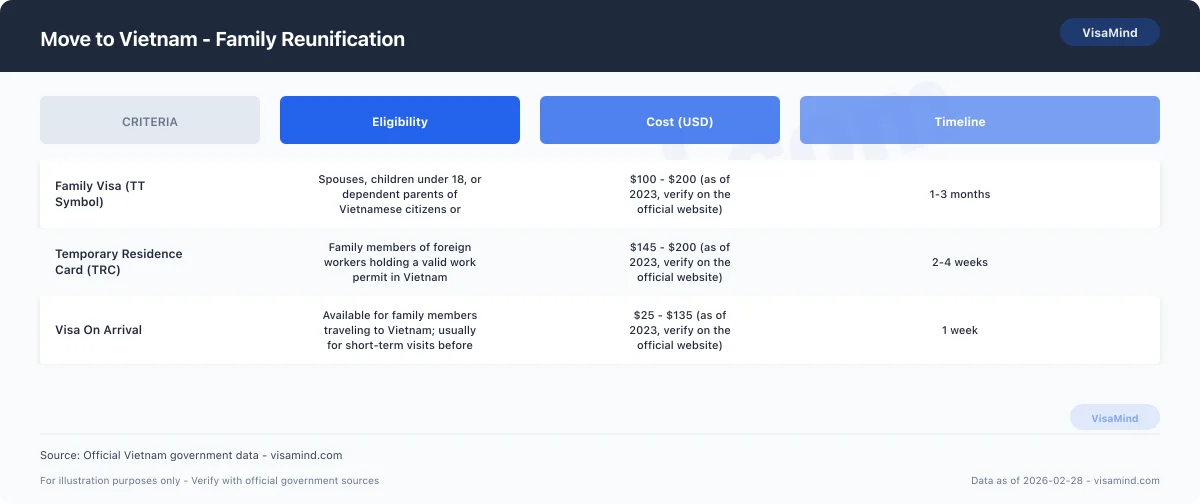
#Moving to Vietnam to join family members involves navigating specific visa pathways designed for spouses, partners, parents, and children. Below, you'll find a comparison of the primary options available for family reunification.
Family Visa Pathways
| Visa Type | Eligibility | Cost | Timeline |
|---|---|---|---|
| Family Visa (TT Symbol) | Spouses, children, or dependent relatives of Vietnamese citizens or residents | Varies, verify on the official website | 1-2 months, check the official website for updates |
| Temporary Residence Card (TRC) | Immediate family members of those holding long-term visas in Vietnam | Varies, verify on the official website | 1-2 months, check the official website for updates |
Applying for a Family Visa
To apply for a Family Visa (TT Symbol), you must demonstrate your relationship to the Vietnamese citizen or resident you intend to join. This can include providing marriage certificates, birth certificates, or other legal documents that affirm familial connections. It’s crucial to prepare these documents in advance, as missing or incorrect paperwork can delay the process.
Obtaining a Temporary Residence Card (TRC)
For those seeking a Temporary Residence Card, eligibility typically extends to immediate family members of individuals who possess long-term visas, such as Work Ld or Investor Dt holders. The TRC offers a more stable residency option for family members planning to stay in Vietnam for extended periods.
Tip: Always verify the most current cost and timeline information on the official Immigration Department of Vietnam website, as these can change frequently.
Preparing Your Application
Before lodging your application, ensure you have gathered all required documents. Commonly needed items include:
- Valid passport
- Proof of relationship (e.g., marriage or birth certificates)
- Completed visa application form
- Any additional documents as specified by the Immigration Department
For more detailed guidance on the application process, consider consulting the How To Apply and Documents Checklist guides.
Important: Incomplete applications may lead to delays or rejections. Double-check your documentation against the checklist provided by the Immigration Department.
By understanding these pathways and following the correct procedures, you can successfully join your family in Vietnam. Always keep abreast of any changes in the immigration process by checking official sources regularly.
Skilled Migration Pathways
#
Vietnam offers several skilled migration pathways for those looking to establish permanent residency. Understanding your options is crucial for selecting the most suitable route. Here, we compare the points-based, employer-sponsored, and independent pathways for skilled migration to Vietnam.
Skilled Migration Pathways Overview
Vietnam's skilled migration pathways cater to various professional profiles, allowing you to apply through different routes based on your qualifications and circumstances. Below is a comparison of the key features of each pathway:
| Pathway | Eligibility Criteria | Cost (VND) | Typical Processing Time |
|---|---|---|---|
| Points-Based | Based on age, education, language proficiency, and work experience | Varies | 6-12 months |
| Employer-Sponsored | Requires a job offer from a Vietnamese employer | Varies | 3-6 months |
| Independent Skilled Worker | Demonstrable skills in demand in Vietnam | Varies | 6-12 months |
Important: Eligibility criteria and costs can change. Always verify on the official Immigration Department of Vietnam website for the latest information.
Points-Based Pathway
The points-based system evaluates applicants on factors such as age, education, language proficiency, and work experience. This pathway is ideal if you have qualifications or skills that are in high demand in Vietnam.
- Age: Younger candidates generally earn higher points.
- Education: Higher educational qualifications can increase your points.
- Language Proficiency: Proficiency in Vietnamese or English is beneficial.
- Work Experience: Experience in industries where Vietnam has skills shortages will enhance your application.
Employer-Sponsored Pathway
If you have secured a job offer from a Vietnamese employer, the employer-sponsored pathway may be the most direct route to obtaining permanent residency. This process involves the employer applying on your behalf, verifying the employment offer, and demonstrating that the job cannot be filled by a local candidate.
- Job Offer: A valid contract and a demonstrated need for your skills.
- Employer Requirements: Employers must be approved by the Vietnamese government to sponsor foreign workers.
- Work Permit: You may need to obtain a Work Permit as part of your application.
Independent Skilled Worker Pathway
For individuals with exceptional skills or qualifications that are in demand in Vietnam, the independent skilled worker pathway offers a route to permanent residency without the need for an employer sponsor.
- Skills in Demand: Professions like engineering, IT, and healthcare are often prioritized.
- Proven Track Record: Evidence of previous work in your field.
- Assessment: You may need to undergo a skills assessment to verify your qualifications.
Tip: Consider applying for a Temporary Residence Card while your permanent residency application is processed. This card allows you to live and work in Vietnam temporarily.
Each skilled migration pathway in Vietnam has its unique benefits and requirements. It's essential to assess your personal circumstances and preferences to choose the most appropriate route for your move to Vietnam. For detailed guidance on the application process, refer to our How To Apply guide and checklists.
Getting PR Step by Step
#To secure Permanent Residency (PR) in Vietnam, it's important to understand the sequential steps and specific requirements set by the Immigration Department of Vietnam. Here’s a step-by-step guide to help you through the process.
1. Determine Eligibility
Before beginning your application for PR in Vietnam, assess your eligibility based on the Immigration Department's criteria. Typically, eligibility is contingent on factors such as family connections, employment, or investment in Vietnam. For those with family ties, the Family Visa (TT Symbol) might be a relevant starting point.
2. Gather Necessary Documents
As of 2023, the documentation for PR includes but is not limited to:
- A valid passport
- Proof of current visa status, such as a Temporary Residence Card
- Evidence of financial stability and employment
- Health certificate from a recognized hospital
- Police clearance certificate
Important: Verify the complete list of required documents on the official Immigration Department website, as requirements can change.
3. Submit Your Application
Once you have compiled all necessary documentation, you will need to lodge your application with the Immigration Department. This includes completing the vietnam-move form, which is specific to Vietnam’s immigration procedures. Ensure that your application is thorough and all documents are current and valid.
4. Attend an Interview
Applicants may be required to attend an interview with the Immigration Department. This step is crucial for assessing the applicant's intention to reside in Vietnam and their integration into Vietnamese society.
Tip: Review potential interview questions and preparation strategies through resources like Interview Prep.
5. Wait for Decision
After submitting your application and attending the interview, the waiting period begins. Processing times can vary, so it's essential to remain patient during this stage. For more detailed information on the expected timeline, consult the Processing Times guide.
6. Receive PR Approval
If your application is successful, you will be notified by the Immigration Department and issued a Permanent Residence Card. This card is proof of your PR status in Vietnam and must be kept up-to-date.
7. Fulfill Ongoing Conditions
Maintaining your PR status involves adhering to specific conditions, such as residing in Vietnam for a certain number of days each year. Ensure you understand these conditions to avoid jeopardizing your residency status.
By following these steps, you can navigate the process of obtaining Permanent Residency in Vietnam. Always consult the official Immigration Department website for the most current information and requirements.
Becoming a Citizen
#To become a Vietnamese citizen, you generally need to have resided in Vietnam for at least 5 consecutive years with a Temporary Residence Card (TRC) or Permanent Residence Card. This residency requirement ensures that applicants have a stable connection to the country before they can apply for citizenship.
Requirements for Naturalization
When applying for Vietnamese citizenship, you will need to meet several criteria:
- Residency: 5 consecutive years of residence in Vietnam.
- Language Proficiency: Demonstrate a basic understanding of the Vietnamese language.
- Cultural Integration: Show knowledge of Vietnamese culture and history.
- Financial Stability: Evidence of a stable means of livelihood in Vietnam.
Important: Ensure all documentation is up-to-date to avoid delays in processing your application.
Dual Citizenship Rules
Vietnam generally does not recognize dual citizenship. If you wish to become a Vietnamese citizen, you may be required to renounce your previous nationality. However, there are exceptions, particularly for those who have made significant contributions to Vietnam or have special circumstances.
Citizenship Application Process
The process of becoming a Vietnamese citizen involves several steps. Here is a simplified overview:
- Gather Necessary Documents: Collect all required documents, such as your residence permit, proof of language proficiency, and financial stability.
- Submit Application: Lodge your application with the Immigration Department of Vietnam.
- Attend an Interview: You may be required to attend an interview to assess your integration into Vietnamese society.
- Receive Decision: Wait for a decision from the Immigration Department.
For more information on the specific steps and necessary documents, you can refer to the Documents Checklist.
Tip: Consider seeking legal advice if you have complex circumstances that might affect your application.
Related Residency Options
Before applying for citizenship, you may want to explore other residency options that could facilitate your stay in Vietnam, such as the Temporary Residence Card or Permanent Residence Card. Each option offers different benefits and requirements, depending on your specific situation.
For a deeper understanding of these options, check the How To Apply guide.
Obstacles to Watch For
#Important: Carefully consider the processing times for your visa type as they can vary significantly, impacting your move to Vietnam.
Processing Times
-
Visa Processing: The processing time for visas can range from a few days to several weeks. For instance, an E Visa typically takes about 3 working days, but a Temporary Residence Card might take longer. It's crucial to check the specific timelines for your visa category on the Processing Times page.
-
Extensions and Renewals: If you anticipate needing an extension, be aware that these requests can also take time. Plan to apply well in advance to avoid overstaying, which can lead to fines or entry bans.
Financial Requirements
-
Proof of Funds: Depending on the visa type, you may need to demonstrate financial stability. For instance, those applying for a Business Dn Visa may need to show evidence of sufficient funds to support their stay in Vietnam. Detailed requirements can be found in the Financial Requirements guide.
-
Sponsorship: If you are being sponsored by a company or family in Vietnam, ensure all financial documentation is complete and accurately reflects the sponsor's ability to support you.
Language Proficiency
-
Work and Study Visas: If you are applying for a Work Ld Visa or Student Dh Visa, proficiency in Vietnamese or English might be a requirement. Some employers and educational institutions may require proof of language proficiency, such as a certification or test score.
-
Language Tests: Consider taking language tests in advance to avoid delays in your application process. Check with the relevant Vietnamese authorities or institutions for the accepted language tests and scores.
Tip: Keep an eye on the official Immigration Department of Vietnam website for the most recent updates on visa requirements and processing times. This ensures you have the latest information and can plan accordingly.
Moving Through Investment
#Vietnam offers several pathways for investors and business professionals looking to move through investment. One of the most relevant options is the Investor Visa (DT), which caters to those planning to invest in the Vietnamese economy. This visa is specifically designed to facilitate the entry and stay of foreign investors and represents a robust opportunity for individuals and companies willing to contribute to Vietnam's economic growth.
What is the Investor Visa (DT)?
The Investor Visa (DT) is geared towards foreign nationals who make investments in Vietnamese enterprises. This visa can vary in validity, typically ranging from one to five years, depending on the level of investment. The visa is categorized into different types, such as DT1, DT2, and DT3, based on the amount of capital invested. For instance, as of 2023, a DT1 visa requires a significant investment threshold, while a DT3 visa may require less. It is advisable to verify the exact amounts on the official website of the Immigration Department.
Requirements for the Investor Visa
To apply for the Investor Visa, you will need to satisfy certain criteria. Key requirements include:
- Investment Proof: Documentation demonstrating your capital investment in a Vietnamese company.
- Business Plan: A clear and detailed business plan outlining your investment strategy and goals.
- Legal Documents: Valid passport, visa application form, and any other relevant legal documents.
- Company Registration: Evidence of company registration in Vietnam, if applicable.
Benefits of the Investor Visa
The Investor Visa provides several advantages, making it a favorable option for business-oriented individuals:
- Extended Stay: Depending on the investment level, you may be eligible for a visa with a longer duration, allowing for more extended residence in Vietnam.
- Business Opportunities: Access to a burgeoning market with numerous business opportunities in various sectors.
- Pathway to Permanent Residency: This visa can be a stepping stone towards obtaining a Permanent Residence Card.
Tip: Ensure your investment aligns with sectors encouraged by the Vietnamese government to enhance your application prospects.
Exploring Other Business-Related Visas
Beyond the Investor Visa, Vietnam offers additional visa options for business activities. The Business Visa (DN) is suitable for short-term business visits, including attending meetings or exploring business opportunities. For a more comprehensive understanding of these options, refer to the Documents Checklist to ensure you're prepared for the application process.
By strategically aligning your business interests with Vietnam's economic opportunities, you can effectively leverage these visa options to establish and grow your ventures in the country.
Options for Retirees
#For retirees considering a move to Vietnam, there are several options available to enjoy your golden years in this vibrant and culturally rich country. While Vietnam does not offer a specific retirement visa, there are alternative pathways that can facilitate a long-term stay.
Temporary Residence Card for Retirees
One viable option is the Temporary Residence Card (TRC), which allows foreigners to reside in Vietnam for an extended period. Although typically associated with employment or family reunification, retirees can potentially qualify through family connections or by investing in Vietnam. The TRC is valid for up to three years and can be renewed, making it a practical solution for those planning a longer stay.
To apply for a TRC, you will need to demonstrate proof of financial stability and possibly a local sponsor. For detailed eligibility criteria, visit the Temporary Residence Card section.
Investing as a Pathway
Another pathway for retirees is through investment. By investing in Vietnam, you can apply for an Investor Visa (DT), which might also lead to a TRC. Investment can be a gateway to residency, offering not only the opportunity to reside in Vietnam but also to engage in its dynamic economy. You can learn more about this option in the Investor Visa section.
Tip: Consider consulting with a local immigration expert to explore how your financial situation and interests align with Vietnam's residency options.
Permanent Residence Consideration
While more challenging, obtaining a Permanent Residence Card is another option for those who have strong ties to Vietnam, such as family connections or significant investment. This card provides long-term residency and can be a goal for retirees wishing to make Vietnam a permanent home. It involves a more rigorous process, and eligibility is more restricted. Details are available in the Permanent Residence Card section.
In summary, while Vietnam doesn't offer a direct retirement visa, options like the TRC, Investor Visa, and Permanent Residence Card provide viable paths for retirees. Always verify the latest criteria on the Immigration Department website to ensure compliance with current regulations.
The Financial Side of Moving
#It's crucial to understand the financial requirements associated with various visa categories. This section provides insights into the settlement funds, income thresholds, and investment amounts you might encounter.
Financial Requirements by Visa Type
For those considering immigration to Vietnam, financial prerequisites vary significantly depending on the visa type. Below is a comparison of some common visas and their associated financial criteria:
| Visa Type | Eligibility | Financial Requirement | Application Cost |
|---|---|---|---|
| E Visa | Short-term stay for tourism or business | No specific financial requirement | $25 USD |
| Business Dn | Business-related activities | Proof of business engagement or sponsorship | $50 USD |
| Work Ld | Employment in Vietnam | Employment contract with a Vietnamese employer | $135 USD |
| Investor Dt | Investing in a Vietnamese enterprise | Minimum investment of $300,000 USD | Varies |
| Temporary Residence Card | Long-term stay for work or family | Proof of stable income or financial support | $145 USD |
Important Considerations
Important: Ensure you have adequate documentation to support your financial claims, such as bank statements or investment records. This will be crucial when lodging your application with the Immigration Department of Vietnam.
Understanding Investment and Income Requirements
For those opting for the Investor Dt Visa, a significant financial commitment is necessary. As of 2026, investors need to demonstrate a minimum investment of $300,000 USD in a Vietnamese company. This requirement underscores the government's focus on attracting substantial foreign investment. Verify the latest investment thresholds on the official website to ensure compliance.
For visa categories requiring proof of income, such as the Temporary Residence Card, applicants must present documents demonstrating a stable source of income. This could include salary slips, tax returns, or affidavits of financial support.
Tips for Financial Preparedness
Tip: Maintain a detailed record of all financial transactions and investments related to your immigration process. This documentation can significantly aid in demonstrating your financial capacity to the Immigration Department of Vietnam.
By understanding and preparing for these financial requirements, you can better navigate the immigration process and ensure a smoother transition to life in Vietnam. For further guidance, including detailed financial requirements, refer to the Financial Requirements guide.
Real Migration Journeys
#An entrepreneur from Australia decided to move to Vietnam to set up a sustainable fashion brand in Ho Chi Minh City. Initially, she was concerned about navigating Vietnam's immigration system to obtain the appropriate visa for her business venture. To address this, she applied for an Investor Visa through the Immigration Department of Vietnam (Cục Quản lý xuất nhập cảnh). She compiled the necessary documentation, including her business plan and financial statements, to demonstrate her investment capacity and the viability of her business. The application process, which was lodged online through the department's portal, took approximately two months. Ultimately, she received approval for her Investor Visa, allowing her to establish her business and reside in Vietnam.
Scenario: Joining Family Members in Vietnam
A software engineer from India aimed to join his spouse, who had recently relocated to Hanoi for a teaching position. He needed to apply for a Family Visa (TT Symbol) to reunite with his family. He gathered the requisite documents, including his marriage certificate and his spouse's employment contract, and submitted them to the Immigration Department of Vietnam. He also consulted the Documents Checklist to ensure he did not miss any critical pieces of evidence. The application process took about six weeks, during which he received updates through the department's online tracking system. Once approved, he was able to move to Vietnam and start a new chapter with his spouse.
Scenario: Pursuing Studies in Vietnam
A recent high school graduate from South Korea decided to pursue a degree in Vietnamese history at a university in Ho Chi Minh City. To make this possible, he needed to secure a Student Visa (DH Symbol). He coordinated with the university's international office, which provided guidance on the application process and necessary documents. The student completed his visa application by including his acceptance letter, proof of financial support, and a detailed study plan. By liaising with the Immigration Department of Vietnam, his application was processed within eight weeks. The successful visa approval allowed him to begin his studies on schedule, immersing himself in Vietnam's vibrant academic environment.
FAQs
What are the steps for getting permanent residency in Vietnam?
Is it possible to combine skilled migration with investment to move to Vietnam?
What kind of evidence do I need to provide for the vietnam-move form?
Can I apply for citizenship in Vietnam after obtaining a Temporary Residence Card?
What financial requirements must retirees meet to move to Vietnam?
How does the Immigration Department of Vietnam assess skilled migration applications?
What are common obstacles when applying for a visa to move to Vietnam?
VisaMind provides informational guidance only and is not a government agency. This is not legal advice. Requirements can change and eligibility depends on your specific facts. If your case is complex or high-stakes, consult a licensed immigration attorney.
Next steps
Requirements vary by nationality, purpose, timeline, and case details. Use Find My Visa to get a personalized checklist for Vietnam with official sources and deadlines.
Find my visa