On this page
- Paths to Working Legally
- Does Your Employer Need to Do Anything?
- The Application Process
- Your Rights as a Worker
- Transitioning to Permanent Residence
- Why Work Visa Applications Fail
- Skills and Qualifications
- Salary and Cost Considerations
- Your Tax Situation Abroad
- Real-World Work Visa Stories
- Visa options for this goal
- Guides for Brazil
- Other goals for Brazil
Paths to Working Legally
#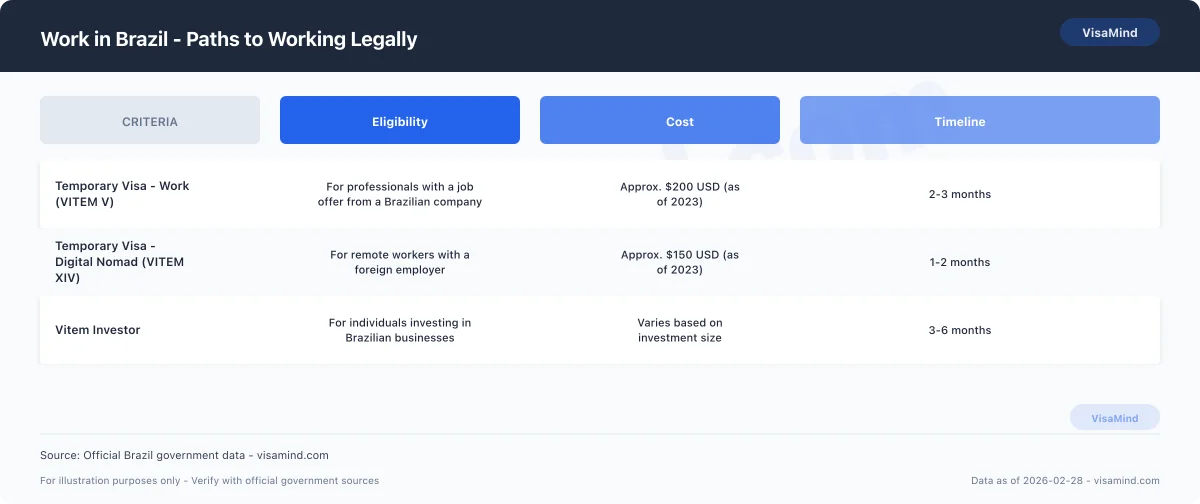
Brazil offers several pathways for individuals seeking to work legally within its borders. Understanding the various work visa categories is crucial for determining the right option for your specific situation. The Federal Police (Polícia Federal) is the authority responsible for handling immigration matters within Brazil, while Brazilian consulates manage visa issuance abroad.
Overview of Work Visa Categories
The table below provides a comparison of the primary work visa categories available in Brazil. Each visa type has distinct eligibility criteria, costs, and processing timelines.
| Visa Type | Eligibility | Cost | Timeline |
|---|---|---|---|
| Temporary Visa - Work (VITEM V) | Professionals with a job offer from a Brazilian employer | Fees vary by consulate | 2-3 months |
| Temporary Visa - Digital Nomad (VITEM XIV) | Remote workers with a stable income from abroad | Fees vary by consulate | 1-2 months |
| Vitem Researcher | Researchers invited by Brazilian institutions | Fees vary by consulate | 2-4 months |
| Vitem Working Holiday | Young individuals from countries with bilateral agreements | Fees vary by consulate | 1-3 months |
Temporary Visa - Work (VITEM V)
The VITEM V is the most commonly used visa for those with a job offer in Brazil. It requires a formal employment contract and is typically sponsored by a Brazilian company. This visa is suitable for various professional roles and allows for multiple entries into Brazil during its validity.
- Eligibility Requirements:
- Formal job offer from a Brazilian employer
- Relevant professional qualifications
- Approval from the Ministry of Labor and Employment
Tip: Engaging a local attorney or immigration consultant can streamline the process and ensure accurate documentation submission.
Temporary Visa - Digital Nomad (VITEM XIV)
The VITEM XIV is designed for digital nomads who work remotely for companies outside Brazil. This visa allows individuals to live in Brazil while continuing their remote work activities.
- Eligibility Requirements:
- Proof of remote employment and income
- Minimum income requirement (verify on the official website)
- Valid travel insurance for the duration of stay
Other Work-Related Visas
For researchers and young travelers, Brazil offers the Vitem Researcher and the Vitem Working Holiday visas. The Vitem Researcher is intended for those participating in academic or scientific research projects, requiring an invitation from a Brazilian institution. The Vitem Working Holiday is available for young individuals from countries that have working holiday agreements with Brazil, allowing them to work temporarily while traveling.
Key Considerations
When choosing the appropriate visa, consider your professional background, the nature of your work, and your long-term plans in Brazil. Each visa type has specific documentation and processing requirements, so it's crucial to gather the necessary information and prepare your application accordingly.
Important: Ensure all documentation is translated into Portuguese where required and check the latest requirements on the official Federal Police website to avoid delays.
For more detailed guidance on application procedures, refer to the How To Apply and Documents Checklist guides.
Does Your Employer Need to Do Anything?
#It's important to understand whether your employer needs to fulfill any specific requirements. These requirements can differ depending on the type of visa you are applying for, such as the Temporary Visa - Work (VITEM V) or the Temporary Visa - Digital Nomad (VITEM XIV).
Employer Requirements
In Brazil, employers play a crucial role in the work visa application process. Before you can start working, your employer may need to undertake certain steps to facilitate your visa application. These steps are often necessary for obtaining a Temporary Visa - Work (VITEM V).
- Job Offer: Your employer must provide a formal job offer that includes details such as your job position, salary, and contract duration.
- Work Authorization: Employers may need to apply for a work authorization from the Ministry of Labor in Brazil, which demonstrates the necessity of hiring a foreign worker.
- Evidence of Efforts to Hire Locally: Employers might be required to show evidence that they have attempted to fill the position with a local candidate before offering it to a foreign national.
Does Your Employer Sponsor You?
Sponsorship is an integral part of obtaining a work visa in Brazil. While not all visa types require employer sponsorship, many do, especially if you are applying for a visa to work in a specialized field or on a long-term basis.
- Sponsorship Letter: A sponsorship letter from your employer is often required, detailing your role and the reasons for hiring you over local candidates.
- Financial Responsibility: Employers might need to assume financial responsibility for certain aspects of your stay, including return transportation costs if your employment terminates prematurely.
Important: Make sure your employer is aware of their obligations under Brazilian law to avoid delays in your visa processing.
How to Ensure Compliance
To ensure compliance with Brazilian immigration requirements, both you and your employer should remain informed and proactive throughout the application process.
- Stay Updated: Regularly check for updates on the requirements for work visas on the official Polícia Federal website to ensure all criteria are met.
- Prepare Documentation: Gather and organize all necessary documents, such as your job offer, sponsorship letter, and any relevant authorizations.
- Consult Official Guides: Use resources like the How To Apply and Documents Checklist to verify that you and your employer have completed all necessary steps.
For more detailed information on specific visa types, it may be helpful to compare options like the Vitem Work and the Vitem Digital Nomad to find the best fit for your needs and circumstances. Always verify current requirements and processes on the official website, as procedures can change.
The Application Process
#Determine Your Eligibility
Before beginning the application process for working in Brazil, confirm which visa category you qualify for. Common options include the Temporary Visa - Work (VITEM V) and the Temporary Visa - Digital Nomad (VITEM XIV). Each category has specific eligibility criteria, so reviewing the Vitem Work Vs Vitem Digital Nomad guide is advisable to ensure you choose the correct path.
Gather Required Documents
Once you have identified the appropriate visa type, collect all necessary documentation. This typically includes:
- Valid passport
- Proof of employment or job offer
- Educational and professional qualifications
- Police clearance certificate
- Health insurance documentation
For a comprehensive list, refer to the Documents Checklist.
Complete the Application Form
Visit the Polícia Federal's official website to access the "Work in Brazil" form.Pay close attention to details as errors can delay processing.
Tip: Ensure all sections are completed and provide consistent information across documents to avoid processing delays.
Submit Your Application
After completing the form, submit it along with all required documents to the Polícia Federal. Depending on your location, this may be done online or in person at a local Federal Police office in Brazil. Be prepared to pay any applicable fees, which can vary based on the visa type and processing speed.
Attend an Interview or Provide Biometrics
Some applicants might need to attend an interview or provide biometric data as part of the process. The Polícia Federal will inform you if this step is necessary.
Important: Failing to respond to interview requests or biometric appointments can result in application delays or denial.
Wait for Processing
The processing time for work visas can vary. As of 2023, expect several weeks for standard processing. Check the Processing Times guide for more detailed estimates and verify on the official website for the most current information.
By following these steps diligently, you will be well on your way to securing the appropriate authorization to work in Brazil.
Your Rights as a Worker
#- Yes, you can change employers while working in Brazil, but you need to update your employment details with the Federal Police (Polícia Federal).
- You must ensure your work visa remains valid and compliant with any new employment conditions.
- Typically, you will need to provide documentation from your new employer and possibly adjust your visa category, such as from a Temporary Visa - Work (VITEM V) to another relevant category if your job role changes significantly.
Tip: Notify the Federal Police promptly about any employment changes to avoid legal issues.
Can Family Join You?
- Family members can join you in Brazil under a family reunification visa.
- This option is available for spouses, children, and other dependents.
- You will need to provide proof of relationship and financial means to support them.
- Family members may also seek their own visa, such as a Vitem Family visa, which allows them to reside with you legally.
Can You Study While Working?
- Yes, it is possible to study while on a work visa in Brazil.
- You do not need to change your visa status to enroll in educational courses, but you should confirm that your visa allows for such activities.
- If you plan to study extensively, consider applying for a Vitem Student visa, which might offer more benefits tailored for students.
Important: Always check the specific conditions of your visa to ensure compliance with any additional activities like studying or changing employers.
Transitioning to Permanent Residence
#Obtaining a work visa in Brazil can be a gateway to permanent residency, allowing you to make Brazil your long-term home. Understanding the transition process from a temporary work visa to permanent residence is crucial for long-term planning.
How Work Visas Lead to Permanent Residency
In Brazil, holding a work visa such as the VITEM V (for general employment) or VITEM XIV (for digital nomads) can be the first step toward permanent residency. Once you have lived in Brazil for a certain period under a valid work visa, you may be eligible to apply for permanent residence. Generally, you need to have resided in Brazil continuously for four years on a work visa to qualify for permanent residency.
Tip: If you have family ties in Brazil, you might be eligible for a quicker transition. Check the Vitem Family for more details.
Timeline for Transitioning to Permanent Residency
The timeline for transitioning from a work visa to permanent residency in Brazil usually follows a structured path. Below is a general timeline for this transition:
-
Initial Work Visa Period: Typically, the work visa is valid for two years. During this period, you must maintain valid employment and comply with visa conditions.
-
Visa Renewal: After two years, you may need to extend your work visa to meet the four-year residency requirement for permanent residency eligibility. The Visa Extension Guide can help you understand this process.
-
Application for Permanent Residency: After four years of continuous legal residency on a work visa, you can apply for permanent residency. Ensure you have all necessary documentation ready for submission to the Federal Police (Polícia Federal).
Key Steps in Applying for Permanent Residency
-
Gather Required Documents: Collect essential documents such as proof of continuous residency, employment history, and any additional evidence of ties to Brazil.
-
Complete the Application: Submit your application for permanent residency to the Federal Police. This process involves thorough checks of your legal and residency status in Brazil.
-
Await Approval: The processing time for permanent residency applications can vary, so it's important to check the current Processing Times and plan accordingly.
Important: Ensure you maintain valid residency status throughout the application process to avoid any complications. Missing deadlines or failing to renew your work visa can affect your eligibility for permanent residency.
By understanding and following these steps, you can smoothly transition from a temporary work visa to permanent residency in Brazil, paving the way for a stable and permanent life in the country. Always verify the latest requirements and timelines on the official Polícia Federal website to ensure compliance.
Why Work Visa Applications Fail
#Important: Incomplete or incorrect applications are a common cause of work visa rejections. Always verify the specific requirements for your visa type before applying.
Common Reasons for Work Visa Rejection
-
Incomplete Documentation: Each visa type has specific documentation requirements. Missing even one document can lead to a denial. Make sure to consult the Documents Checklist to ensure you have everything needed.
-
Inconsistent Information: Discrepancies between the application and supporting documents can raise red flags. Double-check all entries for accuracy and consistency across your application and supporting documents.
-
Insufficient Proof of Employment: For visas like the Temporary Visa - Work (VITEM V), you must provide a valid job offer from a Brazilian employer. Ensure that your employment contract or job offer letter clearly outlines your role, salary, and terms of employment.
Employer Requirements and Failures
-
Employer Sponsorship Issues: Your employer must be registered with the Brazilian Ministry of Labor and capable of sponsoring foreign employees. If your employer fails to meet these requirements, your application may be rejected.
-
Non-compliance with Labor Laws: Ensure that your employer adheres to all Brazilian labor laws, including salary and work conditions. Non-compliance from the employer's side can affect your visa application negatively.
Financial and Legal Concerns
-
Lack of Financial Stability: You may need to demonstrate financial stability, either personally or through your employer. This includes showing you can support yourself in Brazil until you start earning a salary. Refer to the Financial Requirements for more details.
-
Legal Issues: Any past legal issues, such as criminal records, can result in a visa denial. Ensure that all legal matters are resolved before applying.
Tip: Consult the Visa Refusal Reasons guide for more detailed insights into common pitfalls and how to avoid them.
Skills and Qualifications
#Understanding how your skills and qualifications fit into the local job market can be crucial. Here’s how you can ensure your qualifications are recognized and what steps you might need to take.
Skills Assessments
-
Professional Registration: If your profession requires licensing or registration in Brazil, such as engineering, law, or medicine, you must apply for recognition through the relevant Brazilian professional council (e.g., Conselho Regional de Engenharia e Agronomia for engineers).
-
Industry-Specific Requirements: Some industries have specific skill assessment procedures. For example, educators often need to have their teaching credentials evaluated by the Ministry of Education.
Qualification Recognition
-
Equivalency Process: To have a foreign degree recognized, you may need to undergo an equivalency process. This is managed by Brazilian universities, which compare your qualifications against local standards.
-
Translation of Documents: All documents submitted for recognition must be translated into Portuguese by a certified translator. This ensures that your credentials are properly evaluated by Brazilian authorities.
Important: Failing to have your qualifications recognized can limit your job opportunities and even affect your visa application. Verify the requirements early in the process.
Degree Requirements
-
Minimum Educational Criteria: For many work visa categories, such as the Temporary Visa - Work (VITEM V), a university degree or higher is often a prerequisite.
-
Higher Education Verification: Employers may request verification of your degrees and credentials. Be prepared to provide official transcripts and certificates.
Resources for Applicants
To navigate the recognition and assessment processes effectively:
-
Consult the Federal Police: For specific guidance on what documentation you need for your visa category, refer to the How To Apply guide.
-
Check Visa Comparisons: If you are uncertain which visa fits your qualifications, the Vitem Work Vs Vitem Digital Nomad guide can provide clarity.
Understanding these steps and preparing your documents accordingly can make a significant difference in your immigration journey. Always verify the latest requirements on the official Polícia Federal website to ensure compliance with current regulations.
Salary and Cost Considerations
#It's important to be aware of salary and cost requirements related to different visa types. These factors can significantly influence your decision and planning to work legally in Brazil.
Salary Thresholds and Minimum Income Requirements
For many work-related visas in Brazil, maintaining a specified income level is crucial. The Brazilian government imposes these requirements to ensure that foreign workers can support themselves while residing in the country.
Visa Cost and Application Fees
The costs associated with applying for a work visa in Brazil can vary depending on the type of visa. Here's a comparative look at some of the common work-related visas:
| Visa Type | Minimum Income Requirement | Application Fee (BRL) | Processing Timeline |
|---|---|---|---|
| Temporary Visa - Work (VITEM V) | Varies by occupation | Approximately 290 | 2-3 months |
| Temporary Visa - Digital Nomad (VITEM XIV) | USD 1,500/month or BRL 18,000 in savings | Approximately 350 | 1-2 months |
| Residence Permanent | Proof of stable financial situation | Approximately 400 | 4-6 months |
Important: Visa fees are subject to change, and it's advisable to verify the current rates on the official Polícia Federal website.
Application Process and Considerations
When applying for a work visa, ensure you have all necessary documents prepared, including proof of your income. Refer to the Documents Checklist for a detailed list of requirements.
Additionally, the Financial Requirements guide provides further insights into the financial documentation needed for your application.
Understanding the financial aspects of working in Brazil is pivotal for a successful application and smooth transition. Make sure to stay informed about any changes in regulations or fees by consulting official resources regularly.
Your Tax Situation Abroad
#When working in Brazil, understanding your tax obligations is crucial to ensuring compliance with local laws. Here’s a breakdown of your potential tax situation and how to manage it effectively.
Income Tax Obligations
As a foreign worker in Brazil, you are subject to Brazilian income tax on your worldwide income if you spend more than 183 days in the country within a 12-month period. The tax rates range from 0% to 27.5%, depending on your income bracket. It is important to file your taxes annually to avoid any penalties.
Social Security Contributions
If you are employed in Brazil, you are required to contribute to the Brazilian social security system, known as INSS (Instituto Nacional do Seguro Social). Both you and your employer must make contributions, which are typically calculated as a percentage of your salary. These contributions provide access to benefits such as retirement, disability, and maternity leave.
Double Taxation Treaties
Brazil has signed double taxation treaties with several countries to prevent you from being taxed twice on the same income. These treaties often allow you to claim tax credits or exemptions in your home country for taxes paid in Brazil. Some of the countries with such treaties include Japan, Portugal, and the United Kingdom. However, the specific terms can vary, so it is advisable to consult with a tax professional or verify on the official website to understand how these treaties affect your situation.
Tip: Consult a local tax advisor familiar with Brazilian tax laws and international treaties for personalized advice.
Managing Your Tax Situation
To manage your tax situation effectively while working in Brazil, consider the following steps:
- Register for a CPF (Cadastro de Pessoas Físicas): This is a tax identification number required for all tax-related activities in Brazil. You can apply for it through the CPF Application.
- Keep Track of Your Stay: Record your days in Brazil to determine your tax residency status accurately.
- File Your Taxes Promptly: Ensure timely submission of your tax returns to avoid penalties.
- Consult a Professional: Engage with a tax consultant to help navigate complex tax obligations and take advantage of any applicable treaties.
For more information on visas and working arrangements, explore options like the Vitem Working Holiday or Vitem Researcher to find the one that suits your needs.
Real-World Work Visa Stories
#An experienced IT professional from India was offered a position with a Brazilian tech company based in São Paulo. While excited about the opportunity, he was concerned about the process of obtaining the necessary Temporary Visa - Work (VITEM V) to legally work in Brazil. To navigate this, he worked closely with his employer who provided the required job offer documentation and submitted an application to the Polícia Federal. The application included completing the 'Work in Brazil' form and providing evidence of his professional qualifications.
The process took about three months, during which he maintained constant communication with the Federal Police to ensure all documentation was in order. After successfully receiving his work visa, he relocated to São Paulo and began his new role, integrating into his team with ease.
Scenario: Digital Nomad Embraces Brazilian Culture
A British digital marketing consultant decided to embrace the tropical lifestyle of Brazil while continuing her freelance work. She applied for the Temporary Visa - Digital Nomad (VITEM XIV). Given the flexibility of her work, she needed to demonstrate sufficient income to support her stay without seeking local employment. She carefully prepared her financial records, including bank statements and client contracts, to meet the visa requirements.
After lodging her application through a Brazilian consulate, she was granted the visa in approximately two months, allowing her to settle in Rio de Janeiro. She utilized the Digital Nomad Guide to navigate local regulations, ensuring a seamless transition to her new home.
Scenario: Researcher Joins a Prestigious Brazilian University
A Canadian researcher was invited to join a prestigious university in Brazil for a collaborative project on environmental sciences. Facing the challenge of securing the right to work legally, she applied for the Temporary Visa - Researcher. Her sponsoring university provided the necessary invitation letter and proof of the research project, which she submitted alongside her academic credentials to the Polícia Federal.
The application process, supported by the university's administrative team, took roughly four months. Once approved, she was able to move to Brazil and begin her research, contributing valuable insights to her field while enjoying the rich academic culture of Brazil.
FAQs
Can I switch from a Temporary Visa - Digital Nomad (VITEM XIV) to a Permanent Residence in Brazil?
What skills and qualifications are needed for the Work in Brazil visa?
Are there specific income requirements for the Temporary Visa - Digital Nomad (VITEM XIV)?
Can my spouse work in Brazil if I hold a Temporary Visa - Work (VITEM V)?
Why might a Work in Brazil visa application be rejected by the Polícia Federal?
What are the tax implications for foreigners working in Brazil on a Temporary Visa - Work (VITEM V)?
How can I apply for a Temporary Visa - Work (VITEM V) if I'm a skilled professional?
Sources
Last reviewed: March 1, 2026
VisaMind provides informational guidance only and is not a government agency. This is not legal advice. Requirements can change and eligibility depends on your specific facts. If your case is complex or high-stakes, consult a licensed immigration attorney.
Next steps
Requirements vary by nationality, purpose, timeline, and case details. Use Find My Visa to get a personalized checklist for Brazil with official sources and deadlines.
Find my visa