Official sources referenced
When to Read This
#The VITEM V Work Visa and the VITEM XIV Digital Nomad Visa are two specific types of temporary visas available for individuals seeking to reside in Brazil for work-related purposes. Each visa caters to distinct professional needs and lifestyles, making it crucial to understand their differences before applying. If you are planning to work for a Brazilian company or an organization based in Brazil, the VITEM Work Visa is typically the appropriate choice. On the other hand, if you intend to work remotely for a foreign employer while living in Brazil, the Digital Nomad Visa might be more suitable.
Who Benefits from This Comparison?
This comparison is particularly helpful for individuals evaluating their eligibility for either visa type based on their professional situation. Whether you are an employee planning to relocate to Brazil for a job opportunity or a remote worker interested in experiencing Brazil's vibrant culture while maintaining employment with a foreign company, understanding the nuances between these two visas can guide you in making the right decision.
Why Is Understanding the Difference Important?
Choosing the correct visa can significantly impact your ability to stay in Brazil legally and comfortably. Each visa type has unique requirements, application processes, and benefits. For instance, the VITEM Work Visa often involves coordination with a Brazilian employer who will sponsor your stay, whereas the Digital Nomad Visa requires proof of remote employment and self-sufficiency. Familiarizing yourself with these distinctions will help you navigate the application process more efficiently and ensure compliance with Brazilian immigration laws.
Important: Before making a decision, ensure you verify the latest requirements and details on the Federal Police (Polícia Federal) website or consult with a legal expert specializing in Brazilian immigration.
For more detailed guidance on applying for these visas, explore related resources such as the Vitem Work and Vitem Digital Nomad pages.
Side-by-Side Comparison
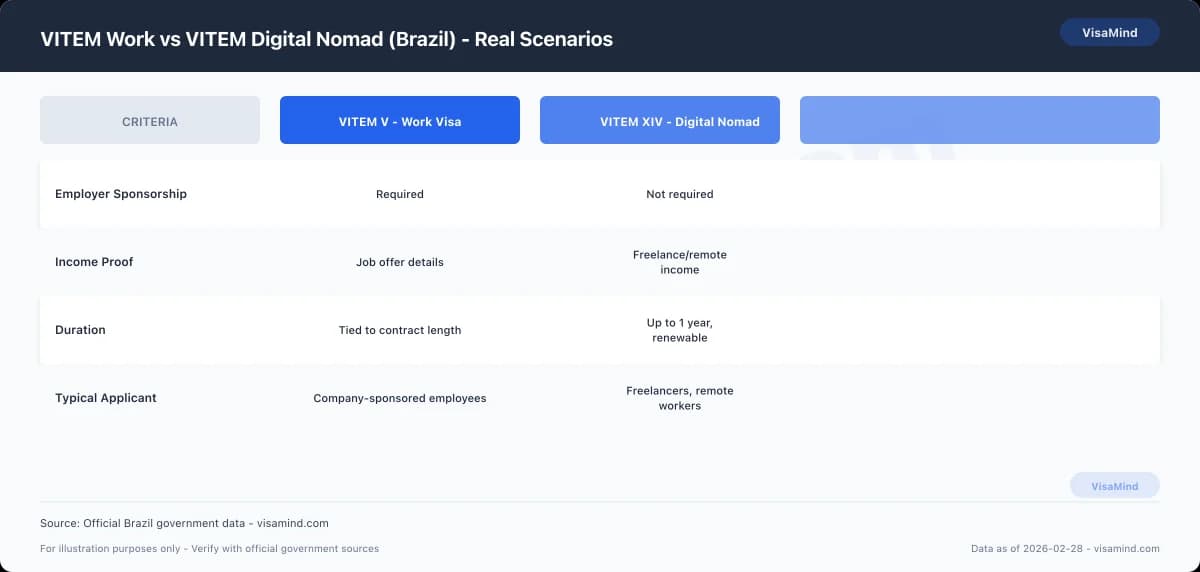
#To help you compare the VITEM Work and VITEM Digital Nomad visas in Brazil, here's a detailed side-by-side comparison of various key aspects.
| Aspect | VITEM Work (VITEM V) | VITEM Digital Nomad (VITEM XIV) |
|---|---|---|
| Eligibility | Requires a job offer from a Brazilian employer and a work contract. | Must prove remote work for a foreign employer and sufficient financial means. |
| Cost | Approximately $100 USD for the visa fee as of 2023, verify on the official website. | Approximately $100 USD for the visa fee as of 2023, verify on the official website. |
| Timeline | Processing can take 2-3 months. Check with the Brazilian consulate for updates. | Processing is typically 1-2 months. Confirm the latest timelines with the Brazilian consulate. |
| Employer Requirements | Brazilian employers must provide a work contract and register the worker with the Ministry of Labor. | No employer requirements in Brazil; the applicant must work remotely for a foreign company. |
| Path to Permanent Residency | Possible after 4 years of continuous residency with proper documentation. | Can lead to permanent residency if eligibility requirements are met, but typically requires a change in visa type. |
Eligibility and Requirements
For the VITEM Work visa, you need to secure a job offer from a Brazilian employer. The employer is responsible for fulfilling necessary obligations, including registering you with the Ministry of Labor. More information on this can be found under Vitem Work.
In contrast, the VITEM Digital Nomad visa caters to those working remotely for non-Brazilian companies. Applicants must provide evidence of their remote work arrangement and demonstrate financial stability. Additional guidance is available in the Digital Nomad Guide.
Timeline and Cost
Both visa types have a similar application fee, currently around $100 USD. However, the processing time for the VITEM Work can be longer, taking up to 3 months, compared to the 1-2 months for the Digital Nomad visa. Always verify the timelines on the official website as they can vary.
Path to Permanent Residency
The VITEM Work visa offers a clearer path to permanent residency, typically after 4 years of residency. This can be a strategic consideration if you're planning a long-term stay in Brazil. The VITEM Digital Nomad visa, however, may require you to transition to another visa type to pursue permanent residency.
Important: Ensure that your visa application aligns with your long-term goals, whether they involve working for a Brazilian company or maintaining a remote job with a foreign employer.
For more details on related visas, consider exploring options like the Vitem Investor or Residence Permanent visas.
When to Pick the First Option
#A software developer from India recently received an employment offer from a Brazilian tech company. The position was full-time and required the developer to work on-site at the company's São Paulo office. Since the job was in Brazil and involved a formal employment relationship, the developer needed to apply for a Temporary Visa - Work (VITEM V), which is suitable for situations involving a direct employer-employee relationship in Brazil.
To proceed, the developer coordinated with the employer, who initiated the work authorization process through the Brazilian Ministry of Justice and Public Security. Once the work authorization was approved, the developer submitted their application to the Brazilian consulate in India, providing all necessary documents, including the work contract, proof of qualifications, and a clean criminal record.
The outcome was successful, and the developer received their VITEM V visa within eight weeks, allowing them to relocate to Brazil and start their new job. This process highlights the importance of choosing the VITEM Work Visa when the employment is structured through a Brazilian company and requires on-site presence.
Scenario: Freelancer Seeking Remote Work Flexibility
A freelance graphic designer from Canada wanted to spend a year in Brazil while continuing to work for her international clients remotely. With no direct employment ties to a Brazilian company, she found the Temporary Visa - Digital Nomad (VITEM XIV) to be a more fitting choice. This visa caters to individuals who earn income from foreign sources and wish to live and work in Brazil without engaging in local employment.
The designer gathered the required documents, including proof of sufficient income from her freelancing activities, a letter of declaration stating her digital nomad status, and valid health insurance coverage. She applied through the Brazilian consulate in Canada, and her application was processed within six weeks.
Upon approval, she was granted a VITEM XIV visa, allowing her to live in Brazil while maintaining her freelance work with international clients. This scenario demonstrates the suitability of the VITEM Digital Nomad Visa for professionals who want the flexibility of working remotely from Brazil without local employment obligations.
Scenario: IT Consultant with a Contract in Brazil
An IT consultant from South Africa secured a consultancy contract with a Brazilian firm for a project lasting six months. The nature of the contract was independent, involving providing IT solutions and expertise without forming an employer-employee relationship. In this case, the Temporary Visa - Work (VITEM V) was the appropriate choice, as it covers independent contractors engaged in specific projects within Brazil.
The consultant and the Brazilian firm coordinated to ensure all necessary documentation was in place, including the consultancy agreement, proof of professional qualifications, and a detailed project outline. They submitted these documents to the Polícia Federal (Federal Police) for approval, followed by an application at the Brazilian consulate.
The process took approximately seven weeks, after which the consultant received the VITEM V visa, allowing him to work on the project in Brazil for its duration. This scenario illustrates the applicability of the VITEM Work Visa for independent consultants involved in specific projects within Brazil.
Choose Option B If...
#A software developer working for a multinational company had the opportunity to work remotely while living in Brazil. However, they were uncertain about the best visa option to facilitate this lifestyle. After researching Brazil's immigration processes, they discovered the VITEM Digital Nomad (VITEM XIV) was perfectly suited for their needs. This visa allows foreign nationals to live in Brazil while working remotely for companies abroad.
To proceed, they gathered the necessary documentation, including proof of employment and income, which demonstrated their ability to sustain themselves without engaging in the local job market. They submitted their application through the appropriate Brazilian consulate. The application process took approximately four weeks, after which they received approval. This allowed them to enjoy the flexibility of working remotely while experiencing life in Brazil.
Tip: Always check the latest guidelines on the Federal Police (Polícia Federal) website to ensure you meet the specific requirements for the VITEM Digital Nomad visa.
Scenario: Entrepreneur Establishing a Tech Startup
An entrepreneur aiming to establish a tech startup in Brazil was considering their visa options. Initially, they thought the Temporary Visa - Work (VITEM V) might be suitable, but they didn't have a local employer to sponsor them. Instead, they discovered that the VITEM Digital Nomad would allow them to legally reside in Brazil while managing their business remotely.
The entrepreneur provided evidence of their remote income from international clients and a business plan outlining their startup's potential. They applied through the Federal Police, ensuring all documentation met the specific criteria outlined for digital nomads. Within six weeks, they secured the visa, enabling them to focus on growing their business in Brazil's vibrant tech landscape.
Scenario: Freelance Graphic Designer Seeking Cultural Immersion
A freelance graphic designer wanted to immerse themselves in Brazilian culture while continuing their work with international clients. They explored the possibility of obtaining the VITEM Digital Nomad visa, which would allow them to live in Brazil without needing local employment.
After consulting the Digital Nomad Guide, they prepared their application, including proof of ongoing freelance contracts and income. They submitted their documentation to the Federal Police, ensuring it aligned with the digital nomad requirements. The application was processed in about five weeks, granting them the opportunity to enjoy Brazil's cultural richness while maintaining their freelance career.
These scenarios illustrate how the VITEM Digital Nomad visa offers a flexible option for those seeking to work remotely in Brazil, without the need for local employment sponsorship.
Key Differences Explained
#One of the primary differences between the VITEM Work and VITEM Digital Nomad visas lies in their eligibility criteria. The VITEM Work (VITEM V) visa is tailored for individuals who have secured employment with a Brazilian company. This visa requires a formal job offer, and the prospective employer must obtain authorization from the Ministry of Labor and Employment. This process ensures that the job cannot be filled by a local Brazilian before hiring a foreign national.
In contrast, the VITEM Digital Nomad (VITEM XIV) is designed for remote workers who are employed by a company outside Brazil or who run their own business abroad. Applicants need to demonstrate that they have sufficient financial means to support themselves during their stay in Brazil. Typically, this involves providing evidence of income, such as bank statements or proof of employment, showing a minimum monthly income, which can vary. It's crucial to verify the latest financial requirements on the official website.
Important: Ensure you meet the specific criteria for the visa type you are applying for. Misunderstanding eligibility can lead to application denial.
Duration and Flexibility of Stay
The duration of stay is another critical aspect distinguishing these two visa types. The VITEM Work visa is usually granted for an initial period of one to two years, with the possibility of renewal, depending on the employment contract and continued need for the foreign worker. This visa offers a pathway to more extended residence options if the employment continues and specific conditions are met.
On the other hand, the VITEM Digital Nomad visa allows for a stay of up to one year, which can be renewed for an additional year. However, the renewal is contingent upon continued proof of financial self-sufficiency and adherence to the visa's conditions. The flexibility of the digital nomad visa is ideal for those who prefer a more transient lifestyle and do not wish to commit to a long-term stay tied to a single employer.
Work Authorization and Restrictions
Work authorization is a significant factor when deciding between these visas. With the VITEM Work visa, you are legally authorized to work in Brazil for the employer who sponsored your visa. This authorization is tied to your specific job and employer, and any change in employment would require a new application or amendment to your visa status.
The VITEM Digital Nomad visa does not permit employment with a Brazilian company; rather, it allows you to continue working remotely for your employer outside Brazil or manage your own business from within Brazil. This visa is not intended for those seeking employment within Brazil, making it an excellent option for individuals who wish to live and work independently while enjoying the country's culture and lifestyle.
For a deeper understanding of how these visas fit into broader immigration strategies, consider reviewing the Digital Nomad Guide and How To Apply resources. Additionally, for those considering long-term options, exploring the Vitem Investor or Residence Permanent might be beneficial.
What People Get Wrong
#Important: Understanding the distinctions between VITEM Work and VITEM Digital Nomad visas is crucial for choosing the right immigration path in Brazil.
Misunderstanding Eligibility Requirements
- Work vs. Digital Nomad Intentions: Many applicants confuse the purpose of each visa type. The VITEM Work visa is intended for individuals who have secured employment with a Brazilian company, while the VITEM Digital Nomad visa caters to those who work remotely for foreign companies or clients.
- Employer Sponsorship: A common misconception is that both visas require Brazilian employer sponsorship. Only the VITEM Work visa mandates a Brazilian employer's involvement. The VITEM Digital Nomad visa, on the other hand, does not require local sponsorship, as it supports remote work for non-Brazilian entities.
Application Process Missteps
- Document Requirements: Applicants often get wrong the type of documentation needed for each visa. For the VITEM Work visa, proof of employment from a Brazilian company is essential. In contrast, the VITEM Digital Nomad visa requires evidence of remote work capability and sufficient financial means to support oneself in Brazil, as detailed in the Digital Nomad Guide.
- Application Location: There is confusion about where applications should be submitted. Visa applications are typically managed by Brazilian consulates abroad, while the Polícia Federal handles in-country processes like registration and extensions.
Financial Misunderstandings
- Income Verification: It's often assumed that both visas have the same financial requirements. The VITEM Digital Nomad visa requires proof of a stable income from foreign sources, while the VITEM Work visa focuses on the employment contract terms agreed upon with the Brazilian employer.
- Tax Obligations: Misunderstandings about tax liability can occur. Digital nomads might incorrectly assume they are exempt from Brazilian taxes, but depending on their length of stay, they may need to address local tax obligations.
Common Confusions
- Visa Duration and Extensions: The duration and extension options differ significantly. The VITEM Work visa duration is generally tied to the employment contract, whereas the VITEM Digital Nomad visa has specific regulations for extensions, which can be clarified in the Visa Extension Guide.
- Switching Between Visas: Some believe it's easy to switch between these visas once in Brazil. In reality, each has distinct criteria and processes, making transitions between them complex and requiring careful planning.
By understanding these key differences and common misconceptions, you can better navigate the Brazilian visa landscape and make informed decisions. For further details, explore the Vitem Work and Vitem Digital Nomad pages.
Can You Switch Later?
#Switching from a VITEM Work Visa (VITEM V) to a VITEM Digital Nomad Visa (VITEM XIV) or vice versa in Brazil involves specific steps and considerations. Understanding these can ease your transition between these visa categories.
Can You Switch Between VITEM Work and VITEM Digital Nomad?
Yes, you can switch between these visa types, but you must comply with distinct application processes and requirements for each. Changing your visa status involves applying for the new visa type with the Federal Police (Polícia Federal) in Brazil or through a Brazilian consulate if you are outside the country.
Key Steps to Transition
-
Assess Requirements: Ensure you meet the eligibility criteria for the new visa type. For instance, the VITEM Digital Nomad Visa requires proof of remote work capability and financial stability. For the VITEM Work Visa, you need an employment offer from a Brazilian company.
-
Gather Documentation: Collect the necessary documents, which may include:
- A valid passport
- Proof of financial means or employment contract
- Additional documents specific to each visa type, such as a letter from your employer or proof of freelance work for digital nomads
-
Lodge Your Application: Submit your application to the appropriate Brazilian authority. If you are in Brazil, this will be with the Federal Police. If you are outside Brazil, you will apply through a Brazilian consulate.
Important: Make sure your current visa remains valid while your new application is processed to avoid any legal issues.
Processing Times and Considerations
Processing times can vary, typically taking a few weeks to several months, depending on the visa type and your location. It's advisable to review processing times on the official website for the most accurate estimates.
Cost Implications
Switching visas may involve application fees. These can vary, so it's important to verify current fees on the official website to plan your budget accordingly.
Tip: Consider consulting the Digital Nomad Guide for detailed information on transitioning to a digital nomad lifestyle in Brazil.
Switching between these visas requires careful planning and adherence to Brazilian immigration rules. Whether transitioning to accommodate a new job or a remote working lifestyle, understanding the requirements and steps will facilitate a smoother process.
Who Chose What and Why
#
A freelance graphic designer based in São Paulo has been working with international clients remotely. Given the rise of remote work opportunities, they decided to shift from a VITEM Work visa to a VITEM Digital Nomad visa to enjoy more flexibility. They were initially uncertain about the process, but after consulting the Digital Nomad Guide, they discovered the specific requirements for proving financial stability and remote work capabilities. By gathering evidence of their regular income and contracts with overseas clients, they were able to lodge the application with the Polícia Federal. Within a few weeks, they received confirmation of their new visa status, enabling them to continue their work from anywhere in Brazil or beyond.
Scenario: Corporate Employee Seeking a VITEM Work Visa
A software engineer from India received an offer from a tech company in Rio de Janeiro. The company advised the engineer to apply for a VITEM Work visa to comply with Brazilian work regulations. The engineer worked closely with the company's HR department to gather necessary documents, including a work contract and proof of qualifications. With comprehensive support from the employer, they submitted the application through the relevant Brazilian consulate abroad. After a thorough review by the consulate and coordination with the Polícia Federal, the engineer received their visa approval within two months. This allowed them to relocate and start work with their new employer without any legal hurdles.
Scenario: Entrepreneur Opting for the Digital Nomad Visa
An entrepreneur running an online marketing agency wanted to take advantage of Brazil's vibrant culture while maintaining their business operations. They decided to apply for the VITEM Digital Nomad visa to legally reside in Brazil while continuing to manage their agency remotely. By following the steps outlined in the How To Apply guide, the entrepreneur prepared a detailed portfolio of their business activities and financial records, showcasing their ability to sustain themselves without relying on Brazilian clients. After submitting the application and attending an interview with the Polícia Federal, they successfully secured the visa in a matter of weeks, gaining the freedom to work from Brazil while exploring new business opportunities.
FAQs
What is the role of the Federal Police in the VITEM Work vs VITEM Digital Nomad (Brazil) process?
Is it possible to hold both VITEM Work and VITEM Digital Nomad (Brazil) visas simultaneously?
What do people commonly misunderstand about VITEM Work vs VITEM Digital Nomad (Brazil)?
Can VITEM Digital Nomad holders apply for a work contract in Brazil?
How long does the Polícia Federal take to process VITEM Work vs VITEM Digital Nomad (Brazil)?
What evidence is required for VITEM Work vs VITEM Digital Nomad (Brazil)?
Why do people switch from VITEM Work to VITEM Digital Nomad (Brazil)?
VisaMind provides informational guidance only and is not a government agency. This is not legal advice. Requirements can change and eligibility depends on your specific facts. If your case is complex or high-stakes, consult a licensed immigration attorney.
Next steps
Requirements vary by nationality, purpose, timeline, and case details. Use Find My Visa to get a personalized checklist for Brazil with official sources and deadlines.
Find my visa