Who This Is For
#Germany welcomes self-employed individuals and freelancers with the right combination of economic potential and financial stability. If you're planning to start a business or work as a freelancer in Germany, you may qualify for a visa or residence permit under this category.
Who Qualifies for Freelance and Self-Employment in Germany?
To be eligible, you must demonstrate a few key factors. These include:
- Economic Interest or Regional Demand: Your business or freelance work should clearly meet an economic interest or fulfill a regional demand within Germany.
- Positive Economic Impact: Your business plan should show potential for positive economic effects in Germany.
- Financial Resources: You should have enough financial resources or a loan commitment to support your business plan.
- Licensing and Qualifications: If your profession requires specific licenses or qualifications, you must obtain these before applying.
Special Considerations for Applicants Over 45
For individuals older than 45 years of age, additional requirements include:
- Old Age Pension Provisions: Proof of adequate pension provisions is mandatory to ensure financial stability in later years.
Why Consider the Freelance and Self-Employment Pathway?
This pathway can be advantageous if:
- You're an entrepreneur with a viable business concept that aligns with Germany's economic needs.
- You are a professional freelancer in a field experiencing demand in Germany, such as IT or creative industries.
- You wish to leverage Germany's robust economy and infrastructure to grow your business.
Tip: Before applying, use the Opportunity Card self-check tool to see if you meet the eligibility criteria.
Related Visa Options
If the freelance and self-employment pathway isn't a perfect fit, consider exploring other visa types like the Self-Employment Visa or the Blue Card EU for skilled professionals. Each pathway has distinct requirements and benefits tailored to different professional profiles.
By understanding the specific qualifications and advantages of the freelance and self-employment pathway, you can better decide if this is the right route for your professional aspirations in Germany.
Requirements to Meet
#To pursue a freelance or self-employment visa in Germany, you must meet specific requirements set by the Federal Office for Migration and Refugees (BAMF). These requirements ensure that your business or freelance activity will contribute positively to the German economy and that you have the necessary qualifications and resources to support your endeavor.
Economic and Financial Requirements
-
Economic Interest or Regional Demand: You must demonstrate that there is an economic interest in or a regional demand for your business or freelance services. This usually involves providing market research or business plans showing how your work fills a gap or meets a demand in Germany.
-
Positive Economic Effect: Your business should be expected to have a positive impact on the German economy. This could be shown through planned job creation, innovation, or other economic benefits.
-
Financial Resources: You need to provide proof of sufficient funds to finance your projects. This could be through personal savings or a loan commitment. It's crucial to have a well-structured financial plan that outlines how you intend to sustain your business and cover living expenses.
Important: If you are over 45 years of age, you must also demonstrate adequate old-age pension provisions to be eligible for the visa.
Professional Qualifications and Experience
-
Relevant Qualifications: Depending on your field, you may need to provide evidence of relevant professional qualifications or degrees. This is particularly important in regulated professions where specific credentials are required.
-
Experience: While not always mandatory, having a proven track record or significant experience in your field can strengthen your application. Documentation such as portfolios, references, or previous employment records can be beneficial.
-
Licenses and Permits: Certain professions in Germany require specific licenses or permits to operate legally. Ensure that you have obtained any necessary licenses before applying.
Age and Language Proficiency
-
Age Considerations: There are no specific age restrictions for freelance or self-employment visas, except for those over 45 who need to show pension provisions, as mentioned earlier.
-
Language Skills: Although not a strict requirement, having a good command of the German language can be advantageous. It can facilitate your integration into the local market and enhance your business prospects.
Additional Considerations
-
Opportunity Card: If you are exploring various options for working in Germany, consider the Opportunity Card, which might offer an alternative pathway depending on your qualifications and skills.
-
Blue Card EU: If you have a recognized academic degree, you might also qualify for the Blue Card EU, which is designed for highly skilled workers.
-
Self-Employment Visa: For more detailed information about the specifics of the Self-Employed Visa, including application processes and required documentation, refer to the relevant guidelines.
Meeting these requirements is crucial to ensuring that your application for a freelance or self-employment visa is successful. Carefully prepare your documentation and demonstrate how your business will contribute to the German economy.
How to Apply
#Determine Your Eligibility
Before applying for a visa or residence permit for self-employment in Germany, ensure that you meet the eligibility criteria set by the Federal Office for Migration and Refugees (BAMF). You must demonstrate an economic interest or regional demand for your business, and be able to finance your business concept through personal funds or a loan commitment. Additionally, if you are over 45, you need to provide proof of adequate old-age pension provisions. Make sure you have obtained any necessary licenses required for your profession.
Gather Required Documentation
Prepare all necessary documents to support your application. These typically include:
- A detailed business plan demonstrating the economic benefit of your business.
- Proof of financial resources or a loan commitment.
- Licenses or permits needed for your business activities.
- Proof of old-age pension provisions if you are over 45.
- Evidence of qualifications, such as a German academic degree or a comparable foreign qualification, if applicable.
Refer to our Documents Checklist for a comprehensive list.
Apply at the Appropriate Authority
If you are still outside Germany, you need to apply for a visa through the Federal Foreign Office at your local German embassy or consulate. If you are already in Germany, you should apply for a residence permit at your local Ausländerbehörde (Foreigners' Office).
Important: Different authorities handle different parts of the application process. Make sure you apply through the correct office to avoid delays.
Pay the Application Fee
There is an application fee for the self-employment visa or residence permit. The exact fee can vary, so check the current rates on the official BAMF website or with your local Ausländerbehörde.
Await a Decision
After submitting your application, the processing time can vary. Typically, it may take several weeks to a few months. The timeframe depends on the complexity of your application and the specific local authority handling it. You can check typical Processing Times for more information.
Tip: Keep track of your application status through the official portal of the Ausländerbehörde or the Federal Foreign Office to ensure you are updated on any additional requirements or decisions.
By following these steps, you can systematically apply for a self-employment visa or residence permit in Germany, ensuring that all requirements are met and that your application is as robust as possible.
What You Need to Submit
#To successfully apply for a visa or residence permit for freelance and self-employment in Germany, it is crucial to gather and submit the necessary documents and evidence. This section provides a detailed list of what you need to submit to the Federal Office for Migration and Refugees (BAMF).
Proof of Economic Interest or Regional Demand
- Business Plan: A detailed business plan that outlines your business idea, target market, and future growth projections. This will help demonstrate the economic interest or regional demand for your business.
- Market Analysis: Evidence of market research or analysis indicating the demand for your product or service in Germany.
Financial Resources and Old Age Pension Provisions
- Proof of Funds: Documentation showing you have sufficient funds to finance your business. This could include bank statements or a loan commitment letter.
- Old Age Pension Provisions: If you are over 45 years old, you must provide proof of adequate old age pension provisions. This could include pension statements or other financial documents.
Professional Licenses and Qualifications
- Licenses and Permits: Obtain and submit any necessary licenses or permits required to perform your freelance work or business activities in Germany.
- Qualifications: Proof of academic or professional qualifications, especially if your profession is regulated in Germany.
Supporting Documents
- Passport: A valid passport with at least six months remaining before expiration.
- Insurance: Health insurance coverage that meets German requirements.
- Residence Permit: If you are already in Germany, include a copy of your current residence permit.
Important: Ensure all documents not in German are translated by a certified translator. This will help avoid delays in processing your application.
For more information on the financial requirements, you can visit the Financial Requirements Guide. If you're considering alternative visa options, you might find the Self-Employed Visa page useful.
Gathering the required documents and supporting evidence is a critical step in applying for a freelance or self-employment visa in Germany. Make sure each document is complete, accurate, and in the required format to increase your chances of a successful application.
Processing Times and Milestones
#Processing times for the Freelance and Self-Employment Visa in Germany can vary significantly based on several factors. Generally, you can expect the process to take between three to six months. However, the timeline can be influenced by the completeness of your application and the workload of the local foreigners' authority (Ausländerbehörde) handling your case.
Factors Affecting Processing Times
Several elements can impact how quickly your visa application is processed:
- Completeness of Documentation: Submitting a well-documented application with all necessary proof, such as economic interest and financial resources, can expedite the process.
- Local Demand and Economic Interest: Applications that clearly demonstrate regional demand or economic benefits may be prioritized.
- Applicant's Background: If you are over 45, providing proof of adequate old age pension provisions is crucial and can affect processing speed.
Tip: Check the Documents Checklist to ensure you have all required paperwork before submitting your application.
Can You Expedite the Process?
While there are no formal expedited processing options, there are steps you can take to potentially speed things up:
- Engage with Local Authorities: Direct contact with the local Ausländerbehörde can sometimes provide insights into any additional requirements or missing documents.
- Thorough Preparation: Ensure all aspects of your business plan and financial backing are clear and well-structured. This can reduce back-and-forth queries from authorities.
Key Milestones in the Process
Here's a brief overview of what to expect once you have lodged your application:
| Milestone | Expected Timeline |
|---|---|
| Initial Review by Ausländerbehörde | 2-4 weeks |
| Evaluation of Economic Interest and Demand | 1-3 months |
| Final Decision and Notification | 3-6 months total |
During this period, staying in regular contact with the Ausländerbehörde can be beneficial. If you're considering moving to Germany for business reasons, explore other visa types like the Blue Card EU or the Opportunity Card, depending on your qualifications and professional background.
Pitfalls to Avoid
#-
Lack of Economic Interest or Regional Demand: Your application may be denied if you fail to demonstrate that there is a significant economic interest or regional demand for your business or freelance services in Germany. It is crucial to thoroughly research and provide compelling evidence of how your business will positively impact the local economy.
-
Insufficient Financial Resources: One of the key requirements is proving that you have sufficient financial resources to support your business activities. Applicants often face rejection due to inadequate proof of funds, whether through personal capital or secured loans. Ensure that you present a detailed financial plan and documentation to support your claims.
-
Inadequate Old Age Pension Provisions: If you are over 45, you must provide proof of adequate old age pension provisions. Failing to meet this requirement is a common pitfall. Be sure to gather and present comprehensive documentation of your pension plans or equivalent financial arrangements.
Documentation Errors
-
Missing Required Licenses: If your freelance work or business activities are regulated in Germany, obtaining the necessary licenses or permits is mandatory. Omitting these documents can lead to a refusal. Verify with the relevant professional bodies or chambers of commerce to ensure you comply with all licensing requirements.
-
Incomplete Applications: Submitting incomplete applications is a frequent issue. Double-check that all sections are filled out and all required documents are included. Use resources like the Documents Checklist to ensure completeness.
Tip: Use the How To Apply guide for a step-by-step overview to avoid missing essential steps in your application process.
Misunderstanding Visa Processes
-
Confusion with Visa Types: Applicants sometimes apply for the wrong type of visa, such as confusing a Freelance Visa with a Self-Employment Visa. Each has distinct requirements and processes. Ensure you understand which visa aligns with your intended business activities.
-
Incorrect Handling of Applications: Applications for residence permits once in Germany should be lodged with the local foreigners’ authority (Ausländerbehörde), not the Federal Office for Migration and Refugees (BAMF), which only handles asylum and refugee matters. Missteps in submitting applications to the wrong agency can delay or derail your plans.
Important: Always verify your visa type and application process on the official Federal Foreign Office or BAMF websites to prevent errors that could extend processing times or lead to refusals.
Should You Consider Something Else?
#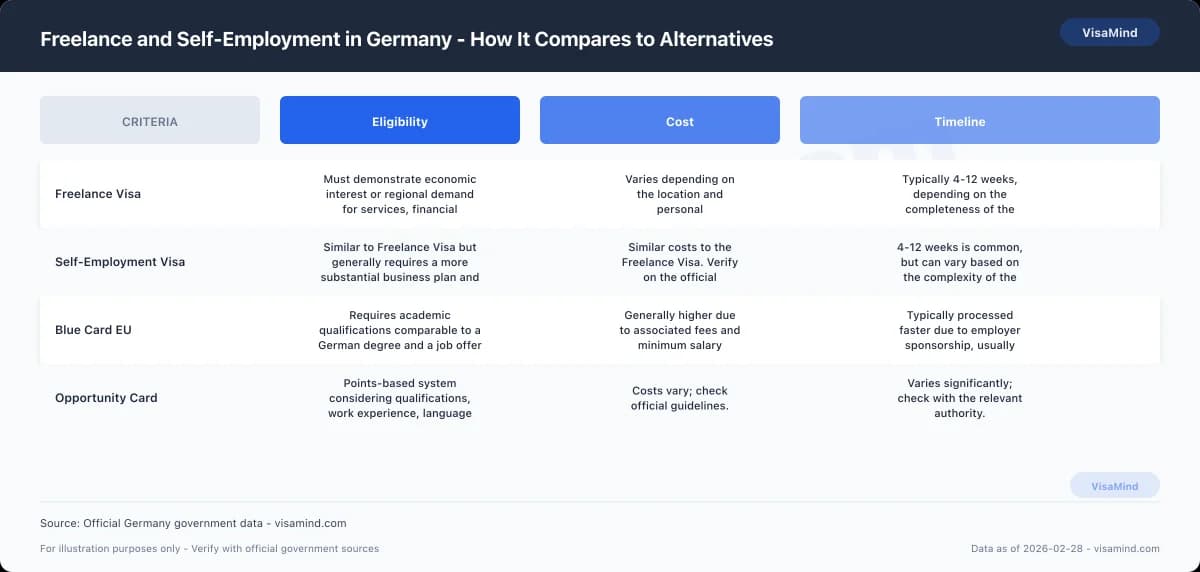
When exploring the option of freelance or self-employment in Germany, it's important to consider whether other visa types might better suit your situation. Below is a comparison of the Freelance Visa, Self-Employment Visa, and the Skilled Worker Visa, highlighting key differences and considerations for each.
Visa Comparison Table
| Visa Type | Eligibility | Cost | Timeline |
|---|---|---|---|
| Freelance Visa | Economic interest or regional demand, proof of sufficient funds, necessary licenses | Approx. €100 | 3-6 months |
| Self-Employment Visa | Positive economic impact, sufficient funds, over 45 requires pension proof | Approx. €100 | 3-6 months |
| Skilled Worker Visa | Job offer in Germany, proof of qualifications, sufficient funds | Approx. €75 | 1-3 months |
Are There Better Options for You?
Freelance vs. Self-Employment Visa
Both the Freelance Visa and the Self-Employment Visa require proving economic interest or regional demand for your work. However, the Freelance Visa is more tailored for professions like artists, journalists, and other independent service providers. On the other hand, the Self-Employment Visa suits those looking to establish a business with a tangible positive impact on the German economy.
Tip: If you're over 45 and applying for the Self-Employment Visa, ensure you have adequate old age pension provisions to meet the requirements.
Considering the Skilled Worker Visa?
The Skilled Worker Visa might be an alternative if you have a job offer from a German employer and your qualifications are recognized in Germany. This visa has a shorter processing time and might suit those who prefer traditional employment over entrepreneurship.
Financial Considerations
The cost of applying for these visas is similar, ranging between €75 and €100. However, the financial requirements differ significantly. For both the Freelance and Self-Employment visas, you must demonstrate that you have the financial means to sustain your business and yourself. This can be through personal capital or a loan commitment.
Important: Insufficient proof of financial resources is a common pitfall. Review the Financial Requirements guide to ensure you meet the necessary criteria.
Final Thoughts
Choosing the right visa type involves evaluating your professional goals and financial situation. If your profession aligns with freelance work and you can prove economic demand, the Freelance Visa might be the right choice. If you're aiming to impact the economy with a new business, consider the Self-Employment Visa. Alternatively, if you have a job offer, the Skilled Worker Visa could be a more straightforward path into the German workforce. Always verify current requirements on the official website, as immigration policies can change.
What It Costs
#Important: Ensure you have adequate financial resources. Proof of sufficient funds is crucial in demonstrating your ability to support your freelance or self-employment venture in Germany.
Costs and Financial Requirements
When considering freelancing or self-employment in Germany, understanding the financial commitments is key. Below is a summary of the typical costs and financial requirements you should be prepared for:
| Item | Description | Cost/Amount |
|---|---|---|
| Visa Application Fee | Fee for submitting your application for a Freelance or Self-Employment Visa. | €100 - €110 depending on the specific visa type. |
| Minimum Investment | Required minimum investment to demonstrate economic benefit and sustainability of your business. | Varies significantly based on the business sector and location; check specific local requirements. |
| Proof of Funds | Evidence that you can finance your business and personal expenses. | Must cover at least €853 per month for living expenses, in addition to business-related costs. |
| Old Age Pension Provision | If you are over 45, you must demonstrate adequate pension provisions. | Amount varies; consult with the Financial Requirements guide for age-specific details. |
Investment and Economic Interest
For your application to be successful, there must be a clear economic interest or regional demand for your business. This means your business plan should indicate a potential positive impact on the local economy. Additionally, you need to secure any necessary licenses for your profession.
Additional Considerations
- Age Considerations: Applicants over 45 must provide proof of sufficient pension provisions. This is crucial to ensure financial stability in the future.
- Licensing: Depending on your profession, certain licenses may be required to legally operate in Germany. Make sure to obtain these in advance.
Tip: Utilize resources like the How to Apply guide to ensure you meet all necessary requirements for your visa application.
By understanding these financial requirements and planning accordingly, you can better prepare for your venture into freelancing or self-employment in Germany. Always verify the latest requirements and costs on official websites or through consultation with relevant authorities.
Rights and Conditions
#When considering freelance or self-employment in Germany, understanding your rights and conditions is essential to making informed decisions about your business and personal life in the country.
Work Rights and Restrictions
As a freelancer or self-employed individual in Germany, you have the right to work in your chosen field, provided you meet the necessary eligibility criteria, such as demonstrating an economic interest or regional demand for your services. Furthermore, you must be able to finance your business concept through your own capital or with a loan commitment.
However, there are certain restrictions and conditions to be aware of:
- Licenses: You must obtain any necessary licenses required for your profession.
- Economic Impact: Your business must have a foreseeable positive effect on the local economy.
- Financial Proof: Adequate proof of financial resources is mandatory to support your business activities.
Tip: Ensure all professional qualifications and licenses are recognized in Germany to avoid delays in starting your business.
Travel and Mobility
Holding a residence permit for self-employment in Germany allows you to travel freely within the Schengen Area. This is particularly beneficial for those whose business activities involve travel across European borders. However, engaging in work outside of Germany may require additional permits or visas depending on the country.
Family Members
If you hold a residence permit for self-employment, your family members, such as your spouse and children, may be eligible to join you in Germany. They can apply for family reunion visas, which allow them to reside in Germany and, in certain cases, work or study.
- Spouse: May be eligible for a work permit.
- Children: Can attend school in Germany.
For more detailed information on family visas, consider visiting the Family Reunion Visa page.
Important Considerations for Older Applicants
Applicants over 45 years old must provide proof of adequate old-age pension provisions to obtain a self-employment visa. This ensures you have a secure financial future, even if your business experiences difficulties.
Important: Failing to provide proof of pension provisions if you are above 45 can lead to application denial.
For more guidance on the application process and specific requirements, you can explore the How To Apply guide.
Real Scenarios
#An experienced IT consultant from India wanted to establish a freelance business in Munich, providing specialized software solutions. However, he was unsure whether there was enough regional demand for his services. To address this, he conducted market research and presented evidence of a growing tech sector in Munich, including letters of intent from potential clients. He submitted this along with his application to the Federal Office for Migration and Refugees (BAMF). Within four months, after fulfilling the financial requirements and demonstrating economic interest in his business, he was granted a self-employment visa. His business has since contributed to the local economy by creating job opportunities for local developers.
Scenario: Graphic Designer Overcoming Age-Related Provisions
A 50-year-old graphic designer from Brazil aimed to launch a freelance graphic design service in Berlin. Knowing the age-related requirements, she needed to prove her old age pension provisions. She provided documentation of her pension plan and savings. Additionally, she presented a robust business plan, highlighting her previous successful projects and the financing she had secured through a German bank. The BAMF reviewed her application, and after a thorough assessment over five months, she received her residence permit. Her creative services are now highly sought after in Berlin's vibrant art scene.
Scenario: Culinary Entrepreneur Establishing a Food Truck Business
A culinary entrepreneur from Canada wanted to start a food truck business in Hamburg, focusing on fusion cuisine. His primary challenge was to show economic interest and regional demand for his unique culinary concept. He gathered testimonials from local food festivals and secured a local partner who was interested in collaborating. He also obtained the necessary licenses for food service operations in Hamburg. The BAMF processed his application, and within three months, he was granted a freelance visa. His food truck has since become a popular fixture at local events, contributing to the city's diverse food culture.
FAQs
What is the cost of applying for a Freelance Visa through BAMF?
What are the pitfalls to avoid when applying for Freelance and Self-Employment in Germany?
Can I combine a Freelance Visa with an EU Blue Card in Germany?
What financial proof is required for Freelance and Self-Employment in Germany?
How can I prove regional demand for my freelance work in Germany?
What should applicants over 45 consider when applying for a Freelance Visa in Germany?
Is it possible to extend a Freelance Visa in Germany?
VisaMind provides informational guidance only and is not a government agency. This is not legal advice. Requirements can change and eligibility depends on your specific facts. If your case is complex or high-stakes, consult a licensed immigration attorney.
Next steps
Requirements vary by nationality, purpose, timeline, and case details. Use Find My Visa to get a personalized checklist for Germany with official sources and deadlines.
Find my visa