Official sources referenced
What You Need to Show Financially
#Germany requires visa applicants to demonstrate sufficient financial means as part of the application process. For many visa types, such as the Student Visa and Job Seeker Visa, applicants must show they can cover living expenses in Germany. As of 2026, students need to prove access to approximately €11,208 per year, which is the estimated cost of living for a student. Always verify the most current requirements on the official website.
How Financial Proof is Evaluated
The Federal Office for Migration and Refugees (BAMF) assesses financial proof based on the applicant's ability to support themselves without relying on public funds. This ensures that visa holders can sustain their stay in Germany without financial hardship. The requirements vary significantly depending on the visa category, such as the Skilled Worker Visa or Freelance Visa, each having specific financial thresholds and documentation standards.
Types of Acceptable Financial Evidence
Applicants typically need to provide bank statements, scholarship letters, or employment contracts to demonstrate financial sufficiency. For self-employed individuals or freelancers, additional documentation like business plans and financial forecasts might be necessary. These documents must clearly show that the applicant has the financial means to cover living costs throughout their stay.
Tip: Submit financial documents that are consistent and clear, as discrepancies might lead to delays or refusals.
Common Financial Requirements Across Visas
While specific financial thresholds differ, a common requirement is that the applicant must not require social benefits. For example, job seekers must have enough funds to cover their living expenses while searching for employment. Similarly, students must demonstrate that they have the necessary funds for at least one academic year. These requirements emphasize financial independence and the ability to contribute economically during the stay.
What Happens If Financial Proof is Insufficient?
If an applicant cannot adequately prove their financial capacity, it may result in the rejection of the visa application. It is crucial to prepare comprehensive and verifiable financial documentation. In certain cases, third-party financial support, such as a Verpflichtungserklärung (declaration of commitment) from a German resident, might be accepted.
Important: Ensure your financial documents are up-to-date and meet the specific requirements for your visa category to avoid application denial.
For more detailed information on the types of visas available and their specific financial requirements, consult the How To Apply and Documents Checklist guides.
How Much You Need by Visa Type
#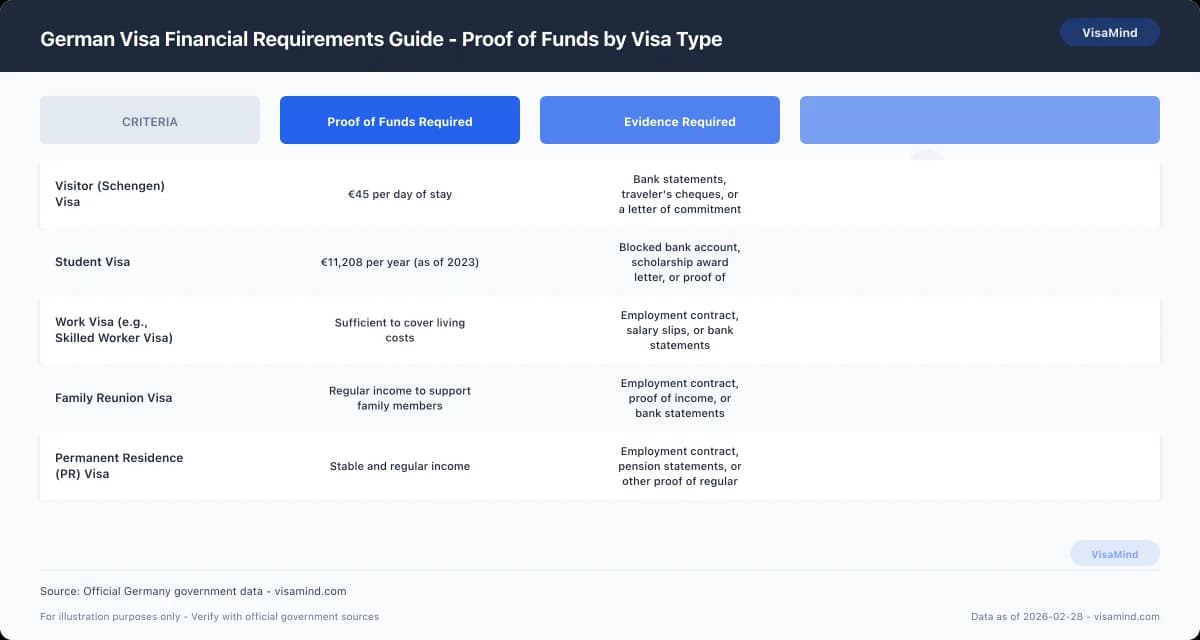
Demonstrating sufficient financial means is crucial. The amount required varies depending on the type of visa you are applying for. Below is a detailed comparison of financial requirements by visa type.
Financial Requirements by Visa Type
| Visa Type | Financial Requirement | Evidence Needed |
|---|---|---|
| Visitor Visa (Schengen) | €45 per day of stay | Bank statements or a Verpflichtungserklärung (formal obligation letter) |
| Student Visa | €11,208 per year (as of 2023) | Proof of a blocked account, scholarship, or parental income declaration |
| Job Seeker Visa | €720 per month (as of 2023) | Bank statements demonstrating funds for at least 6 months |
| Skilled Worker Visa | Sufficient to cover living costs without public assistance | Employment contract or bank statements |
| Family Reunion Visa | Proof of adequate income to support family members | Salary slips and rental contract |
| Permanent Residence (PR) | Stable and regular income to sustain living | Employment contract and tax returns |
Visitor Visa (Schengen)
For the Visitor Visa, you need to prove €45 per day of your intended stay. Bank statements or a Verpflichtungserklärung from a host in Germany are typically required. This visa is short-term, generally allowing stays up to 90 days within a 180-day period.
Student Visa
To apply for a Student Visa, you must show €11,208 per year. This can be demonstrated through a blocked account (Sperrkonto), scholarship proof, or parental income declaration. The financial evidence should cover living costs, including accommodation, food, and study materials.
Important: Ensure that your blocked account is opened with a bank recognized by German authorities.
Job Seeker Visa
For the Job Seeker Visa, you must demonstrate €720 per month for up to 6 months. This ensures you can support yourself while searching for employment in Germany. Bank statements showing sufficient funds are required.
Skilled Worker and Family Reunion Visas
The Skilled Worker Visa necessitates evidence of income sufficient to sustain yourself without public assistance. An employment contract is typically needed. For the Family Reunion Visa, applicants must provide proof of income adequate to support family members, often shown through salary slips and a rental contract.
Permanent Residence (PR)
Permanent Residence in Germany requires proof of stable and regular income. Applicants need to submit employment contracts and tax returns to demonstrate financial independence and the ability to support themselves and any dependents.
Tip: Regularly check the Federal Office for Migration and Refugees (BAMF) website for updates on financial thresholds.
Understanding the financial requirements is a vital step in the visa application process. Ensure you gather and present the necessary documentation to meet the specific criteria for your visa type.
Reading Between the Lines of Bank Statements
#When you apply for a visa in Germany, particularly through the Federal Office for Migration and Refugees (BAMF), it's important to understand how to present your financial situation accurately and effectively. Here's a detailed look at how to interpret and present your bank statements to meet the financial requirements.
Duration and Timeline
- 180-Day Period: Your bank statements should cover the last 180 days prior to your application. This period is crucial as it demonstrates your financial stability over time.
- Monthly Review: Each month's activity should be clearly documented to show consistent financial behavior.
Important: Ensure your bank statements cover the entire 180-day period to avoid any delays or issues with your application.
Balance Requirements
- Minimum Balance: You may be expected to maintain a certain minimum balance in your account. This amount varies based on the visa type, so it's essential to confirm the specific requirements for your situation.
- Average Balance: In addition to a minimum balance, showing a stable average balance over the 180-day period can strengthen your application. Consistency is key—large fluctuations might raise questions.
Eligible Accounts
- Personal Accounts: Only personal accounts in your name are considered valid. Ensure these accounts reflect your financial activities.
- Joint Accounts: If you hold a joint account, you may need to provide additional documentation to prove your claim to the funds. This might include a written statement from the co-account holder or other verification documents.
Types of Accounts Considered
- Current and Savings Accounts: Both current and savings accounts are generally acceptable. However, the liquidity of funds in savings accounts should be clear.
- Investment Accounts: Typically, investment accounts are not considered unless you can demonstrate quick access to these funds.
Presenting Your Financial Situation
- Clearly Labeled Statements: Ensure your bank statements are official and clearly labeled with your name and account details.
- Consistent Transactions: Regular deposits, such as salary payments, can demonstrate stable income. Avoid large, unexplained deposits or withdrawals.
Tip: Highlight regular income entries and consistent spending patterns to reinforce your financial stability.
For those applying for specific visa types like the Skilled Worker Visa or the Student Visa, reviewing the financial requirements associated with these visas is crucial. Consult the Documents Checklist for a comprehensive list of required documents.
Understanding the nuances of your bank statements can significantly impact your visa application. Ensure you present a clear and consistent financial picture to meet the BAMF's requirements effectively.
Accepted and Rejected Evidence
#Demonstrating your financial capability is a critical component of the process. The Federal Office for Migration and Refugees (Bundesamt für Migration und Flüchtlinge, or BAMF) sets specific guidelines on what constitutes acceptable financial evidence. Below is a structured overview of what financial evidence is typically accepted and what is not.
Accepted Forms of Financial Evidence
When preparing your application, you can include various types of financial evidence to demonstrate your financial stability. Here are some of the commonly accepted forms:
-
Cash Savings:
- Bank statements showing a consistent balance over a period of time, typically 3 to 6 months.
- A formal letter from your bank confirming the amount in your account.
-
Investments:
- Documentation of stocks, bonds, or other investments.
- A statement from a financial advisor or investment firm outlining your portfolio.
-
Property Ownership:
- Property deeds or titles.
- A professional property valuation may also be helpful.
-
Scholarships:
- Official scholarship award letters specifying the amount and duration.
- Confirmation from the scholarship provider.
Important: Ensure all documents are translated into German or English if originally in another language. This translation should be certified for authenticity.
Rejected Forms of Financial Evidence
Certain financial sources are typically not accepted by BAMF as evidence of financial stability. It is important to avoid submitting these types of documents:
-
Loans:
- Evidence of loans, including personal loans or lines of credit, are generally not considered.
- Loan statements or letters from lenders indicating borrowed funds.
-
Irregular Income:
- Income from sources that cannot be consistently verified, such as informal work or non-contractual gigs.
-
Unsupported Promises of Future Income:
- Letters or statements of future job offers without a formal contract.
- Promises of financial support without concrete backing, such as notarized affidavits.
Understanding Specific Visa Requirements
Different types of visas may have specific financial requirements. For instance, a Student Visa or Job Seeker Visa might have different thresholds compared to a Freelance Visa or Self-Employment Visa. Therefore, it is essential to consult the specific requirements for your visa category.
Tip: Utilize the Documents Checklist to ensure you gather all necessary financial documents before submitting your application.
In summary, understanding which documents are accepted can significantly impact your visa application process. By preparing accurate and comprehensive financial documentation, you increase your chances of a successful application. Always verify the most current requirements on the official BAMF website or consult with a professional if you have specific questions regarding your situation.
Financial Evidence Pitfalls
#Providing accurate financial evidence is crucial. However, there are common pitfalls that can lead to delays or rejections. Here’s what to watch out for:
Last-Minute Deposits
- Avoid Sudden Influxes: Large deposits made shortly before applying can raise suspicions. Ensure any significant funds in your account have been there for a substantial period.
- Provide Documentation: If a large deposit is unavoidable, such as a scholarship or inheritance, provide documentation explaining the source.
Insufficient Financial History
- Show a Minimum of 180 Days: Your bank statements should cover at least 180 days. This gives the authorities a full picture of your financial stability.
- Regular Transactions: Consistent income and expense patterns are preferable over sporadic, large transactions.
Wrong Currency
- Use Euros: Present your financial evidence in euros to avoid conversion discrepancies. If your bank statements are in a different currency, include a conversion summary.
- Consistent Conversion Rates: Use a reliable source for currency conversion and apply the same rate across all your documents.
Tip: Using a consistent conversion rate helps maintain transparency and avoids misunderstandings.
Missing Explanations
- Explain Anomalies: Any irregularities, such as unusually high expenses or income, should be accompanied by a detailed explanation.
- Attach Supporting Documents: If you have additional income sources like rental income or freelance work, provide contracts or statements to support them.
For those applying for specific visas, such as the Freelance Visa or Blue Card EU, financial evidence is paramount. Different visas may have varying requirements, so it’s crucial to check specifics for each type. You can refer to guides like the Visa Refusal Reasons for more details on common pitfalls.
Important: Missing or incorrect financial evidence can lead to visa denial. Always double-check your documents against the requirements specific to your visa category.
Remember, the Federal Office for Migration and Refugees (BAMF) handles many aspects of your application, but the local Ausländerbehörde will assess your financial evidence for residence permits. Ensure your evidence is comprehensive and transparent to avoid unnecessary complications.
Third-Party Financial Proof
#Especially when a sponsor or guarantor is involved. This section outlines the requirements and processes for third-party financial proof, often necessary for visas like the Family Reunion Visa or Student Visa.
What is Third-Party Financial Proof?
Third-party financial proof involves a sponsor or guarantor who agrees to support the visa applicant financially. This often includes providing evidence of income, an affidavit of support, and tax returns. Such support is critical for applicants who may not meet the financial requirements independently.
Required Documents for Third-Party Financial Proof
When a sponsor or guarantor provides financial support, they must present several documents to the Federal Office for Migration and Refugees (BAMF):
-
Affidavit of Support: A formal declaration where the sponsor confirms their intention to support the applicant financially. In Germany, this is known as a Verpflichtungserklärung, which is a legally binding document.
-
Income Statements: Recent pay slips or a letter from the sponsor's employer verifying their income. This helps demonstrate the sponsor's ability to provide financial support.
-
Tax Returns: Copies of the sponsor’s most recent tax returns, usually covering the last fiscal year, to further substantiate their financial standing.
Important: Ensure that all documents are translated into German or English if they are originally in another language.
Steps to Organize Third-Party Financial Proof
Organizing third-party financial proof involves several steps:
-
Gather Documentation: Collect all necessary documents, including the affidavit of support, income statements, and tax returns from the sponsor.
-
Verify Compliance: Ensure that all documents meet the BAMF's standards and are correctly filled out.
-
Submit with Application: These documents must be submitted along with the visa application to BAMF, either directly or via the German embassy or consulate, depending on your location.
Common Scenarios Requiring Third-Party Financial Proof
Certain visa types often necessitate third-party financial support:
- Family Reunion Visa: When a family member in Germany sponsors the applicant.
- Student Visa: If the student lacks sufficient personal funds.
- Settlement Permit: For those transitioning from temporary visas who require additional financial backing.
For more detailed guidance on gathering these documents for specific visas, refer to the How To Apply guide.
Tip: Maintaining organized and up-to-date financial records can significantly streamline the application process, reducing the risk of delays.
Understanding and preparing third-party financial proof in compliance with BAMF’s requirements can smooth the path to obtaining a German visa, ensuring that your financial backing is clearly demonstrated.
Tips for Preparing Financial Evidence
#- Start Early and Keep Consistent Records
Begin gathering your financial documentation well in advance of your visa application. A key part of meeting the financial requirements is demonstrating a consistent financial history over the last 180 days. This means you should maintain regular bank statements and proof of income. Regular document upkeep ensures you have a complete record when needed, reducing the risk of last-minute complications. For students, this can be particularly important when applying for a Student Visa, where financial stability is crucial.
- Use Cover Letters for Unusual Financial Patterns
If your financial records show any irregular patterns, such as large one-time deposits or gaps in income, include a cover letter explaining these anomalies. Unexplained discrepancies might raise questions during the assessment of your visa application. A well-written cover letter can provide context and clarity, demonstrating transparency and proactively addressing potential concerns of the Federal Office for Migration and Refugees (BAMF).
- Ensure All Documents Are Comprehensive and Up-to-Date
Make sure that all financial documents are current and accurately reflect your financial situation. This includes ensuring that all bank statements, income proofs, and other relevant documents are up-to-date at the time of application. For those applying for long-term visas such as the Blue Card EU, it is especially critical to show ongoing financial stability.
Tip: Regularly review the Visa Refusal Reasons to understand common pitfalls and avoid them in your application.
By following these steps, you can present a strong and transparent financial profile, meeting the expectations set by German authorities and increasing your chances of a successful visa application.
FAQs
Are bank statements from the past 180 days required for all visa types according to Germany's financial guidelines?
Is it possible to switch from a Student Visa to a Self-Employment Visa under the German Visa Financial Requirements Guide?
What are common pitfalls in financial evidence submission for German visas as identified by the German Visa Financial Requirements Guide?
How does the Federal Office for Migration and Refugees (BAMF) verify third-party financial support for German visas?
What financial proof is required for a Freelance Visa in Germany according to the German Visa Financial Requirements Guide?
Can financial requirements for a Skilled Worker Visa be met with savings from non-EU accounts?
How can applicants ensure their financial evidence is accepted under the German Visa Financial Requirements Guide?
Sources
Last reviewed: March 1, 2026
VisaMind provides informational guidance only and is not a government agency. This is not legal advice. Requirements can change and eligibility depends on your specific facts. If your case is complex or high-stakes, consult a licensed immigration attorney.
Next steps
Requirements vary by nationality, purpose, timeline, and case details. Use Find My Visa to get a personalized checklist for Germany with official sources and deadlines.
Find my visa