On this page
- What This Student Visa Covers
- Student Visa Requirements
- Student Visa Document Checklist
- Application Process
- Fees and Wait Times
- When to Consult an Immigration Professional
- Part-Time Work Rules
- After Graduation
- Staying Longer
- Why Student Visas Get Denied
- Required forms
- Related visa types
- Related guides
- Related goals
- Next steps
Official sources referenced
What This Student Visa Covers
#A German Student Visa is your gateway to pursuing your educational ambitions in Germany, covering a range of academic pursuits. With a processing time ranging from 15 to 60 days as of 2026, depending on your category and processing location, this visa is tailored to facilitate entry for students aiming to engage in degree programs, language courses, and exchange programs in Germany.
What Types of Studies Are Covered?
The German Student Visa is designed to support a variety of educational tracks. Whether you're enrolling in a degree program, participating in a language course, or joining an exchange program, this visa provides the necessary residence title. Degree programs can range from undergraduate to postgraduate studies, while language courses often serve as a preparatory pathway for further academic pursuits. Exchange programs, often organized between universities, offer a chance to experience Germany’s rich cultural and academic environment for a semester or two.
How Does the Visa Work?
For students from countries requiring an entry visa, the Student Visa acts as a temporary entry permit. Once in Germany, students must convert this visa into a residence permit at the local Ausländerbehörde (foreigners' authority). This conversion allows students to reside in Germany for the duration of their studies. It's vital to understand that holding a student visa does not automatically guarantee a residence permit; each application is subject to approval by the local authorities.
Important: Ensure you comply with all documentation requirements and deadlines to avoid delays in your application process. Missing documents or incorrect submissions can lead to processing setbacks.
Related Opportunities
Beyond the standard student visa, Germany offers several related visa types that might better suit specific educational or professional paths. For instance, the Vocational Training Visa supports non-academic training, while the Language Course Visa is tailored for those focusing solely on language acquisition without immediate plans for further study. If you're considering working alongside your studies, the Working Holiday Visa offers a blend of work and travel opportunities.
Tip: Check if your country is part of a visa waiver agreement, which may simplify your application process with a biometric passport.
Navigating the German educational landscape with a student visa opens up a world of academic and cultural opportunities. For more detailed steps on how to proceed, consider exploring our How To Apply guide and the Documents Checklist to ensure all requirements are met.
Student Visa Requirements
#To study in Germany, obtaining a student visa involves meeting several requirements. Below is a comprehensive list of what you need to prepare.
Acceptance Letter
- University Admission: You must have an official acceptance letter from a recognized German university or higher education institution. This letter confirms your enrollment in a full-time course.
Financial Proof
- Proof of Financial Resources: Demonstrating financial stability is crucial. You need to show you have sufficient funds for living expenses, which is typically around €10,332 per year (as of 2023). Verify this amount on the official website for the most current figure.
- Blocked Account (Sperrkonto): A common method to prove financial resources is by setting up a blocked account in Germany. This account restricts access to the funds, ensuring you have a monthly allowance to cover living expenses.
Important: Ensure your blocked account is set up before your visa appointment to avoid delays.
Language Requirements
- Language Proficiency: Depending on your course, you may need to demonstrate proficiency in German or English. Accepted tests include TestDaF or DSH for German and IELTS or TOEFL for English. The required scores will vary based on your chosen program.
Health Insurance
- Mandatory Health Insurance: Health insurance is compulsory for students in Germany. You must have coverage that meets German standards before applying for your visa. Public health insurance is generally recommended for students, but private options are also available.
Tip: Check if your home country’s insurance is valid in Germany or if you need to enroll in a local policy upon arrival.
For further guidance on the application process, consider visiting the How To Apply page. Additionally, the Documents Checklist can help ensure you have all necessary documentation prepared. Familiarize yourself with related visa types, such as the Student Applicant Visa, which may be relevant depending on your study plans in Germany.
Student Visa Document Checklist
#For those seeking to study in Germany, ensuring you have all the necessary documentation is crucial. The Student Visa Document Checklist is a vital step in the application process. Here’s what you need to prepare:
Personal Identification Documents
- Valid passport with at least two blank pages
- Biometric passport photo meeting official requirements
- Proof of previous visas (if applicable)
Academic and Enrollment Documents
- Acceptance letter from a recognized German university or educational institution
- Proof of any prior education, such as transcripts or diplomas, translated into German or English
- Language proficiency certificate (if required by your course)
Financial Support Documentation
- Blocked account (Sperrkonto) confirmation showing sufficient funds to cover living expenses in Germany
- Scholarship award letter or financial guarantee from a sponsor
Important: Ensure the blocked account meets the financial requirements set by the authorities, which may change annually. Verify on the official website for up-to-date amounts.
Health and Insurance Requirements
- Proof of adequate health insurance coverage for the duration of your stay
- Medical certificate confirming good health (if specifically requested)
Additional Documents
- Motivation letter explaining your study objectives and plans
- Curriculum vitae (CV) detailing academic and professional background
Nationality-Specific Requirements
For applicants from certain countries, an entry visa may be required before traveling to Germany. Check with the Federal Foreign Office to determine your specific requirements.
Tip: To avoid processing delays, ensure all your documents are complete and meet the official standards before submission.
For further guidance on preparing your application, consider reviewing our Documents Checklist and consult the Processing Times to understand how long the process might take. Remember, applying for a student visa does not guarantee approval, so meticulous preparation is essential.
Application Process
#-
Acceptance into a German Institution
Before beginning your application for a Student Visa, you must first secure admission to a recognized German educational institution. This could be a university, college, or other higher education establishment. Once accepted, you'll receive a letter of admission, which is a crucial piece of documentation for your visa application. Make sure this letter includes details about your course, its duration, and the language of instruction.
-
Determine Visa Requirements Based on Nationality
The need for an entry visa depends on your nationality. Citizens of certain countries, such as Afghanistan, Algeria, and Angola, are required to obtain an entry visa before entering Germany. Conversely, if you hold a biometric passport from specific countries, you may benefit from a visa waiver. It's essential to verify your specific requirements with the Federal Foreign Office.
-
Gather Required Documents
Collect all necessary documents, such as your valid passport, proof of financial resources, health insurance, and your admission letter. You may also need to provide proof of language proficiency, either in German or English, depending on your course requirements. For a comprehensive list, refer to our Documents Checklist.
-
Lodge Your Application
Submit your application through a German consulate or embassy in your country of residence. This step requires scheduling an appointment to submit your documents and possibly attend an interview. It's important to present compliant photos and accurate information; any discrepancies could lead to delays or denial. For detailed preparation tips, see our Interview Prep Guide.
-
Await Processing and Decision
After submission, the processing of your Student Visa can take between 15 to 60 days, depending on various factors including your application location and the time of year. It's advisable to check current Processing Times regularly, as they can vary.
-
Receive and Validate Your Visa
Once your visa is approved, you will receive a notification from the German consulate. Make sure to verify all details on your visa for accuracy. Upon arrival in Germany, you must register with the local foreigners' authority (Ausländerbehörde) to obtain your residence permit. This must be done within the first 180 days of your stay.
Important: Ensure all documents are up-to-date and meet the requirements outlined by the Federal Office for Migration and Refugees (BAMF) to avoid processing delays.
Fees and Wait Times
#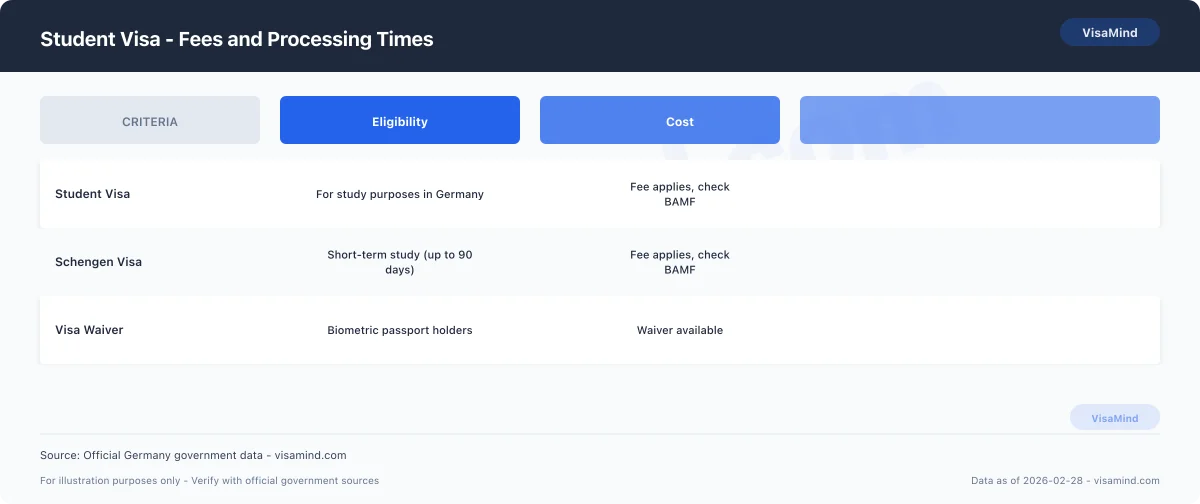
Germany is a popular destination for international students, offering rich academic opportunities and a vibrant cultural experience. If you're considering studying in Germany, understanding the fees and timelines associated with a Student Visa is crucial. Below, find a comparison of key elements related to the visa process.
Visa Fees and Processing Timeline
When applying for a German Student Visa, be prepared for certain fees and wait times. While some applicants may qualify for a visa waiver, most will follow the standard process. Here’s a detailed comparison:
| Visa Requirement | Description | Cost | Processing Time |
|---|---|---|---|
| Standard Visa Application | For students applying from outside Germany. | Refer to official fee data. | 15 to 60 days (as of 2026) |
| Biometric Passport Holder | Certain nationalities may qualify for a visa waiver. | No fee if under waiver agreement. | Varies based on processing location |
| Entry Visa Requirement | Mandatory for citizens from specific countries like Afghanistan, Algeria, and Angola. | Refer to official fee data. | 15 to 60 days (as of 2026) |
Important: Verify your eligibility for a visa waiver or any specific requirements based on nationality before applying. Failing to determine if an entry visa is required may delay your application.
Tuition and Financial Requirements
As part of your application, you must demonstrate the ability to finance your studies in Germany. This includes covering tuition fees and living expenses. The specific financial requirements depend on your study program and institution.
- Proof of Enrollment: Required from a recognized German educational institution.
- Financial Proof: Sufficient funds to cover living expenses, which may require a blocked account (Sperrkonto) with a certain amount deposited.
- Health Insurance: Mandatory for all students, which must be arranged before arriving in Germany.
For more detailed guidance on financial preparation, you can refer to the Financial Requirements Guide.
Application and Further Steps
Once you've gathered your documents and financial proof, the application is lodged with the German consulate or embassy in your home country. For detailed steps, reviewing the How to Apply Guide and Documents Checklist can be very helpful.
Tip: Applying online can expedite the process and provide immediate confirmation and tracking of your application status.
For further visa types related to study, you might explore options like the Language Course Visa or the Student Applicant Visa, depending on your academic plans.
When to Consult an Immigration Professional
#If your student visa application is straightforward -- accepted at a recognized school, clear funding, no immigration history issues -- you can likely prepare it yourself for Germany immigration. But reach out to an immigration professional if:
- You have significant gaps in your education or employment history
- You want to work or change programs mid-visa
- You have a prior visa denial or refusal
- You have a prior overstay, unlawful presence, or removal order
- You have a criminal record, arrest history, or pending charges
- You have a prior misrepresentation or fraud finding
- You are in removal or deportation proceedings
Part-Time Work Rules
#Student visas for Germany come with specific rules regarding part-time work, internships, and summer jobs. Understanding these regulations is crucial to ensure you remain compliant while pursuing your studies in Germany.
Part-Time Work Limits
As a student in Germany, you are allowed to work part-time, but there are restrictions on the number of days you can work. You can work:
- 120 full days per year
- 240 half days per year
These limits are set to ensure that your job does not interfere with your studies. If you wish to work beyond these limits, you will need approval from the local foreigner's authority (Ausländerbehörde).
Co-op and Internship Rules
Internships are an integral part of many academic programs in Germany. When it comes to mandatory internships, which are often part of the curriculum, these do not count towards the 120-day or 240-half-day limits. However, voluntary internships do count towards these limits.
Important: Always confirm whether an internship is mandatory as part of your course. Misclassification can lead to regulatory issues.
Summer Work
During semester breaks, students have the opportunity to work full-time without being restricted by the 120-day rule. This offers a great chance to gain practical experience while earning extra income. However, it's important to ensure that your employment does not affect your academic performance.
Additional Considerations
While working part-time or engaging in internships, you may want to explore other visa options such as the Internship Visa if you plan to focus more intensively on practical work. Additionally, understanding the differences between various visas, like the Schengen Visa vs. National Visa, can help you choose the right path for your situation.
Tip: Keep track of your working days and ensure compliance with the working limits. Non-compliance can impact your student status and future visa renewals.
For further guidance on how to manage your work alongside your studies, consider reading the Visa Extension Guide.
After Graduation
#Germany offers a variety of opportunities for international students to remain and work in the country after graduation. Once you complete your studies, you can apply for an 18-month residence permit to find a job that corresponds to your qualifications. During this period, the German Ausländerbehörde (local foreigners' authority) will be your point of contact for residence matters.
What Are Your Options After Graduation?
After your studies, you have the possibility to explore different pathways that can lead to a more permanent stay in Germany. One of the most popular options is the Blue Card EU, which is designed for highly skilled workers. To qualify, you generally need a job offer that meets the salary threshold and is relevant to your field of study. Alternatively, the Skilled Worker Visa is another viable route if you have a job offer that meets the required criteria.
Pathways to Permanent Residency
For those considering a long-term stay, transitioning from a student visa to a Settlement Permit can be an attractive goal. After two years of employment in a position related to your degree, you may be eligible for a settlement permit, provided you meet other requirements such as language proficiency and financial stability. The PR Pathway Guide can offer more detailed information on this process.
How to Extend Your Stay?
If you need more time to find employment after graduation, the 18-month job-seeking residence permit is a critical option. Ensure that your health insurance remains valid during this period. Should you secure employment during this time, you can apply for a change in your residence status, whether it be the Blue Card EU or another suitable visa type.
Tip: It's advisable to start exploring job opportunities and networking while you are still studying. This proactive approach can significantly enhance your chances of securing employment quickly after graduation.
Important Considerations
Bear in mind that each visa category has specific requirements and benefits. It's crucial to align your career goals with the visa type you qualify for. Make sure to consult the Visa Refusal Reasons to avoid common pitfalls in your application process. Additionally, always verify the most current information on fees and processing times on the official websites, as these can change.
Staying Longer
#When pursuing studies in Germany, maintaining your student status and understanding the extension processes is crucial. Here’s how you can manage program changes, renewals, and extensions for your student visa.
How to Extend Your Student Visa
If your study program extends beyond the initial visa period or if you change your course, you will need to apply for an extension through the local foreigners' authority (Ausländerbehörde). This process involves several key steps:
- Gather Required Documents: Ensure you have a valid passport, proof of enrollment, and evidence of financial support.
- Schedule an Appointment: Contact the Ausländerbehörde well in advance to secure an appointment before your visa expires.
- Lodge Your Application: Submit your application in person, presenting all necessary documents and any additional information required by the authority.
Important: Extensions must be applied for before the existing visa expires to avoid legal complications.
Program Changes and Maintaining Status
Changing your field of study or educational institution can affect your visa status. To maintain your student status, consider the following:
- Notify Authorities: Inform the Ausländerbehörde of any changes in your study program as soon as possible.
- Update Enrollment: Provide proof of enrollment in the new program and ensure it aligns with your initial purpose of stay.
- Check Duration: Confirm that the new program’s duration fits within your current visa period or extend your visa accordingly.
Key Considerations
- Processing Times: Visa processing times can vary. Generally, it can take between 15 to 60 days, depending on the category and location. Always verify the current processing times with the Ausländerbehörde.
- Document Compliance: Ensure all documents meet the specified requirements, such as compliant photos and complete information, to avoid delays.
For more information on related visas, you might be interested in exploring options like the Vocational Training Visa or the Language Course Visa. Additionally, the Visa Extension Guide can offer further insights into extending your stay for educational purposes.
Why Student Visas Get Denied
#It's important to understand why some applications may be denied. This awareness can help you avoid common pitfalls and improve your chances of success.
Common Reasons for Visa Denial
-
Funding Gaps: You must prove you have sufficient financial resources to support yourself during your studies in Germany. This usually involves showing proof of a blocked account, a scholarship, or a formal declaration of commitment by a third-party. Insufficient funding or gaps in your financial documentation can lead to a denial.
-
Program-Background Mismatch: German authorities assess whether the course of study you're pursuing aligns with your educational and professional background. If there's a significant disconnect between your past education or work experience and the program you're applying for, it may raise red flags. Ensure your chosen program logically fits your academic or career path.
-
Immigration Intent Signals: The student visa is specifically for educational purposes, not for permanent residence or employment. If your application suggests you intend to remain in Germany beyond your studies for reasons not permitted under a student visa, this can result in rejection. Clearly articulate your plans to return to your home country after completing your studies.
Tips to Strengthen Your Application
-
Document Accuracy: Ensure all documents, including photos, meet the specified requirements. Non-compliant photos are a common reason for delays or rejections.
-
Clear Intentions: Clearly outline your study objectives and future plans in your application. A well-defined educational and career trajectory can alleviate concerns about your long-term intentions.
Important: Failing to determine if an entry visa is required based on your nationality can result in application delays or denials. Always verify your eligibility requirements and entry needs.
For more detailed information on the application process and visa requirements, refer to resources such as the Visa Refusal Reasons or Financial Requirements. If considering alternative visa options post-graduation, explore the Job Seeker Visa or Blue Card EU for potential pathways.
Next steps
#Use Find My Visa to build a sequenced plan with official sources and deadlines.
VisaMind provides informational guidance only and is not a government agency. This is not legal advice. Requirements can change and eligibility depends on your specific facts. If your case is complex or high-stakes, consult a licensed immigration attorney.
Next steps
Requirements vary by nationality, purpose, timeline, and case details. Use Find My Visa to get a personalized checklist for Germany with official sources and deadlines.
Find my visa