Official sources referenced
Is Extension Possible?
#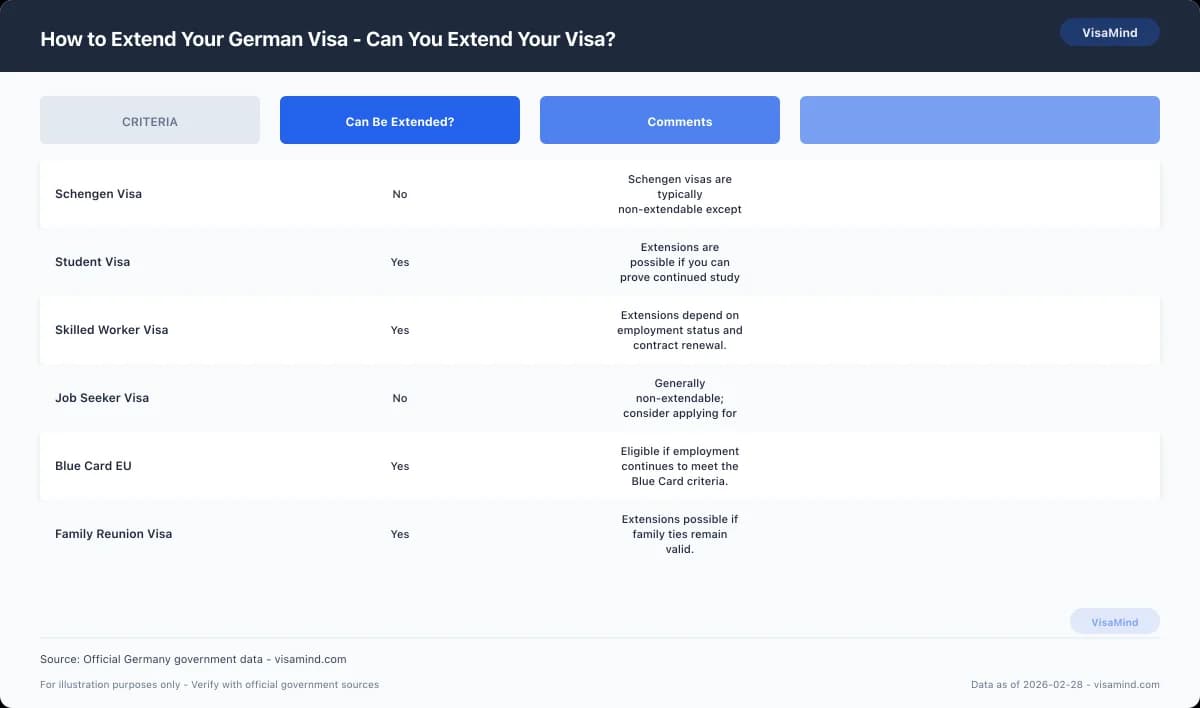
In Germany, extending your visa depends largely on the type of visa you hold. Here's a detailed look into which visas are extendable and which are not:
| Visa Type | Eligibility for Extension | Notes |
|---|---|---|
| Schengen Visa | Not extendable | Typically allows stays of up to 90 days. Extension only in exceptional circumstances (e.g., health issues). |
| Student Visa | Extendable | Must continue to meet enrollment and financial requirements. Check with Student Visa guidelines. |
| Skilled Worker Visa | Extendable | Requires proof of ongoing employment. See Skilled Worker Visa for details. |
| EU Blue Card | Extendable | Must still meet salary and employment criteria. More info at Blue Card EU. |
| Family Reunion Visa | Extendable | Proof of ongoing family ties and adequate living conditions required. Visit Family Reunion Visa. |
| Working Holiday Visa | Not extendable | Limited to a specific duration with no extensions. |
| Settlement Permit (Niederlassungserlaubnis) | Not applicable | This is a permanent residence permit, not subject to extension. See Settlement Permit for more info. |
Can You Extend Your Schengen Visa?
A Schengen Visa is generally not extendable. It allows for travel up to 90 days within a 180-day period across the Schengen Area. Extensions are only possible under exceptional circumstances like medical emergencies that prevent you from traveling.
Important: If you overstay your Schengen Visa, you may face fines and potential bans on future travel to the Schengen Area.
What About National Visas?
National visas like the Student Visa and Skilled Worker Visa are extendable, provided you meet the specific criteria. For example, students must continue their education and show proof of financial means. Skilled workers need to show ongoing employment.
Tip: Contact your local Ausländerbehörde well before your current visa expires to discuss extension options.
Special Considerations for the EU Blue Card
The EU Blue Card is designed for highly skilled workers and is extendable. However, you must still meet the salary threshold and employment conditions. Extensions typically require proof of ongoing employment in a qualified position.
Family Reunion and Other Visas
Visas like the Family Reunion Visa also allow for extensions as long as the circumstances that justified the initial visa continue to apply. This usually involves proving your relationship status and living conditions.
For those holding a Settlement Permit, extensions are not applicable since this permit grants permanent residency.
For more detailed guidance on extending specific visa types, consult the relevant visa pages such as Skilled Worker Visa or Family Reunion Visa.
How to Apply for an Extension
#-
Determine Your Eligibility for Extension
Before proceeding with the application for a visa extension in Germany, it's crucial to confirm that you meet the eligibility requirements. Typically, you must apply within the 180-day period before your current visa expires. Check the specific conditions that apply to your visa category, whether it's a Skilled Worker Visa, EU Blue Card, or another type. Ensure that you have compelling reasons for your stay, such as continued employment or study, which are essential for the extension process.
-
Prepare Your Application Documents
Once you have confirmed your eligibility, gather all required documents. This generally includes your current residence permit, proof of financial stability, health insurance, and any other documents specific to your visa type. A detailed list of necessary documents can often be found in the Documents Checklist. Ensure all documents are current and translated into German if necessary.
-
Visit the Local Ausländerbehörde
To apply for a visa extension, you must contact the Ausländerbehörde (local foreigners' authority) in the area where you reside in Germany. You can usually find the contact information and location on their official website. Depending on your location, you may be required to schedule an appointment in advance, as walk-ins might not be accommodated.
-
Complete the Application Process
At the Ausländerbehörde, you will be required to submit your documents and complete any necessary application forms. It's crucial to review all instructions provided by BAMF and ensure accuracy in your application. You may also need to pay a fee, so be prepared for this step. The current fee structure can vary; thus, verify this on the official BAMF website or with your local Ausländerbehörde.
-
Await Decision and Follow Up
After submitting your application, it may take several weeks to receive a decision. Processing times can vary, so refer to the Processing Times guide for more information. Be proactive and follow up if you haven't received a response within the expected timeframe. If your extension is granted, ensure that you understand any new conditions attached to your stay.
Tip: Consider applying well before your visa's expiration to account for any processing delays and ensure uninterrupted legal status in Germany.
-
Understand the Outcome and Next Steps
If your extension is approved, you will receive a new residence permit with updated validity dates. If denied, you may have the option to appeal the decision or explore other avenues, such as applying for a different type of visa, like the Settlement Permit. It's important to fully understand your options and obligations moving forward.
Important: Failing to secure an extension before your current visa expires may lead to legal consequences, including potential deportation. Always stay informed and act promptly.
Documents Needed
#When you're looking to extend your German visa, gathering the correct documentation is a critical step. Depending on your visa type and individual circumstances, the required documents can vary. Here's a breakdown of the typical documents you'll need when applying for a visa extension with the Federal Office for Migration and Refugees (BAMF).
Personal and Identification Documents
- Valid Passport: Ensure your passport is valid for the entire duration of the requested extension.
- Current Visa or Residence Permit: Include a copy of your existing visa or residence permit.
- Passport Photos: Recent biometric passport-sized photos that meet the German photo requirements.
Proof of Financial Stability
- Bank Statements: Recent bank statements to demonstrate financial stability during your extended stay.
- Employment Contract or Pay Slips: If applicable, provide proof of employment, such as your employment contract or recent pay slips.
- Scholarship or Sponsorship Documentation: If you are a student or sponsored individual, include relevant financial support documents.
Accommodation Details
- Rental Agreement: A current rental agreement or proof of accommodation for the duration of your stay.
- Registration Confirmation (Meldebescheinigung): A confirmation from the local registration office (Bürgeramt) that you are registered at your current address.
Purpose-Specific Documents
- Student Enrollment Confirmation: If extending a Student Visa, include proof of enrollment from your educational institution.
- Job Offer or Internship Confirmation: For those on a Skilled Worker Visa or Internship Visa, provide a job offer or internship confirmation.
- Family Reunion Documentation: If extending a Family Reunion Visa, include proof of relationship and the residence status of the family member in Germany.
Health Insurance
- Health Insurance Confirmation: Proof of valid health insurance coverage for the duration of your extended stay.
Important: Ensure all documents are complete and up-to-date. Incomplete documentation can delay the processing of your application.
Additional Required Documents
Depending on your situation, additional documents may be needed:
- Language Proficiency Proof: If relevant, provide proof of German language proficiency.
- Previous Application Copies: Any previous applications or correspondence related to your stay in Germany.
For a more comprehensive list tailored to your specific visa type, refer to the Documents Checklist available on the official BAMF website. Always verify document requirements on the official BAMF website, as they may change.
Extension Costs and Timeline
#When extending your German visa, understanding the costs and timelines involved is crucial. Here is an overview of the fees and processing times associated with different types of visa extensions in Germany.
Extension Costs and Processing Timelines
| Visa Type | Extension Cost (EUR) | Processing Time (Weeks) | Expedited Options |
|---|---|---|---|
| EU Blue Card | 100-110 | 4-8 | Not typically available |
| Student Visa | 50-60 | 6-8 | Limited, case-by-case |
| Settlement Permit | 135-200 | 8-12 | Not applicable |
| Family Reunion Visa | 60-80 | 4-10 | Limited, case-by-case |
Understanding the Costs
Visa extension fees can vary based on the specific circumstances of your application. For most visa types, you should anticipate costs between €50 and €200. Always check the latest fee structure on the official BAMF website to ensure you have the most current information.
Processing Timelines
The processing time for visa extensions generally ranges from 4 to 12 weeks. It's advisable to apply well in advance, ideally before your current visa expires, to avoid any legal complications. Delays can occur if additional documentation is required, so ensure your application is complete when submitted.
Tip: Contact your local Ausländerbehörde for specific processing times and any potential expedited options, as these can vary by region and current workload.
Expedited Options
Expedited processing is not commonly available for most visa extensions. However, in urgent cases, such as unforeseen changes in personal circumstances, you might be able to request faster processing directly from the Ausländerbehörde. Such requests are typically assessed on a case-by-case basis and are not guaranteed.
By understanding the costs and timelines, you can better plan your visa extension process. Always consult the Documents Checklist to ensure you have all necessary materials ready for your application.
Consequences of Overstaying
#Overstaying your visa in Germany can lead to significant consequences, affecting both your immediate situation and future immigration opportunities. If you find yourself in a situation where your visa is about to expire, it is crucial to act promptly to avoid these penalties.
Immediate Consequences of Overstaying
Overstaying your visa, even by a day, can result in fines and a requirement to leave Germany immediately. The local foreigners' authority (Ausländerbehörde) may impose financial penalties depending on the length of your overstay. Additionally, you may be issued an exit order, which could force you to leave the Schengen Area entirely.
Important: Overstaying your visa can result in a ban from re-entering Germany or other Schengen countries for a specified period, typically ranging from one to five years.
Long-Term Implications
Beyond the immediate penalties, overstaying your visa can have long-term effects on your ability to re-enter Germany or apply for other visas. Any previous record of overstaying will be considered in future applications, potentially resulting in denials or additional scrutiny.
- Impact on Future Applications: Your history of overstaying will be visible to immigration officers during subsequent applications, influencing their decision.
- Ineligibility for Certain Visas: Some visas, such as the EU Blue Card or Settlement Permit, require a clean immigration record.
Preventing Overstay
To avoid the consequences of overstaying, it's advisable to apply for an extension well in advance of your visa's expiration date. The Federal Office for Migration and Refugees (BAMF) provides guidance on the extension process, and it’s crucial to adhere strictly to the timelines and requirements stipulated.
- Timely Application: Begin preparing your application at least three months before your visa expires.
- Consult Authorities: Reach out to the Ausländerbehörde if you anticipate any issues in meeting the requirements for extension.
What to Do If You Overstay
If you have already overstayed, it is essential to contact the Ausländerbehörde immediately to explain your situation. Legal advice may also be beneficial in mitigating the consequences and exploring potential solutions, such as applying for a different visa type like the Job Seeker Visa if you qualify.
Tip: Keeping all documentation related to your stay, including your initial visa application and communications with immigration authorities, can support your case in the event of an overstay.
Navigating the complexities of visa extensions and the potential consequences of overstaying requires careful attention to detail and timely action. Always verify current procedures on the official BAMF website to ensure compliance with the latest requirements.
Extension Eligibility by Visa Type
#Your eligibility largely depends on the type of visa you hold. Below is a detailed breakdown of extension eligibility by visa category:
Extension Eligibility by Visa Type
| Visa Type | Eligibility Criteria | Cost (EUR) | Typical Timeline for Processing (Days) |
|---|---|---|---|
| Tourist Visa | Generally not extendable except in exceptional cases like illness or force majeure. | Varies | Up to 15-30 |
| Student Visa | Must be enrolled in a recognized institution; extension possible if studies continue | 100-110 | 4-6 weeks |
| Work Visa | Must demonstrate continued employment and compliance with initial visa conditions | 100-110 | 4-6 weeks |
| Family Visa | Eligible if family ties (e.g., marriage) remain valid; proof of continued support | 100-110 | 4-6 weeks |
Eligibility Details
Tourist visas, typically issued under the Schengen Visa category, are not normally extendable. However, exceptions are made in rare cases of emergency such as severe health issues.
Student visas require proof of continued enrollment and progress in your studies. Extensions are generally granted if you are actively pursuing your degree. For more information about maintaining your student status, visit the Student Visa page.
If you hold a work visa — such as the EU Blue Card or Skilled Worker Visa — you must provide evidence of ongoing employment and compliance with the original visa terms. Your employer may also need to confirm your continued employment.
For those on a family visa, your eligibility for extension rests on the validity of your relationship, such as marriage or partnership, and your ability to support yourself and your family. The Family Reunion Visa provides more insights into the requirements for family-based visa extensions.
Important: Always verify costs and timelines on the official BAMF website or your local Ausländerbehörde, as they can vary by region and year.
Timeline Considerations
The processing time for visa extensions can range from 15 days for tourist visas to several weeks for student, work, and family visas. It is crucial to apply well in advance, ideally before your current visa expires, to avoid overstaying, which can result in penalties or entry bans. For detailed information on processing times, refer to the Processing Times guide.
If you need further guidance on specific visas or the extension process, you may want to consult related resources like the How To Apply and Visa Refusal Reasons guides.
Other Options If You Can't Extend
#If you find that extending your German visa isn't an option, there are several alternative routes you may consider to maintain legal status in Germany or plan your next steps. Here's a look at some options:
Switching to a Different Visa Type
If extending your current visa is not feasible, you might explore switching to a different visa category that better suits your situation.
- Job Seeker Visa: If you're interested in seeking employment in Germany, consider applying for a Job Seeker Visa. This visa allows you to stay in Germany for up to six months while searching for a job.
- EU Blue Card: For highly skilled professionals, the EU Blue Card offers a pathway to work in Germany, provided you have a job offer that meets the salary threshold.
- Student Visa: If you plan to pursue educational opportunities, a Student Visa could be a suitable option, allowing you to stay and study in Germany.
Leaving and Re-entering Germany
In some cases, leaving Germany and returning with a new visa might be the best approach. This involves planning to apply for a new visa type from outside the country, often through a German embassy or consulate in your home country.
Important: Leaving Germany without sorting your visa status might affect your ability to return, especially if you overstay. Always consult with the Federal Office for Migration and Refugees (BAMF) before making your decision.
Voluntary Departure
If extending or changing your visa isn't possible, you may need to consider leaving Germany voluntarily before your current visa expires. This option helps you avoid the negative consequences associated with overstaying, such as fines or future entry bans.
- Plan Your Departure: Make sure to settle any obligations in Germany, such as closing bank accounts and canceling leases.
- Document Your Exit: Keep records of your departure, as these might be required for future visa applications.
Applying for Permanent Residency
Should you meet the criteria, applying for Permanent Residence is another avenue. This status allows for an indefinite stay in Germany. Key requirements often include a stable job, proficiency in the German language, and integration into the community.
In conclusion, while extending your German visa isn't always possible, these alternatives can offer viable pathways to continue your journey in Germany. Always ensure that any changes to your status are handled promptly to maintain your legal standing.
FAQs
Can I switch from a Student Visa to a Skilled Worker Visa while extending my stay in Germany?
How can I extend my German Family Reunion Visa?
What are the consequences of overstaying a German visa without applying for an extension?
How much does it cost to extend a German EU Blue Card?
Can I combine a Settlement Permit with a Family Reunion Visa in Germany?
What is the process for extending a German Student Visa with BAMF?
Is there a specific timeline for applying for a German visa extension?
Sources
Last reviewed: March 1, 2026
VisaMind provides informational guidance only and is not a government agency. This is not legal advice. Requirements can change and eligibility depends on your specific facts. If your case is complex or high-stakes, consult a licensed immigration attorney.
Next steps
Requirements vary by nationality, purpose, timeline, and case details. Use Find My Visa to get a personalized checklist for Germany with official sources and deadlines.
Find my visa