On this page
The Appeal of Moving Here
#Germany's allure as a destination for skilled professionals, families, investors, and retirees is undeniable. With its robust economy, Germany ranks as the largest in Europe and the fourth largest in the world, offering a wealth of opportunities for those seeking to advance their careers, secure their family's future, or enjoy a vibrant retirement. Skilled migration plays a significant role in this landscape, with options such as the Skilled Worker Visa and the Blue Card EU designed to attract talented individuals to fill high-demand roles.
Why Germany?
Germany offers a high standard of living, comprehensive healthcare, and a rich cultural heritage. Its central location in Europe provides easy access to neighboring countries, making it an attractive base for both personal and professional travel. The country's commitment to innovation and sustainability also makes it a forward-thinking choice for entrepreneurs and investors. For families, Germany's focus on education and child welfare is a significant draw, while retirees benefit from a range of social services and a stable pension system.
Skilled Migration Pathways
For skilled professionals, obtaining the EU Blue Card or a residence permit under specific sections of the Residence Act (AufenthG) is a viable path. To qualify, you typically need to have a recognized degree and a job offer with a minimum salary threshold. The Blue Card is particularly advantageous due to its streamlined process and pathway to permanent residence. More details on the differences and requirements can be found in our Blue Card Vs Skilled Worker guide.
Family and Investment Opportunities
Family reunification is a cornerstone of Germany's immigration policy, allowing those with residence permits to bring close family members to join them. The Family Reunion Visa facilitates this process. For investors, Germany offers a stable business environment with opportunities in technology, manufacturing, and renewable energy sectors. Establishing a business or investing in the local economy can lead to a residence permit, with details available under the Self Employed visa category.
Tip: Demonstrating proficiency in the German language, typically at level B1 CEFR, can greatly enhance your application prospects and integration into German society.
With a blend of economic opportunity, cultural richness, and strategic location, Germany presents a compelling option for those looking to relocate. Whether you're a skilled worker, planning a family reunion, investing in a business, or preparing for retirement, Germany's immigration pathways are structured to accommodate a diverse range of aspirations.
Bringing Your Family
#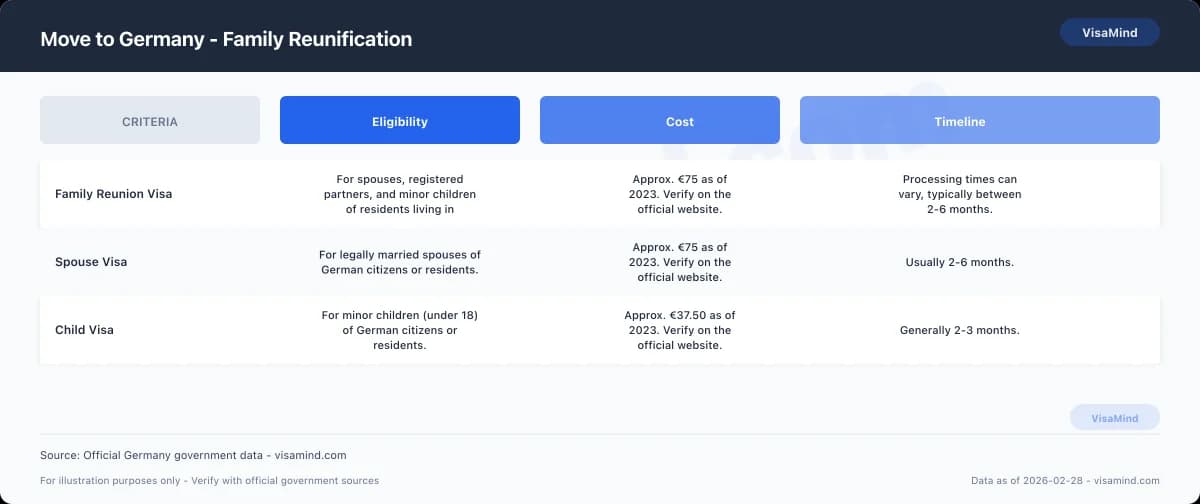
And children. These pathways are essential for reunifying families and ensuring that your loved ones can join you in Germany. Below is a comparison of the main visa options:
| Visa Type | Eligibility | Cost | Timeline |
|---|---|---|---|
| Family Reunion Visa | Available to spouses, registered partners, and minor children of residents. The sponsor must have a valid residence permit. | Varies by country; verify with local German consulate. | Processing times can range from a few weeks to several months, depending on the consulate. |
| Spouse Visa | Applicants must be legally married to a German citizen or a resident with a settlement permit. Must demonstrate basic German language skills (A1 level). | Varies; typically involves visa fees and additional costs for document certification. | Generally takes 3-6 months, but may vary by consulate. |
| Child Visa | For minor children of German citizens or residents. Requires proof of custody and consent from both parents if applicable. | Similar to other family visas; fees differ by country. | Processing can take 1-3 months, with variations based on local procedures. |
Key Requirements for Family Visas
When applying for any family visa, ensure that you meet the following common requirements:
- Proof of Relationship: Provide official documents, such as marriage or birth certificates, to establish the familial connection.
- Financial Stability: Demonstrate the ability to support your family financially without relying on public assistance.
- Living Space: Ensure you have adequate living space for your family members, meeting the local housing standards in Germany.
Application Process
- Gather Documentation: Collect all necessary documents, including proof of financial resources, accommodation, and relationship.
- Lodge Application: Submit your application to the German embassy or consulate in your country. This process involves an interview where you may need to demonstrate language skills and knowledge about Germany.
- Await Decision: The processing time can vary, so it’s important to apply well in advance of when you wish your family to join you.
Important: Ensure all application forms and documents are completed in German, as the process requires proficiency in the language.
Common Pitfalls
- Language Proficiency: Failing to meet the required German language level can delay the process.
- Incomplete Documentation: Missing documents or incorrect information can result in application denial.
For more detailed guidance on specific visas, you can consult resources such as the Settlement Permit or the German Citizenship pathways to understand how family reunion fits into broader immigration strategies.
Routes for Skilled Workers
#Germany offers several pathways for skilled workers to immigrate and potentially achieve permanent residence. The "Move to Germany" initiative includes options like the EU Blue Card, Skilled Worker Visa, and the Independent Pathway. Each route has its own set of criteria, benefits, and processes. Below, you'll find a comparative table that outlines these pathways, helping you determine which option might be best suited for your situation.
| Route | Eligibility | Cost (as of 2023) | Timeline to PR | Key Benefits |
|---|---|---|---|---|
| EU Blue Card | - Hold a degree from a German university or equivalent | €110 for application | 33 months; 21 months with B1 German | - Fast track to PR with B1 German proficiency |
| - Employment contract with a salary of at least €56,800 (€44,304 in shortage occupations) | - Access to other EU countries | |||
| Skilled Worker Visa | - Recognized qualification in Germany | €100 for application | 4 years with continuous employment | - Flexibility to switch employers within your field |
| - Job offer related to qualification | - Can apply for family reunion visa for dependents | |||
| Independent Pathway | - Financial self-sufficiency and sustainable business plan | Varies (consult local authority) | Varies based on business success | - Entrepreneurial freedom |
| - Proof of previous relevant experience | - Potential for innovation-driven growth |
EU Blue Card
The EU Blue Card is designed for highly skilled professionals. To qualify, you must have a recognized university degree and a job offer with a minimum salary threshold. This pathway offers a streamlined process to permanent residence, especially if you can demonstrate B1 level German language proficiency. For more information, visit the Blue Card EU page.
Tip: If you achieve B1 proficiency in German, you can expedite your permanent residence application, reducing the timeline from 33 to 21 months.
Skilled Worker Visa
The Skilled Worker Visa is an attractive option for those with a recognized qualification and a job offer aligned with their skills. It provides flexibility in changing employers within the same field and allows you to bring family members through the Family Reunion Visa. This visa requires you to have basic knowledge of the German social and legal system, as well as sufficient living space.
Important: Ensure you have a recognized qualification in Germany. You may need to apply for Qualification Recognition if you're uncertain about your degree's status.
Independent Pathway
For those seeking entrepreneurial opportunities, the Independent Pathway allows self-employment or starting a business. This route demands a sustainable business plan and proof of financial self-sufficiency. While the cost varies, this pathway offers significant flexibility and the potential for innovation-driven growth. Keep in mind, the timeline to permanent residence can vary depending on the business's success and impact on the German economy.
Navigating these options involves understanding detailed requirements and gathering necessary documents. For a comprehensive guide on these processes, consider reviewing the Documents Checklist to ensure all steps are covered. Each pathway presents unique opportunities and challenges, making it essential to align your professional goals with the right immigration route.
The Permanent Residence Process
#Determining Eligibility for Permanent Residence
To apply for a permanent residence permit, commonly known as the Niederlassungserlaubnis, in Germany, you must first ensure you meet specific eligibility criteria. Generally, you need to have held a residence title under Sections 18a, 18b, 18d, or 18g of the Residence Act (AufenthG) for at least three years. This includes categories like Skilled Workers and EU Blue Card holders. Additionally, you should be able to cover your living costs without state assistance and have paid into the statutory pension scheme for at least 36 months. Proficiency in German at a B1 level according to the CEFR is also essential.
Gathering Required Documents
Before lodging your application, compile all necessary documentation. This includes proof of your residence title and the duration of your stay in Germany, evidence of employment and financial self-sufficiency, and a language proficiency certificate at the B1 level. You will also need to demonstrate that you have sufficient living space for yourself and any accompanying family members. Consulting a Documents Checklist can help ensure you have all the necessary paperwork.
Important: The entire application procedure must be conducted in German. Ensure you have the required language proficiency or assistance to navigate this process effectively.
Applying for the Settlement Permit
Once eligibility is confirmed and documents are gathered, the next step is to make an appointment with your local foreigners' authority (Ausländerbehörde) to apply for the settlement permit. During the appointment, submit your documents and undergo any necessary interviews. Make sure to prepare in advance by reviewing the instructions for your specific eligibility category. You can find more details on the Settlement Permit page.
Tip: Schedule your appointment early, as slots can fill up quickly, especially in larger cities.
Understand the Conditions for Approval
Approval for a permanent residence permit hinges on several conditions. You must have a job that your residence permit allows you to perform, possess a basic understanding of the legal and social systems in Germany, and demonstrate financial self-sufficiency. Be prepared to address any potential pitfalls, such as insufficient language skills or inadequate living space, which could hinder your application.
By following these steps and ensuring that all criteria are met, you increase your chances of successfully obtaining permanent residence in Germany. For more guidance, explore the PR Pathway Guide to navigate the process with confidence.
The Path to Citizenship
#To become a German citizen, the journey typically involves several years of residency and meeting specific requirements. As an immigrant in Germany, you will start by obtaining a residence permit, such as the Settlement Permit, and then progress towards citizenship through naturalization.
Years Required for Naturalization
For most applicants, you need to reside in Germany for at least eight years before applying for citizenship. However, there are exceptions and ways to reduce this period:
- Seven years: If you complete an integration course.
- Six years: If you demonstrate exceptional integration, such as advanced German language skills (B2 level) or significant contributions to German society.
Naturalization Tests and Requirements
To qualify for naturalization, you must fulfill certain criteria:
- Language Proficiency: Demonstrate German language skills at a minimum of B1 level according to the CEFR.
- Knowledge Test: Pass a naturalization test covering German laws, culture, and history.
- Financial Stability: Show that you can support yourself and your family without reliance on social welfare.
- Legal Compliance: Have a clean criminal record and demonstrate commitment to the democratic and constitutional principles of Germany.
Dual Citizenship Rules
Germany generally does not allow dual citizenship, meaning you may need to renounce your original nationality to become a German citizen. However, there are exceptions:
- EU and Swiss Nationals: You can retain your original citizenship while acquiring German citizenship.
- Exception Cases: If renouncing your original nationality imposes significant difficulties, you may be allowed to hold dual citizenship.
Tip: Verify the latest dual citizenship regulations on the official website, as rules can change.
For more detailed guidance on the naturalization process, including required documents and procedural steps, refer to the German Citizenship (Naturalization) page. Additionally, understanding the differences between a settlement permit and citizenship can provide clarity on your long-term residency options, as outlined in our Settlement Permit Vs Citizenship guide.
Common Challenges
#Moving to Germany involves navigating several challenges related to visa processing, financial requirements, and language proficiency. Understanding these hurdles can help you better prepare for your journey.
Processing Times
- Duration of Processing: The processing time for visas and residence permits can vary significantly based on the type of application and the workload of the local foreigners' authority (Ausländerbehörde). It's crucial to start your application well in advance and be prepared for a waiting period that could range from a few weeks to several months.
- Appointment Scheduling: Securing an appointment at your local Ausländerbehörde can be challenging due to high demand. It's advisable to book as early as possible and remain flexible with your dates.
Tip: Regularly check the status of your application and ensure all required documents are submitted to avoid unnecessary delays.
Financial Requirements
- Proof of Financial Self-Sufficiency: You must demonstrate that you can cover your living expenses without state assistance. This often requires evidence of stable employment or sufficient savings.
- Pension Contributions: To qualify for a settlement permit, you need to have paid into the German statutory pension insurance for at least 36 months. This is a critical requirement for those aiming for long-term residence.
- Sufficient Living Space: Ensure you have adequate housing for yourself and any accompanying family members. This is a common requirement that can impact your application.
For more details on financial obligations, refer to the Financial Requirements guide.
Language Proficiency
- German Language Skills: Proficiency in German at level B1 CEFR is mandatory for most residence permits. Failing to meet this requirement is a common pitfall for many applicants.
- Language Tests: Consider enrolling in a German language course early in your planning process. Language proficiency tests are available through various accredited institutions.
Important: All application procedures must be conducted in German. Ensure you have translation support if necessary.
By understanding these challenges and preparing accordingly, you can improve your chances of a successful move to Germany. For further assistance, explore the How To Apply guide to streamline your application process.
Investment and Business
#Germany offers various visa options for individuals interested in investing or starting a business. These visas not only allow you to live in Germany but also provide opportunities to contribute to the vibrant German economy.
Investor Visa Options
Germany does not have a specific "golden visa" program like some other countries, but it does offer pathways for investors and entrepreneurs to obtain residence permits. If you plan to invest in a business or start your own, you will typically need to apply for a Self-Employed Visa or a residence permit for entrepreneurs.
-
Self-Employed Visa: This visa is designed for individuals who intend to start a business or work as a freelancer in Germany. You must demonstrate that your business will fulfill an economic or regional need, and you have secured financing. For more details, visit the Self Employed Visa page.
-
Business Investor Visa: Although not a separate category, business investors can apply for a residence permit if they meet certain conditions, such as making a substantial investment in a German company. The investment should contribute positively to the economy, either through job creation or innovation.
Requirements for Business Visa
To qualify for a business or investor visa, you must meet several key requirements:
- Business Plan: Submit a detailed business plan demonstrating the viability and economic benefit of your venture.
- Financial Proof: Show evidence of financial resources to support your investment or business operations.
- Market Research: Provide market research that supports the potential success of your business.
- German Language Skills: While not mandatory for all business visas, having German language skills can significantly enhance your application.
Application Process
- Prepare Documentation: Gather all necessary documents, including your business plan and financial statements.
- Submit Application: Lodge your application at the local foreigners' authority (Ausländerbehörde) in Germany. Ensure all documents are in German.
- Attend Interview: Be prepared for an interview where you may need to discuss your business plan and investment strategy.
Important: The application procedure must be conducted in German. Ensure all documents are translated and comply with German standards.
Benefits of Business Visas
Obtaining a business or investor visa in Germany offers numerous advantages:
- Economic Opportunities: Access to one of the largest markets in Europe and potential for growth.
- Pathway to Residency: Successful entrepreneurs may eventually qualify for a Settlement Permit, granting permanent residency.
- Networking: Opportunities to connect with other business leaders and investors.
For more detailed guidance on financial requirements, you can refer to our Financial Requirements guide. Additionally, understanding the differences between various visa options can be insightful, such as the comparison between the Blue Card vs Skilled Worker.
Retirement Pathways
#Germany offers a pathway for retirees to settle in the country and enjoy their golden years. This is primarily facilitated through the Settlement Permit (Niederlassungserlaubnis), which is a permanent residence permit that allows indefinite stay in Germany. However, retirees must meet certain criteria to be eligible for this permit.
What Are the Eligibility Requirements?
To qualify for a settlement permit as a retiree, you must have held a residence title under Sections 18a, 18b, 18d, or 18g of the Residence Act (AufenthG) for at least three years. Additionally, you must have made compulsory or voluntary contributions to the statutory pension insurance scheme for at least 36 months. Financial self-sufficiency is crucial; you should be able to cover your living costs without state assistance, and you must have sufficient living space for yourself and any accompanying family members.
Language and Integration
A key requirement is demonstrating German language proficiency at a B1 level according to the Common European Framework of Reference for Languages (CEFR). Understanding the legal and social systems in Germany is also necessary, as this reflects your ability to integrate successfully into German society.
Application Process
The application process for a settlement permit is conducted in German and involves several steps. You must make an appointment at your local foreigners authority (Ausländerbehörde) to lodge your application. It is advisable to gather all necessary documents beforehand, such as proof of your residence title, evidence of financial stability, and your language proficiency certificate.
Tip: Consider consulting the PR Pathway Guide for detailed insights into the permanent residence process, ensuring you have all bases covered before your appointment.
For more detailed information, you can explore related pathways such as the Skilled Worker Visa or the Self Employed Visa, depending on your past employment status or future plans.
Cost and Financial Requirements
#It's essential to understand the financial requirements associated with various types of visas and residence permits. These requirements ensure you can support yourself and any dependents during your stay in Germany. Here's a comparative overview of key financial aspects:
| Visa Type | Financial Requirement | Comments |
|---|---|---|
| EU Blue Card | Minimum annual salary of €58,400 (as of 2023) | Lower threshold of €45,552 for shortage occupations |
| Settlement Permit | Proof of financial self-sufficiency | No reliance on public funds |
| Family Reunion Visa | Sufficient income to support family | Must cover family living expenses |
| Job Seeker Visa | Proof of funds to cover six months' stay | Typically around €5,000-6,000 |
Settlement and Income Thresholds
For those applying for a Settlement Permit, demonstrating financial independence is crucial. This means you must show that you can cover your living expenses without relying on public benefits. For skilled workers, this involves maintaining employment that aligns with your residence permit and having paid into the statutory pension scheme for at least 36 months.
The Settlement Permit is designed for individuals who have held specific residence titles for three years, such as Sections 18a, 18b, 18d, or 18g of the Residence Act (AufenthG). It's a pathway to permanent residency, thus requiring stable financial proof.
Investment and Business Opportunities
If you're considering an entrepreneurial route, Germany offers visas for self-employed individuals and investors. While specific investment amounts can vary depending on the nature of the business, it's generally expected that your venture will have a positive economic impact and meet local market needs.
For more details on starting a business, the Self Employed visa is a great resource, outlining the requirements for foreign entrepreneurs.
Tip: Ensure you have comprehensive financial documentation ready when applying, as financial scrutiny is a significant component of the visa evaluation process.
Sufficient Living Space
Another critical aspect of financial preparedness is demonstrating that you have adequate living space for yourself and any accompanying family members. This requirement helps ensure that new residents have a stable and healthy living environment in Germany.
For further guidance on these financial requirements, check the Financial Requirements Guide. This resource provides more in-depth insights into what is needed to meet Germany's financial criteria for immigration.
Real Scenarios
#A software engineer from India had been living in Germany for three years on a Skilled Worker Visa. Her goal was to obtain a Settlement Permit to secure permanent residence. She ensured that she met all necessary criteria, such as maintaining continuous employment and contributing to the statutory pension scheme. Understanding the importance of language proficiency, she attended language classes to achieve the required B1 level in German. She booked an appointment with her local Ausländerbehörde (foreigners' authority) to submit her application. After a thorough review, her application was approved, and she was granted permanent residency within six months, allowing her to continue her career in Germany without the worry of visa renewals.
Scenario: Family Reunion through Spouse Visa
A Brazilian woman married a German citizen and wished to join her spouse in Germany. To do so, she needed to apply for a Spouse Visa. She gathered the necessary documentation, including proof of marriage and language proficiency at the A1 level, and submitted her application to the German consulate in Brazil. Her spouse provided evidence of adequate living space and financial means to support her. Once her visa was approved, she traveled to Germany and registered at the local Einwohnermeldeamt (residents' registration office). Within a year, she applied for a Settlement Permit under her spouse's sponsorship, facilitating a smooth transition to life in Germany.
Scenario: Researcher Transitioning to EU Blue Card
An American researcher received an offer from a prestigious university in Germany. Initially, he entered the country on a Researcher Visa. As his role expanded, he decided to transition to an EU Blue Card to benefit from the long-term residence advantages. He ensured that his employment contract met the salary threshold and applied through the Federal Office for Migration and Refugees (BAMF). By submitting the necessary documents and fulfilling the employment conditions, his application was approved. This transition not only secured his status in Germany but also opened doors to other EU countries for future opportunities.
FAQs
Is it possible to apply for German citizenship after obtaining a settlement permit?
What is the role of BAMF in the 'Move to Germany' process?
What financial requirements must be met to move to Germany as a skilled worker?
How long does it take to process a Settlement Permit at the local foreigners authority in Germany?
What are the language requirements for obtaining a settlement permit in Germany?
Can I combine the goal of studying and working in Germany under the 'Move to Germany' framework?
What are the housing requirements for obtaining a settlement permit in Germany?
Sources
Last reviewed: March 1, 2026
VisaMind provides informational guidance only and is not a government agency. This is not legal advice. Requirements can change and eligibility depends on your specific facts. If your case is complex or high-stakes, consult a licensed immigration attorney.
Next steps
Requirements vary by nationality, purpose, timeline, and case details. Use Find My Visa to get a personalized checklist for Germany with official sources and deadlines.
Find my visa