Official sources referenced
When to Read This
#Holding a settlement permit in Germany means you can live and work there indefinitely, whereas obtaining German citizenship grants you full rights as a German national, including voting and holding an EU passport. This comparison is particularly valuable for those who have held a residence title under Sections 18a, 18b, 18d, or 18g of the Residence Act (AufenthG) for three years and are considering their next steps.
Who Benefits from Settlement Permits?
Individuals seeking a permanent stay in Germany might find a settlement permit appealing. This option is ideal for those who are EU Blue Card holders, skilled workers, or international researchers. You must demonstrate a minimum of 27 months of qualified employment and contributions to the statutory pension insurance scheme. If you're currently on a Skilled Worker Visa or EU Blue Card, transitioning to a settlement permit may align well with your long-term goals.
What About German Citizenship?
German citizenship offers broader benefits, such as political rights and the ability to live anywhere within the EU. To apply, you typically need to have lived in Germany for eight years, though this can be reduced to six years in certain circumstances, like completing an integration course. Language proficiency at B1 level of the CEFR is required. If you're considering the path to citizenship, evaluating your current status and future ambitions is key.
Tip: Consider your professional and personal goals when deciding between a settlement permit and German citizenship. Each status has distinct advantages and obligations that could impact your future in Germany.
When Should You Consider This Comparison?
This guide is especially relevant if you have recently achieved the prerequisites for either status, such as accumulating required employment duration or meeting the language requirement. If you're unsure which status better suits your needs, exploring both options will help you make informed decisions about your future in Germany. For those eyeing permanent residency, more information can be found under Permanent Residence guidelines.
Side-by-Side Comparison
#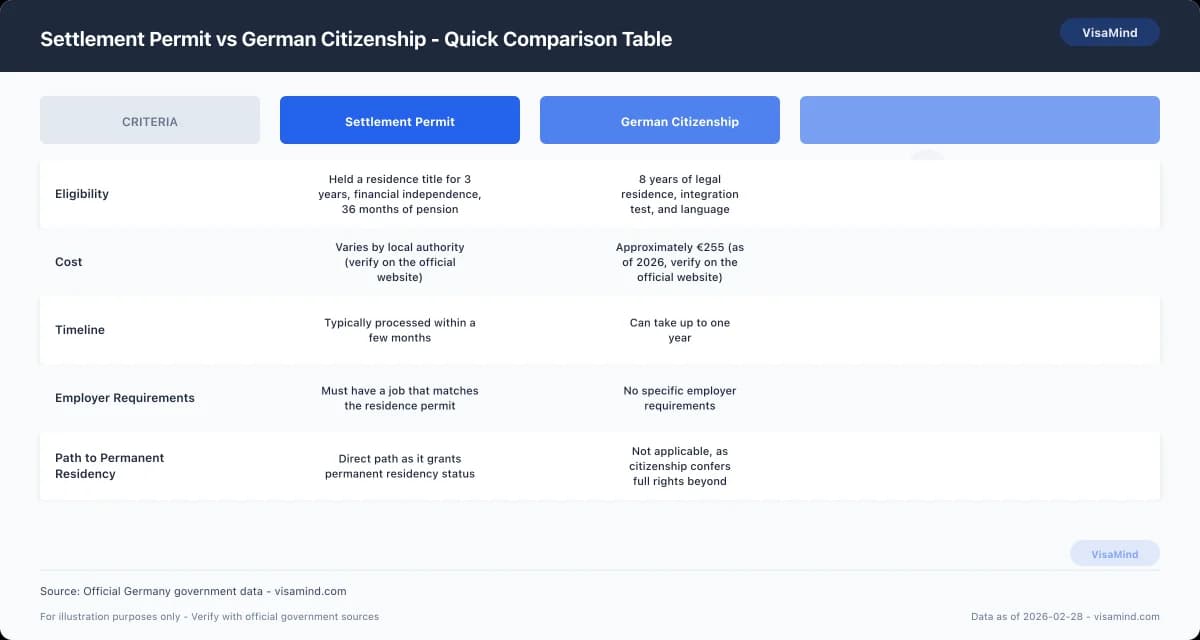
When considering your long-term future in Germany, understanding the differences between a Settlement Permit (Niederlassungserlaubnis) and German Citizenship (Naturalization) is crucial. Below, we provide a side-by-side comparison to help you evaluate which option best suits your needs.
Side-by-Side Comparison
| Aspect | Settlement Permit | German Citizenship |
|---|---|---|
| Eligibility | - Hold a residence title for 3 years (Sections 18a, 18b, 18d, 18g of the Residence Act) <br> - Qualified employment for 27 months <br> - Self-employed for 3 years <br> - Spouse has settlement permit | - Lived in Germany for at least 8 years <br> - Permanent residence status <br> - Integrated into German society |
| Cost | Varies by federal state, typically around €135 | Naturalization fee approximately €255 |
| Timeline | Approximately 3 months for processing | Up to 6 months, depending on individual circumstances |
| Language Requirements | B1 level German language proficiency | B1 level German language proficiency |
| Employer Requirements | None | None |
| Path to Permanent Residence | Direct via the settlement permit | Achieved by obtaining citizenship |
Eligibility Requirements
To be eligible for a Settlement Permit, you must have held a residence title under specific sections of the Residence Act and meet employment or self-employment criteria. In contrast, obtaining German Citizenship requires a minimum residency period of eight years, alongside demonstrating integration into German society.
Cost Considerations
While the cost for securing a Settlement Permit can vary, it generally starts at around €135, depending on the specifics of your situation and the federal state. Meanwhile, the fee for German Citizenship is typically higher, approximately €255, reflecting the comprehensive nature of the citizenship process.
Timeline for Processing
The processing timeline for a Settlement Permit is usually around three months, as long as all documentation is in order. However, obtaining German Citizenship can take up to six months, given the thorough evaluation required for naturalization. For a detailed breakdown of timelines, you can refer to our Processing Times guide.
Important: Ensure all language proficiency and documentation requirements are met to avoid delays. Missing proof of language skills or failing to demonstrate sufficient living space can significantly hinder your application process.
Employer Requirements and Path to Permanent Residence
Neither the Settlement Permit nor German Citizenship imposes specific employer requirements. However, the path to permanent residence is directly linked to obtaining a Settlement Permit, while German Citizenship grants the full rights of a German national, including an EU passport and voting rights.
For further insights into your options, consider exploring the Settlement Permit and German Citizenship visa types to determine which aligns best with your long-term goals in Germany.
When to Pick the First Option
#An IT professional from India has been living in Germany for three years on a Skilled Worker Visa under Section 18b of the Residence Act. Over this period, they have been in qualified employment and consistently contributed to the statutory pension insurance scheme. They wish to secure a more permanent status but are not yet ready to renounce their Indian citizenship.
Given their stable employment history and contributions to the pension scheme, they decide to apply for a Settlement Permit (Niederlassungserlaubnis). They make an appointment with their local Ausländerbehörde (foreigners' authority) to lodge their application. After submitting proof of their employment, pension contributions, and German language skills at level B1 of the CEFR, they successfully obtain their settlement permit within a few months. This status allows them to live and work in Germany indefinitely without losing their original nationality.
Scenario: Self-Employed Entrepreneur Looking for Stability
An American entrepreneur has been living in Germany for three years with a residence title that permits self-employment. She has successfully run a small tech startup during this time and consistently met the financial requirements for her residence status. Seeking stability in Germany but not ready to become a German citizen, she considers applying for a settlement permit.
As her business has been operational and compliant with all legal requirements, she gathers the necessary documentation, including proof of her business's financial health and her statutory pension contributions. She schedules an appointment with the local Ausländerbehörde to discuss her eligibility. After reviewing her case, the authorities grant her the settlement permit. This allows her to plan long-term business strategies in Germany without the pressure of regular visa renewals.
Scenario: Family Reunion and Permanent Residence
A Brazilian software engineer, residing in Germany under the EU Blue Card, has been living with his spouse, who holds a settlement permit for skilled workers under Section 18c of the Residence Act. Desiring to establish deeper roots in Germany and provide stability for their family, they consider applying for a settlement permit for themselves.
Given that the spouse already holds a settlement permit, the engineer is eligible to apply for their own, having met other criteria like employment duration and pension contributions. After attending an appointment at the Ausländerbehörde and presenting the necessary documentation, the engineer receives the settlement permit. This move secures their family's future in Germany while allowing them to maintain their Brazilian citizenship.
Choose Option B If...
#A software developer who has been working in Germany for over two years under the Skilled Worker Visa considers the next steps for permanent residence. Having fulfilled the employment requirements and contributed to the statutory pension insurance scheme, they decide to apply for a Settlement Permit (Niederlassungserlaubnis). They visit their local Ausländerbehörde (foreigners' authority) to make an appointment and gather necessary documents, such as proof of German language skills at level B1 and evidence of sufficient living space. After successfully lodging their application, they receive the Settlement Permit within a few months, securing their ability to reside permanently in Germany.
Scenario: Researcher Opts for German Citizenship
An international researcher has been residing in Germany on a Researcher Visa for several years, conducting significant work in their field. With a strong desire to integrate more fully into German society, they decide to pursue German citizenship. After ensuring they meet all the necessary residency and language requirements, they approach the Bundesamt für Migration und Flüchtlinge (BAMF) to begin the naturalization process. The researcher prepares documentation to demonstrate their integration, including language proficiency and civic knowledge. After a detailed application process, including interviews and assessments, they are granted German citizenship, allowing them to enjoy full rights and responsibilities as a German national.
Scenario: Self-Employed Entrepreneur Chooses Settlement Permit
A self-employed entrepreneur, running a successful tech startup in Berlin, holds a valid residence title for self-employment. After three years of business operation, they decide to apply for a Settlement Permit to secure their long-term future in Germany. They make an appointment with the local Ausländerbehörde to discuss eligibility under the self-employment category. With comprehensive business records, proof of financial stability, and contributions to the statutory pension scheme, their application proceeds smoothly. Within a few months, they receive the Settlement Permit, providing them with permanent residency status and the peace of mind to continue growing their business in Germany.
Key Differences Explained
#When considering your long-term future in Germany, you'll need to decide between a Settlement Permit (Niederlassungserlaubnis) and German Citizenship (Naturalization). Understanding the key differences between these two options can help you make an informed decision. Here, we'll explore the most important differentiating factors: legal rights and obligations, eligibility requirements, and the application process.
Legal Rights and Obligations
One of the most significant differences between a Settlement Permit and German Citizenship is the rights and obligations they confer.
-
Settlement Permit: This allows you to live and work in Germany indefinitely and provides access to social services. However, it does not grant you the right to vote in national elections or hold a German passport.
-
German Citizenship: As a citizen, you gain full political rights, including the ability to vote in all elections and run for political office. You also have the right to a German passport, which facilitates travel within the EU. Additionally, German citizens are required to fulfill certain civic duties, such as jury duty if called upon.
Eligibility Requirements
The eligibility requirements for acquiring a Settlement Permit versus German Citizenship are distinct and depend on various factors, including your current residence status and employment history.
-
Settlement Permit:
- You must have held a residence title under Sections 18a, 18b, 18d, or 18g of the Residence Act (AufenthG) for at least three years.
- You need to have been in qualified employment for at least 27 months and contributed to the statutory pension insurance scheme.
- Proficiency in the German language at level B1 of the CEFR is required.
-
German Citizenship:
- Generally, you need to have lived in Germany legally for at least eight years, although this can be reduced to six years under certain conditions, such as completing an integration course.
- Demonstrating sufficient German language skills at level B1 is also necessary.
- You must prove financial independence and not have a criminal record.
Important: The whole application procedure for both options must be conducted in German. It is crucial to ensure that you meet the specific requirements for each pathway before proceeding.
Application Process
The application processes for a Settlement Permit and German Citizenship involve different steps and authorities.
-
Settlement Permit:
- You must make an appointment with your local foreigners' authority (Ausländerbehörde) to apply. This involves providing evidence such as proof of language proficiency and pension contributions.
- For more details on the requirements, visit the Settlement Permit page.
-
German Citizenship:
- Applications are typically filed with the local citizenship authority (Einbürgerungsbehörde). The process includes submitting a variety of documents, such as proof of residence and language skills.
- Check the German Citizenship page for a comprehensive list of requirements.
Choosing between a Settlement Permit and German Citizenship in Germany involves weighing the benefits and responsibilities of each option, as well as assessing your long-term goals and current circumstances. Understanding these key differences can guide you in making the best decision for your future in Germany.
What People Get Wrong
#-
Many people mistakenly believe that simply having resided in Germany for a certain number of years is sufficient for obtaining a Settlement Permit or German Citizenship. In reality, specific requirements must be met, such as holding a residence title under the appropriate sections of the Residence Act (AufenthG) and demonstrating qualified employment or self-employment.
-
Some applicants think that any residence permit, such as a Student Visa or Schengen Visa, counts towards these residency requirements. However, only certain residence titles, like those for skilled workers or EU Blue Card holders, are eligible.
Language and Integration Requirements
-
A common misconception is that basic German language skills suffice for both the settlement permit and citizenship. In fact, proof of language proficiency at level B1 of the CEFR is typically required.
-
Many assume that integration courses are optional. However, successfully completing an integration course can be a crucial step, particularly for those applying for German Citizenship.
Financial and Employment Misunderstandings
-
Some applicants are unaware that they need to provide evidence of contributions to the statutory pension insurance scheme when applying for a settlement permit. This often leads to delays or denials if such proof is not submitted.
-
There is a misconception that any employment in Germany qualifies an applicant for a settlement permit. However, the employment must be qualified, and in some cases, the applicant must have worked for at least 27 months.
Important: Always verify the specific requirements for your residence title and employment status on the Settlement Permit link to ensure eligibility.
Overlooking the Role of Local Authorities
-
Many people mistakenly believe that BAMF handles all aspects of the application process for settlement permits and citizenship. However, while BAMF plays a significant role in asylum and refugee decisions, applications for residence permits, including settlement permits, should be submitted to your local foreigners authority (Ausländerbehörde).
-
Some applicants think the process can be conducted in English. It's crucial to understand that the entire application procedure must be conducted in German, which can be a hurdle for non-German speakers.
Tip: If you're unsure about your eligibility or the application process, consider consulting an immigration attorney or a local advisory service to avoid common pitfalls.
Can You Switch Later?
#Switching from a Settlement Permit (Niederlassungserlaubnis) to German Citizenship or vice versa is an important consideration for many immigrants in Germany. Understanding the processes and requirements can help you make informed decisions about your long-term residency goals.
Can You Upgrade from a Settlement Permit to German Citizenship?
Yes, it is possible to transition from a Settlement Permit to German Citizenship. Generally, you must have held a Settlement Permit for a minimum of eight years. However, this period can be reduced to seven years if you successfully complete an integration course, or even six years if you demonstrate exceptional integration, such as advanced German language proficiency.
Key Requirements for Naturalization:
- Residence Duration: Minimum of 8 years (or less with integration achievements)
- Language Skills: Proof of German language skills at level B1 of the CEFR
- Financial Stability: Evidence of financial self-sufficiency without social welfare
- Civic Knowledge: Pass the naturalization test covering German laws and culture
Transitioning from German Citizenship to a Settlement Permit
Switching from German Citizenship back to a Settlement Permit is not straightforward, as citizenship is typically considered a permanent status. However, if you renounce your German citizenship or lose it under specific circumstances, you may need to apply for a residence title anew, potentially starting with a different type of visa like the Skilled Worker Visa or the Blue Card EU.
Important: Once you obtain German Citizenship, your Settlement Permit becomes invalid. Ensure you understand the implications of renouncing citizenship, as regaining it can be challenging.
Considerations for Switching
- Language and Integration: Investing in language and integration courses can expedite the naturalization process.
- Employment and Finances: Maintain qualified employment and financial independence to meet both permit and citizenship requirements.
- Legal Advice: Consulting with legal experts or the local foreigners' authority can provide personalized guidance based on your specific situation.
For further details on timelines and application specifics, you may refer to the Processing Times Guide and the Documents Checklist.
Who Chose What and Why
#Maria, an IT specialist from Brazil, had been living in Germany for three years on a Skilled Worker Visa. She enjoyed her life in Germany and appreciated the career opportunities it provided. Having met the eligibility criteria, Maria decided to apply for a Settlement Permit to secure her long-term residence. She gathered her documents, including proof of her German language proficiency at the B1 level and her contributions to the statutory pension insurance scheme. Maria made an appointment at her local Ausländerbehörde (foreigners' authority) to submit her application. After a few months of processing, she received her Settlement Permit, allowing her to remain in Germany indefinitely and providing a sense of security and stability.
Scenario: Researcher Pursues German Citizenship
Dr. Ahmed, an Egyptian biologist, had been working in Germany as an International Researcher under Directive (EU) 2016/801 for several years. He had initially moved to Germany with his family, and they all appreciated the quality of life and educational opportunities available. After fulfilling the residency requirements and integrating into German society, Dr. Ahmed decided to apply for German Citizenship. He contacted his local Ausländerbehörde to understand the naturalization process and ensure compliance with all requirements, such as showing his B1-level German language skills and passing the naturalization test. The process took several months, but ultimately, Dr. Ahmed and his family were granted German citizenship, providing them with expanded rights and the ability to travel freely within the EU.
Scenario: Entrepreneur Chooses Settlement Permit for Stability
Lena, an entrepreneur from Canada, had been residing in Germany on a residence permit for self-employment. After three years of successfully running her business, she was eligible for a Settlement Permit under the self-employment category. Lena valued her ability to work and live in Germany and wanted to secure her status with a more permanent solution. She approached her local foreigners' authority, ensuring all her business documents and financial records were in order. By providing evidence of her successful business operations and fulfilling other necessary requirements, Lena received her Settlement Permit within a few months, allowing her to continue her entrepreneurial journey without residency concerns.
FAQs
What language proficiency is required for German Citizenship compared to a Settlement Permit?
Can EU Blue Card holders apply for German Citizenship directly?
Does a spouse with a Settlement Permit affect your eligibility for German Citizenship?
Is it possible to hold both a Settlement Permit and German Citizenship in Germany?
What employment duration is needed for a Settlement Permit compared to German Citizenship?
What are the main pitfalls when applying for a Settlement Permit vs German Citizenship in Germany?
How does the Federal Office for Migration and Refugees (BAMF) assist in the Settlement Permit vs German Citizenship process?
Sources
Last reviewed: March 1, 2026
VisaMind provides informational guidance only and is not a government agency. This is not legal advice. Requirements can change and eligibility depends on your specific facts. If your case is complex or high-stakes, consult a licensed immigration attorney.
Next steps
Requirements vary by nationality, purpose, timeline, and case details. Use Find My Visa to get a personalized checklist for Germany with official sources and deadlines.
Find my visa