Official sources referenced
What Permanent Residence Grants
#Obtaining German citizenship through naturalization represents a significant step for many individuals residing in Germany. The process is administered by the Federal Office for Migration and Refugees (BAMF), which ensures that applicants meet the necessary criteria for becoming a German national. Naturalization is not just a legal formality; it is an opportunity to fully integrate into German society and embrace the rights and responsibilities that come with citizenship.
What Does Permanent Residence Grant?
Upon successfully obtaining permanent residence status in Germany, you are granted the right to live and work in Germany indefinitely. This status offers a sense of stability and long-term security, enabling you to engage fully in the economic and social life of the country. It also serves as a critical step towards applying for German citizenship through naturalization.
Permanent residence allows you to travel freely within the Schengen Zone, providing greater mobility across Europe. Importantly, it can lead to eventual eligibility for the Settlement Permit, which is an even more secure form of permanent residency.
How Does the Program Work?
The German naturalization process is designed to ensure that applicants are well-integrated into the country. This involves demonstrating adequate proficiency in the German language, having a stable source of income, and showing a commitment to the democratic values enshrined in the German Basic Law. The entire procedure is conducted in German, which reinforces the importance of language proficiency in the integration process.
Eligibility for naturalization typically requires a minimum period of eight years of lawful residence in Germany, although there are exceptions for those who have completed an integration course, potentially reducing this period to seven years. Applicants must also provide evidence of personal and family events, such as birth and marriage certificates, and meet specific legal and political criteria.
Tip: Ensure all your documentation is complete and in order before starting the application process to avoid potential delays.
Navigating the Application Process
The application for naturalization is typically lodged through your local foreigners' authority (Ausländerbehörde). It is essential to gather all necessary documentation beforehand, as missing documents can cause delays. Processing times can vary, so it's advisable to verify the current timeline with the relevant authority.
For those seeking more information on related visa options, such as the Settlement Permit or EU Long Term Residence, these paths also offer insights into achieving stable residency, which can pave the way to citizenship.
Understanding the nuances of obtaining German citizenship through naturalization is critical for a successful application. This high-level overview provides a foundation, with detailed guidance available in related sections of this guide.
Do You Meet the Requirements?
#It's important to ensure you meet several specific requirements. These are designed to confirm your eligibility and readiness for this significant step. Below, we outline the key conditions you need to fulfill.
Residence and Time Requirements
- Minimum Residency: You must have legally resided in Germany for at least eight years. This period can be reduced to seven years if you have successfully completed an integration course.
- Permanent Residency: Holding a permanent residence permit or a right of residence for nationals of EU member states is necessary.
Language Proficiency
- German Language Skills: Demonstrating adequate knowledge of the German language is required. Typically, this means achieving a B1 level according to the Common European Framework of Reference for Languages (CEFR).
Tip: Attending a language course or obtaining a recognized language certificate can help you meet this requirement.
Economic and Social Integration
- Financial Independence: You must be able to support yourself and your family without relying on social welfare benefits.
- No Criminal Record: A clean criminal record is crucial, as any significant legal infringements could affect your eligibility.
Citizenship Test and Loyalty
- Naturalization Test: Passing the naturalization test, which assesses your knowledge of the German legal and social systems, is mandatory.
- Loyalty to the German Constitution: You must declare allegiance to the German constitutional principles and renounce any previous citizenship, unless exceptions apply.
For more detailed guidance on the naturalization process, you can explore related topics such as the Skilled Worker Visa and Settlement Permit Vs Citizenship. These resources can provide additional insights into the pathways to German citizenship.
Important: The entire application process must be conducted in German. Ensure you are prepared to navigate all documentation and communication in the German language.
By meeting these requirements, you position yourself as a candidate for German citizenship, integrating fully into the country's social and legal fabric. Remember to verify any updates or changes to these requirements on the official BAMF website to ensure your application reflects the most current standards.
Application Process
#Eligibility Assessment
Before beginning the naturalization process, you must determine if you qualify for German citizenship through naturalization. Eligibility typically requires continuous legal residence in Germany for at least eight years. Exceptions exist, such as for spouses of German citizens or those demonstrating exceptional integration, which might reduce this period to six years. Ensure you have a valid residence permit, meet language proficiency requirements, and are financially self-sufficient.
Gathering Required Documents
Compile necessary documentation that supports your application. This includes proof of identity, such as a valid passport, and evidence of personal and family events, such as birth and marriage certificates. You should also prepare documents that demonstrate any changes in your legal status, like collective naturalizations during World War II or acquiring foreign nationality. For a comprehensive list, refer to our Documents Checklist.
Application Submission
The entire application process must be conducted in German. Submit your application to the appropriate local authorities (Ausländerbehörde) within Germany or to the Federal Office for Migration and Refugees (BAMF) if you are abroad. Be prepared to provide all necessary documentation and consult with the office on any specific requirements for your eligibility category.
Medical and Police Checks
As part of the naturalization process, you may need to undergo medical examinations and police clearance checks. These procedures ensure you meet public health and safety standards. It's advisable to schedule these checks early to avoid delays in processing your application.
Processing Time
The processing time for naturalization applications can vary. Generally, it ranges from 15 to 60 days, depending on the complexity of your case and workload at the processing location. Verify current processing times with the local authorities or BAMF to manage your expectations. For more information on timelines, visit our Processing Times Guide.
Important: Ensure your application is complete and accurate to avoid unnecessary delays or rejections. Incomplete submissions may lead to extended processing times or denial of citizenship.
Citizenship Decision
Once your application is reviewed, you will receive a decision. Approval means you will be invited to a naturalization ceremony where you will receive your certificate of naturalization. If your application is denied, you may have the right to appeal the decision, depending on the reasons for denial.
By following these steps and ensuring all requirements are met, you can successfully navigate the application process for German citizenship through naturalization. For those who qualify through their ancestry, consider exploring Citizenship by Descent as an alternative pathway.
PR Fees and Timeline
#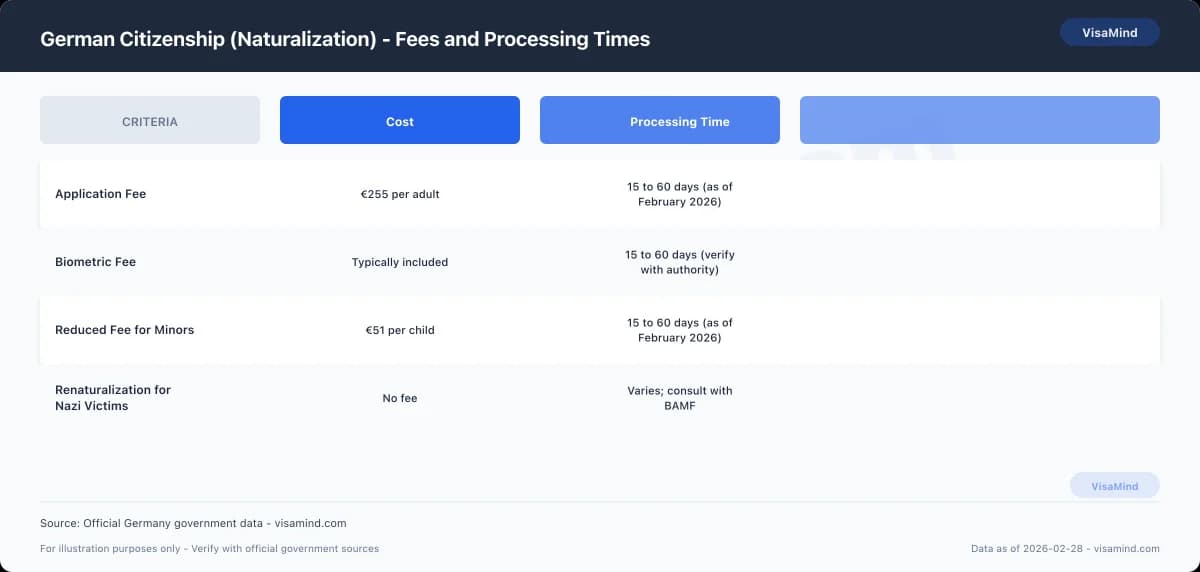
Navigating through the application process for German citizenship via naturalization involves understanding both the costs and the timeline. This section provides a detailed overview of the fees involved and the expected processing times when applying for German citizenship through the Federal Office for Migration and Refugees (BAMF).
Fees for Naturalization
The fees for applying for German citizenship through naturalization are structured to accommodate various applicant categories. Below is a table comparing the fees associated with the process:
| Category | Fee (EUR) |
|---|---|
| Adults | 255 |
| Minors (under 16 years) | 51 |
| Reduced fee for certain cases | Variable (upon application) |
Tip: If you believe you qualify for a fee reduction, contact BAMF for the specific conditions and required documentation.
Processing Timeline
The timeline for processing a naturalization application can vary significantly based on several factors, including the applicant's specific circumstances and the processing location. Below is a general timeline for reference:
| Processing Location | Estimated Timeframe |
|---|---|
| Domestic applications | 15 to 60 days (as of February 2026) |
| Applications from abroad | Longer durations expected |
Important: Processing times may vary. It is advisable to verify current times with the responsible issuing authority.
For those applying from abroad, naturalization is rare and usually requires proof of special interest to the Federal Republic of Germany. This could lengthen the processing period considerably.
By understanding these fees and timelines, you can better prepare for the application process. For further details on the documents required, consult the Documents Checklist guide. Additionally, if you are considering alternative pathways to citizenship, such as Citizenship by Descent, explore the specific requirements linked to your situation.
What PR Gives You
#Establishing permanent residency in Germany through naturalization offers a comprehensive set of rights and obligations. Understanding these benefits and responsibilities is crucial for anyone considering this path to German citizenship.
What Does Permanent Residency Allow You to Do?
Obtaining permanent residency in Germany provides several significant advantages, including the ability to live, work, and travel freely within the country and the European Union.
-
Work and Employment: As a permanent resident, you can work in any profession without restrictions. This flexibility is particularly beneficial for those looking to advance their career or explore new opportunities. Consider exploring options like the Skilled Worker Visa for further career advancement.
-
Travel: Permanent residency grants you the freedom to travel across the Schengen Area without a visa, making it easier to explore other European countries. For more on this, refer to the Schengen Visa requirements.
-
Access to Services: Permanent residents have access to a range of social services, including healthcare, education, and social security benefits. This access ensures a high quality of life and stability for you and your family.
Residency Obligations
While permanent residency comes with numerous benefits, it also entails certain obligations that must be adhered to maintain your status.
-
Residency Requirement: You must maintain a primary residence in Germany. Prolonged absences could jeopardize your status, especially if you plan to be away for more than six months.
-
Language Proficiency: Proficiency in the German language is necessary, not only to fulfill residency conditions but also to integrate into society effectively. The entire naturalization process must be conducted in German, underscoring the importance of language skills.
-
Integration Course: In some cases, attending an integration course might be required to help you understand German laws, culture, and language better.
Important: If you plan to stay outside Germany for an extended period, ensure that you understand the conditions under which your residency status might be at risk. You can explore more about the EU Long Term Residence for added flexibility in living across the EU.
Understanding these rights and obligations is essential for making an informed decision about pursuing permanent residency in Germany. For more detailed requirements, consult our Documents Checklist Guide.
Situations That Need Expert Guidance
#Permanent residence applications are high-stakes and often involve years of accumulated eligibility. Mistakes can mean starting over for Germany immigration. Consider professional help if:
- You are applying from inside the country with a complicated status history
- Your points calculation is borderline or involves credential recognition
- You have a prior visa denial or refusal
- You have a prior overstay, unlawful presence, or removal order
- You have a criminal record, arrest history, or pending charges
- You have a prior misrepresentation or fraud finding
- You are in removal or deportation proceedings
Keeping Your PR
#Maintaining your Permanent Residence (PR) status in Germany is crucial for those on the path to naturalization. Understanding the physical presence requirements, renewal process, and the risks of losing your status will help you navigate this stage effectively.
Physical Presence Requirements
To maintain your PR status in Germany, you generally need to reside in the country for a significant portion of the year. This is a key requirement for those aiming to apply for German Citizenship through naturalization. The exact number of days you must be physically present can vary based on your specific circumstances and visa type.
Important: If you plan to be outside Germany for an extended period, consult the Visa Extension Guide to ensure compliance with your PR requirements.
Renewal Process
Your PR status does not automatically renew. You must actively ensure your residence permit or other documentation remains valid. Typically, this involves verifying your continued eligibility and submitting necessary documentation to your local Ausländerbehörde (foreigners' authority).
- Steps to Renew:
- Confirm your current status and any updates required with the Ausländerbehörde.
- Gather necessary documents, such as proof of residence and employment.
- Submit your renewal request well before your permit's expiration date.
For detailed steps and document requirements, refer to the PR Pathway Guide.
Losing PR Status
Failure to meet certain criteria can result in the loss of your PR status. Key factors include prolonged absence from Germany and non-renewal of residence permits. If you lose your original certificate of naturalization, note that it will not be reissued, which can complicate your status verification.
- Reasons You Might Lose PR:
- Staying outside Germany for more than six consecutive months without permission.
- Failing to renew your residence permit on time.
- Losing essential documentation like your certificate of naturalization.
Tip: Always keep digital and physical copies of vital documents. In case of loss, contact the issuing authority immediately for guidance.
Understanding these elements will help ensure that you maintain your PR status in Germany, keeping you on track for potential citizenship through naturalization. For more information on the citizenship process, explore the Citizenship Descent pathway if applicable.
Path to Citizenship
#German citizenship through naturalization is a structured process with specific requirements and timelines. To be eligible for naturalization, you typically need to have lived in Germany for at least eight years with a valid residence permit. This period can be reduced to seven years if you complete an integration course, or even six years for exceptional integration into German society, such as demonstrating advanced German language skills.
What Are the Key Requirements?
To apply for naturalization, you must fulfill several requirements. These include:
- Legal Residence: You must have had a legal residence in Germany for the required period.
- Language Proficiency: Demonstrating adequate knowledge of the German language is crucial, generally at the B1 level of the Common European Framework of Reference for Languages (CEFR).
- Financial Stability: You should be able to support yourself and your family without relying on public benefits.
- Civic Knowledge: Passing a naturalization test that assesses your understanding of German laws, culture, and society is mandatory.
- No Criminal Record: A clean criminal record is essential.
- Declaration of Loyalty: You must express allegiance to the democratic principles of the Basic Law of Germany.
What Is the Application Process?
The application process for naturalization is conducted entirely in German, so proficiency in the language is key. It involves several steps:
- Gather Required Documents: Compile evidence of personal and family events such as birth and marriage certificates, proof of language proficiency, and a clean criminal record.
- Submit an Application: Lodge your application with the local Ausländerbehörde or foreigners' office.
- Attend an Interview: You may be required to attend an interview to discuss your application and demonstrate your integration into German society.
- Receive a Decision: Processing times can vary. It's essential to verify current processing times with the local authority.
Important: All procedures must be carried out in German. Failure to meet this requirement can result in delays or rejection of your application.
How Long Does the Process Take?
The processing time for naturalization applications can range from several months to over a year, depending on individual circumstances and the local authority's workload. As of 2026, it's crucial to verify the processing time with your local authority to ensure you have the most accurate and current information.
For those interested in exploring other residence options, such as the Blue Card EU or Family Reunion Visa, understanding the naturalization process can also provide insights into the pathway to permanent residency and eventual citizenship in Germany.
Maintaining PR Status
#Maintaining your Permanent Residency (PR) status in Germany is vital for ensuring your pathway to German citizenship through naturalization remains open. Below are essential guidelines and procedures to follow:
PR Card Renewal and Re-entry Permits
To maintain your PR status, it is crucial to ensure your residency permit is valid. Renew your PR card before it expires to avoid complications. If you plan to leave Germany for an extended period, consider applying for a re-entry permit. This permit allows you to maintain your PR status while abroad.
- Renewal: Begin the renewal process several months before your PR card expires.
- Re-entry Permits: Apply if you plan to be outside Germany for more than six months.
Residency Obligation Compliance
To remain eligible for naturalization, you must comply with residency obligations. This typically means residing in Germany for a significant portion of each year. Long absences without a re-entry permit can jeopardize your PR status.
Important: If you reside outside Germany for more than six months without permission, you risk losing your PR status.
Evidence and Documentation
Consistent documentation is vital. Retain evidence of your residence in Germany, including rental contracts, utility bills, and employment records. These documents may be required to prove your continuous residence when applying for naturalization.
- Required Documents:
- Rental agreements
- Utility bills
- Employment records
For more information on maintaining your PR status and transitioning to citizenship, explore Permanent Residence and PR Pathway Guide. Additionally, understanding the differences between Settlement Permit Vs Citizenship can provide clarity on your long-term residency options.
Application Weaknesses
#It is crucial to ensure that your application is comprehensive and accurate. Failing to address certain aspects can lead to delays or even denial. Below are some common weaknesses in applications and tips on how to avoid them.
Points Miscalculation
Applicants must meet specific criteria, such as residency duration, language proficiency, and financial stability, which contribute to the overall eligibility points. Miscalculating these points can lead to ineligibility.
- Residency Requirement: Ensure you have lived in Germany legally for the required number of years, typically 8 years, though this can be reduced to 7 with completion of an integration course.
- Language Proficiency: A B1 level in German is generally required. Provide official language certificates as proof.
- Financial Stability: Demonstrate financial independence without reliance on social welfare benefits.
Tip: Use the How To Apply guide for detailed eligibility criteria that might affect your points calculation.
Incomplete Clearances
The application process involves various clearances to verify your background. Missing documents or incorrect information can halt the process.
- Criminal Record Check: Ensure you have a clean record. Convictions can impact eligibility.
- Tax Clearances: Provide evidence of compliance with tax obligations in Germany.
- Health Insurance: Proof of adequate health insurance coverage is mandatory.
Misrepresentation
All information provided must be truthful and verifiable. Misrepresentation can result in application denial or even future legal consequences.
- Personal Details: Double-check all personal information for accuracy.
- Family Events: Accurately report significant events such as marriages or adoptions.
- Political or Legal Developments: Disclose any political affiliations or legal issues that may affect your application.
Important: Conduct the entire process in German. Failure to do so can result in the rejection of your application.
Additional Resources
For those considering the broader journey from permanent residence to citizenship, the Settlement Permit Vs Citizenship guide provides valuable insights. Additionally, if you're exploring various visa types that might eventually lead to naturalization, consider reviewing options like the Blue Card EU or the Schengen Visa.
By thoroughly preparing your application and addressing the potential weaknesses highlighted above, you can enhance your chances of a successful naturalization process.
Next steps
#Use Find My Visa to build a sequenced plan with official sources and deadlines.
VisaMind provides informational guidance only and is not a government agency. This is not legal advice. Requirements can change and eligibility depends on your specific facts. If your case is complex or high-stakes, consult a licensed immigration attorney.
Next steps
Requirements vary by nationality, purpose, timeline, and case details. Use Find My Visa to get a personalized checklist for Germany with official sources and deadlines.
Find my visa