On this page
- What This Work Visa Offers
- Qualification Criteria
- Employer Obligations
- Application Process
- Filing Fees and Wait Times
- Conditions and Portability
- Dependents
- When Self-Preparation Isn't Enough
- Path to Permanent Residence
- How to Renew
- Common Petition Challenges
- Required forms
- Related visa types
- Related guides
- Related goals
- Next steps
Official sources referenced
What This Work Visa Offers
#The Skilled Worker Visa is a crucial pathway for skilled workers from non-EU countries looking to establish a career in Germany. Managed by the Federal Office for Migration and Refugees (BAMF), this visa is part of the Skilled Immigration Act, allowing qualified individuals to obtain a residence permit for employment purposes in Germany.
What Does This Visa Offer?
The Skilled Worker Visa offers a streamlined process for individuals whose qualifications are recognized in Germany, thereby facilitating their entry into the German workforce. This visa is specifically designed to address the needs of the local labor market by attracting skilled professionals in various sectors. With the Skilled Worker Visa, you can reside in Germany while contributing to its economy, working in roles that require your specific expertise.
Who Can Apply?
To be eligible, you must be a skilled worker with qualifications that meet the standards set by German authorities. This often means that your educational credentials need to be recognized as equivalent to German qualifications. If you're unsure about the recognition status of your qualifications, you may need to start with a Qualification Recognition process. Additionally, you'll need to provide comprehensive documentation, including proof of your skills and qualifications, as part of your application.
Duration and Processing Times
The Skilled Worker Visa allows for an initial stay of up to 180 days, with opportunities for extension based on employment status and other conditions. Processing times can vary significantly, typically ranging from 15 to 60 days, depending on your category and location of application. It's advisable to verify the current processing times with the issuing authority, especially as these can fluctuate based on demand and administrative workloads.
Tip: Be thorough in gathering and presenting all necessary documents to avoid delays. Missing documents can lead to longer processing times or even rejection of your application.
Related Visa Options
While the Skilled Worker Visa is a popular choice for many professionals, other visa options may better suit different circumstances. For instance, the EU Blue Card is another avenue for highly skilled workers, particularly those with higher income prospects. Alternatively, the Job Seeker Visa allows you to enter Germany while searching for employment opportunities.
The Skilled Worker Visa is a pivotal component of Germany’s strategy to attract global talent, ensuring that skilled professionals can contribute effectively to the country’s economic landscape. By offering a clear path to employment and residence, it supports Germany's commitment to fostering a diverse and skilled workforce.
Qualification Criteria
#Germany's Skilled Worker Visa, governed by the Federal Office for Migration and Refugees (Bundesamt für Migration und Flüchtlinge, BAMF), facilitates employment for skilled workers from non-EU countries. To qualify, applicants must meet specific criteria related to job offers, qualifications, and salary thresholds.
Job Offer Requirements
- Valid Job Offer: You must have a concrete job offer from a German employer before applying.
- Relevant Position: The job must correspond to your professional qualifications and skills.
- Employment Contract: An employment contract or binding job offer is necessary to demonstrate the terms of employment.
Qualification Criteria
- Recognized Qualifications: Your professional qualifications must be recognized in Germany. You can check this through the Qualification Recognition process.
- Skilled Occupations: The position offered should be in a field recognized as requiring specialized qualifications. This often includes engineering, IT, healthcare, and other technical fields.
Important: Ensure that your qualifications are assessed and recognized by the appropriate German authorities before applying for the visa.
Salary Thresholds
- Minimum Salary: You must meet the minimum salary requirement, which varies depending on the field and location in Germany. For high-demand professions, the minimum might be adjusted. Verify these details on the official website as they are subject to change.
- Comparable Wages: The salary offered should be comparable to wages paid to German employees in similar positions.
Labor Market Considerations
- Priority Check: In some cases, the German Federal Employment Agency (Bundesagentur für Arbeit) might conduct a labor market test to ensure no suitable German or EU candidate is available for the job. However, this is often not required for positions in shortage occupations.
- Employment Conditions: The job must offer conditions similar to those for German nationals, ensuring a fair and equitable work environment.
For those considering alternative pathways or seeking further information, comparing the Blue Card EU and Job Seeker Visa options may be beneficial. These visas cater to different circumstances and may offer more suitable opportunities depending on your professional background and goals.
Tip: If you're unsure about the recognition of your qualifications or the salary thresholds, consult the Documents Checklist for detailed guidance on documentation and requirements.
Employer Obligations
#When sponsoring a worker for a Skilled Worker Visa in Germany, employers must fulfill specific obligations. These responsibilities align with the Skilled Immigration Act and ensure compliance with German immigration laws. Firstly, employers need to verify that the applicant's qualifications are recognized in Germany, which is crucial for the visa application process. Employers must also ensure that the job offer matches the skills and experience of the candidate.
Moreover, employers are typically required to provide a written job offer and contract that specifies the terms of employment. This contract should meet the standard employment criteria set forth by German labor laws.
Sponsorship Duties
Employers sponsoring a skilled worker must adhere to several duties to maintain compliance:
- Verify Qualifications: Ensure that the applicant’s qualifications are recognized in Germany.
- Provide a Job Contract: Offer a clear and legally compliant job contract.
- Maintain Records: Keep thorough records of the employee's work status and visa conditions.
Important: Employers should regularly check the status of their sponsored employee's visa and ensure that any changes in employment conditions are reported to the local foreigners' authority (Ausländerbehörde).
Financial and Compliance Responsibilities
Employers are responsible for certain costs and compliance measures. These include:
- Covering Visa Costs: Employers might be required to pay for visa application fees or associated costs.
- Compliance with Labor Laws: Ensure that the employment conditions comply with German labor standards.
- Assisting with Accommodation: While not mandatory, employers often assist in finding accommodation to ease the transition for the new employee.
Can You Change Employers?
While on a Skilled Worker Visa, changing employers is possible but involves several steps. The new employer must fulfill the same obligations as the original sponsor, including verifying qualifications and providing a compliant job contract. Additionally, the change must be reported to the Ausländerbehörde.
Tip: If you are considering a change in employment, consult the Visa Extension Guide for details on maintaining your visa status during the transition.
By understanding these employer obligations, both employers and skilled workers can better navigate the requirements of the German immigration system.
Application Process
#The Skilled Worker Visa process in Germany involves a dual-track approach, combining both employer and worker responsibilities. This structured system ensures that skilled workers from non-EU countries can effectively transition to employment in Germany under the Skilled Immigration Act. Below is a detailed breakdown of the application process:
Employer Responsibilities
-
Job Offer and Contract: The employer in Germany must first provide a formal job offer or employment contract to the prospective skilled worker. This document should clearly outline the job role, salary, and other employment conditions.
-
Recognition of Qualifications: Employers should verify that the candidate's qualifications are recognized in Germany. This often involves a formal recognition process, which can be initiated through the Qualification Recognition portal.
-
Submission to Local Employment Agency: The employer may need to submit the job offer to the local employment agency (Arbeitsagentur) for approval, particularly to ensure compliance with labor market regulations.
Tip: Engaging a legal or HR specialist familiar with German immigration laws can streamline the employer’s part of the application process.
Worker Application Process
-
Gather Necessary Documents: Prospective skilled workers must gather essential documents, including proof of qualifications, a valid passport, and possibly a motivation letter. Refer to the Documents Checklist for a detailed list of required items.
-
Lodge Application at German Embassy: Applicants should submit their visa application at the German embassy or consulate in their country of residence. This step involves filling out the visa application form and paying any associated fees.
-
Attend an Interview: As part of the application, an interview at the embassy may be required. This is an opportunity for applicants to demonstrate their qualifications and intent. Preparation tips can be found in our Interview Prep guide.
Processing and Approval
-
Processing Time: The processing time for the Skilled Worker Visa can vary. As of February 2026, it generally ranges from 15 to 60 days. Applicants are advised to verify current processing times on the official website.
-
Notification of Outcome: Once the application is processed, applicants will be notified of the outcome. If approved, they will receive a visa that allows entry into Germany to commence work.
Important: Submitting incomplete applications or missing required documents can delay the process or result in a denial. Ensure all sections are completed accurately.
Additional Considerations
-
Alternative Visa Options: Depending on your qualifications and job offer, you might also consider the Blue Card EU for highly skilled positions or the Job Seeker Visa if seeking employment opportunities in Germany.
-
Residence Permit: Upon arrival in Germany, securing a residence permit from the local foreigners' authority (Ausländerbehörde) is crucial. This permit will validate your stay for employment purposes.
Navigating the Skilled Worker Visa process requires careful coordination between the employer and the applicant. By following the outlined steps and ensuring all requirements are met, skilled workers can successfully transition to employment in Germany.
Filing Fees and Wait Times
#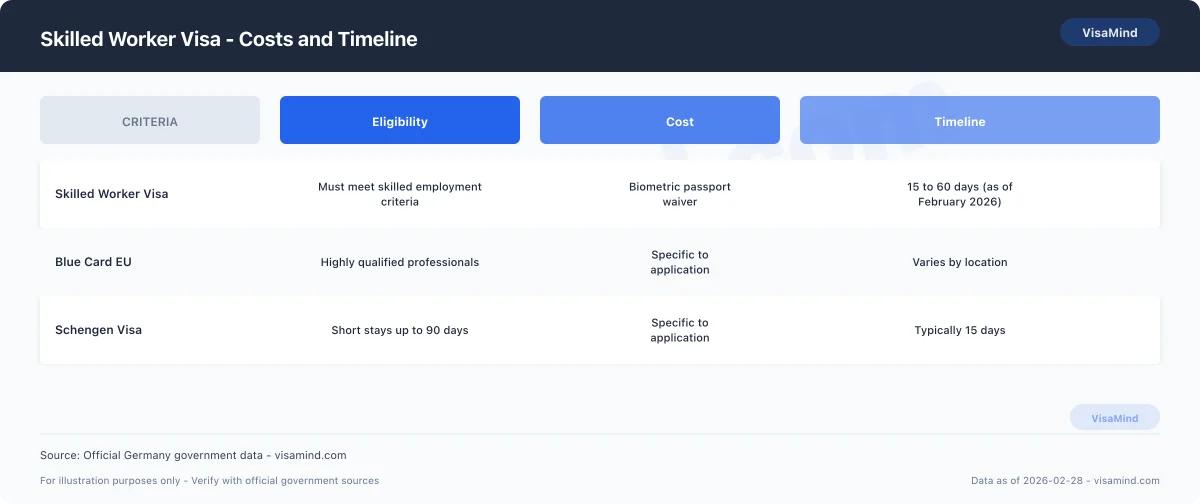
Understanding the associated costs and expected wait times is crucial for effective planning. The Federal Office for Migration and Refugees (BAMF) is responsible for issuing these visas. Below, you'll find a breakdown of relevant details regarding filing fees and typical processing timelines.
Filing Fees and Processing Timelines
| Visa Type | Eligibility Requirements | Cost (EUR) | Typical Timeline |
|---|---|---|---|
| Skilled Worker Visa | Recognized qualifications in Germany | €75 | 15 to 60 days (as of February 2026) |
| EU Blue Card | High qualifications and employment with a certain salary | €100 | 4 to 8 weeks |
| Job Seeker Visa | University degree recognized in Germany | €75 | 4 to 6 weeks |
Important: Processing times can vary based on your country of origin and the specific German embassy or consulate handling your application. Always verify the most current processing times with the Federal Foreign Office.
Premium Processing Options
Currently, there are no expedited or premium processing options available for the Skilled Worker Visa through BAMF. Applicants must plan their application timelines accordingly, especially considering the typical processing period ranges from 15 to 60 days. For those who require faster entry to Germany, exploring alternative visa options such as the EU Blue Card may prove beneficial, as it can sometimes offer more expedited processing depending on the applicant's qualifications and job offer details.
Additional Considerations
-
Document Preparation: Ensure all required documents, including proof of qualifications and personal identification, are complete and accurate. Missing documents or errors can lead to delays or refusals.
-
Verification of Qualifications: Before applying, confirm that your qualifications are recognized in Germany, as this is a critical component of the Skilled Worker Visa eligibility.
For further guidance on preparing your application, visit our How To Apply guide, and make sure to consult the Documents Checklist for detailed requirements.
Tip: To manage expectations and reduce stress, start your application process well in advance of your planned move date. This will allow ample time for any unforeseen issues that may arise.
Conditions and Portability
#The Skilled Worker Visa allows non-EU nationals with recognized qualifications to work in Germany under the Skilled Immigration Act. However, it is essential to understand the conditions regarding job changes and the portability of this visa.
Can You Change Employers?
Once you have obtained the Skilled Worker Visa, you are generally tied to the employer and the job specified in your application for an initial period. This period is typically 180 days. During this time, you must remain with the employer who sponsored your visa to ensure compliance with your residence permit conditions.
After the initial 180-day period, changing employers is possible, but it requires prior approval from the local Ausländerbehörde (foreigners' office). You will need to demonstrate that your new job offer aligns with your qualifications and that the new employer fulfills similar sponsorship conditions.
Important: Always consult with the Ausländerbehörde before making any employment changes to avoid jeopardizing your residence status.
What Are the Portability Provisions?
The Skilled Worker Visa provides some degree of portability, allowing you to change jobs within Germany after the initial lock-in period, provided that your new position also requires your specific skills and qualifications. This ensures that your transition between employers does not lead to a breach of your visa conditions.
Here are key points to consider:
- New Job Requirements: The new job must be in the same field or require the qualifications you initially used to obtain the visa.
- Employer Compliance: The new employer must meet the requirements set under the Skilled Immigration Act.
- Approval Process: You need to apply for a change with the Ausländerbehörde, providing evidence of employment and necessary qualifications.
Comparisons with Other Visas
While the Skilled Worker Visa offers some flexibility, it is essential to compare it with other options like the Blue Card EU. The Blue Card EU often provides broader mobility within the EU and may have different employer change requirements. For those still exploring options, the Job Seeker Visa allows individuals to enter Germany to search for a job in the first place, without a specific employer lock-in.
Tip: If you plan to change employers or job roles frequently, consider whether the Blue Card EU might offer more flexibility for your career goals.
Understanding these conditions and portability provisions ensures you can navigate your employment opportunities in Germany effectively, maintaining your residence status while pursuing your professional goals.
Dependents
#When applying for a Skilled Worker Visa in Germany, understanding the options available for your dependents is essential. Here’s what you need to know about bringing your spouse and children with you and their rights while in Germany.
Spouse Visa Options
- Eligibility: Your spouse can accompany you to Germany, provided that you hold a valid residence permit under the Skilled Immigration Act.
- Application Process: The application for a spouse visa is typically lodged at a German consulate in your home country, handled by the Federal Foreign Office (Auswärtiges Amt).
- Language Requirement: In some cases, a basic knowledge of German (A1 level) may be required for the spouse, though exceptions exist.
Children's Visa Options
- Eligibility: Dependent children under 18 years can join you in Germany. You must have adequate living space and financial resources to support them.
- Education and Schooling: Children have the right to attend public schools in Germany, which are tuition-free.
Work Rights for Dependents
- Spouse Employment: Once in Germany, your spouse is generally allowed to work without restrictions, enabling them to seek employment or pursue self-employment opportunities.
- Children’s Rights: While minor children cannot work, they can engage in educational and recreational activities.
Important Considerations
Important: Ensure that all documents required for dependents, such as proof of relationship and living arrangements, are complete to avoid delays. Missing documents can result in application setbacks.
For more information on related visas, you might consider exploring the Family Reunion Visa or comparing options like the EU Blue Card which may offer additional benefits for dependents. Always verify the latest requirements and processing times on the official websites or with the relevant authorities.
When Self-Preparation Isn't Enough
#Work visa petitions involve both you and your employer for Germany immigration. If the case is straightforward, this guide covers what you need. But professional help is worth considering if:
- Your employer has a complex corporate structure (staffing agency, multinational, franchise)
- You are changing employers mid-petition or mid-status
- You have a prior visa denial or refusal
- You have a prior overstay, unlawful presence, or removal order
- You have a criminal record, arrest history, or pending charges
- You have a prior misrepresentation or fraud finding
- You are in removal or deportation proceedings
Path to Permanent Residence
#Obtaining a Skilled Worker Visa in Germany is a significant step towards achieving permanent residence. Once you secure this visa, you are granted a residence permit, which allows you to work and live in Germany. The path to permanent residency is streamlined for skilled workers, especially under the provisions of the Skilled Immigration Act. After a certain period of continuous employment and residence, you may be eligible to apply for a Settlement Permit, which is Germany’s version of permanent residency.
Duration and Eligibility
To transition from a Skilled Worker Visa to permanent residency, you typically need to hold a residence permit for employment purposes for a minimum of four years. During this time, you must demonstrate stable employment, integration into German society, and sufficient language skills. Having qualifications recognized in Germany is a prerequisite for the initial visa and continues to be relevant for your permanent residency application.
Permanent Residence Requirements
To apply for a Settlement Permit, you must meet several critical requirements:
- Continuous Residence: You must have lived in Germany for at least four years under the Skilled Worker Visa.
- Secure Employment: Proof of stable income and employment is crucial. The income should be sufficient to support yourself without relying on public funds.
- Language Proficiency: A minimum of B1 level in German language proficiency is often required.
- Integration Course: Completion of an integration course, if applicable, can be beneficial and sometimes mandatory.
For more detailed information on the Settlement Permit, you might find it helpful to explore the Settlement Permit page.
Fast-Track Options
In some cases, there are fast-track options available. For example, if you hold an EU Blue Card, you might qualify for a Settlement Permit after just 33 months. This period can be further reduced to 21 months if you demonstrate a higher level of German proficiency.
Tip: Consider enrolling in language courses early to improve your chances of meeting language requirements and integrating successfully into German society.
The path from a Skilled Worker Visa to permanent residency is a structured process that encourages skilled workers to establish a long-term presence in Germany. For further guidance, consult our PR Pathway Guide for detailed steps and advice.
How to Renew
#To renew your Skilled Worker Visa in Germany, understanding the process and timeline is crucial. Here’s what you need to know to ensure a seamless transition.
Eligibility for Renewal
Before initiating the renewal process, confirm that you meet the necessary criteria:
- You must continue to be employed in a position that requires your recognized qualifications.
- Your employment contract should remain valid for the duration of the renewal.
- Ensure that your professional qualifications are still recognized in Germany.
Timeline and Process
The renewal application should be lodged with the local Ausländerbehörde (foreigners' authority) in Germany. It's advisable to start the renewal process early. Typically, the application should be submitted at least 60 days before your current visa expires.
- Gather Necessary Documents: Prepare updated proof of employment, proof of qualifications, and any other required documentation.
- Schedule an Appointment: Contact your local Ausländerbehörde to schedule an appointment for your renewal application.
- Application Submission: Present your documents and application at your scheduled appointment.
Important: Processing times can vary, but expect it to take between 15 to 60 days. Verify current processing times on the Processing Times guide.
Extensions and Re-filing
If you miss the renewal deadline or if your circumstances change, you may need to re-file your application. In such cases:
- Ensure your employment is still valid and aligns with the Skilled Immigration Act.
- Be prepared to provide additional documentation if requested by the Ausländerbehörde.
Tip: Consider consulting the Visa Extension Guide for detailed advice on managing extensions and re-filings efficiently.
For those exploring other opportunities, it might be worthwhile to look into related visas, such as the EU Blue Card or Job Seeker Visa, which may offer alternative pathways for skilled professionals in Germany.
Common Petition Challenges
#Navigating the application process for a "Skilled Worker Visa" in Germany involves several key challenges. Understanding these common issues can help you better prepare your application for submission to the Federal Office for Migration and Refugees (BAMF).
Occupation-Qualification Alignment
One of the main hurdles is ensuring that your qualifications align with the occupation you are applying for. Germany requires that your educational and professional credentials be recognized and relevant to the job you intend to perform. This ensures that you meet the criteria set by the Skilled Immigration Act. You may need to undergo a credential recognition process to confirm that your qualifications are equivalent to German standards. For more information on this process, you can refer to the Qualification Recognition form.
Wage Compliance
Another critical aspect is meeting the wage compliance requirements. Germany has specific salary thresholds that skilled workers must meet to be eligible for the visa. These thresholds are designed to ensure that foreign workers are paid in line with local labor market standards. It is essential to verify with your employer that your proposed salary meets these requirements. In some cases, aligning with the Blue Card EU salary criteria might be beneficial if your profession qualifies.
Credential Mismatch
Credential mismatch can occur when there is a discrepancy between your qualifications and the job requirements in Germany. This issue can lead to delays or even rejection of your visa application. It's crucial to ensure that all documents, including diplomas and certificates, are correctly translated and recognized. For assistance, you might explore the Documents Checklist guide for a comprehensive list of required documents.
Important: Submitting incomplete applications or missing necessary documents are common reasons for delays. Ensure all sections are fully completed and all required documents are submitted to avoid processing setbacks.
By addressing these challenges proactively, you can improve your chances of a successful application. For further guidance, consider reviewing the Visa Refusal Reasons guide to understand common pitfalls and how to avoid them.
Next steps
#Use Find My Visa to build a sequenced plan with official sources and deadlines.
Sources
Last reviewed: 2026-03-02
VisaMind provides informational guidance only and is not a government agency. This is not legal advice. Requirements can change and eligibility depends on your specific facts. If your case is complex or high-stakes, consult a licensed immigration attorney.
Next steps
Requirements vary by nationality, purpose, timeline, and case details. Use Find My Visa to get a personalized checklist for Germany with official sources and deadlines.
Find my visa