The Admission Step
#-
Secure Admission to a Recognized Institution
Before you can apply for a student visa, you must have an admission letter from a state-recognized higher education institution in Germany. This is a critical requirement and serves as proof that you are eligible to enroll in a German university. Make sure the institution is officially recognized to avoid any issues with your visa application. -
Meet Language Proficiency Requirements
Most German universities require students to demonstrate a certain level of language proficiency, typically level B2 of the Common European Framework of Reference for Languages (CEFR). You may need to provide a language certificate, such as TestDaF or DSH, depending on the requirements of your specific program. This is also a vital component for your visa application, as you must prove your language skills to the German embassy or consulate. -
Prove Financial Stability
You must demonstrate that you have sufficient funds to cover your living expenses in Germany. This can be done through a blocked bank account, a scholarship, or a declaration of commitment from a resident in Germany. As of 2023, the amount usually required is approximately €11,208 per year, but it is advisable to verify the exact amount on the official website. This financial proof is necessary for both university enrollment and visa application. -
Verify Academic Qualifications
Ensure that your school-leaving certificate qualifies you to study at a German higher education institution. This typically means having a certificate that is equivalent to the German Abitur. If there are any doubts about your qualifications, you may need to undertake a preparatory course or exam to demonstrate your eligibility.
Important: Failing to provide any of these documents can delay or even result in the rejection of your visa application. Ensure all your documents are accurate and up-to-date before submitting your application.
For more detailed guidance on the visa application process, you can refer to the Student Visa page. Additionally, consult the How To Apply and Documents Checklist guides to ensure you have all the necessary paperwork in order.
Student Visa Requirements
#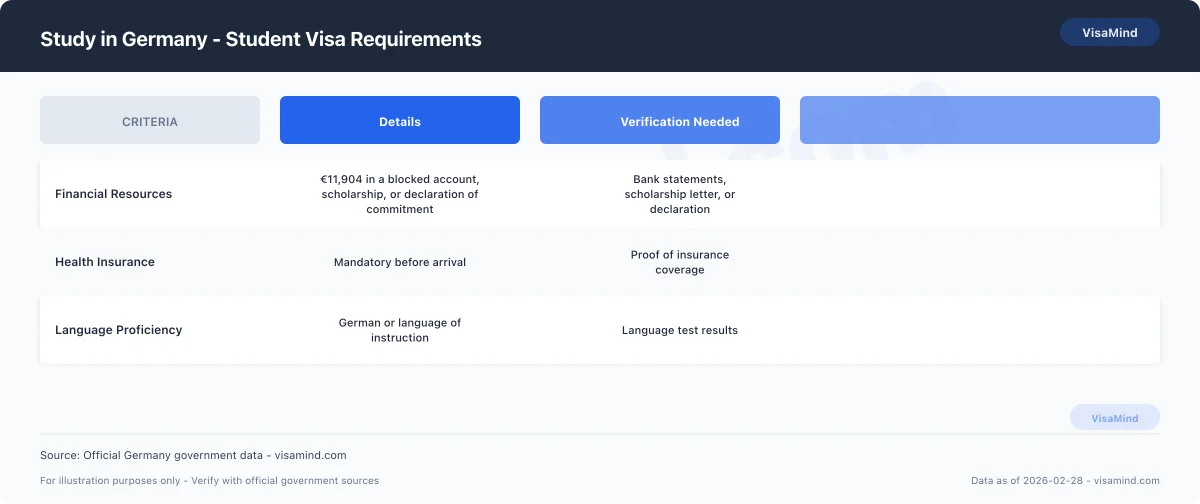
To study in Germany as an international student, you must meet specific visa requirements. These include financial proof, health insurance, and language proficiency. Below is a detailed comparison of these requirements.
| Requirement | Details |
|---|---|
| Financial Proof | You need to demonstrate sufficient funds, either through a blocked bank account with €11,208 (as of 2023), a scholarship, or a declaration of commitment from a sponsor. Verify current amounts on the official website. |
| Health Insurance | Proof of valid health insurance is mandatory. Students often opt for public or private insurance plans available in Germany. Make sure to secure this before your arrival. |
| Language Proficiency | Most programs require at least B2 level proficiency in German, as per the Common European Framework of Reference for Languages (CEFR). Some international programs may accept English proficiency instead. |
Important: Failure to meet any of these requirements can lead to visa refusal. Review your financial proof and language proficiency carefully.
Financial Requirements
To ensure you can cover your living expenses while studying, you need to present evidence of financial stability. A blocked account is a common method, where you deposit a specific sum and withdraw a fixed amount monthly. The current requirement is €11,208, but always check for updates here.
Health Insurance
Health insurance is compulsory for students in Germany. You can choose between public health insurance, which is often more affordable for students, or private insurance, which might offer more extensive coverage. Ensure you have valid insurance before moving to Germany, as this is a critical part of your Documents Checklist.
Language Proficiency
Most academic programs in Germany require proof of language proficiency. For courses taught in German, a B2 level or higher in the CEFR is usually needed. Some programs may accept English proficiency tests like TOEFL or IELTS if the course is taught in English. Check the specific requirements of your program when you apply for your student visa.
Tip: Contact the German embassy or consulate in your home country for guidance on acceptable language proficiency tests and other document requirements.
Meeting these requirements is crucial for successfully obtaining a student visa in Germany. For further details on the application process, visit the How To Apply page.
The Application Process
#The application process for studying in Germany involves several critical steps that must be followed meticulously to ensure a smooth transition into your academic journey. Here's a comprehensive guide to help you navigate through the essential steps:
1. Gather Your Documents
Before you begin the application process, make sure you have all the necessary documents ready. This includes:
- Admission letter from a state-recognized German higher education institution.
- Proof of financial means, such as a blocked bank account or scholarship.
- Language proficiency certificate, usually level B2 of the CEFR.
- Your school-leaving certificate that qualifies you for higher education in Germany.
For a detailed list, refer to the Documents Checklist.
2. Apply Online
The visa application for studying in Germany should be lodged online through the Consular Services Portal provided by the Federal Foreign Office (Auswärtiges Amt). This process involves completing your application and uploading the required documents.
Tip: Apply online to avoid mail delays and receive a confirmation receipt immediately.
3. Schedule Your Visa Appointment
Once your application is submitted online, schedule an appointment at the German embassy or consulate in your country. This step is crucial as it enables you to present your documents in person and answer any questions regarding your application.
4. Attend Your Visa Interview
During your visa appointment, you will be required to attend an interview. Be prepared to discuss your study plans, financial situation, and any other relevant details. It's essential to demonstrate your intention to return to your home country upon completing your studies.
Important: Not meeting language proficiency or financial requirements can lead to visa refusals. Ensure you fully understand the Financial Requirements before your interview.
5. Await the Decision
After your interview, it's time to wait for the decision on your visa application. Processing times can vary, so check the Processing Times for current estimates. Once approved, you will receive your visa, allowing you to enter Germany and pursue your studies.
By following these steps and ensuring all requirements are met, you can successfully navigate the application process for studying in Germany. For more information on the next steps after obtaining your visa, explore the Student Visa section.
Working While Studying
#Germany offers international students the opportunity to work while pursuing their studies, but there are specific regulations you must follow. Understanding these rules is crucial to ensure you stay compliant with your student visa conditions while enjoying the benefits of working in Germany.
How Many Hours Can You Work?
As an international student in Germany, you are typically allowed to work 120 full days or 240 half days per year. This is the standard limit set by the German immigration authorities. A full day is considered to be any workday exceeding four hours.
During the academic term, students can work up to 20 hours per week, allowing you to balance work commitments with your academic responsibilities. This restriction helps ensure that your studies remain your main focus, while also providing the opportunity to gain work experience and supplement your income.
Are There Restrictions on the Type of Work?
While the number of hours is regulated, the type of work you can engage in is generally flexible. However, if you wish to exceed the 120/240 day limit, you must seek permission from the local foreigners' authority (Ausländerbehörde). Unauthorized work might jeopardize your student visa status.
Important: Always inform your employer about your status as an international student to avoid any legal complications. Some employers may require confirmation from the Ausländerbehörde.
Can You Work During Semester Breaks?
Yes, you have more flexibility to work full-time during semester breaks. These periods are not included in the 120/240 day calculation. This is an excellent time to engage in internships or temporary full-time employment, which can enhance your practical skills and expand your professional network in Germany.
Special Considerations for EU Nationals
If you're a student from an EU or EEA country, you have the same right to work as German students. This means there are no specific restrictions on working hours, providing greater flexibility in balancing work and study.
For more detailed guidance on working while studying in Germany, consider consulting resources like the Financial Requirements Guide and the Visa Extension Guide to help manage your financial planning and potential visa adjustments.
After Graduation
#Upon graduating from a German higher education institution, international students have several pathways to extend their stay in Germany and gain valuable work experience. Understanding your options can pave the way for a successful transition from student life to professional life in Germany.
Post-Study Work Opportunities
Graduates from German universities can apply for an 18-month residence permit to seek employment related to their field of study. This period allows you to explore various job opportunities and establish professional connections within Germany.
Tip: During these 18 months, you are allowed to take up any kind of employment to support yourself while you search for a job that matches your qualifications.
Here's a quick overview of the steps involved in securing your post-study work permit:
- Gather Required Documents: You'll need your university degree certificate, proof of health insurance, and evidence of sufficient financial means.
- Apply at the Local Foreigners' Authority: Submit your application to the local Ausländerbehörde. Ensure all documents are in order to avoid processing delays.
- Seek Relevant Employment: Utilize this time to find a job that aligns with your academic background.
Long-Term Employment Visas
If you secure a job offer, you may be eligible for one of several long-term visas:
- EU Blue Card: Designed for highly skilled professionals, it requires a minimum salary threshold and a relevant job offer. For detailed eligibility, refer to the Blue Card EU page.
- Skilled Worker Visa: If your employment doesn't meet Blue Card criteria, consider this visa. It focuses on your qualifications and the relevance of the job offer. More information can be found on the Skilled Worker Visa page.
- Job Seeker Visa: If you're still searching for a qualified job, this visa provides additional time to find suitable employment. Check the Job Seeker Visa for more details.
Path to Permanent Residence
Long-term residence in Germany can be achieved through several pathways. After holding a Blue Card for 33 months (or 21 months with sufficient German language skills), you may apply for a Settlement Permit. This permit allows indefinite residency, offering stability and the opportunity to live and work in Germany permanently.
Important: Language proficiency can significantly expedite your path to permanent residence. Consider enrolling in language courses to improve your German skills.
Financial and Legal Considerations
Before applying for any post-study visa or permit, ensure you meet the financial requirements and have a solid understanding of the legal processes involved. The Visa Refusal Reasons guide can help you avoid common pitfalls that may lead to application denial.
Navigating the post-graduation phase in Germany offers a wealth of opportunities if approached with the right knowledge and preparation. Whether you're seeking immediate employment or planning a long-term stay, understanding your options is crucial to making informed decisions.
Pathway to Permanent Residence
#A significant advantage of studying in Germany is the opportunity to transition from a student to a permanent resident. This pathway hinges on securing employment and fulfilling specific residency requirements.
Transitioning from Student to Professional
After graduation, students can apply for an 18-month residence permit to search for employment in their field of study. This period allows you to explore professional opportunities and secure a job that aligns with your qualifications. It's essential to begin job hunting early to maximize this timeframe.
Tip: Engage with your university's career services and attend job fairs to enhance your employment prospects.
Employment and Residence Permit
Once you secure a job offer, you can apply for a work-related residence permit, such as the Skilled Worker Visa or the Blue Card EU. Crucial requirements include:
- A recognized degree and a job offer with a minimum salary.
- Proof of health insurance.
- Evidence of accommodation in Germany.
Pathway to Permanent Residence
After working in Germany for a few years, you may qualify for a Settlement Permit, which grants permanent residence. Criteria often include:
- Holding a residence permit for at least four years.
- Demonstrating sufficient German language skills (usually B1 level).
- Proving financial stability and job security.
Steps to Obtain Permanent Residence
- Accumulate Work Experience: Typically, two years of employment in a qualified position are required.
- Fulfill Language Requirements: Achieving B1 level proficiency in German is usually mandatory.
- Verify Financial Stability: Ensure you have continuous employment and adequate financial resources.
Important: Begin preparing documents early, such as proof of employment and language proficiency, to streamline the application process.
By strategically navigating the study-to-PR pipeline, international students can not only gain valuable academic qualifications but also establish a long-term future in Germany. For more detailed steps on this transition, consult the PR Pathway Guide.
Common Mistakes
#Certain common mistakes can lead to delays or even visa denials. Understanding these pitfalls is crucial for a successful application process.
Financial Missteps
-
Insufficient Proof of Funds: One of the primary requirements is proving that you have enough financial means to support yourself during your stay. This can be shown through a blocked bank account, a scholarship, or a declaration of commitment. Failing to provide adequate proof can result in your visa application being denied. For detailed guidance, refer to the Visa Refusal Reasons.
-
Inaccurate Financial Calculations: Ensure you account for the full duration of your studies, including tuition, living expenses, and any additional costs. An error in calculation can jeopardize your financial proof.
Academic and Admission Errors
-
Lack of Admission Letter: You must have an official admission letter from a state-recognized higher education institution in Germany. Applying without this crucial document can lead to automatic rejection.
-
Unverified Academic Credentials: Make sure your school-leaving certificate qualifies you for higher education in Germany. If your documents are not recognized, you may need to pursue a preparatory course.
Language Proficiency Issues
-
Not Meeting Language Requirements: Most programs require language proficiency at level B2 of the CEFR. Failing to demonstrate the necessary language skills can result in a refusal. To avoid this, ensure you have an up-to-date language proficiency certificate before applying.
-
Incorrect Language Test: Only certain language tests are accepted. Verify which tests are recognized by the institution you are applying to and prepare accordingly.
Tip: Consult the Documents Checklist to ensure you have all necessary documents before starting your application.
Intent and Purpose Misunderstandings
-
Questionable Study Intent: The immigration authorities need assurance that your primary purpose for entering Germany is to study. Any indication that you might not be a genuine student can lead to a visa denial. This means demonstrating a clear plan for your studies and future career.
-
Incomplete or Misleading Information: All information provided in your application must be complete and truthful. Any discrepancies can lead to suspicions about your intent and result in rejection.
By avoiding these common mistakes, you increase your chances of a smooth and successful application process. For further information on visa processes, visit the How To Apply guide.
What It Actually Costs
#Understanding the financial implications of studying in Germany is essential for planning your educational journey. Here's a breakdown of the costs involved, including tuition, living expenses, and financial requirements for international students.
Tuition Fees and Living Costs
While many state-recognized universities in Germany offer low or no tuition fees, especially for undergraduate programs, there are still costs to consider.
| Expense Type | Estimated Cost (per year) |
|---|---|
| Tuition Fees | €0 - €1,500 (public universities) |
| Living Expenses | €10,332 (approx. €861/month) |
Financial Requirements
To study in Germany, you must demonstrate that you can financially support yourself throughout your stay. This is often done through a blocked bank account, which requires a deposit of €10,332 (as of 2023) to cover living expenses for one year. Alternatively, proof of a scholarship or a declaration of commitment can also suffice.
Additional Costs to Consider
Beyond tuition and basic living expenses, students should account for other potential expenditures:
- Health Insurance: Approximately €80 - €160 per month
- Semester Fees: Around €100 - €350 per semester, covering administrative costs and public transportation
- Books and Study Materials: €200 - €300 per semester
Tip: Some cities in Germany have higher costs of living than others. Research your chosen city to better estimate your budget and financial needs.
Resources
For more details on financial planning and visa requirements, refer to the Financial Requirements Guide and How To Apply for a comprehensive overview of the application process. Additionally, explore options like the Opportunity Card or Skilled Worker Visa if you plan to transition into work after your studies.
Day-to-Day Student Life
#- All students in Germany must have health insurance. You can choose between public and private providers based on your needs.
- Public health insurance is generally more affordable for students, costing around €110 per month as of 2023. Verify the exact costs on the official website.
- Private health insurance might be necessary if you're over 30 or a long-term student. Costs vary, so compare options carefully.
Important: Ensure your health insurance is recognized in Germany to avoid any interruptions in coverage.
Housing Options
- Student Dormitories: Managed by Studentenwerk, these are affordable and popular among international students. Apply early, as spots fill quickly.
- Private Accommodation: Options include shared apartments (WGs) or studio flats. Prices range significantly by city, with Berlin and Munich being more expensive.
- Temporary Housing: Consider Airbnb or hostels for short-term stays while seeking permanent accommodation.
Tip: Use online platforms like WG-Gesucht to find shared housing and connect with potential roommates.
Banking for Students
- Opening a Bank Account: Essential for managing daily expenses and receiving funds. Most German banks offer student accounts with no monthly fees.
- Blocked Account: If using this method to prove financial means, ensure it meets the requirements set by the German government. This account will hold at least €11,208 as of 2023, which is the estimated annual living cost for students.
- Debit Cards: Once your account is open, you'll receive a Girocard (EC card) for convenient transactions across Germany.
Navigating Daily Life
- Public Transport: Most universities offer a semester ticket included in your fees, granting unlimited travel in your city.
- Language Courses: If you need to improve your German, many universities offer affordable or free language classes for enrolled students.
- Cultural Adjustment: Familiarize yourself with local customs and etiquette to ease your transition into German life. Joining student clubs can help you integrate and make friends.
For more detailed guidance on managing financial requirements, consider checking the Visa Refusal Reasons and Financial Requirements guides.
Real Student Visa Stories
#Maria, a young engineer from Brazil, was thrilled to receive an admission letter for a Master’s program in Environmental Engineering at a prestigious German university. However, she faced a significant concern: proving her financial stability to cover the living expenses during her studies. Maria opted to open a blocked bank account in Germany, a common method to meet financial requirements. She deposited the necessary funds, which were verified by the German consulate in Brazil. This approach satisfied the financial proof requirement, allowing her to successfully lodge her application through the Consular Services Portal of the Federal Foreign Office. Within eight weeks, Maria received her student visa, enabling her to start her studies on time.
Scenario: Overcoming Language Barriers
Rahul, a prospective student from India, aspired to study Computer Science in Germany but was initially worried about meeting the language proficiency requirements. Although his program was offered in English, the university still required proof of German language skills at a B2 level. Rahul enrolled in an intensive language course at a certified institute. Upon completion, he passed the language test and received his certificate, which he submitted along with his visa application. This proactive approach helped him secure his student visa, allowing him to transition smoothly from his language course to his academic studies in Germany.
Scenario: Switching Fields of Study
Li, a Chinese student, initially enrolled in a Bachelor’s program in Business Administration but soon realized her true passion lay in Graphic Design. Concerned about the implications of switching fields, she consulted with the local Ausländerbehörde (foreigners' authority) in Germany. They advised her on the necessary steps, including obtaining a new admission letter and updating her residence permit to reflect the change in her academic path. By following the guidance from the Ausländerbehörde, Li managed to seamlessly transition to her new program without any disruption to her visa status.
FAQs
How do I apply for a student visa to study in Germany?
Can I switch from a student visa to a work visa in Germany after graduation?
What happens if I don't meet the language proficiency requirements for studying in Germany?
What are the common mistakes to avoid when applying to study in Germany?
What is the pathway to permanent residence after studying in Germany?
Can I combine a language course with my study programme in Germany?
How is the Federal Office for Migration and Refugees involved in the student visa process for Germany?
Sources
Last reviewed: March 1, 2026
VisaMind provides informational guidance only and is not a government agency. This is not legal advice. Requirements can change and eligibility depends on your specific facts. If your case is complex or high-stakes, consult a licensed immigration attorney.
Next steps
Requirements vary by nationality, purpose, timeline, and case details. Use Find My Visa to get a personalized checklist for Germany with official sources and deadlines.
Find my visa