On this page
- What This Family Visa Covers
- Sponsor and Applicant Requirements
- Evidence Checklist
- Application Process
- What It Costs
- When to Consult an Immigration Professional
- Your Rights After Approval
- Path to Permanent Residence
- Removing Conditions
- Relationship Scrutiny Red Flags
- Required forms
- Related visa types
- Related guides
- Related goals
- Next steps
Official sources referenced
What This Family Visa Covers
#For those seeking to join their spouse in Germany, the Spouse Visa provides an opportunity for family reunification under specific conditions. If you are married to a non-EU citizen residing in Germany, you can apply to join them, provided you meet certain criteria. This visa is part of Germany's broader family reunification policy, which also includes options for partners, parents, and children wishing to reunite with family members in Germany.
Who Can Apply?
The Spouse Visa is available for spouses of both EU citizens and non-EU citizens residing in Germany. Spouses of EU/EEA Member States or Switzerland benefit from the right of free movement, making their application process comparatively straightforward. On the other hand, spouses of non-EU citizens must often navigate additional requirements, which can vary depending on the status of the resident spouse, such as whether they hold a Blue Card EU or a Settlement Permit.
Key Requirements
To qualify for a Spouse Visa, several key requirements must be met. First and foremost, proof of marriage or civil partnership is mandatory. This means your marriage must be legally recognized in the country where it was registered, and all necessary documentation should be officially recorded. Additional requirements include providing evidence of adequate health insurance coverage and sufficient financial resources. These requirements ensure that you and your spouse will not become a burden on the German social welfare system.
What the Visa Covers
The Spouse Visa not only allows you to live in Germany but also permits you to work and integrate into German society. Upon arrival, it is crucial to register with the local Residents' Registration Office. If your visa is initially issued as a temporary entry visa, you must apply for a residence permit at the local foreigners' authority (Ausländerbehörde) before it expires. This step is vital to legalize your long-term stay in Germany.
Important: Ensure that all documentation is complete and meets the specific requirements of your spouse's residency status to avoid delays or rejection.
Additional Family Reunification Options
In addition to the Spouse Visa, Germany offers other family reunification options. If you are interested in reuniting with children or parents, you may explore the Family Reunion Visa. Each type of family reunion visa has unique requirements and benefits, making it essential to understand the specific conditions that apply to your situation.
For more detailed guidance on applying and gathering the necessary documents, refer to our How To Apply and Documents Checklist guides. These resources provide comprehensive information tailored to your family reunification needs.
Sponsor and Applicant Requirements
#For those applying for a Spouse Visa in Germany, there are specific requirements that both the sponsor and the applicant must meet. These requirements ensure the legitimacy of the relationship and the financial stability of the couple in Germany. Below are the crucial elements you need to consider:
Relationship Proof
- Marriage or Civil Partnership Documentation: You must provide a valid marriage certificate or proof of a registered civil partnership. This documentation should be recognized by the legal authorities in your country.
- Registration and Legal Effects: The civil partnership must be registered in the respective country, with declarations recorded in official files or registers. The partnership should entail legal effects and obligations.
Sponsor Requirements
- Residence Title: The sponsoring spouse, if a skilled worker from a third country, must hold a residence permit, a settlement permit, or an EU Blue Card for Germany. This is crucial for the family reunification process.
- Proof of Accommodation: Evidence of sufficient living space in Germany for both partners is required. This often includes a rental contract or property ownership documents.
Financial Thresholds
- Sufficient Financial Resources: The sponsor must demonstrate the capacity to financially support the spouse without relying on public funds. This is often evidenced through pay slips, tax statements, or other proof of income.
- Health Insurance: Adequate health insurance coverage is mandatory for both the sponsor and the applicant. EU Blue Card holders need to show proof of health insurance uniquely tailored for them.
Important: Ensure all documents are up-to-date and correctly translated into German if they are in another language. This step is crucial for avoiding delays in processing your application.
Upon fulfilling these requirements, spouses can apply for a Family Reunion Visa at the German embassy or consulate. Additionally, registering with the local Residents' Registration Office upon arrival in Germany is necessary to ensure compliance with local regulations. For more detailed guidance, you may refer to the Documents Checklist and How To Apply resources.
Evidence Checklist
#Important: Ensure all documents are properly translated into German or English by a certified translator to avoid processing delays.
Relationship Evidence
To demonstrate the legitimacy of your marriage or civil partnership, you should prepare the following:
- Marriage or Civil Partnership Certificate: Must be officially registered in the respective country and recorded in official files or registers.
- Photographs and Correspondence: Provide recent photos of you and your partner together, as well as any correspondence that demonstrates ongoing communication.
- Joint Household Documentation: Include evidence such as a joint lease, mortgage, or utility bills showing a shared address.
Sponsor Documents
If your spouse is a skilled worker from a third country, they are required to provide:
- Residence Title: Proof of a residence permit, settlement permit, or EU Blue Card for Germany is mandatory.
- Employment Documentation: Recent pay slips, employment contract, or a letter from the employer verifying employment status.
- Proof of Health Insurance: Evidence of adequate health insurance coverage, especially if your spouse holds an EU Blue Card.
Financial Proof
To demonstrate financial stability, gather the following documentation:
- Bank Statements: Recent bank statements showing sufficient funds to support the family.
- Income Proof: Pay slips or tax statements from your spouse, which can include income from employment or other sources.
- Accommodation Evidence: Rental agreement or proof of property ownership in Germany to confirm adequate living arrangements.
Additional Considerations
- Health Insurance: Ensure you have coverage that meets German requirements, as this is crucial for visa approval.
- Language Skills: While not always mandatory, demonstrating basic German language proficiency can be beneficial.
For more detailed information on financial requirements, consult the Financial Requirements Guide. Additionally, ensure you understand the steps for applying for a residence permit once you arrive in Germany.
Tip: Register with the Residents' Registration Office (Einwohnermeldeamt) promptly upon arrival in Germany to comply with local regulations.
Application Process
#Sponsor Approval
The first step in the spouse visa application process for Germany involves obtaining approval from your spouse's residence status. If your spouse is a skilled worker from a third country, they must hold a valid residence permit, settlement permit, or EU Blue Card for Germany. The residence status of your spouse plays a crucial role in determining your eligibility for a spouse visa.
The civil partnership or marriage must be officially registered, and requisite documentation, including proof of marriage or civil partnership and proof of adequate health insurance coverage, must be gathered. Review the complete list of required documents on the Documents Checklist guide.
Tip: Make sure your spouse's employment and residence documents are up-to-date to prevent any delays in the approval process.
Lodging Your Visa Application
Once your spouse's residence status has been confirmed, you can lodge your spouse visa application. This can be done online through the Federal Office for Migration and Refugees (BAMF) website or at the German embassy or consulate in your country. Ensure you include all necessary documents, such as a valid passport, marriage certificate, pay slips or tax statements, and any other documents that may be required based on your specific situation.
Processing times for spouse visas can vary, typically ranging from 15 to 60 days, depending on the category and processing location. Verify current processing times with the issuing authority to plan accordingly.
Important: Incomplete applications or missing documents, such as proof of adequate health insurance, could lead to delays or rejection of your application. Check all requirements thoroughly before submission.
Arrival and Registration in Germany
Upon receiving your spouse visa, make arrangements to travel to Germany. Once you arrive, you must register at the local Residents' Registration Office (Einwohnermeldeamt). This is a crucial step in establishing your residence in Germany. Following registration, apply for a residence permit at the local foreigners' authority (Ausländerbehörde) before your visa expires.
Failure to apply for a residence permit in time may result in legal complications. For further guidance on maintaining your legal status, refer to the Visa Extension Guide.
By following these steps carefully, you can streamline the process of joining your spouse in Germany and begin your new life together.
What It Costs
#
Important: Ensure that you have adequate health insurance coverage before applying for a Spouse Visa to Germany, as this is a critical requirement.
What It Costs to Apply for a Spouse Visa
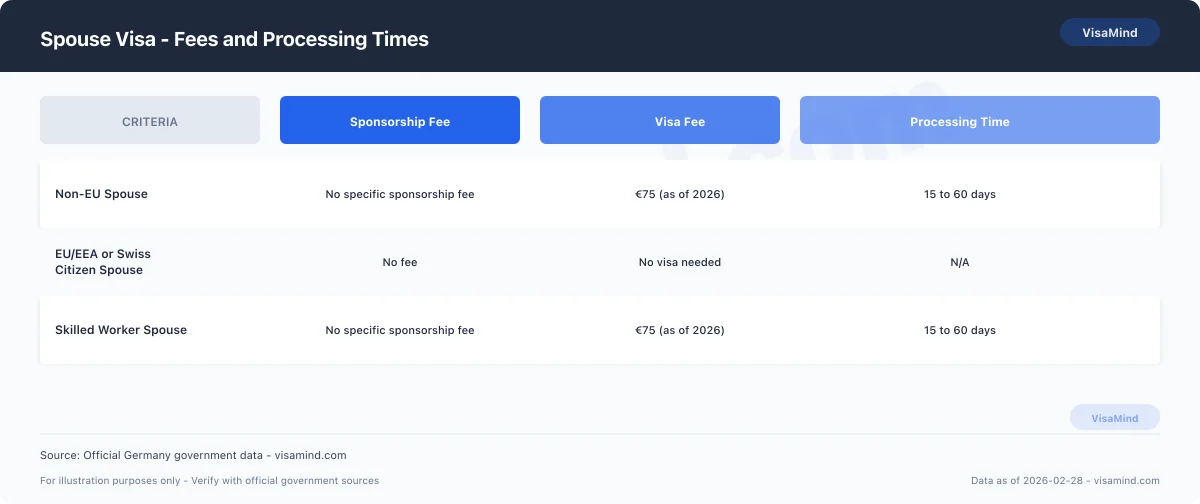
When applying for a Spouse Visa to join your partner in Germany, understanding the associated costs and processing times is crucial. Below, you'll find a detailed comparison of the fees and typical timelines involved in this process.
| Category | Visa Fee | Sponsorship Fee | Processing Window |
|---|---|---|---|
| Spouse of EU/EEA Citizen | Free | Not applicable | Immediate to a few weeks |
| Spouse of non-EU Skilled Worker | €75 as of 2026 | Not typically applicable | 15 to 60 days as of 2026 |
| Spouse of non-EU Blue Card Holder | €75 as of 2026 | Not typically applicable | 15 to 60 days as of 2026 |
Understanding the Fees
For spouses of EU/EEA citizens, there is typically no visa fee, thanks to the right of free movement within the European Union. However, spouses of non-EU citizens, including those holding an EU Blue Card, face a standard visa fee of €75. Note that these fees are subject to change, so it's essential to verify the latest amounts on the official Federal Foreign Office (Auswärtiges Amt) website.
Processing Timelines
The processing time for Spouse Visas can vary significantly. For spouses of EU/EEA citizens, the process is often quicker, ranging from immediate to a few weeks, due to streamlined regulations. For spouses of non-EU skilled workers or EU Blue Card holders, the processing window is typically between 15 to 60 days. This timeline can fluctuate based on the application volume and the specific foreign mission handling your case. To ensure timely processing, gather all necessary documents, such as your Documents Checklist and ensure they are complete before submission.
Tip: To expedite your application, ensure all documentation, including proof of financial resources and health insurance coverage, is thorough and up-to-date. Missing documents can lead to delays.
It's advisable to consult with your local Foreigners' Authority (Ausländerbehörde) in Germany after your arrival to transition smoothly from a visa to a residence permit. This proactive approach can mitigate any potential disruptions in your residency status.
When to Consult an Immigration Professional
#Family-based immigration adds relationship scrutiny on top of standard requirements for Germany immigration. An immigration professional can help if:
- Your relationship involves circumstances that could raise genuineness questions (short courtship, significant age gap, limited shared history)
- Your sponsor's immigration status is itself complicated
- You have a prior visa denial or refusal
- You have a prior overstay, unlawful presence, or removal order
- You have a criminal record, arrest history, or pending charges
- You have a prior misrepresentation or fraud finding
- You are in removal or deportation proceedings
Your Rights After Approval
#When your Spouse Visa for Germany is approved, you gain several rights and responsibilities as you join your partner in the country. Understanding these rights ensures that you and your spouse can settle smoothly into your new life in Germany.
Work Rights
With a Spouse Visa, you are typically granted the right to work in Germany. This means you can seek employment or start your own business without needing an additional work permit. However, it is important to check the specific conditions attached to your visa, as these might vary depending on your spouse's status in Germany.
Residency Conditions
After entering Germany on a Spouse Visa, you must register with the local Residents' Registration Office (Einwohnermeldeamt) within two weeks. Following this, you need to apply for a residence permit at the local Foreigners' Authority (Ausländerbehörde) before your visa expires. This permit allows you to stay and live with your spouse in Germany legally.
- Registration Requirement: Register at the Residents' Registration Office
- Residence Permit: Apply before your visa expires
Important: Failing to apply for a residence permit in time can result in legal issues, potentially affecting your stay in Germany.
Minimum Income and Financial Requirements
To ensure that you can support yourselves financially, you must meet certain income requirements. This involves proving that your spouse in Germany has a stable income to support both of you, without needing social assistance. The exact amount can vary based on factors such as family size and location, so it is advisable to consult the Financial Requirements Guide for detailed information.
Health Insurance Obligations
Having adequate health insurance is mandatory when living in Germany. You must provide proof of health insurance coverage when applying for your residence permit. This is crucial for accessing healthcare services and is a legal requirement for all residents in Germany.
For more detailed guidance on maintaining your legal status and navigating residency conditions, consider reviewing our Visa Extension Guide or exploring options like the EU Blue Card for skilled workers.
Path to Permanent Residence
#When holding a Spouse Visa in Germany, one of the main objectives for many is achieving permanent residence. For spouses of non-EU citizens, the path to permanency begins with meeting specific conditions tied to their current residence status. Initially, you must ensure you hold a valid residence permit that corresponds to your situation, whether it be tied to a Skilled Worker Visa or another qualifying permit type. The requirements for transitioning to permanent residence—such as securing a Settlement Permit—depend on factors like the duration of your stay, integration into German society, and your financial independence.
What Are the Key Steps to Permanent Residence?
To apply for permanent residence, you must typically reside in Germany for at least five years. During this period, it is crucial to demonstrate your capability to support yourself financially and possess adequate health insurance coverage. Moreover, proof of proficiency in the German language is essential, often requiring at least an A2 level as per the Common European Framework of Reference for Languages. You should also have a solid understanding of German legal and social systems, which can be achieved through integration courses.
How Does the Spouse Visa Affect Your Eligibility?
The status of your spouse plays a significant role in your journey towards permanent residence. If your spouse holds an EU Blue Card or a Settlement Permit, you might be eligible for permanent residence sooner, depending on specific conditions. It's essential to verify the requirements that apply to your situation, as they can vary based on your spouse's professional and legal standing in Germany. For instance, spouses of Blue Card holders may have expedited pathways due to the card's emphasis on attracting skilled workers to Germany.
Tip: Registering with the local Residents' Registration Office (Einwohnermeldeamt) upon arrival is crucial. This not only fulfills a legal requirement but also helps establish your presence in Germany, which is important for future residence applications.
What Are the Potential Hurdles?
While the path to permanent residence is structured, there are potential hurdles. Failing to renew your residence permit before it expires or not providing necessary documentation, like proof of marriage or financial stability, can impede your progress. Additionally, the processing time for converting your Spouse Visa to a permanent residence permit can vary. As of 2026, processing times might range from several weeks to a few months, depending on the local foreigners' authority and your specific circumstances. Always verify current timelines with the relevant authorities to plan accordingly.
By understanding these pathways and requirements, you can better navigate your journey from a Spouse Visa holder to a permanent resident in Germany. For more detailed guidance, consider exploring the Settlement Permit Vs Citizenship guide to make informed decisions about your future in Germany.
Removing Conditions
#Important: Ensure you apply for your residence permit before your spouse visa expires to maintain your legal status in Germany.
What Are the Conditions to Remove?
When residing in Germany on a Spouse Visa, it's essential to understand the conditions you need to meet to maintain and eventually remove any conditional status. This typically involves ensuring that the marriage or civil partnership is legally recognized both in Germany and in the country where it was registered. You must also continue to meet financial requirements and have adequate health insurance coverage.
Steps to Maintain Your Family Visa Status
-
Register with Local Authorities: Upon arrival in Germany, you and your spouse should register with the Residents' Registration Office (Einwohnermeldeamt). This is a crucial step in establishing your residency.
-
Apply for a Residence Permit: Before your initial visa expires, apply for a residence permit through the local foreigners' authority (Ausländerbehörde). Failure to do so can lead to a lapse in your legal residency status.
-
Meet Ongoing Requirements: Continuously provide proof of adequate health insurance, sufficient financial resources, and any other documents that may be required based on your specific situation.
Renewal Process and Timelines
The process to renew your Spouse Visa involves ensuring all documentation is current and filing the necessary paperwork with the appropriate German authorities. Processing times can vary, with the renewal typically taking anywhere from 15 to 60 days, depending on your category and location. It's advisable to check current processing times with the issuing authority to avoid any disruptions.
Tip: Use the Visa Extension Guide for detailed steps on extending your visa and ensuring uninterrupted residency.
Path to Permanent Residence
After a certain period, often several years of maintaining your family visa status and meeting all conditions, you may become eligible to apply for a more permanent status, such as the Settlement Permit or the EU Long-term Residence Permit. These options provide increased stability and rights within Germany.
Relationship Scrutiny Red Flags
#Relationship scrutiny can be a significant aspect of the spouse visa application process for Germany. Understanding potential red flags can help you prepare adequately.
Relationship Evidence Gaps
One of the primary concerns when applying for a spouse visa is proving the authenticity of your relationship. You must provide sufficient documentation to demonstrate a genuine and ongoing relationship. Commonly required documents include:
- Valid passport and marriage certificate
- Proof of cohabitation, such as joint lease agreements or utility bills
- Photographs and communication records
Important: Missing documents or insufficient evidence of a genuine relationship can lead to delays or visa denial. Ensure all documents are complete and well-organized.
Financial Shortfalls
Financial stability is crucial for a successful spouse visa application. Applicants must demonstrate they have adequate financial resources to support themselves and their partner in Germany. This typically includes:
- Proof of income, such as pay slips or tax statements
- Evidence of savings or financial support from your spouse
Tip: Use the Financial Requirements guide to ensure you meet the necessary financial thresholds.
Prior Violations and Compliance
Past immigration violations or non-compliance issues can severely impact your spouse visa application. Be transparent about any previous visa refusals or overstays. If applicable, provide explanations and any corrective actions taken. Moreover, ensure compliance with all current visa requirements:
- Apply for a residence permit before your visa expires to avoid complications
- Register with the Residents' Registration Office upon arrival in Germany
By addressing these potential red flags proactively, you can strengthen your application and improve your chances of a successful outcome. For further assistance, consider reviewing the Visa Refusal Reasons to better understand common pitfalls.
Next steps
#Use Find My Visa to build a sequenced plan with official sources and deadlines.
Sources
Last reviewed: 2026-03-02
VisaMind provides informational guidance only and is not a government agency. This is not legal advice. Requirements can change and eligibility depends on your specific facts. If your case is complex or high-stakes, consult a licensed immigration attorney.
Next steps
Requirements vary by nationality, purpose, timeline, and case details. Use Find My Visa to get a personalized checklist for Germany with official sources and deadlines.
Find my visa