Official sources referenced
When to Read This
#The EU Blue Card and the Skilled Worker Visa are two prominent pathways for non-EU nationals seeking employment in Germany. As of 2023, both options cater to professionals but have distinct eligibility criteria and benefits. Understanding these differences is crucial when deciding which visa best suits your situation.
Who Should Consider This Comparison?
If you hold an academic qualification comparable to a German degree and have a job offer meeting the required salary threshold, the EU Blue Card might be ideal for you. This visa offers advantages such as family reunification and a faster route to permanent residency. However, if your qualifications do not meet the EU Blue Card criteria, the Skilled Worker Visa is a viable alternative. It is designed for individuals with vocational training or equivalent qualifications and also requires a job offer in Germany.
Why Compare These Options?
Comparing these immigration pathways helps you make an informed decision based on your qualifications, job offer, and long-term goals in Germany. Each visa type has specific application processes and requirements overseen by the Federal Office for Migration and Refugees (BAMF) and the local foreigners' authorities, influencing your choice significantly.
Important: Not meeting the salary threshold is a common pitfall when applying for the EU Blue Card. Ensure your job offer aligns with your qualifications to avoid application issues.
For detailed information about the EU Blue Card and Skilled Worker Visa, explore the specific requirements and benefits.
Side-by-Side Comparison
#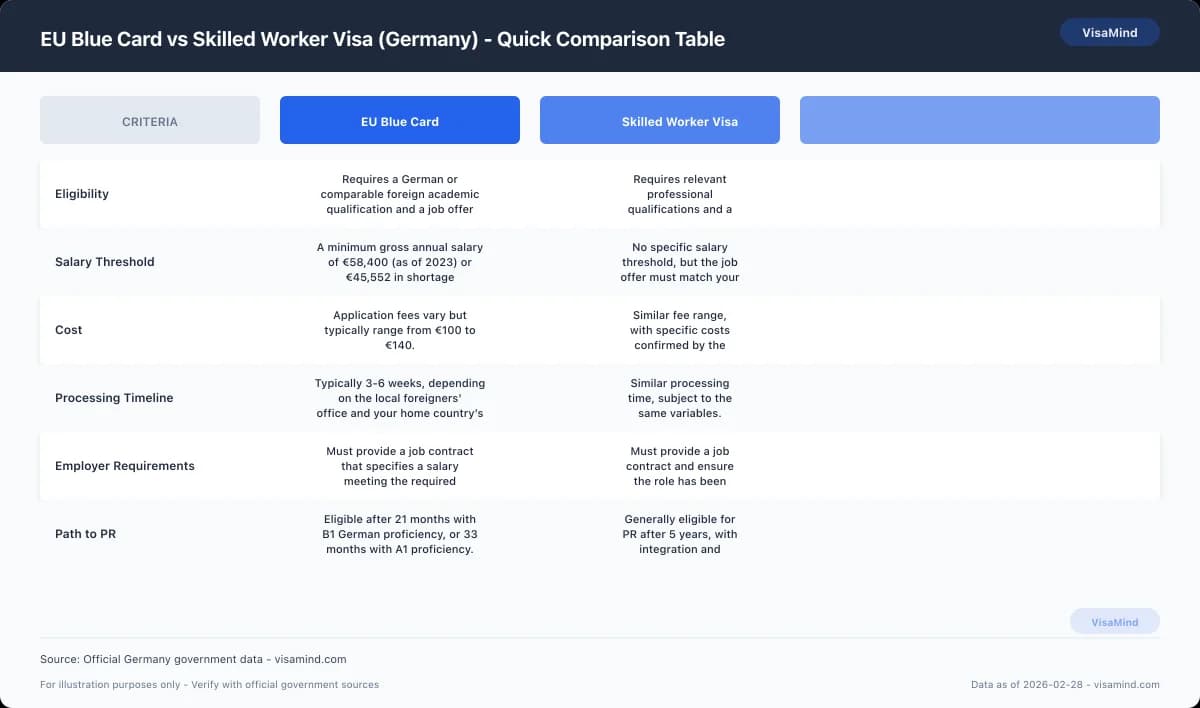
| Dimension | EU Blue Card | Skilled Worker Visa |
|---|---|---|
| Eligibility | Requires a recognized academic qualification or comparable; specific job offer meeting salary thresholds. | Requires vocational training or a university degree; specific job offer in your field. |
| Cost | Varies by consulate; typically around €100 for the application fee. | Varies by consulate; typically around €75 for the application fee. |
| Timeline | Decision usually within 90 days from application submission. | Decision usually within 90 days from application submission. |
| Employer Requirements | Job must match qualifications and meet salary thresholds; approval from the Federal Employment Agency needed for some roles. | Employer must confirm the need for your skills; approval from the Federal Employment Agency may be required. |
| Path to Permanent Residence | Eligible for a Settlement Permit after 33 months, or 21 months with sufficient German language skills. | Eligible for a Settlement Permit after 48 months of employment. |
Eligibility Criteria
The EU Blue Card is designed for highly qualified individuals. You must have an academic degree recognized in Germany or a comparable foreign degree. Additionally, you need a job offer that meets the required salary threshold, which varies depending on your field. For shortage occupations, the salary requirement might be lower, but you will need approval from the Federal Employment Agency (Bundesagentur für Arbeit).
In contrast, the Skilled Worker Visa requires vocational training or a university degree and a job offer in your field. While the academic requirement is less stringent than the EU Blue Card, the job offer must still be relevant to your qualifications.
Cost and Timeline
Both visas involve an application fee, though it varies slightly. The EU Blue Card typically costs around €100, while the Skilled Worker Visa is approximately €75. Processing times for both are similar, with decisions usually made within 90 days of submitting your application.
Employer Requirements
Employers play an integral role in both visa processes. For the EU Blue Card, your job offer must align with your qualifications and meet specific salary thresholds. If your occupation is on the shortage list, you’ll need the Federal Employment Agency's approval.
For the Skilled Worker Visa, your employer must justify the need for your skills. Approval from the Federal Employment Agency might also be necessary, depending on the job market conditions at the time of your application.
Path to Permanent Residence
The EU Blue Card offers a faster route to permanent residence. After 33 months of employment, you can apply for a Settlement Permit. This period reduces to 21 months if you demonstrate sufficient German language proficiency.
On the other hand, the Skilled Worker Visa allows you to apply for permanent residence after 48 months of employment in Germany. While this pathway is slightly longer, it remains a viable option for those with vocational qualifications.
Tip: Enhance your chances by learning German. Proficiency can speed up your path to permanent residence, especially with an EU Blue Card.
When to Pick the First Option
#A recent engineering graduate from India, Akash, received an enticing job offer from a German automotive company. The role perfectly aligned with his qualifications, but his concern was meeting the salary threshold required for the EU Blue Card. Fortunately, engineering is classified as a shortage occupation in Germany, which allows for a lower salary threshold. Akash confirmed his eligibility through the Federal Employment Agency's approval process. After gathering the necessary documentation, he applied for the EU Blue Card through the German mission in his home country. His application was processed efficiently, and he was able to relocate to Germany within a few months. Upon arrival, Akash registered his address at the local Residents' Registration Office and applied for his residence title at the Foreigners Authority. This path offered him a streamlined process to start his career in Germany, with the added benefit of quicker settlement prospects.
Scenario: IT Specialist Without a Formal Degree
Lea, an IT specialist from Brazil with extensive work experience but no formal academic degree, was offered a job with a prominent tech company in Berlin. She was concerned that her lack of a formal degree might hinder her ability to secure a work visa. However, Germany's immigration system recognizes practical experience in the IT sector as a valid qualification for the EU Blue Card, provided it aligns with university graduate-level work. Lea meticulously documented her three years of experience and ensured it met the requirements set by the Federal Employment Agency. She submitted her application for the EU Blue Card and received approval to work in Germany. This allowed her to join the company without needing to pursue additional academic qualifications, highlighting how the EU Blue Card can be an excellent option for experienced professionals in fields where practical skills are highly valued.
Scenario: Young Professional Seeking Family Reunification
Sofia, a young professional from Argentina, secured a lucrative position in the pharmaceutical sector in Munich, right after completing her master's degree. Her primary concern was not only starting her new job but also bringing her spouse to Germany. The EU Blue Card provided an ideal solution, as it offers significant benefits for family reunification. Sofia ensured her salary met the required threshold and submitted her application through the German consulate in Argentina. Once in Germany, she applied for her residence title at the local Foreigners Authority. Because the EU Blue Card facilitates family reunification, her spouse was able to join her in Germany shortly after her arrival, ensuring a smooth transition for both. This scenario illustrates how the EU Blue Card can be particularly advantageous for young professionals seeking career advancement while maintaining family ties.
Choose Option B If...
#An experienced IT specialist from India, with over five years of professional experience but no formal university degree, sought to work in Germany. He was aware of the opportunity to apply for an EU Blue Card based on his work experience. The challenge was to demonstrate that his professional experience was at a university graduate level.
To address this, he gathered detailed documentation of his work history, including letters from previous employers and a portfolio of his projects. He then approached the Federal Employment Agency (Bundesagentur für Arbeit) to obtain approval for his application, given that his field is considered a shortage occupation in Germany.
After receiving the agency's approval, he lodged his application for the EU Blue Card through the German mission in India. Within two months, he received his EU Blue Card, allowing him to move to Germany and start his new job. This pathway also opened the door to quicker permanent residency options, as the EU Blue Card provides a fast track to the Settlement Permit.
Scenario: Recent Graduate with a Job Offer
A recent engineering graduate from Brazil, who completed her master's degree less than a year ago, received a job offer from a German automotive company. The position met the lower salary threshold applicable to young professionals, a key aspect of her eligibility for the EU Blue Card.
She started by validating her academic qualifications with the Qualification Recognition process to ensure they were comparable to German qualifications. Once her credentials were recognized, she submitted her EU Blue Card application at the German consulate in São Paulo.
Due to her recent graduate status and the lower salary threshold, her application was processed swiftly. Within six weeks, she received her EU Blue Card, allowing her to relocate to Germany and begin her career. This card also facilitated family reunification, enabling her spouse to join her in Germany through the Family Reunion visa process.
Scenario: Experienced Engineer Switching to Skilled Worker Visa
An experienced mechanical engineer from Russia, already residing in Germany on an EU Blue Card, decided to switch jobs to a smaller firm offering a position that did not meet the EU Blue Card salary threshold. This scenario required a change to a Skilled Worker Visa.
The engineer informed the local Foreigners Authority (Ausländerbehörde) about his intention to change jobs, as required during the first year of employment under the EU Blue Card. He then applied for a Skilled Worker Visa, which did not have the same strict salary requirements as the Blue Card but still required a job offer relevant to his qualifications.
Once he secured approval from the Federal Employment Agency, he was able to transition smoothly to the Skilled Worker Visa, continuing his professional journey in Germany without interruption. This flexibility allowed him to work in a role more suited to his career aspirations, while still maintaining compliance with German immigration regulations.
Key Differences Explained
#Understanding the differences between the EU Blue Card and the Skilled Worker Visa is crucial. Both visas cater to skilled professionals aiming to work in Germany, but they have distinct requirements and benefits. Below, we explore the key differences to help you determine which option may be better suited for your circumstances.
Eligibility Criteria
The EU Blue Card is specifically tailored for highly qualified professionals with an academic background. To qualify, you need:
- A recognized German academic qualification or a foreign qualification equivalent to a German degree.
- A job offer in Germany that aligns with your qualifications and meets a salary threshold of at least €58,400 annually (as of 2023). For shortage occupations, the threshold is lower at €45,552, provided you have approval from the Federal Employment Agency.
In contrast, the Skilled Worker Visa is more broadly accessible to professionals with vocational training or a recognized qualification. The key eligibility requirements are:
- A recognized foreign qualification or a German vocational qualification.
- A job offer relevant to your qualifications. There is no specific salary threshold; however, the Federal Employment Agency must approve the employment conditions, ensuring they meet German standards.
Settlement Prospects
A significant advantage of the EU Blue Card is the pathway to permanent residency. Holders can apply for a Settlement Permit after 33 months of employment. This period can be reduced to 21 months if you demonstrate adequate German language proficiency (B1 level).
For the Skilled Worker Visa, the path to permanent residency typically requires five years of residing and working in Germany. During this time, you will need to contribute to the statutory pension scheme and demonstrate sufficient language skills and financial stability.
Family Reunification
Both the EU Blue Card and the Skilled Worker Visa facilitate family reunification, but the EU Blue Card offers more streamlined benefits. Family members can join Blue Card holders in Germany without needing to prove any German language proficiency beforehand. They are also permitted to work without restrictions.
For those with a Skilled Worker Visa, family members must usually demonstrate basic German language skills (A1 level) to qualify for reunification, unless exceptions apply. Upon arrival, family members are typically allowed to work, but this may depend on individual circumstances.
Important: Ensure your job offer matches your qualifications and meets the necessary salary thresholds where applicable. Misalignment can lead to application rejections.
In conclusion, the choice between the EU Blue Card and the Skilled Worker Visa depends on your qualifications, job offer, and long-term settlement goals. Each option provides a unique pathway to living and working in Germany, and understanding these differences will guide you in making an informed decision. For more detailed guidance, consider reviewing our How To Apply guide to navigate the application process effectively.
What People Get Wrong
#-
Assuming Any Job Offer Suffices: A common misconception is that any job offer in Germany will qualify you for an EU Blue Card or Skilled Worker Visa. In reality, the job offer must match your qualifications and meet specific salary thresholds. For the EU Blue Card, a higher salary threshold applies, while the Skilled Worker Visa has different criteria, often linked to specific shortage occupations.
-
Overlooking Qualification Recognition: Many applicants mistakenly believe that their foreign academic qualifications are automatically recognized in Germany. It's crucial to verify whether your qualifications are comparable to German standards. This is especially important for the EU Blue Card, which requires a recognized academic qualification or equivalent.
Salary Requirements Confusion
- Not Understanding Salary Thresholds: There is often confusion about the salary requirements for these visas. The EU Blue Card requires a minimum salary which is typically higher than that required for a Skilled Worker Visa, especially if the position is in a shortage occupation. Always check the current salary thresholds, as they can change annually.
Important: Applying without meeting the correct salary threshold is a frequent cause of application denial. Ensure your job offer meets these requirements before proceeding.
Process and Approval Missteps
-
Ignoring Necessary Approvals: For certain shortage occupations under the Skilled Worker Visa, approval from the Federal Employment Agency is mandatory. Many applicants erroneously skip this step, leading to application delays or rejections.
-
Failure to Notify When Changing Jobs: Another common mistake is not notifying the local foreigners' authority when changing jobs within the first year of holding an EU Blue Card. This is a crucial requirement to maintain the validity of your residence title.
Misinterpreting Visa Benefits
- Assuming Immediate Benefits: Some individuals falsely assume that obtaining these visas grants immediate benefits like permanent residence or unrestricted work rights. While both visas provide pathways to more permanent statuses, they come with specific conditions and timeframes. For example, the EU Blue Card offers quicker settlement prospects but requires continuous employment and residence in Germany.
For more detailed guidance, refer to our How To Apply and Documents Checklist guides.
Can You Switch Later?
#Switching between an EU Blue Card and a Skilled Worker Visa is possible in Germany, though it involves understanding specific processes and meeting certain criteria. Both visas serve skilled professionals, but they cater to different applicant profiles and offer distinct advantages.
Can You Convert from a Skilled Worker Visa to an EU Blue Card?
If you hold a Skilled Worker Visa and wish to transition to an EU Blue Card, you must meet the eligibility requirements for the Blue Card. These include having a recognized academic qualification and a job offer with a salary meeting the required threshold, which varies based on your occupation and experience. The salary threshold for the EU Blue Card is generally higher than that for the Skilled Worker Visa.
- Eligibility Check: Ensure your job offer meets the required salary threshold.
- Document Preparation: Gather necessary documents, such as your academic qualifications and employment contract.
- Application Submission: Apply through the competent Foreigners Authority (Ausländerbehörde) before your current visa expires.
Tip: The EU Blue Card offers benefits like family reunification and a faster path to permanent residency, making it a desirable option if you qualify.
Switching from an EU Blue Card to a Skilled Worker Visa
Transitioning from an EU Blue Card to a Skilled Worker Visa might be considered if your job situation changes, such as a salary drop below the Blue Card threshold. The Skilled Worker Visa has more flexible salary requirements, depending on the occupation.
- Job Offer: Secure a job offer that aligns with the Skilled Worker Visa requirements.
- Application Procedure: Submit your application through the local Foreigners Authority.
- Documentation: Include proof of employment and qualifications.
Process Comparison
Here's a quick comparison of the switch between these two visas:
| Aspect | Skilled Worker to EU Blue Card | EU Blue Card to Skilled Worker |
|---|---|---|
| Salary Requirement | Higher threshold | Lower threshold possible |
| Eligibility Check | Detailed qualification review | Job offer compliance |
| Authority Involved | Foreigners Authority | Foreigners Authority |
Important: Always notify the local Foreigners Authority when changing your residence permit type to ensure compliance with German immigration regulations.
For more details on each visa type, visit the pages for the EU Blue Card and Skilled Worker Visa. If you're considering a permanent residency path, you might also explore the Settlement Permit.
Who Chose What and Why
#An IT specialist from India with over five years of work experience sought to move to Germany for a new job opportunity. Despite not having a formal academic degree, they had acquired skills equivalent to those of a university graduate through hands-on experience. Knowing that the EU Blue Card typically requires recognized academic qualifications, the specialist was initially uncertain about eligibility. However, they learned that under Germany's immigration system, the Federal Employment Agency can approve applications for IT specialists without formal qualifications if they have at least three years of relevant work experience. The specialist gathered documentation of their work history and applied through the Blue Card EU process, securing approval. Within three months, they received their EU Blue Card and began their new role in Berlin.
Scenario: Young Professional Benefiting from Lower Salary Threshold
A recent university graduate from Brazil, holding a degree in mechanical engineering, received a job offer from a German engineering firm. Although the salary was competitive, it did not meet the standard threshold required for an EU Blue Card. Fortunately, the young professional discovered that recent graduates, who completed their last degree less than three years ago, could apply with a lower salary threshold. This option, supported by the Federal Employment Agency, was crucial in their application process. After submitting the necessary documentation and receiving the agency's approval, the graduate's EU Blue Card application was processed by the Federal Office for Migration and Refugees (BAMF). Within two months, they successfully relocated to Germany, joining the workforce under the EU Blue Card scheme.
Scenario: Skilled Worker Visa for Lower Salary Occupation
A nurse from the Philippines aimed to work in Germany, where skilled healthcare professionals are in high demand. Despite having a valid job offer, the salary did not meet the EU Blue Card threshold. Aware of the options, they decided to apply for the Skilled Worker Visa, which is suitable for roles in shortage occupations with lower salary requirements if approved by the Federal Employment Agency. The nurse gathered all necessary documents, including proof of qualification recognition, and submitted their application through the German embassy in Manila. The process took approximately four months, after which they were granted a Skilled Worker Visa, allowing them to start their new position in Frankfurt.
FAQs
What is the process to apply for an EU Blue Card vs Skilled Worker Visa (Germany)?
Can IT specialists without formal qualifications apply for an EU Blue Card vs Skilled Worker Visa (Germany)?
How does the Federal Employment Agency affect EU Blue Card vs Skilled Worker Visa (Germany) applications?
What are common pitfalls when applying for an EU Blue Card vs Skilled Worker Visa (Germany)?
Can you combine goals of family reunification with EU Blue Card vs Skilled Worker Visa (Germany)?
What is the approval process timeline for an EU Blue Card vs Skilled Worker Visa (Germany) at BAMF?
Are there specific job offer requirements for an EU Blue Card vs Skilled Worker Visa (Germany)?
Sources
Last reviewed: March 1, 2026
VisaMind provides informational guidance only and is not a government agency. This is not legal advice. Requirements can change and eligibility depends on your specific facts. If your case is complex or high-stakes, consult a licensed immigration attorney.
Next steps
Requirements vary by nationality, purpose, timeline, and case details. Use Find My Visa to get a personalized checklist for Germany with official sources and deadlines.
Find my visa