On this page
- How to Retire in This Country
- Financial and Pension Requirements
- Medical Coverage for Retirees
- The Application Process
- How Retirement Income Is Taxed
- What Retirees Struggle With
- Where Retirees Live
- How Long You Can Stay
- Path to Permanent Residence
- What Other Retirees Did
- Visa options for this goal
- Guides for Thailand
- Other goals for Thailand
How to Retire in This Country
#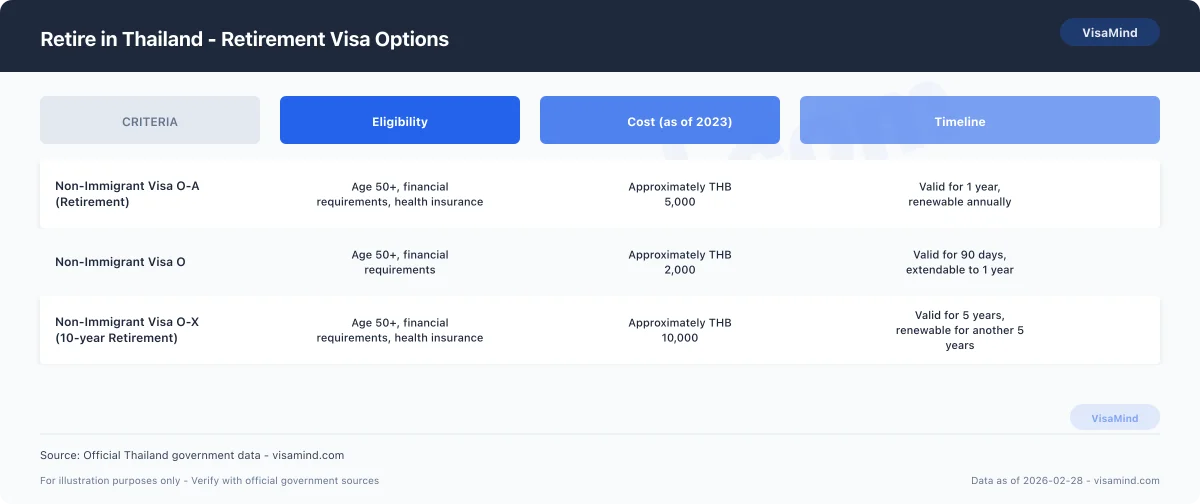
Thailand offers several visa options for retirees looking to enjoy their golden years in the "Land of Smiles." With its affordable cost of living, warm climate, and welcoming culture, Thailand is an attractive destination for retirees worldwide. Below is an overview of the primary visa categories available for retirees wishing to settle in Thailand.
| Visa | Eligibility | Cost | Timeline |
|---|---|---|---|
| Non-Immigrant Visa O-A (Retirement) | Applicants aged 50 or older, with proof of pension or income of at least 65,000 THB per month or a deposit of 800,000 THB in a Thai bank | Approximately 5,000 THB (as of 2023, verify on the official website) | Valid for 1 year; renewable annually |
| Non-Immigrant Visa O | Typically for individuals visiting family in Thailand, but can be used for retirement if certain conditions are met | Varies (verify on the official website) | Initially valid for 90 days, extendable for long-term stay |
| Non-Immigrant Visa O-X (10-year Retirement) | Applicants aged 50 or older from specific countries, with a deposit of at least 3 million THB or proof of monthly income of at least 100,000 THB | Approximately 10,000 THB (as of 2023, verify on the official website) | Valid for 5 years, renewable once for a total of 10 years |
Understanding the Visa Options
Each visa type has distinct eligibility criteria and benefits, making it crucial to choose the one that best fits your retirement plans. The Non-Immigrant Visa O-A is a popular choice, offering a straightforward path for those over 50 with sufficient financial means. Alternatively, the Non-Immigrant Visa O is more flexible, often used by those visiting family but also suitable for retirement under certain conditions.
For those seeking a longer-term solution, the Non-Immigrant Visa O-X provides a 10-year stay with more stringent financial requirements. This option is ideal for retirees from specific countries looking for stability and long-term residence in Thailand.
Application Process
To apply for any of these visas, you must lodge your application with the appropriate Thai embassy or consulate in your home country. It's important to gather all necessary documentation, such as proof of sufficient funds, medical certificates, and a clean criminal record, before starting the application process. For more detailed guidance, consider reviewing the How To Apply and Documents Checklist guides.
Tip: Ensure that all your documents are in order and meet the requirements set by the Thai Immigration Bureau to avoid delays in processing your application.
Financial Considerations
Each visa type has specific financial requirements that must be met to qualify. These requirements are designed to ensure that retirees have the means to support themselves during their stay in Thailand. You may need to provide bank statements or pension letters as evidence of your financial stability. For comprehensive details, you can explore the Financial Requirements guide.
By understanding the different visa options and their requirements, you can better plan your retirement in Thailand and make the most of your time in this beautiful country. Whether you choose a short-term or long-term visa, Thailand offers a welcoming environment for retirees from around the world.
Financial and Pension Requirements
#Understanding the financial and pension requirements is a crucial step. The Immigration Bureau of Thailand specifies certain financial thresholds that must be met to qualify for retirement visas such as the Non-Immigrant Visa O-A (Retirement) and the Non-Immigrant Visa O-X (10-year Retirement).
Financial Requirements for Retirement Visas
To ensure you meet the necessary financial criteria, you will need to provide evidence of sufficient funds through savings, pension, or regular income. Below is a comparison of the requirements for different retirement visa options:
| Visa Type | Minimum Savings Requirement | Pension Requirement | Bank Deposit Requirements |
|---|---|---|---|
| Non-Immigrant Visa O-A | ฿800,000 in Thai bank | Monthly pension of at least ฿65,000 | Must be deposited in a Thai bank account |
| Non-Immigrant Visa O-X | ฿3,000,000 in Thai bank | No specific pension requirement | ฿1,800,000 must be maintained after the first year |
Proof of Regular Income
Proof of regular income is crucial when applying for a retirement visa. You must demonstrate that you can sustain yourself financially during your stay in Thailand. For the Non-Immigrant Visa O-A, this can be shown through a combination of savings and pension or regular income, as long as the total amount meets the minimum threshold.
Important: Ensure that your bank statements or pension certificates are officially translated into Thai and certified. This will facilitate the verification process by the Immigration Bureau of Thailand.
Bank Deposit Requirements
For the Non-Immigrant Visa O-X, applicants must deposit a significant amount in a Thai bank account and maintain a minimum balance. This long-term financial commitment is a testament to your intention to reside in Thailand for an extended period.
Tip: Regularly update your bank statements to reflect compliance with the deposit requirements, especially for the Non-Immigrant Visa O-X, as the Immigration Bureau may request this information during annual renewals.
For more detailed guidance on the financial requirements, you can refer to the Financial Requirements guide, which provides additional insights and tips for ensuring you meet these criteria when planning your retirement in Thailand.
Medical Coverage for Retirees
#Retiring in Thailand comes with the need to consider your healthcare options, as medical coverage is a significant component of settling into your new life. Understanding the differences between public and private healthcare systems, the requirements for mandatory insurance, and the quality of medical facilities will be vital as you plan your retirement.
Public vs. Private Healthcare
Thailand offers both public and private healthcare options, each with its own set of benefits and considerations.
-
Public Healthcare: Available through government hospitals and clinics, public healthcare in Thailand is generally affordable. However, the services can be limited in scope and availability, particularly in rural areas. The quality of care is generally adequate but may not meet the expectations of retirees used to Western standards.
-
Private Healthcare: Private hospitals and clinics provide a higher standard of care and are more likely to have English-speaking staff. They offer quicker service and access to more advanced medical technologies. However, this comes at a higher cost, which is why many retirees opt for private health insurance.
Mandatory Health Insurance
To retire in Thailand, especially under visas like the Non-Immigrant Visa O-A (Retirement), you are required to have health insurance. This insurance must cover:
- Inpatient Coverage: At least 400,000 THB per year.
- Outpatient Coverage: At least 40,000 THB per year.
These requirements ensure that retirees can afford medical care without relying on the public system, which can be strained.
Important: Verify current insurance requirements on the official Immigration Bureau of Thailand website, as these may be subject to change.
Quality of Medical Facilities
Thailand is renowned for its medical tourism, thanks to high-quality medical facilities, particularly in urban centers like Bangkok and Chiang Mai. These facilities often feature:
- Modern Equipment: State-of-the-art technology comparable to Western standards.
- Specialized Services: Access to a wide range of specialists and treatments.
- Accredited Hospitals: Many private hospitals are internationally accredited, ensuring high standards of care.
Retirees in Thailand can benefit from a diverse array of healthcare options, but it’s crucial to have a clear understanding of your needs and preferences. For more detailed guidance on retirement visas, consider checking the Retirement Guide to make informed decisions about your healthcare coverage and other retirement-related matters.
The Application Process
#It's important to follow a structured application process to ensure your retirement visa is processed smoothly. Here's a step-by-step guide on how to apply through the Immigration Bureau of Thailand.
-
Determine Your Eligibility and Visa Type
Before starting the application process, identify the appropriate visa type for your situation. The common options for retirees are the Non-Immigrant Visa O-A (Retirement) and the Non-Immigrant Visa O-X (10-year Retirement). Make sure you meet the age, financial, and health requirements specific to each visa type.
-
Gather Necessary Documents
Collect all required documents to support your application. These typically include:
- Passport with at least one year validity
- Completed visa application form
- Recent passport-sized photographs
- Proof of financial stability (e.g., bank statements, pension statements)
- Health insurance covering your stay in Thailand
- Police clearance certificate from your country of residence
For a comprehensive checklist, refer to the Documents Checklist.
-
Submit Your Application
Applications for retirement visas can be submitted at a Royal Thai Embassy or Consulate in your home country. If you are already in Thailand, you may submit your application at the local Immigration Bureau office.
Tip: Submitting your application at least 60 days before your intended move gives ample time for processing and any unforeseen issues.
-
Attend an Interview (if required)
Some applicants may be required to attend an interview as part of the application process. Prepare by reviewing your application details and being ready to discuss your retirement plans in Thailand. Check out the Interview Prep guide for tips.
-
Await Processing and Approval
The processing time for retirement visas can vary, but it generally takes around 2-4 weeks. During this period, the Immigration Bureau will review your application and documents. You can follow up on your application's status through the contact details provided by the embassy or consulate where you applied.
Important: Ensure all documents are accurate and complete. Any discrepancies may lead to delays or refusal of your application.
-
Receive Your Visa
Once approved, you will receive your retirement visa, allowing you to reside in Thailand. Make sure to familiarize yourself with the Visa Extension Guide to maintain your visa status while staying in Thailand.
By following these steps, you can efficiently manage the application process for retiring in Thailand. For further guidance, consult the Retirement Guide for detailed information on living and settling in the country.
How Retirement Income Is Taxed
#Understanding how retirement income is taxed is crucial for financial planning. Thailand offers a favorable tax environment for retirees, but there are important details to consider, especially regarding pension income and tax treaties.
How Is Retirement Income Taxed in Thailand?
In Thailand, income tax is levied on income earned within the country. For retirees, this means that if you are receiving a pension from a foreign source, this income is generally not taxed by Thailand, provided it is not remitted into the country during the same tax year it is earned. However, if you transfer this income into Thailand in the year it is earned, it may be subject to Thai income tax.
Important: Consult a tax professional to understand how the timing of transferring your pension to Thailand can impact your tax obligations.
What About Worldwide Income?
Thailand does not tax worldwide income, which is beneficial for retirees who receive income from overseas. However, be aware that if you are considered a tax resident in Thailand, you might be required to report your global income, even though it may not be taxed. A person is generally considered a tax resident if they spend 180 days or more in Thailand in a calendar year.
Tax Treaties and Their Impact
Thailand has entered into tax treaties with numerous countries to prevent double taxation. These treaties can significantly impact how your foreign income is taxed and may provide relief from paying taxes in both your home country and Thailand. Here are a few key points regarding tax treaties:
- Double Taxation Avoidance: These treaties ensure you are not taxed twice on the same income.
- Vary by Country: The specific terms of these agreements can vary, so it is important to refer to the treaty between Thailand and your home country.
- Consultation Recommended: Engaging with a tax advisor familiar with international treaties is advisable.
Tax Obligations for Retirees
Even with favorable tax conditions, retirees must still comply with Thai tax regulations. Here are a few obligations to consider:
- Annual Tax Filing: Regardless of income source, residents must file an annual tax return with the Thai Revenue Department.
- Reporting Requirements: If you are a tax resident, you may need to declare your foreign income, even if it is not taxable.
- Verification: Always verify current tax obligations and rates on the official Thai Revenue Department website, especially as rules can change.
For more detailed guidance, you can explore resources like the Retirement Guide to understand the broader context of retirement in Thailand, while the Financial Requirements guide can provide specific financial thresholds and documentation needed for your retirement visa application.
By understanding the tax implications of retiring in Thailand, you can better manage your finances and enjoy your retirement years with peace of mind.
What Retirees Struggle With
#Retiring in Thailand offers numerous benefits, but it's not without its challenges. Here are some common struggles retirees face:
Financial Proof Requirements
- Adequate Funds: Retirees need to demonstrate financial stability, typically through a bank account in Thailand with at least 800,000 THB or proof of a monthly income of no less than 65,000 THB. Ensuring these funds are consistently available can be stressful for some applicants.
- Currency Fluctuations: Variations in exchange rates can affect the required financial thresholds, especially for those relying on foreign income or pensions.
Healthcare Gaps
- Health Insurance: Obtaining comprehensive health insurance that meets the requirements for a retirement visa, such as the Non-Immigrant Visa O-A or O-X, can be complex. Insurance must cover at least 40,000 THB for outpatient and 400,000 THB for inpatient services.
- Access to Services: While Thailand offers quality healthcare, language barriers and unfamiliar systems can make accessing services challenging.
Annual Reporting and Extensions
- 90-Day Reporting: Retirees must report their current address to the Immigration Bureau every 90 days. This can be burdensome, especially if you travel frequently within or outside of Thailand.
- Visa Extensions: The process of extending a retirement visa annually can be time-consuming and requires careful preparation of documents. Refer to the Visa Extension Guide for detailed steps.
Language Barriers
- Communication Issues: Navigating daily life and official procedures in Thai can be daunting for non-Thai speakers. While English is commonly spoken in tourist areas, official documents and communications may still be in Thai.
- Cultural Nuances: Understanding cultural expectations and social norms can aid in smoother interactions with both locals and authorities.
Tip: Consider enrolling in a Thai language course or hiring a local consultant to help with bureaucratic processes. This can greatly ease the transition and ensure compliance with visa regulations.
These challenges highlight the importance of thorough preparation and understanding of the Thai immigration system. For more detailed guidance, visit the Retirement Guide.
Where Retirees Live
#Thailand offers a variety of appealing locations that have become popular among retirees. These regions offer diverse lifestyles and cost considerations, catering to different preferences and budgets.
Popular Retirement Destinations
Many retirees choose to reside in Bangkok for its vibrant city life and access to top-notch healthcare facilities. However, the cost of living here is higher compared to other parts of Thailand. For those who prefer a slower pace and cheaper living costs, Chiang Mai in the north is a favored choice, known for its cooler climate and rich cultural experiences.
Phuket and Pattaya are also popular, offering beautiful beaches and a lively expat community. These areas provide a balance of relaxation and excitement, making them ideal for retirees seeking a coastal lifestyle.
Cost of Living Comparison
Here's a quick comparison of monthly expenses in some popular retirement destinations:
| Location | Estimated Monthly Cost (USD) | Key Features |
|---|---|---|
| Bangkok | $1,200 - $1,800 | City life, excellent healthcare |
| Chiang Mai | $900 - $1,400 | Cool climate, cultural hub |
| Phuket | $1,000 - $1,500 | Beaches, expat community |
| Pattaya | $1,000 - $1,400 | Beach town, nightlife |
Tip: Living in smaller towns or rural areas can significantly reduce your monthly expenses, but may limit access to some amenities.
Expat Communities and Activities
Thailand is home to large and active expat communities, particularly in cities like Bangkok, Chiang Mai, Phuket, and Pattaya. These communities often organize social events, volunteer opportunities, and clubs, providing a supportive network for newcomers.
Retirees can also enjoy a variety of activities such as:
- Cultural Events: Festivals and local markets
- Outdoor Activities: Hiking, golf, and water sports
- Volunteer Opportunities: Engaging with local charities and initiatives
For more information about the different visas that might suit your retirement plans, such as the Non-Immigrant Visa O or the Non-Immigrant Visa O-X (10-year Retirement), you can refer to the Visa Extension Guide for details on how to extend your stay.
How Long You Can Stay
#And annual reporting requirements is essential. The Immigration Bureau of Thailand oversees these aspects for retirees.
Visa Validity
For those applying for the Non-Immigrant Visa O-A (Retirement), the initial validity is typically one year. This visa is designed for individuals aged 50 and over who wish to retire in Thailand. An alternative is the Non-Immigrant Visa O-X (10-year Retirement), which offers extended validity but requires meeting higher financial thresholds.
Tip: Ensure your passport is valid for at least 18 months when applying for the Non-Immigrant Visa O-A to avoid issues with your visa issuance.
Renewal Process
Visa renewal is crucial for continuous stay in Thailand. For the Non-Immigrant Visa O-A, you must apply for an extension annually at the Immigration Bureau. This involves:
- Gathering necessary documents, including proof of financial stability.
- Visiting the local Immigration Office to lodge your application.
- Paying the extension fee, which is currently 1,900 THB (as of 2023; verify on the official website).
For those holding the Non-Immigrant Visa O-X, the renewal process is less frequent but requires similar documentation and proof of financial means.
Annual Reporting Requirements
Retirees must comply with Thailand's 90-day reporting rule. This means notifying the Immigration Bureau of your address every 90 days. The process can be done:
- In person at the nearest Immigration Office
- By mail, using Form TM-47
- Online, via the Immigration Bureau's e-service platform
Failing to report can result in fines and complications with future visa renewals.
Important: Always keep a copy of your 90-day report receipt as proof of compliance with reporting requirements.
Understanding these processes ensures a smooth transition to retirement in Thailand. For more detailed guidance, refer to the Visa Extension Guide and the Retirement Guide.
Path to Permanent Residence
#For retirees considering Thailand as a long-term home, understanding the path from a retirement visa to permanent residence is crucial. While holding a retirement visa does not automatically lead to permanent residency, it is a viable starting point for those looking to settle in Thailand.
Does a Retirement Visa Lead to Permanent Residence?
Holding a Non-Immigrant Visa O-A (Retirement) or Non-Immigrant Visa O-X (10-year Retirement) allows retirees to stay in Thailand for extended periods. However, these visas by themselves do not directly provide a pathway to permanent residency or citizenship.
To transition from a retirement visa to permanent residence, you must meet certain criteria set by the Immigration Bureau of Thailand. Typically, you should have lived in Thailand for at least three consecutive years under a valid visa before you can apply for Permanent Residence. This period provides ample time to understand local customs and integrate into Thai society.
Timeline and Requirements for Permanent Residence
To apply for permanent residency in Thailand, you'll need to satisfy several conditions:
- Minimum Stay: At least three years on a qualifying visa, which could include the retirement visas or other long-term visas.
- Annual Quota: Thailand has an annual quota for permanent residency applications, which varies each year.
- Application Period: Applications are usually accepted once a year, and the process can take several months.
Important: Ensure your current visa remains valid while your permanent residency application is being processed. Overstaying your visa can lead to penalties and affect your application.
Steps to Transition from Retirement Visa to Permanent Residence
- Confirm Eligibility: Ensure you meet the minimum stay requirement and have the necessary documentation.
- Gather Required Documents: This includes proof of income, medical certificates, and police clearance. Check the Documents Checklist for comprehensive details.
- Submit Application: Lodge your application with the Immigration Bureau during the designated period.
- Attend Interview: You may need to attend an interview as part of your application process. Prepare by reviewing the Interview Prep guide.
For those retirees who envision Thailand as their permanent home, understanding these pathways and preparing accordingly can facilitate a smoother transition from temporary retirement status to permanent residence. For more details on the process, you can explore the Permanent Residence visa information.
What Other Retirees Did
#A retired engineer from Canada wanted to spend his retirement years exploring Thailand's vibrant culture and natural beauty. He decided to apply for the Non-Immigrant Visa O-A (Retirement), which is managed by the Immigration Bureau of Thailand. Initially, he was concerned about meeting the financial requirements and ensuring he had the correct documentation. He carefully reviewed the financial thresholds and collected all necessary documents, such as proof of pension and health insurance. Using the Documents Checklist, he ensured that everything was in order before submitting his application. After lodging his application at the local Thai embassy, he received his visa approval in about four weeks, allowing him to enjoy his retirement in Thailand with peace of mind.
Scenario: Transitioning from a Tourist Visa to Retirement
A retired teacher from the UK had been visiting Thailand on a Tourist Visa for several months and decided she wanted to make Thailand her permanent home. She aimed to apply for the Non-Immigrant Visa O, a retirement option that offers a longer stay. Understanding the need to transition smoothly, she visited the Immigration Bureau of Thailand and consulted their guides on how to apply for a change of visa status. By gathering all the required documents, such as a bank letter and proof of address in Thailand, she submitted her application. The process took approximately six weeks, and once approved, she was able to enjoy an extended stay in Thailand without the hassle of frequent renewals.
FAQs
How long can I stay in Thailand with a Non-Immigrant Visa O-X?
What medical coverage is required for retirees in Thailand?
Is my retirement income taxed if I Retire in Thailand?
Can I apply for permanent residence after retiring in Thailand?
Where do most retirees live in Thailand?
What challenges do retirees face when moving to Thailand?
How do other retirees manage their finances in Thailand?
Sources
Last reviewed: March 1, 2026
VisaMind provides informational guidance only and is not a government agency. This is not legal advice. Requirements can change and eligibility depends on your specific facts. If your case is complex or high-stakes, consult a licensed immigration attorney.
Next steps
Requirements vary by nationality, purpose, timeline, and case details. Use Find My Visa to get a personalized checklist for Thailand with official sources and deadlines.
Find my visa