On this page
- Who Should Consider This
- Do You Qualify?
- The Application Process
- Documents and Evidence
- How Long It Takes
- Common Mistakes
- This Program vs Other Options
- Costs and Financial Thresholds
- Your Rights Under This Program
- What Others Have Done
- Visa options for this goal
- Guides for United Kingdom
- Other goals for United Kingdom
Who Should Consider This
#Applying for indefinite leave to remain (ILR) in the UK is a significant milestone for many immigrants. This status allows you to live, work, and study in the UK indefinitely. If you have resided in the UK under a qualifying visa, you might be eligible to settle permanently.
Who Is Eligible?
Eligibility for settling in the UK depends on your current visa type and how long you have lived in the country. Here are the key categories:
- Work Visa Holders: If you have lived and worked in the UK for 5 years, you might be eligible to apply.
- Tier 1 Visa Holders: You can apply after 2 or 3 years of residency, depending on the specifics of your visa.
- Innovator Founder or Global Talent Visa Holders: Eligible after 3 years in the UK.
- Family Connections: If you have a partner, parent, or child who is settled in the UK, you may qualify.
- UK Ancestry Visa Holders: Eligible after 5 years of residency.
- British National (Overseas) Visa Holders: Eligible after 5 years of residency.
- Long Residence: If you have lived in the UK for 10 years, you may apply based on long residency.
Tip: Review your specific visa type requirements on the UKVI website to ensure you meet all criteria.
Benefits of Indefinite Leave to Remain
Once granted ILR, you gain several important rights:
- Permanent Residency: Live, work, and study in the UK without time restrictions.
- Access to Benefits: If eligible, you may apply for public benefits.
- Path to Citizenship: ILR is often a stepping stone towards applying for British citizenship. For more information, see Indefinite Leave to Remain Vs Citizenship.
Special Considerations
Some additional factors might affect your eligibility or the process:
- Financial Requirements: Depending on your visa, you may need to prove financial stability.
- Proof of Relationship: If applying through a family connection, you'll need to provide documentation of your relationship.
Important: Double-check your residency duration and financial documents to avoid common pitfalls, such as failing to provide sufficient evidence or submitting outdated documents.
For more detailed guidance on the application process, including necessary documents and potential pitfalls, explore our How To Apply and Documents Checklist guides.
Do You Qualify?
#To determine if you qualify to settle in the United Kingdom with Indefinite Leave to Remain (ILR), it's important to understand the specific eligibility criteria associated with your visa type and personal circumstances. Below are the main requirements and categories that might apply to your situation.
Residency Requirements
- Work Visa Holders: Typically, you must have lived and worked in the UK for at least 5 years if you're on a work visa, such as the Skilled Worker Visa.
- Tier 1 Visa Holders: You may qualify after 2 or 3 years of residency in the UK.
- Innovator Founder or Global Talent Visa Holders: You can apply after 3 years of residency.
- UK Ancestry Visa Holders: You must have lived in the UK for 5 years.
- British National (Overseas) Visa Holders: Eligibility requires 5 years of residency.
Family and Long-Term Residency
- Family Connections: If you have a partner, parent, or child who is settled in the UK, you may be eligible.
- Long Residence: Those who have lived in the UK for 10 years continuously may apply under the ILR Long Residence category.
- Spouse or Civil Partner of a British Citizen: You must have lived in the UK for the last 3 years.
Financial and Language Requirements
- Financial Stability: Depending on your visa type, you might need to meet certain salary or financial thresholds. For more details, refer to the Financial Requirements guide.
- English Language Proficiency: Demonstrating English language skills is often required. This might involve passing an approved English language test or having an academic qualification taught in English.
Other Eligibility Criteria
- Citizenship Eligibility: If you were born in the UK and are not automatically a British citizen, you may be eligible to apply for citizenship.
- Outside the UK Applications: If you are applying from outside the UK, ensure you use the correct online process.
Important: Ensure that you have continuous and sufficient evidence of residency, such as utility bills, bank statements, or tenancy agreements, to support your application.
Key Considerations
- Multiple Eligibility Paths: If eligible through multiple routes, select the one that best fits your circumstances.
- Document Checklist: Gathering all required documentation is crucial. Refer to the Documents Checklist for a comprehensive guide.
- Avoid Common Mistakes: Ensure all documents are current and accurate to prevent delays or refusals. Common pitfalls include submitting outdated documents or lacking evidence of financial stability.
By understanding these requirements and ensuring you meet the qualifications, you can confidently prepare your application to settle in the UK. For more detailed guidance, visit How To Apply and explore the related visas and guides provided.
The Application Process
#-
Determine Your Eligibility
Before starting the application process to settle in the United Kingdom, confirm your eligibility for indefinite leave to remain (ILR). This depends on the specific visa category under which you currently reside in the UK. Common eligibility scenarios include having a Skilled Worker Visa for five years (Skilled Worker Visa), a Tier 1 Visa for two or three years, or living in the UK for ten years. You may also qualify if you are a spouse or civil partner of a British citizen and have lived in the UK for three years. Review the detailed eligibility criteria on the ILR application page.
-
Gather Your Documentation
Once you confirm eligibility, collect all necessary documents. This includes proof of residency, such as utility bills or tenancy agreements, and evidence of financial stability or salary requirements specific to your visa type. If applying through family, provide proof of relationship to a settled family member. Having a comprehensive Documents Checklist will ensure you have all required materials ready before proceeding.
-
Complete the Online Application
Access the official UK Visas and Immigration (UKVI) website to proceed with your application for ILR. Use the ILR Online Application form and follow the instructions tailored to your eligibility category. Be precise and complete all required sections. Providing accurate information, such as your National Insurance number and other personal details, is crucial to avoid processing delays.
-
Pay the Application Fee
As part of the application process, you must pay the fee for processing ILR applications. The fee varies based on your visa type and personal circumstances. Ensure you check the latest fee structure on the UKVI website, as fees are subject to change.
-
Submit Your Application and Evidence
After completing the online form and paying the required fee, submit your application along with all gathered documents. The UKVI requires evidence such as proof of residency duration and financial requirements to be submitted alongside your application.
Important: Failure to provide sufficient evidence of residency or financial stability can result in application denial. Double-check all documents against the Financial Requirements to ensure compliance.
-
Receive a Decision from UKVI
After submission, UKVI will review your application. Processing times may vary, so monitor any communication from UKVI regarding your application status. If additional information or an interview is required, respond promptly to avoid delays.
Tip: Opting for online submissions allows quicker updates and receipt confirmations, helping you track your application's progress effectively.
By following these steps, you can navigate the process of applying for indefinite leave to remain in the UK, paving the way for permanent residency and eventually British citizenship.
Documents and Evidence
#When applying to settle in the United Kingdom through UK Visas and Immigration (UKVI), it is essential to gather the appropriate documents and evidence to support your application for indefinite leave to remain (ILR). This section outlines the main documents required, including certifications and translations if necessary, to ensure a successful application process.
Proof of Residency and Immigration Status
-
Residency Documentation: Provide documents that demonstrate your continuous residency in the UK for the required duration, which varies depending on your visa type. This may include:
- Utility bills
- Council tax statements
- Rental agreements
-
Immigration Status: Include documents that confirm your current immigration status, such as:
- Biometric residence permit
- Current visa or leave to remain documents
Financial Evidence
- Financial Stability: If your visa requires meeting financial or salary thresholds, you must provide evidence such as:
- Recent bank statements
- Payslips
- Tax returns
Important: Ensure all financial documents cover the necessary period and meet the specific financial requirements related to your visa type, such as those for the Skilled Worker Visa.
Proof of Relationship (if applicable)
- Family Connections: If applying based on a relationship with a settled family member, submit:
- Marriage or civil partnership certificate
- Birth certificates for children
- Evidence of cohabitation, such as joint bills or tenancy agreements
For more information on family-related applications, see the Spouse Partner Visa details.
Document Certification and Translation
- Certification: Some documents may need to be certified copies, especially if originals are not available.
- Translation: If any documents are not in English or Welsh, they must be accompanied by a certified translation.
Additional Personal Information
- National Insurance Number: Provide your National Insurance number as part of your application.
- Identity Verification: You may need to submit a valid passport or other official identification.
Tip: Double-check that all documents are up-to-date and correctly correspond to the information in your application. Outdated or incorrect documents can lead to delays or denial.
By ensuring you have gathered all necessary documents and evidence, you can more confidently proceed with your application for indefinite leave to remain. For detailed guidance, consider reviewing the Indefinite Leave to Remain (ILR) page for more insights into the process.
How Long It Takes
#Processing times for applications to settle in the United Kingdom, specifically for indefinite leave to remain (ILR), can vary based on several factors. As a general rule, UK Visas and Immigration (UKVI) aims to process these applications within six months. However, the actual time taken can be influenced by various elements, including the complexity of your case and the completeness of your documentation.
What Affects Processing Speed?
Several factors can impact the processing time of your ILR application:
- Completeness of Application: Ensure all required documentation is included to prevent delays.
- Complexity of Case: Applications with unique or complex circumstances may take longer.
- Verification Requirements: Additional checks required for financial stability or residency proof can extend processing times.
- Peak Application Periods: Times of high demand can naturally slow down processing.
Tip: Applying online can expedite the process and provide immediate confirmation of receipt.
Expedited Processing Options
If you require a faster decision, UKVI offers a priority service for an additional fee:
- Priority Service: Decision within 5 working days.
- Super Priority Service: Decision by the end of the next working day after your appointment.
These services are subject to availability and may not be offered for all types of applications or during peak periods. Verify the availability of these services for your specific visa type on the Indefinite Leave to Remain page.
How to Ensure a Smooth Process
To facilitate a smoother and potentially quicker processing time, follow these guidelines:
- Gather All Required Documents: Ensure all evidence, such as proof of residency and financial documents, is complete and up-to-date.
- Double-Check Your Application: Review all sections of your application for accuracy.
- Consider Professional Advice: If your case is complex, seeking legal advice could provide clarity and help prevent errors.
For more detailed guidance, refer to the How To Apply and Processing Times guides.
Lastly, remember that while UKVI aims to adhere to these timelines, external factors may cause unexpected delays. Keep communication lines open with UKVI and monitor your application's status regularly.
Common Mistakes
#When applying to settle in the United Kingdom through the UK Visas and Immigration (UKVI), there are several common mistakes that can lead to delays or refusals. Understanding these pitfalls can help ensure a smoother application process.
Inadequate Documentation
- Insufficient Proof of Residency: One of the most common reasons for application refusal is the failure to provide adequate evidence of your residency duration. Ensure you have comprehensive documentation, such as tenancy agreements, utility bills, or council tax statements, covering the entire period required for your specific visa type.
- Outdated Immigration Status Documents: Submitting expired or outdated documents related to your immigration status can result in application delays. Always verify that you are providing the most current and relevant documents.
- Missing Financial Evidence: For those applying under work visas, it is crucial to meet the financial requirements. This includes providing evidence of salary or other financial stability, as outlined in your visa conditions. Review the Financial Requirements guide for specifics.
Relationship Proof Errors
- Lack of Relationship Evidence: If you are applying based on a family connection, such as being the partner or child of someone settled in the UK, ensure you provide thorough evidence of this relationship. This could include marriage certificates, birth certificates, or shared financial documents.
Application Process Mistakes
- Incomplete Online Application: Ensure every section of the online application is completed accurately. Missing information can delay processing or lead to outright refusal. Refer to the ILR Online Application for guidance.
- Incorrect Category Selection: Choose the appropriate category that matches your eligibility criteria. If you qualify under multiple categories, select the one that best aligns with your circumstances.
Tip: Thoroughly review the Visa Refusal Reasons guide to understand potential pitfalls and how to address them proactively.
Timing and Submission Errors
- Missed Deadlines: Adherence to timelines is critical. For instance, if you are applying for indefinite leave to remain (ILR) based on long residency, ensure you meet the 10-year continuous residence requirement without gaps or interruptions.
- Application from Outside the UK: If applying from outside the UK, ensure you follow the correct procedures and submit your application through the appropriate online portal.
By being aware of these common mistakes and taking steps to avoid them, you can improve your chances of a successful application to settle in the United Kingdom.
This Program vs Other Options
#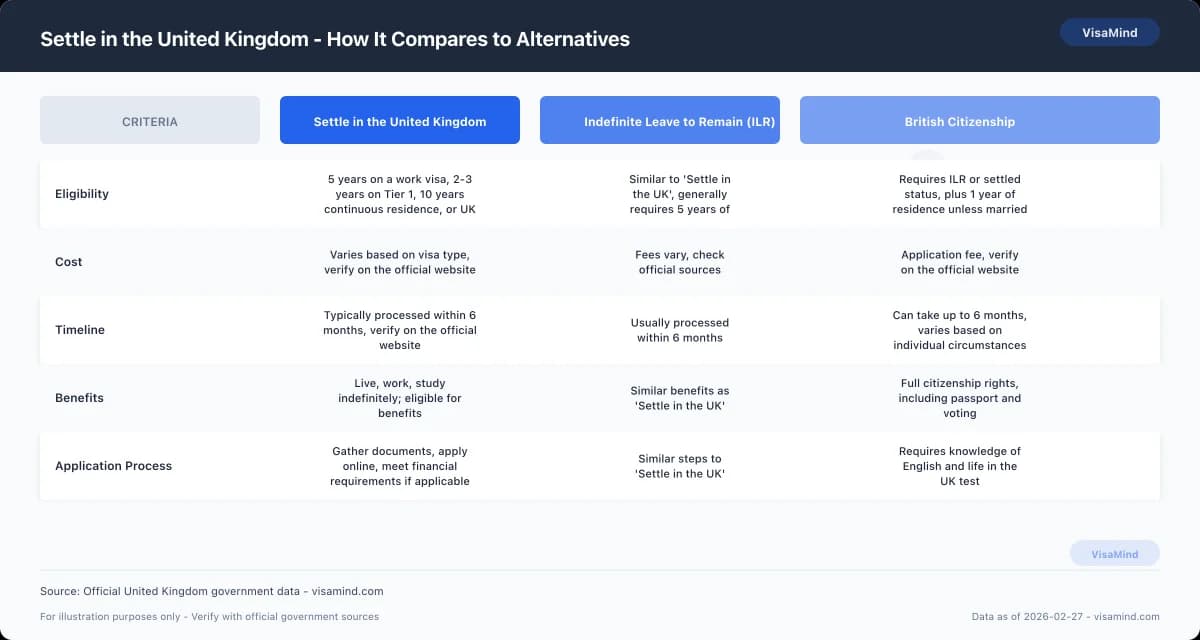
When considering the "Settle in the United Kingdom" program, it's important to understand how it contrasts with other immigration options. This program primarily focuses on obtaining Indefinite Leave to Remain (ILR), a key step toward permanent residency and potential British citizenship. Below, we compare this with other common UK immigration options to highlight the key differences.
How Does "Settle in the United Kingdom" Compare?
| Program | Eligibility | Residency Requirement | Purpose |
|---|---|---|---|
| Settle in the United Kingdom | Work visa holders after 5 years, Tier 1 visa holders after 2-3 years, Innovator Founder or Global Talent visa holders after 3 years, UK Ancestry visa holders after 5 years, family connections, or 10-year residency | 2-10 years based on visa type | Permanent residency (ILR), potential British citizenship |
| Skilled Worker Visa | Job offer from a UK employer with sponsorship | No specific residency duration for visa renewal | Work in the UK with potential pathway to ILR |
| Spouse Partner Visa | Married to or in a civil partnership with a UK citizen or settled person | Must live in the UK for 3 years before applying for ILR | Join family members residing in the UK |
| Global Talent Visa | Recognized leader or emerging leader in a field such as science or arts | Eligible for ILR after 3 years | Work and live in the UK with potential for fast-track ILR |
Key Differences to Consider
-
Eligibility Requirements: Unlike the Skilled Worker Visa, which requires a job offer and sponsorship, the "Settle in the United Kingdom" program allows for various eligibility pathways, including long-term residency and family connections.
-
Residency Duration: The residency requirement for ILR through "Settle in the United Kingdom" varies significantly, from as few as 2 years for some Tier 1 visa holders to 10 years for those applying based on long residency. This contrasts with other visas like the Spouse Partner Visa, which requires 3 years of living in the UK before ILR eligibility.
-
Long-term Benefits: Achieving ILR through this program grants you the right to live, work, and study in the UK indefinitely, and you may apply for benefits if eligible. It's a more permanent solution compared to temporary visas, which may require renewals.
Important: Ensure you meet the specific residency and financial requirements for your visa category when applying for ILR. Failure to provide adequate evidence can delay or negatively impact your application.
Conclusion
Choosing the "Settle in the United Kingdom" program depends on your current visa status and long-term goals. Whether you're looking for permanent residency through a work-related visa, family connection, or extended residency, this program offers a comprehensive pathway to settling in the UK. Consider consulting our ILR vs. Citizenship guide for further insights into transitioning from ILR to full British citizenship.
Costs and Financial Thresholds
#Understanding the financial implications is vital. This section outlines the costs and financial thresholds associated with applying for indefinite leave to remain (ILR) and other relevant visas.
Application Fees and Financial Requirements
The costs and financial thresholds for various visas leading to settlement in the UK vary. Below is a comparison of the fees and financial requirements for some common pathways to settlement.
| Visa Type | Eligibility | Application Fee | Financial Requirement |
|---|---|---|---|
| Indefinite Leave to Remain (ILR) | 5 years on a work visa | £2,404 (as of 2023) | Salary threshold applicable to your current visa |
| Global Talent Visa | 3 years in the UK | £2,404 | No minimum salary, but must demonstrate success in your field |
| Innovator Founder Visa | 3 years in the UK | £2,404 | Investment of £50,000 required |
| Spouse Partner Visa | Married to a British citizen for 3 years | £2,404 | Minimum income of £18,600 per year |
Important: The application fees are subject to change. Always verify the latest fees on the UK Visas and Immigration (UKVI) website before applying.
Financial Proof Requirements
To successfully apply for settlement, you must provide proof of financial stability. This is particularly crucial for those on work visas or those applying through a partner.
- Salary Thresholds: If you're applying through a work visa, you must meet the salary thresholds pertinent to your visa type. For instance, the Skilled Worker route requires a minimum salary of £25,600 per year.
- Investment Requirements: For the Innovator Founder Visa, proving an investment of at least £50,000 is necessary.
- Partner Income: If applying as a spouse or partner, you must demonstrate a combined income of at least £18,600 annually. This threshold increases if you have children.
Understanding these financial criteria is essential to avoid common pitfalls in the application process. For more detailed guidance on financial requirements, visit Financial Requirements.
By ensuring you meet these financial criteria, you enhance your prospects of a successful application for settlement in the UK.
Your Rights Under This Program
#When you successfully obtain Indefinite Leave to Remain (ILR) in the United Kingdom, you gain several significant rights and privileges. These rights enable you to live, work, and travel with more freedom and security.
Work and Employment Rights
With ILR, you have the right to work in the UK without restriction. This means you can:
- Accept any job without needing a work visa.
- Change employers freely.
- Be self-employed or start your own business.
This flexibility provides a strong foundation for career growth and entrepreneurship in the UK.
Travel and Residency
Holding ILR allows you to travel more freely:
- You can leave and re-enter the UK without a visa.
- However, you should not be absent from the UK for more than two consecutive years, as this could lead to the loss of your ILR status.
Important: If you plan to be away for an extended period, consider applying for a Returning Resident Visa.
Family Members
Your ILR status can positively impact your family:
- You can sponsor eligible family members for visas to join you in the UK.
- If you have a partner, child, or parent who is settled in the UK, they may also be eligible for ILR, enhancing family unity.
Restrictions and Considerations
While ILR offers many benefits, there are some restrictions to be aware of:
- ILR holders are not eligible to vote in UK general elections, though you may vote in local elections.
- You must continue to meet any conditions that apply to your immigration status, such as financial requirements if applicable.
- To apply for British citizenship, you need to have held ILR for at least one year, unless married to a British citizen. See the ILR Vs Citizenship guide for more details.
Tip: Regularly review your residency status and travel plans to maintain compliance and safeguard your ILR status.
What Others Have Done
#An entrepreneur who successfully launched a tech startup in the UK on an Innovator Founder Visa was eager to secure a more permanent status after three years of building and growing his business. He aimed to apply for Indefinite Leave to Remain (ILR) through UK Visas and Immigration (UKVI). To do so, he made sure to gather comprehensive documentation, including proof of his continuous residency and evidence of his active role in the company. He used the ILR Online Application to submit his application. Recognizing the importance of meeting all financial and business viability criteria, he also sought guidance from a legal advisor familiar with UK immigration processes. The application was successful, and within six months, he received his ILR status, allowing him to continue his entrepreneurial journey in the UK indefinitely.
Scenario: Long-Term Resident Applying Through Ancestry
A professional who had lived in the UK for five years on a UK Ancestry Visa wanted to make the UK her permanent home. She was eligible to apply for ILR, given her continuous residency and ancestry ties. Familiar with the procedural requirements, she carefully collected all necessary documents, including her birth certificate to confirm her ancestry and proof of her consistent employment during her stay. She submitted her application through the UKVI's online portal and was mindful to include all required financial documents. After a thorough review process lasting around six months, her application was approved, granting her the right to live and work in the UK indefinitely. This successful transition paved the way for her to eventually apply for British Citizenship, should she choose to do so in the future.
FAQs
Can my partner or spouse help me qualify to Settle in the United Kingdom?
What documents do I need to apply for Indefinite Leave to Remain in the UK through ancestry?
How does the Settle in the United Kingdom program compare to the British Citizenship application?
Can I apply for Indefinite Leave to Remain if I have lived in the UK for 10 years?
Is it possible to apply for Indefinite Leave to Remain with a Global Talent visa in the UK?
What role does UK Visas and Immigration play in the Settle in the United Kingdom process?
Can I combine my residency years from different visa categories to apply for Indefinite Leave to Remain in the UK?
VisaMind provides informational guidance only and is not a government agency. This is not legal advice. Requirements can change and eligibility depends on your specific facts. If your case is complex or high-stakes, consult a licensed immigration attorney.
Next steps
Requirements vary by nationality, purpose, timeline, and case details. Use Find My Visa to get a personalized checklist for United Kingdom with official sources and deadlines.
Find my visa