On this page
- Quick summary
- Overview (What is Form DS-156E?)
- Context and workflow
- Failure prevention (What causes Form DS-156E rejections?)
- What it asks for (What does Form DS-156E ask for?)
- What you need (What do you need for Form DS-156E?)
- Checklist (What is the Form DS-156E checklist?)
- Where to file
- Fees
- Form sections (What sections does Form DS-156E have?)
- Key terms
- Strategy tips
- Mistake severity
- Examples (What are examples for Form DS-156E?)
- Common misconceptions (What misconceptions surround Form DS-156E?)
- Edge cases and variations
- Scenarios
- Key differentiators
- Why it matters
- Next steps
- Verification
- Related guides
- Resources
Quick summary
#Applicants seeking a visa use DS-156E as part of the visa application process at a U.S, as described in the Online Nonimmigrant Visa Application guide, as described in the Nonimmigrant Visa Application (legacy – replaced guide. embassy or consulate.
When the official instructions indicate this form is required
Include it with your application package and follow official instructions for submission.
Names, dates of birth, and passport details on other forms Program checklist requirements Supporting documents and translations
Overview (What is Form DS-156E?)
#Applicants must thoroughly compile their documentation to substantiate their eligibility and the substantiality of their trade or investment, thereby improving their chances of obtaining an E-1 or E-2 visa. Form DS-156E is used by nationals of treaty countries to apply for these nonimmigrant visas through the Department of State. The application process requires electronic submission of detailed information about the U.S. enterprise and evidence of trade between the United States and the treaty country.
While this form is not for a K visa, which is used for a fiancé, it is crucial to ensure all documentation is complete and organized to avoid delays.
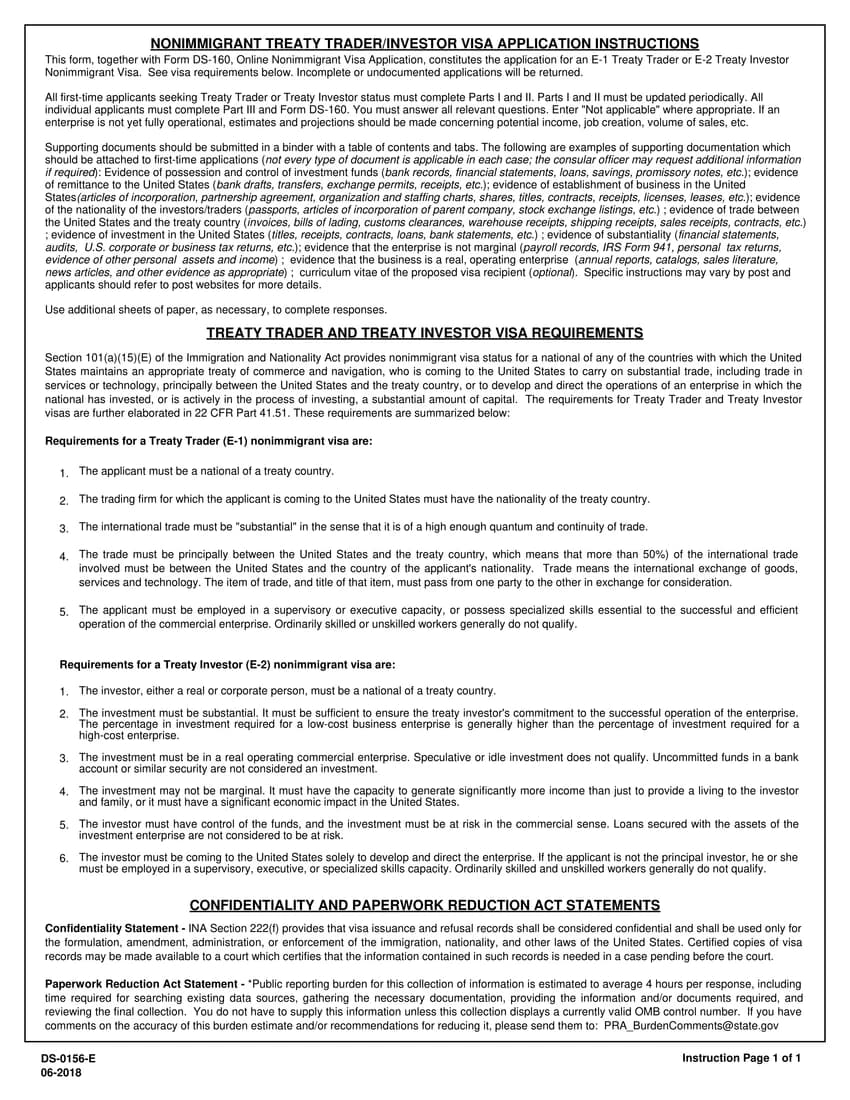
First page of DS-156E form
Source: DS-156E PDF
Context and workflow
#Processing time for DS-156E varies by location — always check the official Department of State processing time tool.
Why this matters
- This form acts as a cross-check point: details here must match other forms and supporting documents.
- This form helps confirm that the application matches the program’s requirements and checklist.
Where it fits in the workflow
- Initiating the application process for a nonimmigrant treaty trader or investor visa.
- Leads to a visa interview at a U.S. consulate or embassy.
- Receipt Notice (a related form) after submission.
- DS-156E is commonly filed alongside Form DS-160, Form DS-156.
Who uses it
Applicants seeking a visa use DS-156E as part of the visa application process at a U.S, as described in the Online Nonimmigrant Visa Application guide, as described in the Nonimmigrant Visa Application (legacy – replaced guide. embassy or consulate.
When it is used
- When the official instructions indicate this form is required
- As part of a complete application package with supporting documents
- [object Object]
- [object Object]
- [object Object]
- [object Object]
Failure prevention (What causes Form DS-156E rejections?)
#Technical rejections
- Ensure form edition is current
Substantive weaknesses
- Insufficient evidence of investment or trade volume.
- Lack of documentation proving the enterprise is not marginal.
- To avoid incomplete or inconsistent information across form: Use exact passport and document details; review all answers before submission.
- To avoid invalid or unreachable agent address: Use an address that can receive international mail; NVC correspondence is time-sensitive.
- To avoid submitting ds-261 after fees or documents: Complete DS-261 early in the NVC process before paying fees.
What it asks for (What does Form DS-156E ask for?)
#- Details about the U.S. enterprise, including name, address, and type of business.
- Information on the investment and its substantiality
- Details about the total investment from abroad and source of investment capital
- Evidence of trade between the United States and the treaty country
- Your full legal name as it appears on official documents
- Your date and place of birth
- Your current passport number and issuance details
- Documentation related to: Submit supporting documents in a binder with a table of contents and tabs
- Documentation related to: Complete all required sections, sign, and submit with required evidence
Sources for this section
What you need (What do you need for Form DS-156E?)
#- The current edition of DS-156E
- Proof of current immigration status
- Government-issued photo identification
- Passport-style photographs meeting specifications
- Supporting documents in a binder with a table of contents and tabs.
- Complete all required sections, sign, and submit with required evidence.
- Failure to provide evidence of substantiality for the investment.
- Not providing evidence that the enterprise is not marginal.
- [object Object]
- [object Object]
Checklist (What is the Form DS-156E checklist?)
#- To begin, ensure you download the most recent version of Form DS-156E along with its instructions directly from the official Department of State website.
- Review the official DS-156E instructions before filing
- Gather required supporting documents per the instructions
- Complete all required sections of DS-156E
- Sign, date, and submit DS-156E with all required supporting evidence
Sources for this section
Where to file
#Online filing is available for some categories — verify on the official form page. Otherwise, file by mail to the address in the instructions.
File online
Check the official DS-156E page to see if online filing is available for your category.
Submit application
Paper filing addresses vary by eligibility category and state of residence. Check the official instructions for the correct filing address.
Filing locations and procedures may change. Always verify on the official Department of State website before submitting.
Fees
#| Component | Amount |
|---|---|
| Filing FeeThe standard filing fee for form ds-156e. | See official schedule |
Can the Form DS-156E fee be waived?
Fee waivers may be available for qualifying applicants. See official instructions for eligibility.
What happens if I submit the wrong fee?
Department of State will reject your application if the incorrect fee is submitted. Verify the current fee on the official schedule before filing.
Fee waiver: Fee waivers may be available for qualifying applicants. See official instructions for eligibility.
Department of State fee schedule
Fees change; always verify on Department of State.
Form sections (What sections does Form DS-156E have?)
#Note
DS-156E has been replaced by DS-160.
- Use Form DS-160 for all nonimmigrant visa applications
- Access via the Consular Electronic Application Center
- Complete online at ceac.state.gov
Key terms
#- Treaty Country
- A country with which the United States has a treaty of commerce and navigation.In this form: Determines eligibility for E-1 and E-2 visas.
Strategy tips
#Mistake severity
#| Mistake type | Severity | How to avoid |
|---|---|---|
| Incomplete or inconsistent information across form | Rejection | Use exact passport and document details; review all answers before submission. |
| Invalid or unreachable agent address | Delay | Use an address that can receive international mail; NVC correspondence is time-sensitive. |
| Submitting DS-261 after fees or documents | Delay | Complete DS-261 early in the NVC process before paying fees. |
| Agent cannot receive or forward mail | Delay | Designate someone who can reliably receive and forward NVC correspondence. |
Examples (What are examples for Form DS-156E?)
#- Strong application: An applicant submits the form with all required documents and receives a timely decision.
- Strong application: A business owner provides detailed financial records and a comprehensive business plan, leading to a successful application.
- Weak application: An applicant submits the form without evidence of substantiality for the investment, resulting in a denial.
- [object Object]
- [object Object]
Common misconceptions (What misconceptions surround Form DS-156E?)
#- Filing this form does not guarantee approval of the underlying case
- Requirements may differ based on your specific situation
- [object Object]
Edge cases and variations
#- If you are asked to submit or update DS-156E, treat it as a package update: check every place the same details appear and keep them consistent.
Scenarios
#An applicant finds an old DS-156E form online. This form has been replaced by DS-160 for nearly all nonimmigrant visa applications.
DS-156E is obsolete. The applicant must use DS-160 at CEAC instead.
DS-156E was the electronic predecessor to DS-160. All nonimmigrant visa applicants now use DS-160.
A consulate's website still references DS-156E in old instructions.
Applicant should follow the CEAC link and use DS-160. Consulates may have outdated web pages.
Always use the current Consular Electronic Application Center (CEAC) for nonimmigrant visa applications.
A visa consultant provides a completed DS-156E from 2010.
Form is no longer valid. Must use DS-160.
Do not use old form versions.
Key differentiators
#- Unlike DS-160: DS-156E is specifically for treaty traders and investors, while DS-160 is a general nonimmigrant visa application.
- Unlike Form DS-160: Online Nonimmigrant Visa Application: Filed together: DS-160 required alongside DS-156E for E-1/E-2 visa processing
- Unlike Form DS-156: Nonimmigrant Visa Application (legacy – replaced by DS-160): Filed together: DS-156 base nonimmigrant form required with DS-156E at legacy posts
Why it matters
#The investment must not be marginal and should generate more than just a living for the investor.
Why it matters: Ensures the investment contributes significantly to the U.S. economy.
The trade must be principally between the U.S. and the treaty country.
Why it matters: Confirms the primary purpose of the E-1 visa is met.
Loans secured with the assets of the investment enterprise are not considered at risk.
Why it matters: Determines the genuine financial commitment of the investor.
Next steps
#- Receive a Receipt Notice (a related form) confirming submission.
- Attend a visa interview at a U.S. consulate or embassy.
- Await a decision on the visa application.
- If approved, receive the visa and prepare for travel to the U.S.
- If additional information is requested, provide the necessary documents promptly.
Verification
#This guide is based on official Department of State instructions for DS-156E and is updated when form editions or filing rules change. Always verify current requirements on the official Department of State website.
FAQs
Do I need to file DS-156E if I'm only updating my address or contact information?
Check the official instructions to see which form or process applies to your type of update. Review the official DS-156E instructions for complete guidance specific to your immigration case and circumstances.
What is the purpose of Form DS-156E?
Form DS-156E is used by nationals of treaty countries to apply for E-1 Treaty Trader or E-2 Treaty Investor visas, allowing them to engage in substantial trade or investment activities in the United States.
Can I apply for an E-1 or E-2 visa if my business is marginal?
No, the enterprise must not be marginal; it should have the capacity to generate more than just enough income to provide a minimal living for the treaty investor and their family.
What supporting documents do I need for DS-156E?
Provide evidence demonstrating possession and control of investment funds, as well as proof of trade activities between the United States and the treaty country. Organize all supporting documents in a binder, ensuring it includes a table of contents and clearly labeled tabs.
Who is eligible to file DS-156E?
Certain international travelers might qualify to enter the United States without a visa, provided they meet the criteria for visa-free travel. Before beginning the application process, it is crucial to examine the instructions pertinent to your specific eligibility category.
What are common reasons DS-156E gets rejected?
Common reasons DS-156E is rejected include missing or incorrect signatures, using an outdated form edition, incomplete required fields, incorrect fee payment, missing required supporting documents, and photographs that do not meet official specifications. Carefully review the instructions and checklist before submitting.
When will DS-156E be processed and what is the workflow?
Processing timing for DS-156E varies depending on the filing category, processing location, and current application volume. Standard processing can range from a few weeks to several months. Before submitting, check the official Department of State processing times tool for the most current estimates. After filing, monitor your case status and consider whether expedited options are available.
VisaMind provides informational guidance only and is not a government agency. This is not legal advice. Requirements can change and eligibility depends on your specific facts. If your case is complex or high-stakes, consult a licensed immigration attorney.
Next steps
Requirements vary by nationality, purpose, timeline, and case details. Use Find My Visa to get a personalized checklist with official sources and deadlines.
Find my visa