On this page
- Quick summary
- Overview (What is Form DS-160?)
- Context and workflow
- Requirements snapshot
- Failure prevention (What causes Form DS-160 rejections?)
- What it asks for (What does Form DS-160 ask for?)
- What you need (What do you need for Form DS-160?)
- Checklist (What is the Form DS-160 checklist?)
- Fees
- Processing times
- Where to file
- Key terms
- Mistake severity
- Examples (What are examples for Form DS-160?)
- Common misconceptions (What misconceptions surround Form DS-160?)
- Scenarios
- Key differentiators
- Why it matters
- Next steps
- Verification
- Related guides
- Resources
Quick summary
#Most nonimmigrant visa applicants completing consular processing, including visitor, student, exchange, work, and K visa applicants.
After choosing the visa category and before fee payment, appointment scheduling, and the consular interview.
Use the confirmation-page barcode to pay the visa fee, schedule the interview, and check in at the embassy or consulate.
Passport biographic details and prior travel records Appointment profile and confirmation-page barcode Route-specific documents such as I-20, DS-2019, I-129, or I-129F
Overview (What is Form DS-160?)
#The DS-160 is the core online application a consular officer reviews before deciding most nonimmigrant visa cases. It collects identity details, travel plans, address and work history, prior U.S. travel, security questions, and category-specific information so the embassy or consulate can compare your answers against the rest of your case file. A strong DS-160 is not about writing persuasive answers. It is about being complete, internally consistent, and accurate from the first CEAC screen through the barcode confirmation page you bring to the interview.
That is why the form works best when you prepare it alongside the broader route context, including the relevant visa category pages, the U.S. visa requirements guide, the documents checklist, and practical prep resources like visa interview practice.
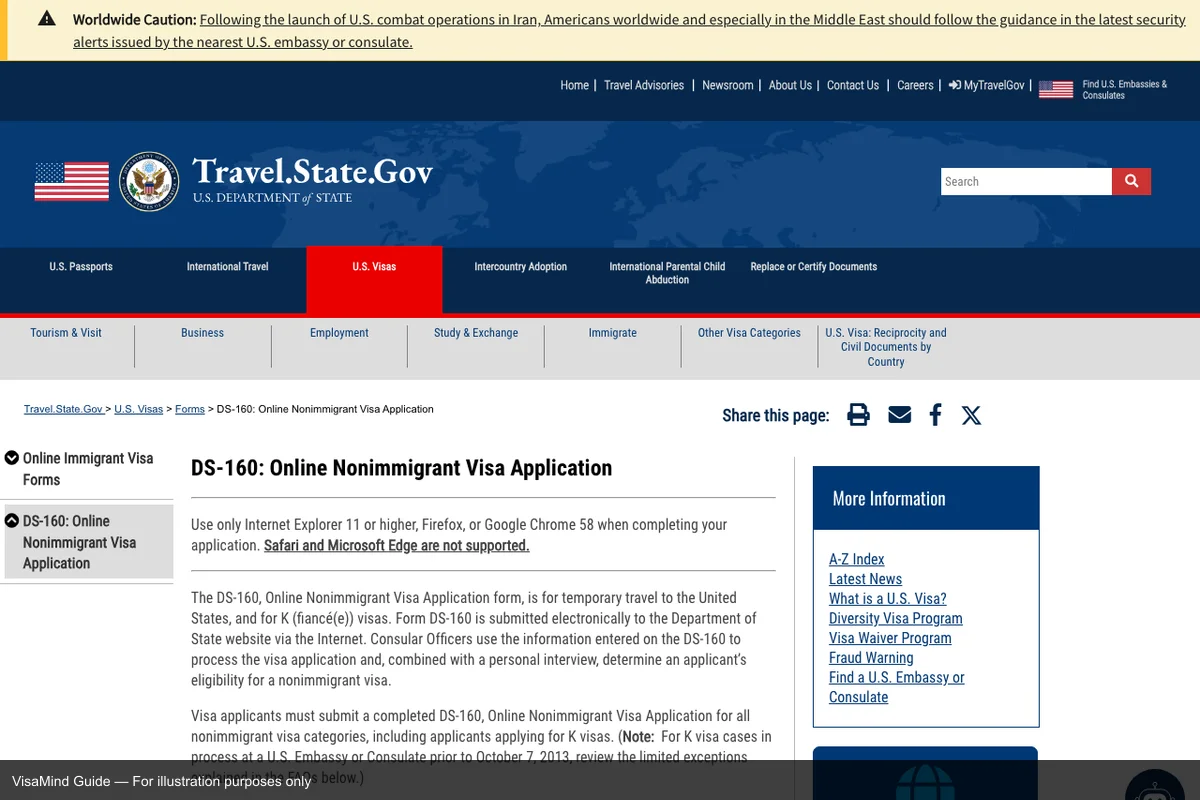
Official portal interface for DS-160
Source: DS-160 online portal
Context and workflow
#For most applicants, DS-160 is one of the first real consular steps after choosing which visa category to pursue. You start the form in the CEAC portal, select the post where you expect to apply, save the application ID and security question, complete the answers in English, submit the final version, and then use the confirmation barcode page for fee payment, appointment scheduling, and embassy or consulate check-in.
If you are still choosing the right route, it is worth comparing the visa eligibility checker, the main U.S. visa requirements page, and the all U.S. forms hub.
Where it fits in the workflow
- Initiates the nonimmigrant visa application process at the consular stage.
- Leads to visa-fee payment and interview scheduling through the embassy or consulate process for your post.
- Precedes the visa interview, where the officer compares the barcode-linked DS-160 against your passport and supporting documents.
- Appointment wait times vary by embassy or consulate, and additional administrative processing can extend the overall case timeline.
- DS-160 is often used alongside route-specific records such as I-20, DS-2019, I-129, or I-134.
Who uses it
Most people applying for a temporary U.S. visa through a consulate or embassy need DS-160. That includes visitor visa applicants, students, exchange visitors, many petition-based workers, treaty traders and investors, and K visa applicants. Each person normally needs a separate DS-160, even children and dependents. It is not the immigrant visa form, and it does not replace supporting records such as an I-20, DS-2019, approved petition notice like I-129, or financial support evidence like I-134. If you are preparing for the interview stage, the next helpful pages are usually visa interview prep and visa interview practice.
When it is used
- B-1/B-2 visitor visa applicants applying for business or tourism travel
- F-1 and M-1 students before the visa interview stage
- J-1 exchange visitors using information from Form DS-2019 and the broader visa interview prep guide
- H-1B, L-1, O-1, and similar petition-based applicants after petition approval and before consular interview
- K-1 applicants completing the consular application stage after petition approval and before visa interview practice
- E-1 and E-2 applicants who need the DS-160 as part of treaty trader or treaty investor processing, sometimes with an additional form such as DS-156E
Requirements snapshot
#- DS-160 is the standard online application for most nonimmigrant visa interviews, including B-1/B-2, F-1, H-1B, and L-1.
- After submission, you generally need the confirmation barcode page for fee payment, scheduling, and interview check-in, plus broader prep through the visa interview prep guide.
- The form does not by itself approve a visa, schedule the appointment, or grant status, so many applicants also use the visa eligibility checker and visa interview practice tool.
Failure prevention (What causes Form DS-160 rejections?)
#Technical rejections
- Submitting answers in the wrong language format or leaving required screens incomplete.
- Failing to save the application ID and confirmation barcode page.
- Using a photo that does not meet the current technical specifications.
Substantive weaknesses
- Entering travel, school, or employment history that does not match the supporting documents you will take to the interview.
- Using the wrong embassy or consulate location for your case planning.
- Uploading a photo that does not meet the specified requirements.
What it asks for (What does Form DS-160 ask for?)
#- Passport and identity details exactly as shown on your travel document
- Travel plans, U.S. point-of-contact details, and the embassy or consulate where you expect to interview
- Previous U.S. travel, prior visa refusals, and other immigration history
- Work, education, and training history, including current employer or school information
- Security and background questions covering arrests, immigration violations, medical issues, and other admissibility topics
- Category-specific identifiers such as a SEVIS ID for students and exchange visitors or petition details for employment-based applicants
Sources for this section
What you need (What do you need for Form DS-160?)
#- A valid passport and any prior passport details you need for travel or visa history questions
- Your intended travel dates, U.S. address or hotel information, and a U.S. point of contact if you have one
- Five years of address, work, and education history if your route requires those details
- Your previous U.S. travel dates, prior visa numbers, refusal history, and any petition, case, or SEVIS information that applies to your category
- A digital visa photo that meets Department of State standards, plus the wider U.S. documents checklist
- A plan for saving progress, including your application ID, security-question answer, and a local save if you may need more than 30 days to return
- Route-specific documents such as I-129, I-129F, I-134, an I-20, or a DS-2019 so the form matches the file you will present later
Checklist (What is the Form DS-160 checklist?)
#- Start only after you have your passport, travel details, and category-specific records in front of you.
- Choose the embassy or consulate you expect to use and save your application ID and security question as soon as the session begins.
- Complete every screen in English, except where the form specifically asks for your full name in your native alphabet.
- Match names, dates, passport numbers, SEVIS IDs, petition details, and prior travel history exactly to your supporting documents.
- Save your progress as you go, and download a local copy if you may need more than 30 days before returning.
- Upload or prepare a compliant visa photo and check whether the confirmation page shows a successful photo image or an X that means you need to bring a printed photo.
- Print or save the DS-160 confirmation barcode page because you will need that page, not the full application, for scheduling and interview processing.
Sources for this section
Fees
#| Component | Amount |
|---|---|
| DS-160 submissionThere is no separate filing fee just to complete and submit the DS-160 online. | $0 |
| Nonimmigrant visa application feeMost applicants must pay a separate visa application processing fee before the interview can be scheduled. The amount depends on the visa category and reciprocity rules. | Usually $185 or $205 |
Do I pay a DS-160 fee or a visa fee?
Usually both concepts appear together in search results, but they are not the same. DS-160 itself has no separate submission fee, while the nonimmigrant visa category often has a separate application fee that must be paid during the consular process.
Should I verify the fee before I schedule the interview?
Yes. Review the Department of State visa fee page and the embassy or consulate instructions for your post, because category rules and local procedures can affect how and when the fee is paid.
Fee rules can change, and some visa types have separate reciprocity or category-specific charges. Verify on the Department of State site and your post's instructions before paying.
Processing times
#- Submitting DS-160 online is immediate once you finish the form, but the real timeline depends on how quickly you can pay the visa fee, get an interview slot, and complete post-specific steps.
- The Department of State says interview wait times are estimates based on workload and staffing, and they can change from week to week.
- Interview-waiver processing and interview appointments follow different queues, and local post procedures can add steps for students, exchange visitors, and urgent travel requests.
- The wait-time tools do not include the extra time required for administrative processing or passport return after the interview.
- If a consular officer needs additional review after the interview, the case may enter administrative processing and the timeline becomes highly case specific.
Where to file
#You complete and submit DS-160 online through the Consular Electronic Application Center (CEAC), then follow the website of the U.S. embassy or consulate where you plan to apply for fee payment, scheduling, and interview instructions.
File online
Start, save, retrieve, and submit the DS-160 through the official CEAC portal. Save the application ID and security question so you can return if needed.
Submit application
After submission, use the confirmation-page barcode for scheduling and interview processing. The Department of State notes that the post where you actually apply should generally be able to access the form using that barcode, but local instructions still control the next steps.
The embassy or consulate does not schedule the appointment for you. Always review the website of the post where you will apply for local procedures, interview-waiver rules, and document-submission instructions.
Key terms
#- SEVIS ID
- A unique identifier for students and exchange visitors in the U.S.In this form: Used to track and verify student and exchange visitor status.
- Application ID
- The unique number CEAC assigns when you begin a DS-160.In this form: You use it to retrieve, finish, or reprint the application and confirmation page.
- Confirmation page barcode
- The barcode printed on the DS-160 confirmation page after submission.In this form: Posts use it to pull up your DS-160 for scheduling, interview processing, and check-in.
Mistake severity
#| Mistake type | Severity | How to avoid |
|---|---|---|
| Submitting answers in a language other than English, except where the form specifically requests a native-alphabet name | Rejection | Complete all answers in English characters unless the field explicitly allows a native script entry. |
| Passport, travel-history, SEVIS, or petition details do not match the supporting records | Delay | Complete DS-160 with the passport, I-20, DS-2019, petition notice, and prior visa records in front of you. |
| Replacing DS-160 after submission but failing to update the appointment record to the correct barcode | Delay | If you submit a new DS-160, make sure the interview scheduling profile and the confirmation page you bring both use the new barcode. |
| Photo upload failed but applicant arrives without the required printed photo | Delay | Check the confirmation page before interview day. If the photo box shows an X, bring a printed photo that meets the official standards. |
| Applicant arrives without the DS-160 confirmation page | Delay | Print or reprint the confirmation page from CEAC and keep it with the interview file. |
Examples (What are examples for Form DS-160?)
#- Common weakness: An applicant submits an incomplete form or misses required signatures, causing rejection or delay.
- Strong application: A student applying for an F-1 visa submits the DS-160 with accurate personal and educational details, includes their SEVIS ID, and brings all required documents to the interview, resulting in a smooth process.
Common misconceptions (What misconceptions surround Form DS-160?)
#- Filing this form does not guarantee approval of the underlying case
- Requirements may differ based on your specific situation
- Some applicants assume that completing the DS-160 guarantees a visa interview appointment; however, you must contact the embassy or consulate to schedule the interview separately.
Scenarios
#An F-1 student completes DS-160 only after getting the final I-20, checks the SEVIS ID carefully, and brings the barcode page and school records to the interview.
The officer can compare the DS-160 cleanly against the school documents and the case moves through interview review without an avoidable mismatch.
DS-160 works best when the category-specific documents are final before you submit.
A visitor visa applicant submits a corrected DS-160 after spotting a passport-number mistake but forgets to update the appointment profile to the new barcode.
The interview day becomes harder because the post may need extra steps to locate the right application or may require the applicant to follow local correction instructions.
When you replace a DS-160, always make sure the appointment record and the confirmation page match.
A worker applicant sees an X where the photo should be on the confirmation page and arrives with a printed photo that meets the Department of State requirements.
The failed upload does not automatically derail the case because the applicant followed the official fallback instructions.
Treat the confirmation page photo box as a final quality check before interview day.
Key differentiators
#- Unlike DS-260: The DS-160 is for nonimmigrant visas, while the DS-260 is for immigrant visas.
Why it matters
#The DS-160 must be completed in English, except for the full name in the native alphabet.
Why it matters: Submitting the form in another language will result in denial.
You can return to a partially completed DS-160 for 30 days in CEAC, and longer if you save the application file locally.
Why it matters: Applicants who lose the application ID or fail to save a copy often have to rebuild work they could have preserved.
The confirmation page, not the full DS-160 printout, is the critical document for interview processing.
Why it matters: Without the confirmation page and barcode, the post may not be able to retrieve the case.
If the confirmation page shows an X where the photo should be, the Department of State treats that as a failed upload.
Why it matters: Applicants should bring a printed photo that meets the official standards instead of assuming the digital upload was accepted.
Petition-based workers and exchange or student applicants should keep the petition, I-20, or DS-2019 in front of them while completing DS-160.
Why it matters: Those category-specific details are some of the easiest places for avoidable inconsistencies to appear.
Next steps
#- Save and print the DS-160 confirmation page with barcode, and reprint it from CEAC if you misplace it.
- Pay the nonimmigrant visa application fee required for your category and follow the local embassy or consulate instructions to schedule the appointment.
- Review the [Department of State wait-time tools](https://travel.state.gov/content/travel/en/us-visas/visa-information-resources/wait-times.html) and the website of the post where you will apply so you know the local process.
- Assemble your passport and route-specific evidence such as an I-20, DS-2019, petition notice, or financial support documents.
- If the photo area on the confirmation page shows an X, bring a printed photo that meets the official requirements.
- Attend biometrics or interview appointments and answer consistently with the DS-160 you submitted.
- Track the case through the consular process and respond quickly if additional documents or administrative-processing follow-up are requested.
Verification
#This guide is grounded in official Department of State information for DS-160 and is meant to help you prepare a cleaner, more accurate filing. Always verify the current instructions and embassy-specific process before you submit or book an interview.
FAQs
At what point in the visa process do I complete DS-160?
Most applicants complete DS-160 before paying the visa fee and before booking the visa interview. You submit it early in the consular process, then use the confirmation page when paying fees, scheduling the appointment, and preparing interview documents for your embassy or consulate. The next useful prep links are often the visa interview prep guide and visa interview practice tool.
Is there a separate filing fee for DS-160?
There is no separate filing fee just to submit the DS-160 itself. Most applicants do pay a separate nonimmigrant visa application fee before the interview can be scheduled, and the amount depends on the visa category and Department of State fee schedule.
Can I save my DS-160 application and complete it later?
Yes. Save the application ID and your security-question answer immediately. The Department of State says you can return to a partially completed DS-160 in CEAC for up to 30 days, and longer if you save the file to your computer. While you are saving your progress, it also helps to keep your interview prep links handy, especially visa interview prep and visa interview practice.
What should I do if I make a mistake on my DS-160?
If you catch the mistake before the interview, the usual fix is to complete a new DS-160 or retrieve the application in CEAC if the post allows corrections, then make sure your appointment record uses the correct barcode confirmation page. Before resubmitting, cross-check the route-specific documents tied to your case, such as I-129, I-129F, I-134, and the broader U.S. visa requirements.
Do I bring the whole DS-160 to the interview?
Usually no. The Department of State says applicants are generally required to bring the confirmation page with the application ID number, not the full DS-160. Without that confirmation page, the embassy or consulate may not be able to process the case.
What if the confirmation page shows an X where the photo should be?
That usually means the photo upload failed. In that situation, the Department of State instructs applicants to bring a printed visa photo that meets the official requirements together with the DS-160 confirmation page, and to follow the local embassy or consulate instructions.
VisaMind provides informational guidance only and is not a government agency. This is not legal advice. Requirements can change and eligibility depends on your specific facts. If your case is complex or high-stakes, consult a licensed immigration attorney.
Next steps
Requirements vary by nationality, purpose, timeline, and case details. Get a personalized plan with official sources and deadlines.
Get my plan