On this page
- Overview (What is Form I-129F?)
- Context and workflow
- Failure prevention (What causes Form I-129F rejections?)
- What it asks for (What does Form I-129F ask for?)
- What you need (What do you need for Form I-129F?)
- Checklist (What is the Form I-129F checklist?)
- Form sections (What sections does Form I-129F have?)
- Common mistakes (What mistakes are common with Form I-129F?)
- Examples (What are examples for Form I-129F?)
- Common misconceptions (What misconceptions surround Form I-129F?)
- Scenarios
- Why it matters
- Next steps
- Verification
- Related guides
- Resources
Overview (What is Form I-129F?)
#Additionally, USCIS requires electronic payment methods for filing fees unless an exemption is granted, in which case Form G-1651, Exemption for Paper Fee Payment, must be submitted.
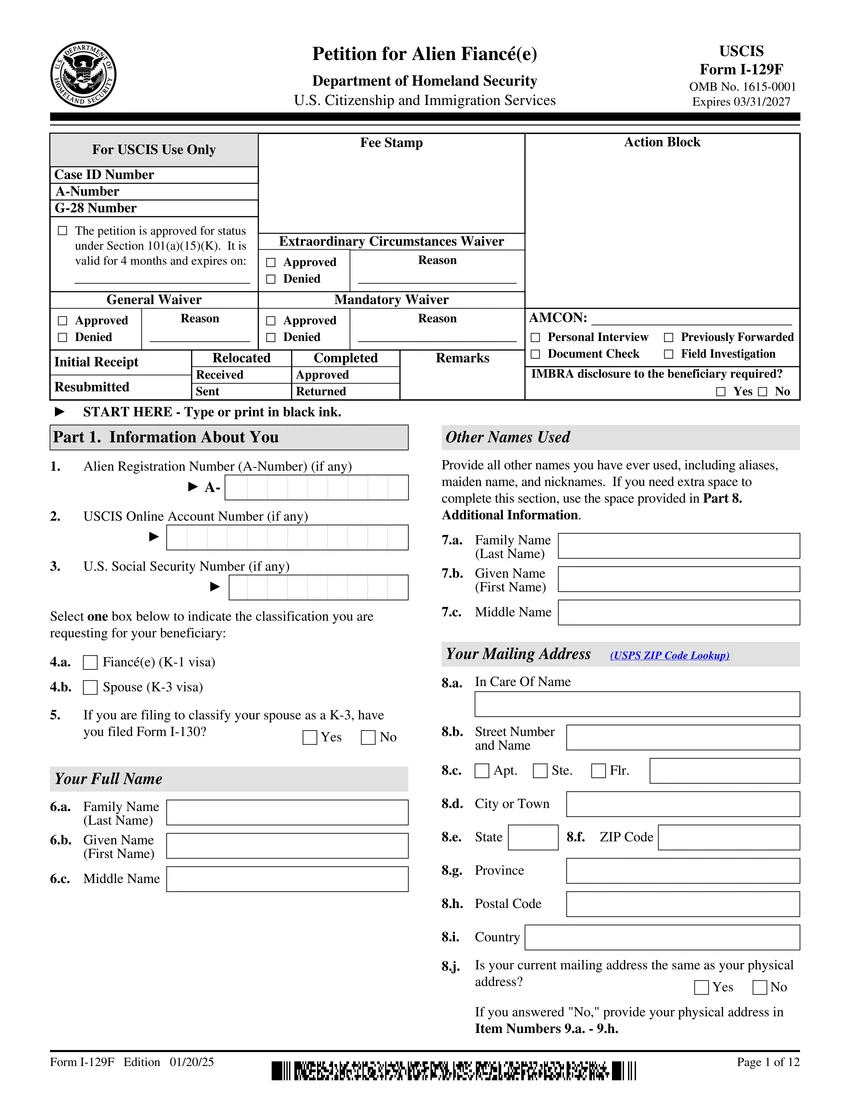
First page of I-129F form
Source: I-129F PDF
Context and workflow
#Processing time for I-129F varies by category — always check the official USCIS processing time tool.
Where it fits in the workflow
- Initiating the fiancé(e) visa process.
- Receipt Notice (a related form) issued upon acceptance.
- Attend biometrics appointment (fingerprints, photo, and signature) if required.
- Approval leads to visa processing at a U.S. consulate abroad.
- I-129F is commonly filed alongside Form I-134.
Who uses it
The petitioner (sponsor) files this form on behalf of the beneficiary (the relative).
When it is used
- K-1: K-1 Fiancé(e) Visa
Failure prevention (What causes Form I-129F rejections?)
#Technical rejections
- Submitting the form without a valid signature.
- Failing to provide translations for documents not in English.
- Ensure form edition is current
Substantive weaknesses
- Insufficient evidence of a bona fide relationship.
- Omitting details of previous marriages or their terminations.
What it asks for (What does Form I-129F ask for?)
#- Details about the relationship between the petitioner and the beneficiary.
- Biographic information including ethnicity, race, height, weight, eye color, and hair color.
- Criminal history and any related documents if applicable.
- Applicant identification information
- Supporting documentation inventory
- Eligibility or purpose details
- Declarations and signatures
What you need (What do you need for Form I-129F?)
#- The current edition of I-129F
- Proof of your own immigration status (citizenship certificate, passport, or green card (Permanent Resident Card))
- Evidence of the qualifying relationship
- Beneficiary identification documents and photographs
- Certified copies of court and police records for any arrests or convictions involving the petitioner or beneficiary.
Checklist (What is the Form I-129F checklist?)
#- Download the current I-129F and instructions from the official USCIS website
- Review the official I-129F instructions before filing
- Gather required supporting documents per the instructions
- Complete all required sections of I-129F
- Confirm the form is signed and dated in all required fields
- Sign, date, and submit I-129F with all required supporting evidence
Form sections (What sections does Form I-129F have?)
#Part 1. Information About You Item Number
Part 1. Information About You
- Required for K-3 Spouse Visa: I-130 receipt notice
- USCIS verifies eligibility category.
Part 4. Biographic Information
Complete this section as described in the official instructions.
- Submitting a petition without a valid signature.
- Failing to provide a full English translation for documents in a foreign lang...
- Submitting original documents when not required, which may be destroyed.
- USCIS verifies this section.
Common mistakes (What mistakes are common with Form I-129F?)
#- Submitting a petition without a valid signature.
- Failing to provide a full English translation for documents in a foreign language.
- Not attending the biometric services appointment.
- Submitting original documents when not required, which may be destroyed.
- Failing to provide certified copies of court and police records for any arrests or convictions.
- Submitting incorrect or incomplete evidence.
- Not providing photographs that meet the specified requirements.
Examples (What are examples for Form I-129F?)
#- Strong application: An applicant submits the form with all required documents and receives a timely decision.
- Weak application: An applicant fails to provide evidence of meeting their fiancé(e) in person within the last two years, resulting in a request for additional evidence and delayed processing.
Common misconceptions (What misconceptions surround Form I-129F?)
#- Filing this form does not guarantee approval of the underlying case
- Requirements may differ based on your specific situation
- Some applicants assume that meeting their fiancé(e) online is sufficient evidence of a relationship; however, evidence of having met in-person within two years of filing the form is required.
Scenarios
#A software engineer submitted their petition with all supporting documents
The case was approved within the standard timeline
Prepare all evidence before filing to avoid delays
Why it matters
#A K-4 nonimmigrant is only eligible to adjust to lawful permanent resident status if under 18 when the K-3 parent marries.
Why it matters: This affects the eligibility of children to adjust status, impacting family unity.
Meeting in person requirement can be waived if it violates strict customs or causes extreme hardship.
Why it matters: Understanding this can prevent unnecessary denials due to unmet requirements.
Photocopied signatures are accepted if they are of the original handwritten signature.
Why it matters: Ensures that submissions are not rejected due to signature issues.
IMBRA requires disclosure of any permanent protection or restraining orders.
Why it matters: Failure to disclose can result in denial of the petition.
Next steps
#- Receive Receipt Notice (a related form) confirming form acceptance.
- Attend biometrics appointment (fingerprints, photo, and signature) if required.
- Await notice of action regarding approval or denial.
- If approved, proceed with visa processing at a U.S. consulate abroad.
Verification
#This guide is derived from official USCIS instructions for I-129F and is updated when form editions or filing rules change. Always verify current requirements at the official USCIS website.
FAQs
What are the most common errors when completing Form I-129F, and what happens if it is rejected?
Common issues with I-129F include: • Insufficient evidence of the claimed relationship • Inconsistencies between the petition and supporting documents • Missing information about derivative applicants • Petitioner status documentation not current Carefully organize your evidence package to address each requirement.
What happens if I make an error on Form I-129F or need to correct something after filing?
If your filing is accepted but later found deficient, you may receive a request for evidence (RFE). Generally, forms should be filed according to the sequence outlined in the official instructions for your immigration category.
Can I file Form I-129F if I've already left the country or my situation has changed?
Review the official I-129F instructions for your situation. Review the official I-129F instructions for complete guidance specific to your immigration case and circumstances.
What evidence is required to prove the termination of previous marriages?
Applicants need to provide legal documents such as a divorce decree or death certificate to prove the termination of any previous marriages.
VisaMind provides informational guidance only and is not a government agency. This is not legal advice. Requirements can change and eligibility depends on your specific facts. If your case is complex or high-stakes, consult a licensed immigration attorney.
Next steps
Requirements vary by nationality, purpose, timeline, and case details. Use Find My Visa to get a personalized checklist with official sources and deadlines.
Find my visa