
On this page
- Quick summary
- Overview (What is Form I-485?)
- Context and workflow
- Requirements snapshot
- Eligibility Category Codes
- Failure prevention (What causes Form I-485 rejections?)
- What it asks for (What does Form I-485 ask for?)
- What you need (What do you need for Form I-485?)
- Checklist (What is the Form I-485 checklist?)
- Fees
- Processing times
- Where to file
- Form sections (What sections does Form I-485 have?)
- Choose your path
- Category comparison
- Strategy tips
- Mistake severity
- Examples (What are examples for Form I-485?)
- Common misconceptions (What misconceptions surround Form I-485?)
- Edge cases and variations
- Scenarios
- Key differentiators
- Why it matters
- Next steps
- Verification
- Related guides
- Resources
- Visual references
Quick summary
#Applicants in the United States who are eligible to adjust to lawful permanent resident status through a family, employment, humanitarian, K, diversity, or other qualifying immigrant category.
After you have the right immigrant basis and, when required, a current priority date that lets your category file now.
File the packet with USCIS, then move through receipt notices, biometrics, possible RFEs, and sometimes an interview before final adjudication.
Names, dates of birth, A-Numbers, and passport details across every form in the packet Underlying petition records, category code, and visa-bulletin timing when applicable Civil documents, translations, medical packet, and financial support documents where required
Overview (What is Form I-485?)
#Form I-485 is used to apply for lawful permanent resident status from within the United States. In practical terms, it is the form that turns an approved or concurrently filed immigrant basis into an adjustment-of-status case USCIS can adjudicate. Applicants must generally be physically present in the United States, in the correct eligibility category, and able to file only when an immigrant visa is immediately available unless their category is exempt from that rule.
Some applicants can file concurrently with forms such as I-130 or I-140, while others must wait until the petition is approved and the visa bulletin permits filing. A strong I-485 filing is not just a completed form. It is a coordinated packet with the right eligibility basis, medical evidence, financial evidence where required, and consistent answers across the entire case file.
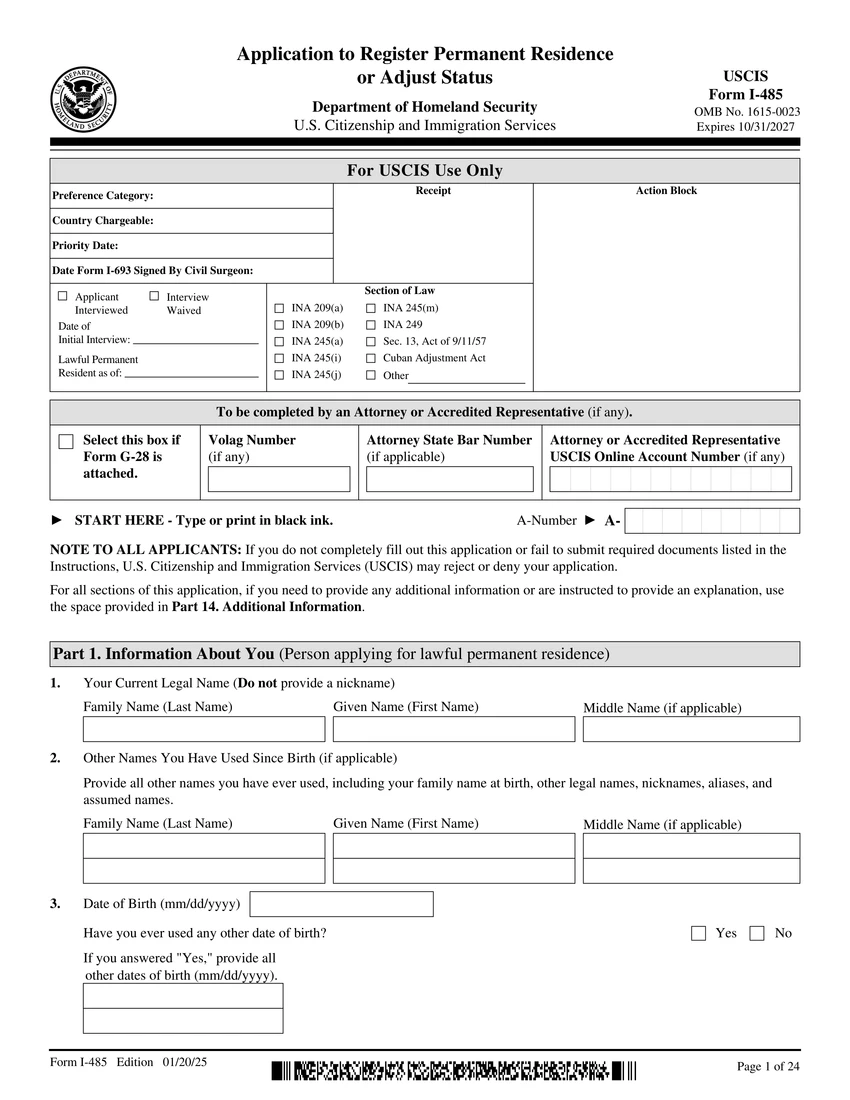
First page of I-485 form
Source: I-485 PDF
Context and workflow
#I-485 sits in the middle of the green-card journey, not at the beginning. You usually reach this step after a family, employment, humanitarian, or special immigrant basis exists and after checking that your category can file now. Once submitted, the case typically moves through receipt notices, biometrics, possible requests for evidence, and sometimes an interview before a decision. If you are deciding whether this is the right path, compare the U.S. visa requirements, I-130, I-140, and all U.S. forms pages before filing.
Why this matters
- Small mismatches inside I-485 (or between I-485 and supporting evidence) can force rework later in processing.
- This form helps confirm that the application matches the program’s requirements and checklist.
Where it fits in the workflow
- Starts the USCIS adjustment-of-status case that can lead to a green card from inside the United States.
- Usually follows an underlying immigrant basis such as an approved or concurrently filed I-130 or I-140, or a humanitarian or special-category adjustment path.
- Moves through receipt notices, biometrics, possible RFEs, and in some cases an interview before final adjudication.
- Can run alongside I-765 and I-131, but those companion benefits now have separate fee considerations for newer filings.
- Ends in approval, denial, or another action depending on eligibility, admissibility, and the completeness of the filing package.
Who uses it
I-485 is for people in the United States who are eligible to become lawful permanent residents without leaving for consular processing. Common groups include immediate relatives and family-preference beneficiaries, employment-based applicants with a current priority date, asylees, refugees, certain K-1 entrants who married the petitioner, diversity visa selectees filing in time, and other special categories described in the USCIS instructions. It is not the right form for people applying from abroad, and it is not the same as simply changing or extending nonimmigrant status.
When it is used
- IR-1: IR-1 Immigrant Visa (Spouse of US Citizen)
- CR-1: CR-1 Conditional Resident Visa (Spouse)
- EB-1: EB-1 Employment-Based First Preference
- When petitioning for IR-1 — approval of I-485 is a step toward this visa category
- When filing I-485 alongside I-130 (Concurrent filing for immediate relatives of U.S. citizens)
- When filing I-485 alongside I-140 (Concurrent filing for employment-based when current)
- When filing I-485 alongside I-765 (Work authorization while adjustment is pending)
- When filing I-485 alongside I-131 (Advance parole for travel while pending)
Requirements snapshot
#- family: Through I-130 petition (spouse, parent, child of U.S. citizen or LPR)
- employment: Through I-140 petition (EB-1, EB-2, EB-3) when priority date is current
Eligibility Category Codes
#Eligibility information for this form. Confirm your category in the official instructions before filing.
This is a shortlist of common categories. The official instructions include many more.
| Code | Who applies |
|---|---|
| General | Review the official instructions to confirm you meet the filing requirements for I-485. |
| Eligibility | You may apply as the principal applicant or as the spouse or child of a principal applicant. |
Failure prevention (What causes Form I-485 rejections?)
#Technical rejections
- Failure to sign the application.
- Submitting original documents unnecessarily.
Substantive weaknesses
- Lack of required supporting documentation or translations.
- To avoid filing before priority date is current (employment-based): Check the visa bulletin; file only when your category and priority date are current.
- To avoid missing i-693 or medical exam completed more than 60 days before filing: Complete I-693 within 60 days of filing; civil surgeon must sign Form I-693.
- To avoid missing i-864 affidavit of support (family-based): Include I-864 and supporting tax/income documents for family-based cases.
- To avoid not in valid nonimmigrant status when filing (for those who require it): Verify eligibility; immediate relatives may file even if out of status; others may not.
What it asks for (What does Form I-485 ask for?)
#- Biographical information, immigration history, and your current U.S. address and contact details
- Your admission, inspection, parole, or other basis for being in the United States
- Your immigrant category and whether you are filing as a principal or derivative applicant
- Marriage, family, employment, or humanitarian facts that support the adjustment category
- Public-charge and inadmissibility-related questions, including criminal, immigration, and security history
- Information that must line up with the petition, visa-bulletin timing, and supporting documents in the package
- Interpreter, preparer, and signature certifications
Sources for this section
What you need (What do you need for Form I-485?)
#- The current edition of I-485 and the instructions for your filing category
- Proof of your identity, admission or parole, and current or prior immigration status as required for the category
- A copy of the underlying petition approval or concurrent filing evidence, such as I-130 or I-140
- Required civil documents, including birth, marriage, divorce, or court records where applicable
- A properly prepared I-693 or partial I-693 when your category must submit medical evidence with I-485
- An I-864 package for family-based cases that require an affidavit of support
- Passport-style photos, translations, and any category-specific supplements such as I-485 Supplement J
- A payment plan that follows the current USCIS fee and payment rules, including the fee calculator for your filing situation
Checklist (What is the Form I-485 checklist?)
#- Download the current I-485 edition and instructions from USCIS and confirm every page is from the same edition.
- Confirm that your immigrant category is eligible to file now and that your priority date is current if your category depends on visa availability.
- Gather the underlying petition evidence, civil documents, translations, and category-specific support documents before filling in the form.
- Include the required I-693 or partial I-693 with the filing when your category must submit medical evidence with I-485.
- Check the correct filing address for your category and residence, and make sure your payment method follows the current USCIS lockbox rules.
- Review the entire package for signatures, consistency, and all required attachments before mailing or filing online.
Sources for this section
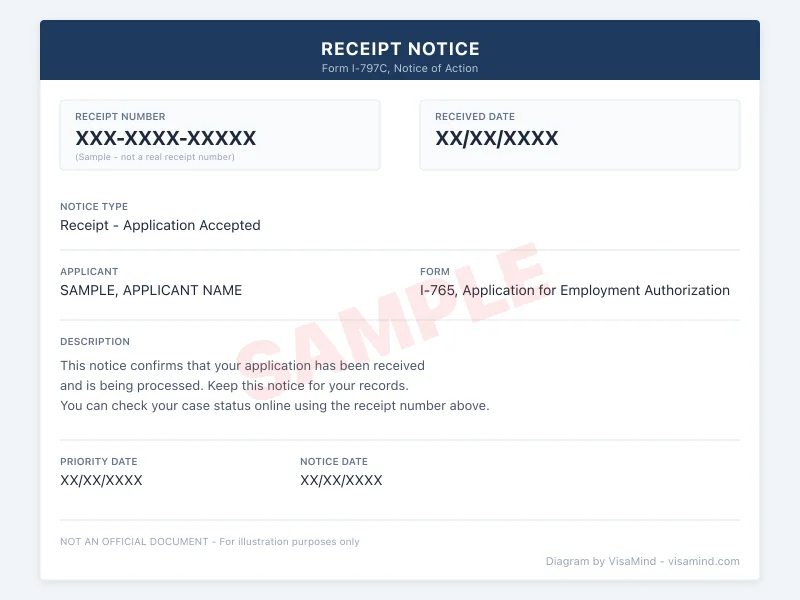
Example Receipt Notice (I-797) for I-485
Fees
#| Component | Amount |
|---|---|
| Filing FeeCheck the current I-485 fee on the USCIS fee schedule or fee calculator because the amount can vary by filing situation. | See official schedule |
| Biometrics Services FeeBiometrics fee treatment depends on the filing rules in effect for your case. Missing a biometrics appointment can still lead to denial or serious delay. | See official schedule |
Can the Form I-485 fee be waived?
Sometimes, but not for every filing situation. Check the current USCIS fee rules and instructions for your category before relying on a fee waiver.
What happens if I submit the wrong fee?
USCIS can reject the package for an incorrect fee or for using the wrong paper payment method. Before filing, verify the fee with the USCIS fee calculator and confirm whether you need G-1450, G-1650, or another accepted payment option.
Fee waiver: Fee waivers may be available for some qualifying applicants, but not every category qualifies. Review the current USCIS fee rules before assuming you can request one.
Fees and payment rules change. USCIS now requires specific electronic payment methods for many paper filings, so always verify both the amount and the payment method before you send the package.
Processing times
#| Category | Processing time |
|---|---|
| Family-Based adjustment applications | 7.5 to 51 monthsas of January 2026 |
| Employment-Based adjustment applications | 11 to 38 monthsas of January 2026 |
| Based on grant of asylum more than 1 year ago | 20.5 to 29 monthsas of January 2026 |
| Based on refugee admission more than 1 year ago | 12 to 19 monthsas of January 2026 |
| All other applications | Up to 161 monthsas of January 2026 |
| Based on an approved T Visa | 41 to 43 monthsas of January 2026 |
| Based on an approved U Visa | 25 to 29 monthsas of January 2026 |
- Processing times for I-485 vary sharply by eligibility category, service center or field office, and whether USCIS decides to interview the case.
- Family-based, employment-based, asylum, refugee, and special-category adjustments do not move on one shared timeline, so compare only against your actual filing basis.
- The USCIS processing-times tool shows the stage of cases currently being worked, not a guaranteed countdown for your own application.
- RFEs, interview scheduling, visa-bulletin movement, and admissibility issues can all extend the total timeline even after the filing is accepted.
- While the case is pending, track it using your receipt number, keep your address updated, and watch companion filings like I-765 and I-131 separately.
Where to file
#Where you file I-485 depends on your eligibility category and sometimes whether you are filing concurrently with another form. USCIS uses different direct filing addresses for family-based, employment-based, humanitarian, investor, and special-category cases.
File online
Check the official I-485 page to see whether online filing is available for your category and whether companion forms should be filed the same way.
Submit application
Paper filing addresses vary by category and sometimes by where you live. Use the USCIS direct filing address page instead of assuming one national lockbox address fits every case.
Applications mailed to the wrong address may be delayed or rejected. Also verify the accepted payment method for paper filing before you send the packet.
Form sections (What sections does Form I-485 have?)
#Part 1. Information About You (Applicant)
Personal and biographic data must match identity documents.
- Common mistake: Name or DOB mismatch with passport—use exact spelling and dates.
- Common mistake: Incorrect A-Number or classification—verify before filing.
- USCIS cross-checks data against supporting documents.
Part 2. Application Type or Filing Category
Select the correct basis for adjustment.
- Common mistake: Wrong eligibility category—select the correct option for your case.
- Different categories require different evidence; wrong choice can cause denial.
Part 3. Biographic Information
Address, employment, travel, and family history.
- List all addresses for the past 5 years; gaps raise questions.
- Travel history must be accurate; CBP records may be checked.
Part 8. Applicant's Statement
Sign, date, and certify accuracy.
- Common mistake: Unsigned form—sign and date before submitting.
- False statements can result in denial and inadmissibility.
Choose your path
#Choose your path based on your eligibility category. Each block summarizes who qualifies, what to file, common mistakes, and typical processing time.
Family-Based (I-130 Petitioner)
family
Beneficiaries of approved I-130 petitions — immediate relatives and preference categories.
File with:
- I-130 approval or pending receipt
- I-864 Affidavit of Support
- I-693 Medical
- civil documents
Common mistakes:
- Missing I-864 or using wrong income year
- Not including I-693 medical in sealed envelope
- Filing before priority date is current for preference categories
Typical processing: 8-24 months
Employment-Based (I-140 Petitioner)
employment
Beneficiaries of approved I-140 petitions in EB-1 through EB-5 categories.
File with:
- I-140 approval
- Employment letter
- I-485 Supplement J (if porting)
- evidence of continued employment
Common mistakes:
- Not filing Supplement J when changing employers after 180 days
- Missing current employment verification letter
- Priority date not current when filing
Typical processing: 12-36 months
Asylum/Refugee
asylum, refugee
Asylees (1 year after grant) and refugees (1 year after admission).
File with:
- Asylum/refugee approval documentation
- I-693 Medical
- Evidence of 1 year since status grant
Common mistakes:
- Filing before 1 year since asylum grant
- Not including updated I-693
- Missing evidence of continuous residence since status grant
Typical processing: 8-14 months
Diversity Visa (DV Lottery)
diversity
Diversity Visa lottery selectees with current rank number.
File with:
- DV selection notification
- KCC correspondence
- I-864 Affidavit of Support
Common mistakes:
- Not filing before fiscal year ends (September 30)
- Missing DV notification letter
- Applying without current rank number
Typical processing: 3-8 months
Category comparison
#| Category code | Eligibility | Typical filing companion | Auto-extension? | Premium processing? |
|---|---|---|---|---|
| family | Through I-130 petition (spouse, parent, child of U.S. citizen or LPR) | I-864 affidavit, I-693 medical, I-130 approval or concurrent | N/A | No |
| employment | Through I-140 petition (EB-1, EB-2, EB-3) when priority date is current | I-140 approval or concurrent, I-693 medical | N/A | No |
| asylum | Granted asylum in U.S. one year ago | Asylum approval, I-693 medical | N/A | No |
| k1 | Entered on K-1 visa, married petitioner within 90 days | I-129F approval, marriage certificate, I-693 medical | N/A | No |
| eb5 | EB-5 investor; conditional green card removed or direct investment | I-526/E approval, evidence of investment | N/A | No |
Strategy tips
#Mistake severity
#| Mistake type | Severity | How to avoid |
|---|---|---|
| Filing before priority date is current (employment-based) | Rejection | Check the visa bulletin; file only when your category and priority date are current. |
| Missing required full or partial I-693 with the I-485 filing | Rejection | If your category must submit medical evidence, include the required I-693 or partial I-693 with the I-485 package and follow the sealed-envelope rules where a full medical exam is required. |
| Missing I-864 affidavit of support (family-based) | Rejection | Include I-864 and supporting tax/income documents for family-based cases. |
| Not in valid nonimmigrant status when filing (for those who require it) | Rejection | Verify eligibility; immediate relatives may file even if out of status; others may not. |
| Incorrect fee, outdated form version, or wrong paper payment method | Rejection | Check the current edition date, use the fee calculator, and follow the current USCIS payment instructions before mailing the package. |
| Failing to disclose arrests, convictions, or immigration violations | Rejection | Disclose all requested information; omissions can lead to denial and fraud findings. |
Examples (What are examples for Form I-485?)
#- Strong application: An applicant submits the form with all required documents and receives a timely decision.
- Scenario: A software engineer submitted their petition with all supporting documents The case was approved within the standard timeline Prepare all evidence before filing to avoid delays
- Strong application: Beneficiaries of approved I-130 petitions — immediate relatives and preference c submits with required evidence; receives Employment Authorization Document (EAD) in approximately 8-24 months.
- Strong application: Beneficiaries of approved I-140 petitions in EB-1 through EB-5 categories. submits with required evidence; receives Employment Authorization Document (EAD) in approximately 12-36 months.
- Strong application: Asylees (1 year after grant) and refugees (1 year after admission). submits with required evidence; receives Employment Authorization Document (EAD) in approximately 8-14 months.
- Strong application: Diversity Visa lottery selectees with current rank number. submits with required evidence; receives Employment Authorization Document (EAD) in approximately 3-8 months.
Common misconceptions (What misconceptions surround Form I-485?)
#- Filing this form does not guarantee approval of the underlying case
- Requirements may differ based on your specific situation
- Some applicants assume that being physically present in the U.S. automatically qualifies them for adjustment of status, but eligibility depends on several factors including immigration history and any applicable bars.
Edge cases and variations
#- If you are asked to submit or update I-485, treat it as a package update: check every place the same details appear and keep them consistent.
Scenarios
#Immediate relative (spouse of U.S. citizen) filed I-130 + I-485 concurrently.
Approved after interview; green card received in ~12–18 months.
Concurrent filing reduces overall wait for eligible beneficiaries.
EB-2 applicant filed I-485 when priority date became current.
Approved without interview; green card produced in ~6–12 months.
Employment-based cases often do not require interview when evidence is strong.
Applicant forgot to disclose a past arrest; USCIS discovered it.
Denial for willful misrepresentation.
Full disclosure of arrests and convictions is required regardless of outcome.
Key differentiators
#- Unlike Form I-130: Petition for Alien Relative: Filed together: Concurrent filing for immediate relatives of U.S. citizens (Adjustment of status pathway)
- Unlike Form I-140: Immigrant Petition for Alien Worker: Filed together: Concurrent filing for employment-based when current (Adjustment of status pathway)
- Unlike Form I-765: Application for Employment Authorization: Filed together: Work authorization while adjustment is pending
Why it matters
#Next steps
#- Receive USCIS receipt notices and save every receipt number for case tracking.
- Attend the biometrics appointment and respond quickly if USCIS asks for updated documents or evidence.
- Track any companion filings such as I-765 or I-131 separately because they can move on different timelines.
- Prepare for a possible interview, especially in family-based cases or cases with issues USCIS wants to clarify.
- If approved, follow card-delivery tracking and keep your address updated with USCIS so the green card is not lost in the mail.
Verification
#This guide is based on official USCIS instructions for I-485 and is updated with changes in form editions or filing rules. Always check the official USCIS website for the latest requirements.
Visual references
#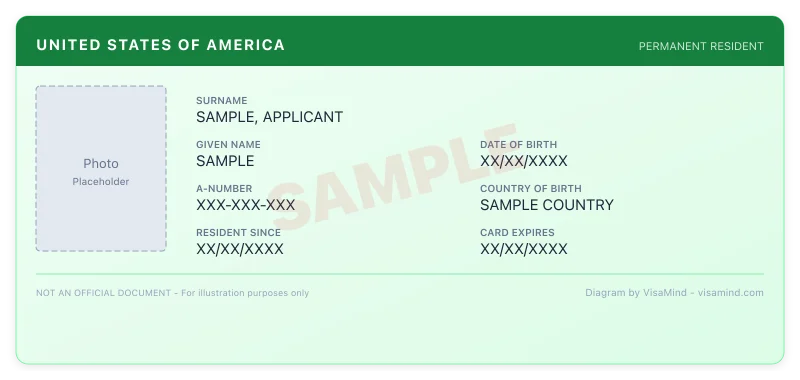
Example Green Card (Permanent Resident Card)
FAQs
At what point in the immigration process is Form I-485 typically filed?
I-485 is usually filed after you already have an immigrant basis and, for categories that require it, when an immigrant visa is immediately available. In family-based and some employment-based cases, that can mean concurrent filing with I-130 or I-140. In other cases, you must wait for petition approval and a current priority date before filing.
Who is eligible to file I-485?
Eligibility depends on the immigrant category, your immigration history, whether you are physically present in the United States, and whether your category can file now. Common paths include family-based adjustment, employment-based adjustment, asylum or refugee adjustment, certain K-1 entrants, diversity visa applicants filing in time, and several special immigrant categories.
Do I need to file Form I-693 with I-485?
If your category must submit a full or partial I-693, USCIS says you must include it with Form I-485 or the filing may be rejected. Some refugees, derivative asylees, K entrants, and certain Afghan parole-related cases may submit only the vaccination record portion rather than a full new medical exam, so check the current I-693 instructions for your category.
How do I choose the correct eligibility category code on I-485?
The category code tells USCIS the legal basis for your adjustment application, so it must match the underlying petition, visa-bulletin eligibility, and the evidence in your package. If you are unsure, check the current I-485 instructions and your petition approval notice before filing because using the wrong basis can lead to rejection, requests for evidence, or denial.
What supporting documents do I need for I-485?
That depends on the category, but most applicants should expect identity and civil documents, proof of admission or parole, the underlying petition evidence, category-specific support documents, translations, and when required an I-693 and I-864. Use the USCIS required initial evidence checklist as a starting point, but always compare it against the current form instructions for your specific basis.
Do I need to provide a mailing address for I-485?
You need a reliable mailing address for notices and card delivery. If you do not have a stable address, USCIS allows alternatives (e.g., a representative's address or safe mailing options) per official rules — review the instructions for your situation.
What documents are required if I have a criminal record?
Applicants with arrests, charges, convictions, or other law-enforcement history should generally expect to provide certified police, court, sentencing, and disposition records if the instructions or category require them. The safe rule is to disclose the history accurately on the form and gather the official records before filing rather than waiting for an RFE.
What happens after I submit I-485?
After USCIS accepts the filing, most applicants receive receipt notices, then a biometrics appointment, and later either an interview notice, an RFE, or a decision depending on the case. You can track the case online with the receipt number, and if you filed companion forms such as I-765 or I-131, those may move on their own timelines.
What are common reasons I-485 gets rejected?
Common rejection or delay triggers include filing before the category is eligible, using the wrong edition, missing signatures, sending the package to the wrong address, paying incorrectly under the current USCIS rules, omitting required medical or support forms, and giving answers that do not match the rest of the packet.
VisaMind provides informational guidance only and is not a government agency. This is not legal advice. Requirements can change and eligibility depends on your specific facts. If your case is complex or high-stakes, consult a licensed immigration attorney.
Next steps
Requirements vary by nationality, purpose, timeline, and case details. Get a personalized plan with official sources and deadlines.
Get my plan