
On this page
- Quick summary
- Overview (What is Form I-864?)
- Context and workflow
- Requirements snapshot
- Failure prevention (What causes Form I-864 rejections?)
- What it asks for (What does Form I-864 ask for?)
- What you need (What do you need for Form I-864?)
- Checklist (What is the Form I-864 checklist?)
- Fees
- Processing times
- Where to file
- Form sections (What sections does Form I-864 have?)
- Strategy tips
- Mistake severity
- Examples (What are examples for Form I-864?)
- Common misconceptions (What misconceptions surround Form I-864?)
- Edge cases and variations
- Scenarios
- Key differentiators
- Why it matters
- Next steps
- Verification
- Related guides
- Resources
Quick summary
#The petitioning sponsor, and sometimes a joint sponsor or household member, in immigrant cases that require an affidavit of support.
After the underlying immigrant case is moving forward and before the green-card or immigrant-visa case can be approved.
The affidavit is reviewed as part of the larger adjustment or immigrant-visa case, usually alongside I-485 or DS-260.
Household size, tax records, and current income evidence Proof of sponsor status and U.S. domicile Any joint-sponsor or household-member financial documents tied to the case
Overview (What is Form I-864?)
#I-864 is a financial sponsorship form, but it is also a legal contract with the U.S. government. USCIS and the Department of State use it to decide whether the sponsor meets the support rules for the immigration case and whether the intending immigrant is likely to rely on means-tested public benefits. In practical terms, it sits between the family-petition stage and the final green-card or immigrant-visa stage.
The important questions are not only income amount, but also domicile, household size, whether a joint sponsor is needed, and whether a household member's income must be added through I-864A.
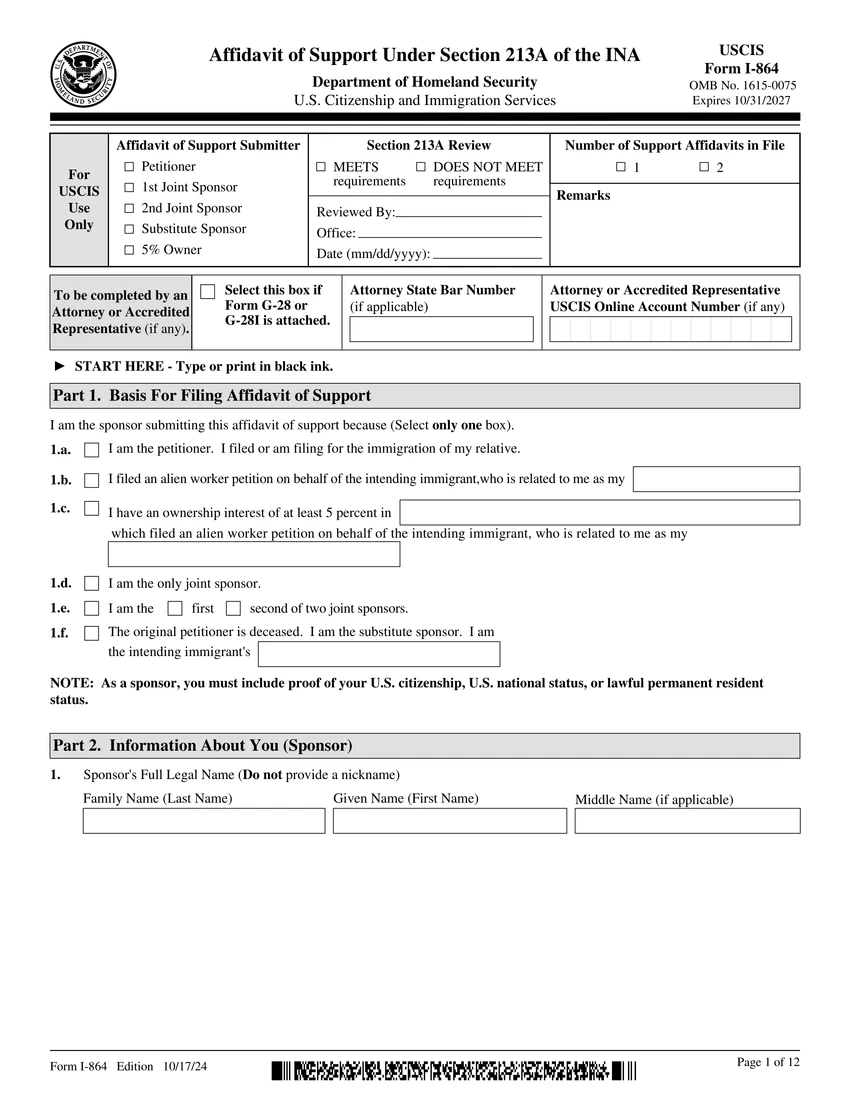
First page of I-864 form
Source: I-864 PDF
Context and workflow
#I-864 usually appears only after the family or qualifying employment case is already moving forward and before the immigrant visa or green-card case can be finalized. That is why sponsors should treat it as part of the same packet strategy as I-130, I-485, DS-260, and I-864A, not as a standalone form.
Why this matters
- Small mismatches inside I-864 or between the affidavit and the tax evidence can stall the larger immigrant case even when the relationship petition is already approved.
- This is one of the clearest points in the family-based process where weak packet preparation creates avoidable delays.
Where it fits in the workflow
- Works as the financial-support contract inside the larger green-card or immigrant-visa process.
- Usually follows the relationship or employment stage and must be ready before final immigrant-case adjudication.
- May be filed with I-485 at USCIS or reviewed through National Visa Center and DS-260 processing.
- Often connects to I-864A when household-member income is needed and to a separate joint sponsor when the petitioning sponsor does not qualify alone.
Who uses it
Sponsors and some qualifying household members use I-864 in immigrant visa and adjustment cases where financial sponsorship is required. It is especially common after I-130 approval, during I-485 preparation, or in consular cases tied to DS-260. If the main sponsor cannot qualify alone, the case may need a joint sponsor or a household member using I-864A.
When it is used
- IR-1: IR-1 Immigrant Visa (Spouse of US Citizen)
- CR-1: CR-1 Conditional Resident Visa (Spouse)
- When a family-based green-card case reaches the financial-sponsorship stage
- When an adjustment-of-status case needs sponsor financial evidence with I-485
- When an immigrant-visa case reaches National Visa Center or consular affidavit-of-support review with DS-260
Requirements snapshot
#- Used to document a sponsor’s financial support obligations for an intending immigrant.
- Supporting evidence must demonstrate the sponsor’s ability to meet the required support level.
Failure prevention (What causes Form I-864 rejections?)
#Technical rejections
- Submitting an unsigned form.
- Using a stamped or typewritten signature instead of a handwritten one.
- Ensure form edition is current
Substantive weaknesses
- Failing to provide proof of the sponsor's immigration status.
- To avoid insufficient income or assets to meet 125% of poverty guidelines: Use I-864P poverty guidelines; add household member (I-864A) or joint sponsor if needed.
- To avoid missing tax returns or employment evidence: Include the most recent tax transcript and employer letter; self-employed need business records.
- To avoid unsigned or undated form: Sign and date Part 8; joint sponsors and household members must sign their sections.
- To avoid household size or income calculation errors: Count all household members per instructions; verify income meets 125% of poverty level.
What it asks for (What does Form I-864 ask for?)
#- Sponsor identity, immigration status, and domicile in the United States
- Household size and the relationship between the sponsor and the intending immigrant
- Federal tax filing information, current income, and when needed assets used to meet the support threshold
- Whether the sponsor qualifies at 125% of the poverty guidelines or at the 100% military threshold for a spouse or child
- Whether household member income is being used through I-864A
- Whether a separate joint sponsor is needed because the petitioning sponsor cannot qualify alone
- Required signatures and supporting documents that match the sponsor's claimed income and status
Sources for this section
What you need (What do you need for Form I-864?)
#- Evidence of income and/or assets to meet the required poverty-guideline threshold
- A recent federal tax return or IRS transcript, plus W-2s or 1099s where appropriate
- Current income evidence such as pay stubs or an employer letter
- Proof of status and domicile for the sponsor
- If needed, the household-member supplement in I-864A
- The case-stage documents showing where the affidavit fits, such as I-485 or DS-260
Sources for this section
Checklist (What is the Form I-864 checklist?)
#- Download the current I-864 and instructions from the official USCIS website
- Review the I-864 instructions for sponsor and household requirements
- Compile evidence of the sponsor's income and necessary household documentation.
- Complete all required sections of I-864
- Confirm the form is signed and dated in all required fields
- Sign, date, and submit I-864 with all required supporting evidence
Sources for this section
Fees
#| Component | Amount |
|---|---|
| If filed with USCISCheck the current USCIS fee schedule for any I-864 fee rules that apply in the filing context. | See official schedule |
| If filed through the Department of State sideThe Department of State publishes separate visa-service fee guidance and affidavit-of-support FAQs for consular cases. | See official schedule |
Do USCIS and DOS use the same I-864 fee source?
Not always. USCIS points sponsors to the USCIS fee schedule when filing with USCIS, but it points consular filers to the Department of State visa-fee and affidavit-of-support guidance for DOS cases.
What happens if I pay based on the wrong process?
Using the wrong fee source or filing assumptions can delay the immigrant case because I-864 is tied to a larger USCIS or DOS workflow. Verify whether you are in adjustment or consular processing before paying or submitting.
Fee waiver: Fee handling for I-864 depends on whether the affidavit is being used in a USCIS filing or a Department of State immigrant-visa process, so always verify the correct fee source before paying.
For I-864, verify whether the affidavit is being handled in a USCIS case or in a Department of State consular case before relying on any fee guidance.
Processing times
#- USCIS does not present I-864 as a standalone processing track the way it does for many primary forms.
- In practice, the affidavit moves on the timeline of the larger immigrant case it supports, such as I-485 or DS-260.
- What matters most is whether the financial packet is accepted without follow-up. If the affidavit is incomplete, the green-card or immigrant-visa case can stall even when the underlying petition is already approved.
Where to file
#I-864 is not a simple standalone online form. USCIS says sponsors should use the USCIS Lockbox Filing Locations Chart for Certain Family-Based Forms when filing with USCIS, and follow Department of State or National Visa Center instructions when the case is on the consular side.
Submit application
When the affidavit is part of a USCIS filing, the completed form and evidence are generally given to the immigrant or included with the USCIS package, such as the adjustment filing.
Submit application
If the National Visa Center or Department of State instructs you to complete I-864 for an immigrant-visa case, follow the consular instructions they provide rather than using a USCIS-only filing assumption.
USCIS specifically points sponsors to the lockbox chart for certain family-based forms and to DOS affidavit guidance for consular cases. The right filing path depends on where the immigrant case is being processed.
Form sections (What sections does Form I-864 have?)
#Sponsor Information
Petitioner or sponsor identity and status.
- Full name and citizenship or LPR status
- Current address and household size
- Relationship to beneficiary
Income and Employment
Financial capacity evidence.
- Employer name and annual income
- Tax returns for the last 3 years
- W-2s and 1099s
- Current employment letter
Assets
If using assets to meet the requirement.
- Bank statements and account balances
- Property valuations
- Evidence of ownership
- 5x shortfall rule for assets when income is insufficient
Strategy tips
#Mistake severity
#| Mistake type | Severity | How to avoid |
|---|---|---|
| Insufficient income or assets to meet the support threshold | Rejection | Check the current I-864P poverty guidelines, calculate household size carefully, and use a joint sponsor or qualifying assets if needed. |
| Missing proof of domicile in the United States | RFE | Provide clear evidence that the sponsor lives in the United States or will reestablish U.S. domicile in time for the immigrant's admission. |
| Using household-member income without a valid I-864A | RFE | Use I-864A for each qualifying household member whose income or assets are being counted. |
| Unsigned I-864 or missing related signatures | Rejection | Review every signature block on the sponsor and any related household-member or joint-sponsor forms before submission. |
| Wrong household size or tax evidence | Delay | Cross-check the household-size count against the tax return, dependents, and all immigrants being sponsored on the affidavit. |
Examples (What are examples for Form I-864?)
#- Strong application: A sponsor submits Form I-864 with all necessary supporting documents, including proof of income and domicile, resulting in a smooth approval process.
- A sponsor completes I-864 to provide evidence required for the case
- Applicants use I-864 to provide supporting declarations and evidence
- An applicant in the IR-1 category files I-864 as part of their immigration process
Common misconceptions (What misconceptions surround Form I-864?)
#- Filing this form does not guarantee approval of the underlying case
- Approval of this form does not grant immigration status by itself
- The financial obligation can continue after filing, depending on the case outcome
- The financial obligation ends once the immigrant enters the country — Obligations under I-864 continue according to the immigration authority rules and do not end automatically after entry.
Edge cases and variations
#- If the sponsor lives abroad, wants to count the intending immigrant's current income, or needs a joint sponsor, review the instructions carefully before assuming the usual household-income rules apply.
Scenarios
#A sponsor with income at 150% of the poverty guideline completes the affidavit with 3 years of tax returns and 6 months of bank statements.
Affidavit accepted. Beneficiary's visa or adjustment application proceeds to approval.
Include complete tax documentation. IRS transcripts are preferred over photocopies of returns.
A sponsor uses a joint sponsor but the household member's Form I-864A is not signed by both parties.
RFE issued. The I-864A must be signed by both the sponsor and the household member.
All parties must sign. Household member income only counts with a properly executed I-864A.
An elderly sponsor has significant assets but low current income. The affidavit includes asset documentation exceeding 5 times the income shortfall.
Assets accepted. The 5x rule for assets applies when income is below the poverty guideline.
When using assets, the value must be 5 times the difference between your income and the poverty guideline for your household size.
Key differentiators
#- Unlike Form I-130: Petition for Alien Relative: Next step after approval: Required after I-130 approval for immigrant visa (Family-based immigration pathway)
- Unlike Form I-485: Application to Register Permanent Residence or Adjust Status: Filed together: Required for family-based adjustment of status
- Unlike Form DS-260: Online Immigrant Visa Application: Filed together: Required for immigrant visa interview (Family-based immigration pathway)
Why it matters
#Next steps
#- Receive Receipt Notice (a related form) confirming the form submission.
- USCIS reviews the form and supporting documents for completeness.
- If additional information is needed, USCIS may issue a Request for Evidence (RFE).
- Receive a decision on the petition based on the provided evidence.
- If approved, proceed with next stage forms or interviews as applicable.
Verification
#This guide is based on official USCIS instructions for Form I-864 and is updated with any changes in form editions or filing rules. Always check the official USCIS website for the most current requirements.
FAQs
Why does USCIS need the information requested on Form I-864?
USCIS uses I-864 to determine whether the sponsor has adequate financial means to support the intending immigrant and whether the immigrant is likely to rely on means-tested public benefits. USCIS also warns that I-864 creates a legally binding support obligation, not just a one-time paperwork requirement.
At what point in the immigration process is Form I-864 typically filed?
I-864 is usually filed after the underlying immigrant petition is already moving forward and before the immigrant visa or green-card case can be approved. In practice, that often means the affidavit is included with I-485 in adjustment cases or provided for NVC and consular processing together with DS-260.
What happens if I submit an unsigned Form I-864?
USCIS says it can reject an unsigned I-864 at the lockbox stage. Sponsors should use the required original signature and make sure every related I-864A or joint-sponsor form is also properly signed.
Is it necessary to provide proof of domicile in the U.S.?
Yes, domicile matters. A sponsor must generally show domicile in the United States or a qualifying U.S. territory. If the sponsor lives abroad, they usually need to show that the stay abroad is temporary or that they will reestablish domicile in time for the immigrant's admission.
What supporting documents do I need for I-864?
A legal guardian may need to provide documentation confirming their appointment as the guardian of your estate. This includes an order from the court or agency that specifically authorizes the guardian to use your income and assets to support the sponsored immigrant. Additionally, you may need to submit a copy of your individual federal income tax return, along with W-2 forms for the most recent tax year. Evidence demonstrating that your income and/or assets meet the required poverty guidelines is also necessary.
Do I need to provide a mailing address for I-864?
You need a reliable mailing address for notices and card delivery. If you do not have a stable address, USCIS allows alternatives (e.g., a representative's address or safe mailing options) per official rules — review the instructions for your situation.
Who is eligible to file I-864?
The petitioning sponsor is usually the starting point, and if that sponsor cannot qualify alone the case may use a joint sponsor or household member income through I-864A. Most family-based immigrants and some employment-based immigrants require the affidavit of support structure described in the USCIS instructions.
What are common reasons I-864 gets rejected?
Common problems include missing signatures, insufficient tax or income evidence, wrong household-size calculations, lack of proof of status or domicile, and using household-member income without a properly completed I-864A. These issues often delay the immigrant case even if the underlying petition itself is fine.
When will I-864 be processed and what is the workflow?
There is usually not a clean standalone I-864 processing timeline separate from the immigrant case it supports. Timing depends on whether the affidavit is being reviewed with I-485 at USCIS or through immigrant-visa processing connected to DS-260 and the National Visa Center.
VisaMind provides informational guidance only and is not a government agency. This is not legal advice. Requirements can change and eligibility depends on your specific facts. If your case is complex or high-stakes, consult a licensed immigration attorney.
Next steps
Requirements vary by nationality, purpose, timeline, and case details. Get a personalized plan with official sources and deadlines.
Get my plan