On this page
- Quick summary
- Overview (What is Form DS-260?)
- Context and workflow
- Requirements snapshot
- Failure prevention (What causes Form DS-260 rejections?)
- What it asks for (What does Form DS-260 ask for?)
- What you need (What do you need for Form DS-260?)
- Checklist (What is the Form DS-260 checklist?)
- Fees
- Key terms
- Strategy tips
- Common mistakes (What mistakes are common with Form DS-260?)
- Examples (What are examples for Form DS-260?)
- Common misconceptions (What misconceptions surround Form DS-260?)
- Scenarios
- Key differentiators
- Why it matters
- Next steps
- Verification
- Related guides
- Resources
Quick summary
#Immigrant-visa applicants completing consular processing through the Department of State.
After the petition reaches the National Visa Center or CEAC stage and before the immigrant-visa interview.
The case moves into civil-document review, affidavit-of-support review, and later the interview at the assigned U.S. embassy or consulate.
Passport details and the NVC or CEAC case information Civil records and petition history Any financial and document submissions tied to the same immigrant-visa case
Overview (What is Form DS-260?)
#DS-260 is the main immigrant-visa application the Department of State reviews before the consular interview. It is not the immigrant petition itself and it is not the nonimmigrant visa form. Instead, it is the detailed electronic application used after a qualifying family or employment petition is already in motion and the case reaches the National Visa Center and consular-processing stage.
A strong DS-260 is about consistency: the answers need to match the petition history, passport details, civil records, prior U.S. travel, and every document you later present for document review and interview.
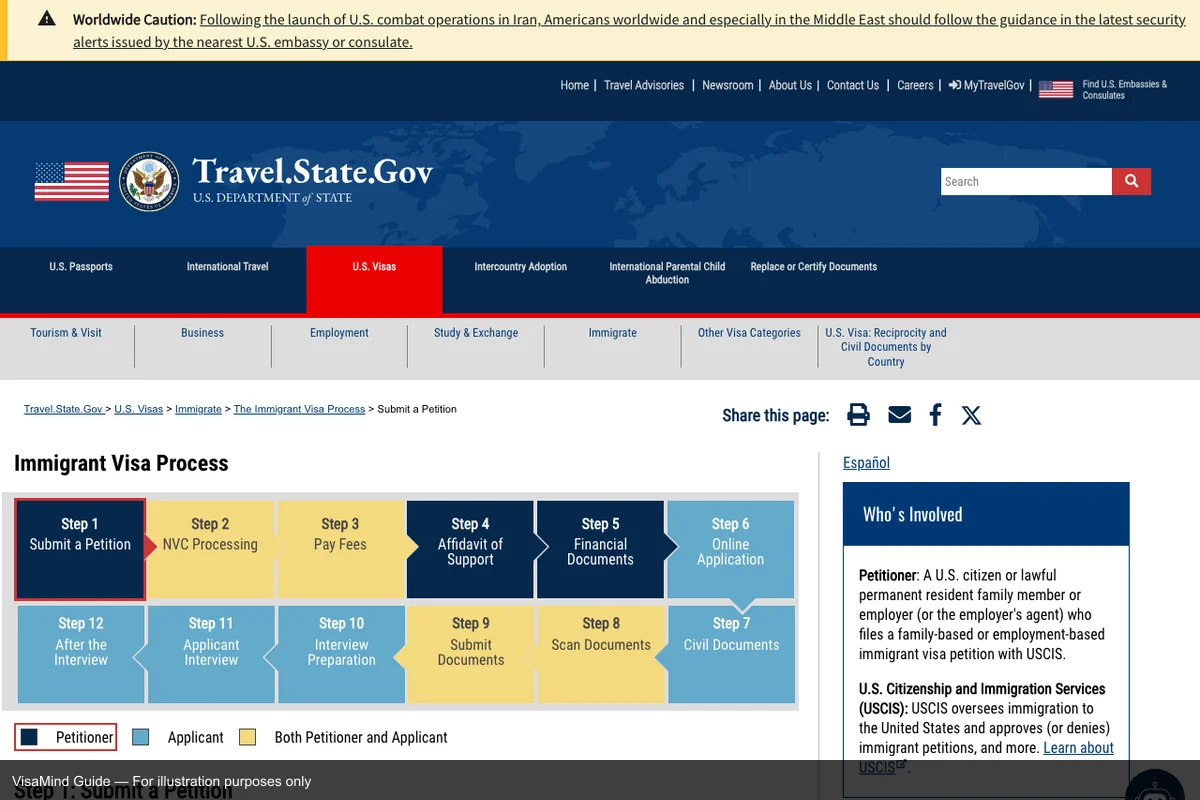
Official portal interface for DS-260
Source: DS-260 online portal
Context and workflow
#DS-260 usually appears after USCIS has already approved the petition and the case has moved into National Visa Center processing. In CEAC, applicants use their NVC case information to complete the DS-260, pay fees where applicable, and later upload civil documents when the case allows it. That is why the form makes the most sense when you read it together with the broader consular processing guide, I-130, I-140, and I-864 context.
Where it fits in the workflow
- Begins the detailed immigrant-visa application step in CEAC after the case reaches the consular side.
- Connects the approved petition to document review, financial sponsorship, and the interview process.
- Precedes the immigrant-visa interview at the U.S. embassy or consulate.
- Usually moves together with I-864, civil-document uploads, and later interview preparation.
Who uses it
Applicants seeking an immigrant visa at a U.S. embassy or consulate use DS-260 as part of consular processing. That includes many family-based and employment-based immigrant-visa applicants whose cases are already moving through the National Visa Center and Department of State process. It is not the form for temporary visas and it is not usually the right form for someone pursuing I-485 inside the United States.
When it is used
- IR-1: IR-1 Immigrant Visa (Spouse of US Citizen)
- CR-1: CR-1 Conditional Resident Visa (Spouse)
- EB-1: EB-1 Employment-Based First Preference
Requirements snapshot
#- After submitting DS-260, you generally schedule a visa interview and bring the confirmation page with barcode.
Failure prevention (What causes Form DS-260 rejections?)
#Technical rejections
- Not saving progress, resulting in data loss.
- Submitting the form without completing all typically necessary fields.
- Ensure form edition is current
Substantive weaknesses
- Providing information in a language other than English.
What it asks for (What does Form DS-260 ask for?)
#- Personal, family, and background information.
- Background and immigration history
- Previous U.S. visits and visa details
- Full legal name and any other names used
- Mailing and physical addresses
What you need (What do you need for Form DS-260?)
#- Your passport and the biographic details that must match the visa case exactly
- Your NVC case number, invoice ID, and access to the Consular Electronic Application Center (CEAC)
- Your petition and case-stage context, such as I-130, I-140, or related NVC correspondence
- Your full address, work, education, and prior U.S. travel history
- Civil-document information that will later be uploaded or presented for the immigrant-visa case
- Related financial and medical planning, including I-864 and the immigrant-visa interview document set
Checklist (What is the Form DS-260 checklist?)
#- Confirm the immigrant petition has already moved into the National Visa Center or CEAC stage before starting DS-260.
- Gather passport details, address history, work and education history, and prior U.S. travel information before logging in.
- Complete the DS-260 in CEAC using the exact case information tied to the NVC file.
- Review every answer for consistency with the petition, passport, civil records, and any prior immigration history.
- Submit the DS-260, then continue with CEAC document steps and interview preparation according to the NVC or embassy instructions.
Fees
#| Component | Amount |
|---|---|
| Immigrant visa application feesDS-260 sits inside the immigrant visa fee and NVC process rather than acting like a standalone paper filing. Applicants should verify the current immigrant-visa fee steps on the Department of State pages before submitting CEAC materials. | See official schedule |
| Case-stage feesFee handling often interacts with NVC case setup, affidavit of support review, and civil-document processing, so the practical fee questions usually belong to the full immigrant-visa case rather than DS-260 alone. | See official schedule |
Does DS-260 have a standalone filing fee?
Think in terms of the immigrant-visa process rather than a separate DS-260 filing charge. The right fee source is the Department of State immigrant-visa and NVC fee guidance for your case stage.
Always verify the current immigrant-visa and NVC fee steps directly with Department of State guidance before paying.
Key terms
#- NVC Case Number
- A unique identifier assigned to your visa application case by the National Visa Center.In this form: Used to access and complete the DS-260 form online.
Strategy tips
#Common mistakes (What mistakes are common with Form DS-260?)
#- Submitting the form with mandatory fields left blank.
- Providing answers in a language other than English.
- Not saving progress, leading to data loss after timeout.
- Assuming DS-260 can be started before the case reaches the NVC or CEAC stage.
- Inaccurate or incomplete travel and immigration history.
- Treating the DS-260 as separate from the civil-document and affidavit-of-support steps that follow it in the consular process.
Examples (What are examples for Form DS-260?)
#- Strong application: An applicant submits the form with all required documents and receives a timely decision.
Common misconceptions (What misconceptions surround Form DS-260?)
#- Filing this form does not guarantee approval of the underlying case
- Requirements may differ based on your specific situation
- Some applicants assume that bringing the DS-260 application to the interview is required; however, it is not necessary to bring the application itself.
Scenarios
#A software engineer submitted their petition with all supporting documents
The case was approved within the standard timeline
Prepare all evidence before filing to avoid delays
Key differentiators
#- Unlike DS-160: Online Nonimmigrant Visa Application: The DS-260 is for immigrant visas, while the DS-160 is for nonimmigrant visas.
Why it matters
#All answers must be in English.
Why it matters: Submitting answers in another language can lead to rejection of the form.
The DS-260 is completed in CEAC after the immigrant case reaches the NVC or Department of State stage.
Why it matters: Applicants who think it can be completed before the case is opened on the consular side often misunderstand the order of the process.
The DS-260 has a timeout feature.
Why it matters: Failure to save progress can result in data loss after timeout.
Civil-document upload and document review usually happen in the same CEAC/NVC process after the DS-260 stage opens.
Why it matters: The form should be prepared together with the document plan, not in isolation.
Next steps
#- Submit the DS-260 in CEAC and continue with the financial and civil-document steps for the immigrant visa case.
- Watch the CEAC or NVC case for document qualification, follow-up requests, and interview scheduling.
- Prepare for the immigrant-visa interview at the U.S. embassy or consulate handling the case.
- Provide any additional documentation requested during review or after the interview.
- If approved, follow the consular instructions for visa issuance and travel preparation.
Verification
#This guide is derived from official Department of State instructions for DS-260 and is updated when form editions or filing rules change. Always verify current requirements at the official Department of State website.
FAQs
What are common misconceptions about DS-260?
A common mistake is treating DS-260 like a generic visa form that can be handled before the case reaches the National Visa Center. In reality, it is the immigrant-visa application completed online in CEAC after the consular case is already in the Department of State pipeline.
At what point in the immigration process is DS-260 typically filed?
DS-260 is usually filed after the underlying immigrant petition has already moved into the Department of State and National Visa Center process. Applicants typically receive case information from NVC and then complete the immigrant visa application in CEAC before the interview is scheduled.
What information is required about previous U.S. visits?
Applicants need to provide details of any previous U.S. visits, including visa details and immigration history. Review the official DS-260 instructions for complete guidance specific to your immigration case and circumstances.
Is Internet access necessary for completing the DS-260?
Yes, Internet access is required to complete the DS-260 as it must be submitted through the Consular Electronic Application Center (CEAC) website.
Do I need to save my progress while filling out the DS-260?
Yes. CEAC sessions can time out, so save your work regularly and keep your case-access information available. It is easier to complete DS-260 accurately when you gather the full travel, address, and document history before you start.
VisaMind provides informational guidance only and is not a government agency. This is not legal advice. Requirements can change and eligibility depends on your specific facts. If your case is complex or high-stakes, consult a licensed immigration attorney.
Next steps
Requirements vary by nationality, purpose, timeline, and case details. Get a personalized plan with official sources and deadlines.
Get my plan