On this page
- Overview (What is Form I-131?)
- Context and workflow
- Requirements snapshot
- Failure prevention (What causes Form I-131 rejections?)
- What it asks for (What does Form I-131 ask for?)
- What you need (What do you need for Form I-131?)
- Checklist (What is the Form I-131 checklist?)
- Form sections (What sections does Form I-131 have?)
- Common mistakes (What mistakes are common with Form I-131?)
- Examples (What are examples for Form I-131?)
- Common misconceptions (What misconceptions surround Form I-131?)
- Scenarios
- Why it matters
- Next steps
- Verification
- Related guides
- Resources
- Visual references
Overview (What is Form I-131?)
#The fee for filing Form I-131 varies, and applicants should refer to the current USCIS fee schedule for the most accurate information.
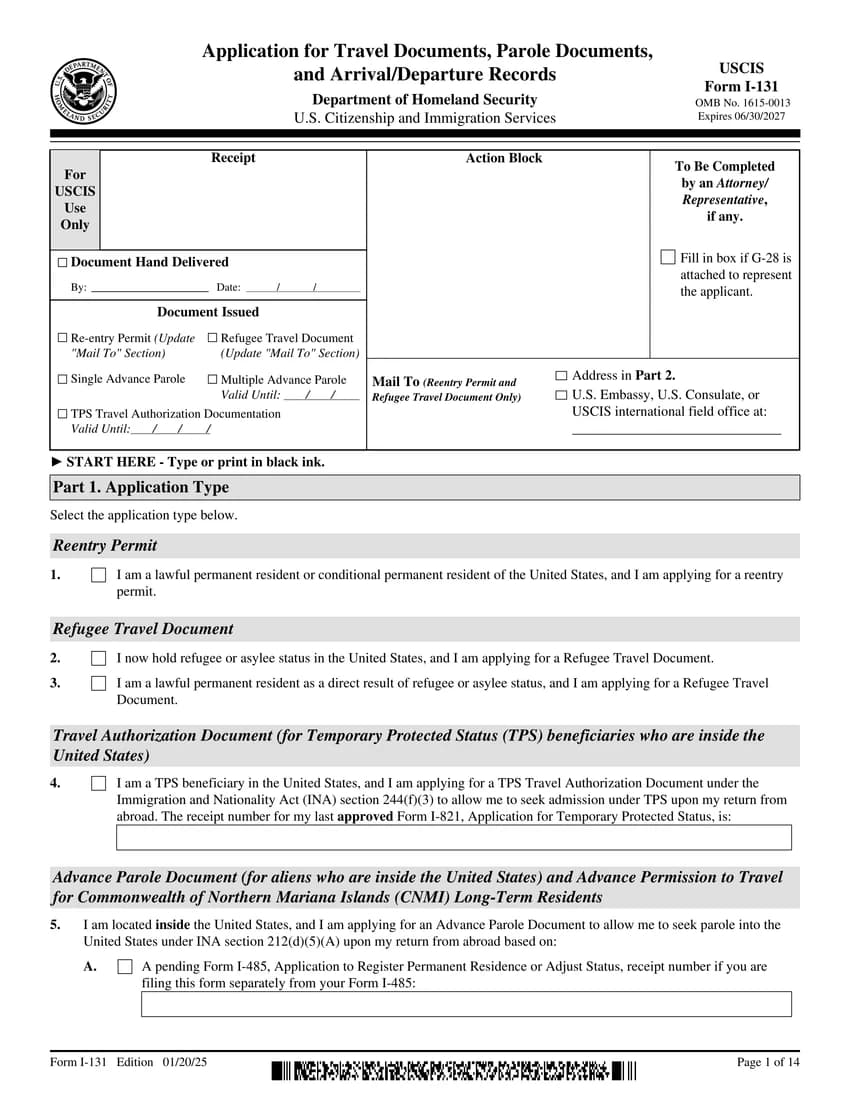
First page of I-131 form
Source: I-131 PDF
Context and workflow
#Processing time for I-131 varies by location — always check the official USCIS processing time tool.
Where it fits in the workflow
- Receipt Notice (a related form)
- Attend biometrics appointment (fingerprints, photo, and signature)
- Approval or denial notice
- Travel with the issued document
- I-131 is commonly filed alongside Form I-485.
Who uses it
This includes applicants with pending applications who need advance permission to travel.
When it is used
- Before traveling internationally while your case is pending
- When you need advance permission to return to the country
- If you must travel but want to maintain your pending application
Requirements snapshot
#- advance_parole: Pending adjustment (I-485); need to travel without abandoning application
- reentry_permit: LPR who will be abroad for extended period (1+ year)
- refugee_travel: Asylee or refugee; need travel document
Failure prevention (What causes Form I-131 rejections?)
#Technical rejections
- Ensure form is current edition.
Substantive weaknesses
- Lack of sufficient evidence for eligibility
- Underlying case is still pending or status is valid
What it asks for (What does Form I-131 ask for?)
#- The type of travel document being requested.
- The purpose(s) of the intended travel, specific dates of the trip, and travel destination(s).
- Your full name, mailing address, and physical address.
- Applicant identification information
- Supporting documentation inventory
- Eligibility or purpose details
- Declarations and signatures
What you need (What do you need for Form I-131?)
#- A completed Form I-131 with all required parts filled out.
- A copy of an official photo identity document showing your photo, name, and date of birth.
Checklist (What is the Form I-131 checklist?)
#- Download the current I-131 and instructions from the official USCIS website
- Review the official I-131 instructions before filing
- Gather required supporting documents per the instructions
- Complete all required sections of I-131
- Sign, date, and submit I-131 with all required supporting evidence
Form sections (What sections does Form I-131 have?)
#Part 2. Information About You Item Number
Complete this section as described in the official instructions.
- Common mistake: Traveling without advance parole while I-485 is pending
- Avoid: Do not leave the U.S. without approved advance parole if you have a pending I-485.
- Common mistake: Wrong document type selected (advance parole vs reentry permit)
- Avoid: Select the correct application type based on your status and travel needs.
- USCIS verifies identity documents.
Part 4. Processing Information Item Number
Complete this section as described in the official instructions.
- Submitting the application to the wrong filing location can cause delays or d...
- Leaving the United States without obtaining an Advance Parole Document may re...
- Traveling without a valid travel document may result in inadmissibility upon ...
- USCIS verifies this section.
Part 8. They may also complete Part
Complete this section as described in the official instructions.
- Common mistake: Missing evidence of pending I-485 (for advance parole)
- Avoid: Include I-485 receipt notice when applying for advance parole with pending adjustment.
- Common mistake: Not applying early enough before planned travel
- USCIS verifies this section.
Part 13. Additional Information
Complete this section as described in the official instructions.
- Common mistake: Missing evidence of pending I-485 (for advance parole)
- Avoid: Include I-485 receipt notice when applying for advance parole with pending adjustment.
- Common mistake: Not applying early enough before planned travel
- USCIS verifies this section.
Common mistakes (What mistakes are common with Form I-131?)
#- Failure to attend a required biometrics appointment may may result in delays or denial of the application.
- Submitting the application to the wrong filing location can cause delays or denial.
- Leaving the United States without obtaining an Advance Parole Document may result in abandonment of Form I-485.
- Traveling without a valid travel document may result in inadmissibility upon return.
- Submitting duplicate Form I-131 requests for the same application type may lead to rejection or denial.
- Failure to include a statement describing the purpose of travel and supporting documentation.
- Not selecting a specific program or process when applying for an initial Parole Document.
- Incorrect or incomplete biographical details
Examples (What are examples for Form I-131?)
#- Common weakness: Applicant forgets to sign; form returned, causing delay.
Common misconceptions (What misconceptions surround Form I-131?)
#- Filing this form does not guarantee approval of the underlying case
- Approval does not guarantee re-entry to the country
- Travel while a case is pending may have consequences depending on your situation
Scenarios
#A software engineer submitted their petition with all supporting documents
The case was approved within the standard timeline
Prepare all evidence before filing to avoid delays
Why it matters
#A Reentry Permit is generally valid for 2 years, but may be limited to 1 year if the applicant has been outside the U.S. for more than 4 of the last 5 years.
Why it matters: Understanding the validity period is crucial for planning travel and maintaining lawful permanent resident status.
Advance Parole Documents do not replace the need for a passport and cannot be used to bypass visa issuance procedures.
Why it matters: Misunderstanding this can lead to travel complications and inadmissibility upon return.
Traveling without a Refugee Travel Document may result in inadmissibility upon return for refugees and asylees.
Why it matters: Ensures that refugees and asylees maintain their status and can re-enter the U.S. after travel.
Travel for vacation is not a valid purpose for an Advance Parole Document.
Why it matters: Applicants must demonstrate a valid purpose such as educational, employment, or humanitarian reasons to be eligible.
Next steps
#- Receive Receipt Notice (a related form) confirming application submission
- Attend biometrics appointment (fingerprints, photo, and signature) if required
- Wait for approval or denial notice from USCIS
- If approved, receive the travel document by mail
- Use the travel document for reentry into the U.S. after traveling abroad
Verification
#This guide is derived from official USCIS instructions for I-131 and is updated when form editions or filing rules change. Always verify current requirements at the official USCIS website.
Visual references
#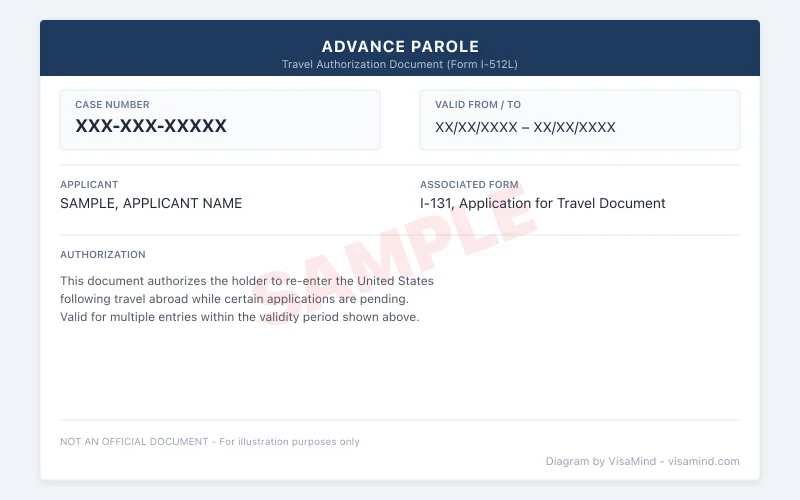
Example Advance Parole Document
FAQs
Can I travel while my Form I-131 is pending?
Review the official I-131 instructions for complete guidance specific to your immigration case and circumstances.
What is I-131?
I-131 is the Application for Travel Document, an official USCIS form. Review the official instructions to determine if it applies to your situation.
Where can I get I-131 and its instructions?
Download the current edition of I-131 and its instructions from the official USCIS website. Always verify you are using the most recent form version before filing.
VisaMind provides informational guidance only and is not a government agency. This is not legal advice. Requirements can change and eligibility depends on your specific facts. If your case is complex or high-stakes, consult a licensed immigration attorney.
Next steps
Requirements vary by nationality, purpose, timeline, and case details. Use Find My Visa to get a personalized checklist with official sources and deadlines.
Find my visa