On this page
- More K-1 Fiancé(e) Visa answers
- What the K-1 Fiancé(e) Visa Covers
- Required Documents
- Fees and Processing Times
- Conditions and Rights
- When to Get Help
- Renewal and Extension
- Path to Permanent Residence
- Application Process
- Eligibility Requirements
- Relationship Scrutiny Red Flags
- Fees
- Required forms
- Related visa types
- Related guides
- Related goals
- Next steps
What the K-1 Fiancé(e) Visa Covers
#The K-1 Fiancé(e) Visa allows a U.S. citizen to bring a foreign fiancé(e) to the United States for marriage by filing a petition with USCIS. Certain dependent children may also qualify to accompany the fiancé(e).
Purpose and Scope
The K-1 Fiancé(e) Visa exists to let you bring a foreign fiancé(e) to the United States for marriage.
You begin by filing Form I-129F, Petition for Alien Fiancé(e), with USCIS. This asks the government to recognize your relationship and allow your fiancé(e) to apply for a visa.
The visa is for entry to marry, not for permanent residence by itself.
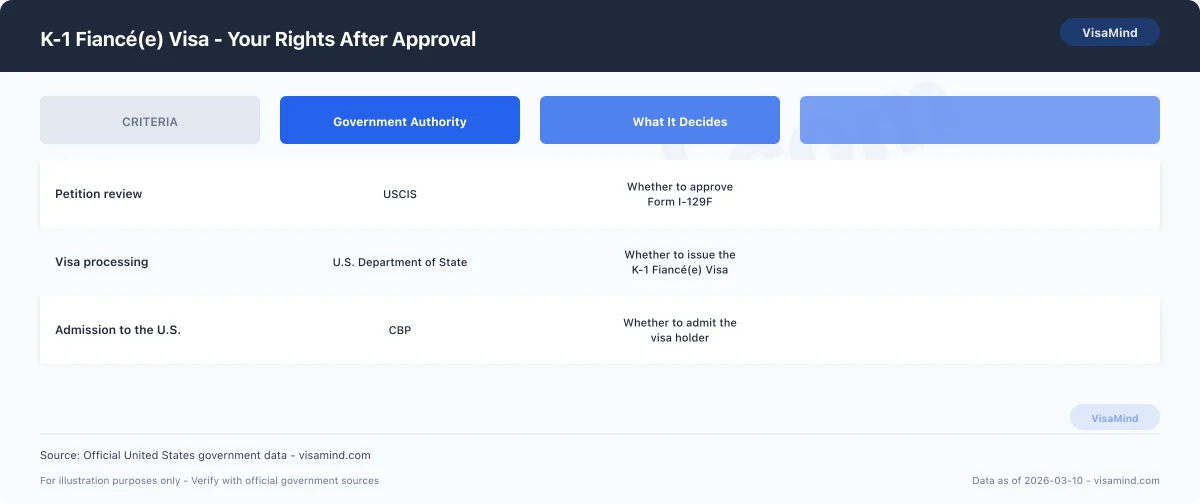
USCIS reviews and decides the I-129F petition. If approved, the U.S. Department of State handles the visa application and interview abroad.
Admission at a U.S. port of entry is decided by U.S. Customs and Border Protection (CBP).
Fiancé(e) and Dependent Coverage
The K-1 category covers your foreign fiancé(e) and certain children.
You may include eligible children as K-2 visa nonimmigrants when you file Form I-129F.
Who you can include:
- Your foreign fiancé(e) (K-1 Fiancé(e))
- Your fiancé(e)’s children (K-2)
The petition form for both is Form I-129F.
| Category | Who Qualifies | Petition Form | Purpose |
|---|---|---|---|
| K-1 Fiancé(e) | Your foreign fiancé(e) | I-129F | Entry to marry you in the U.S. |
| K-2 | Child of your fiancé(e) | I-129F | Accompany or follow the K-1 parent |
Each applicant must complete visa processing through the U.S. Department of State after USCIS approves the petition.
Related Non‑Fiancé Categories
Form I-129F also applies to certain spouses under a different visa classification.
If you are already married to a foreign national, you may use Form I-129F to seek a K-3 visa nonimmigrant visa for your spouse. This allows your spouse to come to the United States while waiting for approval of Form I-130, Petition for Alien Relative.
Children of a K-3 spouse may apply as K-4 visa nonimmigrants.
| Category | Relationship to You | Related Petition | Purpose |
|---|---|---|---|
| K-3 | Foreign spouse | I-129F (while I-130 pending) | Await I-130 approval in the U.S. |
| K-4 | Child of K-3 spouse | I-129F | Accompany or follow the K-3 parent |
These categories differ from the K-1 Fiancé(e) Visa because they apply after marriage and connect directly to a pending immigrant petition.
Required Documents
#
You must submit clear proof of identity, U.S. citizenship, and a bona fide relationship when filing Form I-129F with USCIS. Missing civil records or incomplete evidence will delay processing.
Identity and Civil Documents
You and your fiancé(e) must provide biographical details and proof of identity with the Form I-129F petition. USCIS uses this to confirm eligibility under family-based immigration rules.
Include:
- Proof of your U.S. citizenship, such as:
U.S. birth certificate
-
Naturalization certificate
-
Valid U.S. passport
-
Biographical information for both you and your fiancé(e)
-
Passport-style photos of you and your fiancé(e)
-
Certified copies of divorce decrees or death certificates for all prior marriages
List every prior marriage for both parties.
If you were previously married, you must prove the legal termination of each marriage before filing the I-129F.
| Document Type | Who Provides It | Purpose |
|---|---|---|
| Birth certificate or passport | U.S. petitioner | Proves U.S. citizenship |
| Divorce decree or death certificate | Either party, if applicable | Proves prior marriages ended |
| Passport-style photos | Both parties | Identity verification |
Relationship and Marriage Evidence
You must prove that you and your fiancé(e) intend to marry within 90 days of entry to the United States on the K-1 Fiancé(e) Visa.
Submit documentation that states your mutual intent to marry, signed by both you and your fiancé(e).
USCIS expects evidence that the relationship is real and ongoing.
Key items include:
- Written statements of intent to marry within 90 days
- Biographical details that show consistent information across forms
- Evidence supporting the bona fide nature of your engagement
Your documentation should match the information listed on Form I-129F. Inconsistent dates, names, or prior marriage history often trigger requests for evidence.
Supplementary Evidence and Special Items
Certain cases require additional documentation beyond standard civil records. Review the Form I-129F instructions before filing.
If requested, you may need to provide:
- Additional proof of U.S. citizenship
- Certified translations of documents not in English
- Any biological or genetic testing results, such as DNA evidence, if specifically required
Only submit DNA or genetic evidence if USCIS instructs you to do so.
If you are unsure whether a document meets USCIS standards, review the official Form I-129F instructions. Submit legible copies unless original documents are specifically required.
Fees and Processing Times
#You must pay filing and biometric fees when you submit Form I-129F for a K-1 Fiancé(e) Visa. processing times vary by service center and eligibility category.
Filing and Biometric Fees
When you file Form I-129F with USCIS for a K-1 Fiancé(e) Visa, you must include the required filing fee and biometric services fee.
As of February 2026, the fees are:
| Fee Type | Amount (USD) |
|---|---|
| Form I-129F filing fee | $675 |
| Biometrics services fee | $85 |
USCIS will not process your petition without the correct payment. If you qualify for an exemption from electronic payment requirements, submit Form G-1651, Exemption for Paper Fee Payment, with your filing and include proper payment as instructed by USCIS.
Fees can change. Before you file, confirm the current amounts using the USCIS fee calculator.
Typical Processing Windows
USCIS processing times for Form I-129F depend on the service center handling your case and the eligibility category. For the K1/K2/K3/K4 fiancé(e) or spouse and dependent children category, recent data shows a typical range of 10 to 14 months.
Some reports show an overall range of 8 to 14 months, depending on workload and case complexity.
To check current estimates:
-
Go to the USCIS processing times tool.
-
Select Form I-129F.
-
Choose the correct category for the K-1 Fiancé(e) Visa.
-
Select the service center listed on your receipt notice.
Processing times reflect averages, not guarantees. USCIS may take longer if it issues a request for evidence or needs additional review.
Where to Check Case Status
After USCIS accepts your Form I-129F, it will issue a receipt notice with a unique receipt number. You use that number to track your case.
You can check your status by:
- Visiting the official USCIS case status page.
- Entering your receipt number exactly as shown on your notice.
The system will display updates such as receipt confirmation, requests for evidence, approval, or other actions. Processing time estimates and real-time case status are separate tools.
Conditions and Rights
#You must follow strict conditions after approval of the Form I‑129F petition and entry on a K‑1 Fiancé(e) Visa. Your ability to remain in the United States depends on meeting timing, financial, and procedural requirements set by USCIS and the U.S. Department of State.
Post‑Entry Conditions
Approval of Form I‑129F by USCIS does not guarantee visa issuance or admission to the United States.
After USCIS approves the petition, your fiancé(e) applies for the K‑1 Fiancé(e) Visa through a U.S. embassy or consulate. The U.S. Department of State reviews the visa application and conducts the interview.
If the consular officer issues the visa, your fiancé(e) may travel to the United States and request admission. Admission decisions are made at the port of entry.
Once admitted, you must marry within 90 days of entry. This 90‑day requirement is strict.
| Stage | Authority Involved | Key Requirement |
|---|---|---|
| I‑129F petition | USCIS | Approval required before visa processing |
| Visa application | U.S. Department of State | Consular interview and eligibility review |
| U.S. entry | CBP | Admission determination at port of entry |
| After entry | — | Marriage within 90 days |
If you do not marry within 90 days, you do not meet the conditions of K‑1 status.
Financial Support and Forms
Financial support plays a central role at the visa stage. Before the K‑1 interview, prepare Form I‑134, Declaration of Financial Support.
The consular officer reviews Form I‑134 to determine whether your fiancé(e) has adequate financial backing. You must present evidence that you can financially support your fiancé(e).
Prepare:
- Completed Form I‑134
- Supporting financial documentation as required by the consulate
- Evidence consistent with the information provided in the I‑129F petition
The officer evaluates whether your financial situation meets the applicable standards at the time of the interview. If you cannot demonstrate sufficient support, the visa may be refused.
Approval Limitations
Filing Form I‑129F starts the K‑1 Fiancé(e) Visa process, but filing alone does not grant any immigration status. USCIS approval of the petition only allows your fiancé(e) to apply for a visa; it does not provide entry rights.
Visa issuance depends on the consular officer’s independent review. Each stage involves a separate decision.
You should understand these limits:
- Petition approval is not visa approval
- Visa issuance is not guaranteed
- Admission is determined at entry
- Marriage must occur within 90 days
Failure at any stage stops the process. Each requirement must be met in sequence.
When to Get Help
#Certain problems in a K-1 Fiancé(e) Visa case increase the risk of rejection or a Request for Evidence (RFE). Consider legal help if your Form I-129F filing contains inconsistencies, missing documents, or a complex relationship history.
Common denial and RFE issues
USCIS rejects or questions Form I-129F petitions that lack required initial evidence. Missing documents can lead to outright rejection instead of just a Request for Evidence (RFE).
Pay attention to these frequent problems:
| Issue | What Triggers It | What You Must Provide |
|---|---|---|
| Missing proof of relationship | No supporting evidence included | Documentation that matches your relationship history |
| Inconsistent dates | Engagement or meeting dates conflict with civil records | Dates that align with passports, divorce decrees, and other records |
| No proof of intent to marry | No written statements or wedding plans | Clear evidence that both of you intend to marry |
| Prior marriage not terminated | No certified divorce decree or death certificate | Certified proof that every prior marriage legally ended |
Even small date discrepancies can result in an RFE. If your timeline doesn’t match your civil documents, USCIS will question credibility.
Seek counsel if you can’t clearly document your relationship history or if you’ve received an RFE or rejection before.
When relationship or document gaps need counsel
Help is needed when your case has gaps you can’t easily document. Family-based immigration petitions require consistency across every document.
Consider legal guidance if:
- Prior marriages involve missing or hard-to-obtain termination records
- Your relationship timeline has long periods without documentation
- Engagement dates differ across records
- You’re struggling to gather written proof of mutual intent to marry
An attorney can review your Form I-129F packet before filing and compare each date and statement against your civil documents.
If you’ve already received an RFE from USCIS, don’t respond casually. Address each point directly and submit precise evidence that resolves the issue.
Renewal and Extension
#The K-1 Fiancé(e) Visa process doesn’t involve a traditional renewal of the visa petition. Depending on your situation, you may need to update, correct, or withdraw your Form I-129F with USCIS.
Extending or changing filings
USCIS doesn’t provide a standard renewal process for an approved or pending Form I-129F. If your circumstances change, address the issue with USCIS using the appropriate written request or updated filing.
Common situations that may require action include:
- Correcting information in a pending Form I-129F
- Notifying USCIS of changes that affect your petition
- Deciding whether you must file a new Form I-129F
Use this table to understand your options:
| Situation | Possible Action |
|---|---|
| Information error on pending petition | Submit a written clarification to USCIS |
| Major change affecting eligibility | Review whether a new Form I-129F is required |
| Unsure about next steps | Review USCIS form instructions and policy guidance |
Keep copies of everything you send to USCIS. Consistency across all submitted documents is essential.
Withdrawing a petition
If you decide not to continue with the K-1 Fiancé(e) Visa process, you must formally withdraw your petition. USCIS requires a signed, written request to withdraw your Form I-129F.
Your withdrawal request should include:
- Your full name
- The beneficiary’s full name
- Identification details for the filed Form I-129F
- A clear statement that you want to withdraw the petition
- Your original signature
Submit the request according to the filing instructions listed for your petition. USCIS will process the withdrawal and update its records.
| Action | Required Step |
|---|---|
| Withdraw Form I-129F | Send a signed, written withdrawal request to USCIS |
| Stop K-1 Fiancé(e) processing | Ensure USCIS confirms receipt and processing of withdrawal |
Once withdrawn, the petition won’t support a K-1 Fiancé(e) Visa application through the U.S. Department of State.
Path to Permanent Residence
#After entering the United States as a K-1 Fiancé(e), the long-term goal is permanent residence through family-based immigration. You move from a temporary visa to a green card process handled by USCIS.
How this filing relates to other petitions
Form I-129F starts the K-1 Fiancé(e) Visa process, but it doesn’t grant permanent residence. It allows you to travel to the United States to marry your U.S. citizen petitioner and continue the immigration process from inside the country.
Here’s how each step fits together:
| Stage | Purpose | Agency Involved |
|---|---|---|
| Form I-129F | Classifies you as eligible for a K-1 Fiancé(e) Visa | USCIS |
| Visa issuance | Issues the K-1 visa for travel | U.S. Department of State |
| Admission at port of entry | Determines entry into the U.S. | CBP |
| Permanent residence process | Grants green card after marriage | USCIS |
The K-1 category supports reunification while you prepare to complete the next phase of family-based immigration. You must follow the proper sequence.
Timing and transition considerations
The K-1 Fiancé(e) Visa is temporary and exists to allow marriage and continuation of your immigration case.
Delays in filing for permanent residence can affect your status. You remain responsible for maintaining eligibility under U.S. immigration law while USCIS reviews your case.
Key points:
- File the required permanent residence application with USCIS after marriage.
- Use the correct edition of each form.
- Pay the current filing fees listed by USCIS.
- Respond promptly to any USCIS requests.
Family-based immigration requires accuracy and complete documentation. Careful preparation helps you move from temporary status to lawful permanent residence.
Application Process
#You start the K-1 Fiancé(e) Visa process by filing Form I-129F with USCIS. After review and approval, the case moves to visa processing handled by the U.S. Department of State.
Each stage demands careful preparation, complete documentation, and strict attention to official instructions.
Preparing and completing Form I-129F
Download the most recent edition of Form I-129F, Petition for Alien Fiancé(e), directly from USCIS. Don’t use outdated versions.
Before you begin, review the form instructions for your specific eligibility category under family-based immigration. The instructions explain what evidence you must include and how to organize your submission.
Complete every required section. If a question doesn’t apply, follow the instructions rather than leaving it blank.
Use this checklist before filing:
| Requirement | What You Must Do |
|---|---|
| Current form version | Download from USCIS |
| Eligibility review | Read the official I-129F instructions |
| Required evidence | Gather documents listed in the instructions |
| Signatures | Sign the form where required |
| Completeness check | Review for missing information |
USCIS will reject an unsigned or incomplete petition. Review your entire packet before submission to avoid delays.
Submitting to USCIS and next steps
After completing Form I-129F and assembling all required evidence, mail the petition package to the USCIS address listed in the official instructions. Always verify the correct filing location before sending your documents.
Follow these steps:
-
Confirm you’re using the correct form edition.
-
Assemble supporting documentation as required.
-
Sign the form.
-
Mail the full packet to the address listed in the USCIS instructions.
USCIS will review your petition and determine whether to approve it. processing times vary; check for current timelines and case updates.
If USCIS needs additional information, it may request it. Respond promptly and completely if that happens.
Post-approval consular steps
Once USCIS approves the I-129F petition, the case proceeds to visa processing through the U.S. Department of State. USCIS handles the petition stage; the Department of State manages visa interviews and issuance.
You must follow the instructions provided for consular processing. Review guidance from the U.S. Department of State for required forms, documentation, and interview procedures.
At this stage, you will:
- Follow consular instructions
- Prepare required documentation
- Attend a visa interview as directed
The consular officer decides whether to issue the K-1 Fiancé(e) Visa. Final admission into the United States is determined by U.S. Customs and Border Protection at the port of entry.
Eligibility Requirements
#You must meet specific sponsor and relationship standards before USCIS will approve Form I-129F for a K-1 Fiancé(e) Visa. Clear documentation is needed to prove your eligibility at the time you file.
Sponsor minimums
The U.S. sponsor must meet baseline legal requirements before USCIS reviews the relationship itself.
You qualify as a sponsor only if you:
- Are at least 21 years old
- Are a U.S. citizen
- Are sponsoring your fiancé(e) through a family-based immigration process
USCIS reviews your Form I-129F to confirm these criteria. If you don’t meet the age or citizenship requirement, USCIS will deny the petition.
| Requirement | Standard You Must Meet |
|---|---|
| Minimum age | 21 years old |
| Citizenship | U.S. citizen |
| Filing form | Form I-129F with USCIS |
You must also properly complete and sign Form I-129F and submit it according to the official instructions. Always confirm current filing requirements before submission.
Beneficiary relationship criteria
The K-1 Fiancé(e) Visa requires a real, qualifying relationship between you and your fiancé(e).
You must show that:
- You are engaged to marry your foreign fiancé(e)
- You have met each other in person within the last two years
USCIS expects proof of this in-person meeting. If you can’t demonstrate that you met within the required timeframe, your petition won’t meet eligibility standards.
This in-person requirement is central to approval. USCIS focuses on whether the meeting occurred and whether the relationship is genuine enough to support a fiancé(e)-based petition.
Evidence expectations
USCIS doesn’t rely on statements alone. You must submit documents that support every required element of eligibility.
Strong evidence of your in-person meeting includes:
- Photographs of you together
- Travel records such as tickets or boarding passes
- Affidavits from people with personal knowledge of your relationship
Organize your evidence clearly and label each document. USCIS officers review Form I-129F and the supporting documents together to determine if your petition satisfies the legal standard.
Submit copies unless the instructions specifically require originals. Always follow the most current guidance before filing.
Relationship Scrutiny Red Flags
#USCIS closely reviews your Form I-129F petition for the K-1 Fiancé(e) Visa. Technical mistakes often trigger delays, even when your relationship is genuine. Small filing errors can lead to Requests for Evidence (RFEs) or rejections.
Missing or incorrect pages and editions
USCIS rejects or delays many I-129F petitions because applicants submit mixed form editions or omit required pages.
Each form edition has a specific date listed at the bottom of every page. If you combine pages from different editions, USCIS may treat the petition as improperly filed.
Use this checklist before filing:
- Confirm every page of Form I-129F shows the same edition date
- Include all pages, even if a page doesn’t apply to you
- Review the current edition listed by USCIS before printing
| Issue | What Happens |
|---|---|
| Mixed edition pages | Petition may be rejected or delayed |
| Missing pages | Filing may be considered incomplete |
| Outdated edition | USCIS may reject the package |
USCIS doesn’t correct these errors for you. If the petition is rejected, you must reassemble and resubmit the entire package.
Photos, translations, and signatures
Incomplete supporting documents raise immediate concerns in family-based immigration filings.
You must include any required passport-style photographs as instructed in the Form I-129F instructions. If photographs are missing, USCIS may issue an RFE or reject the petition.
All foreign language documents require a full English translation. Partial translations aren’t acceptable. The translation must cover every word in the original document.
Signatures are mandatory. An unsigned Form I-129F isn’t valid. USCIS may reject the petition if you forget to sign in the designated area.
Review this document checklist:
- Required photographs included
- Complete English translations for all foreign language documents
- Original signature present where required
These are basic compliance issues, but they often delay K-1 Fiancé(e) Visa cases.
How to avoid RFEs
Most RFEs in K-1 Fiancé(e) filings result from preventable technical errors.
Take these steps before mailing your petition:
-
Compare every page of your Form I-129F to the current edition listed by USCIS.
-
Confirm you included all pages in proper order.
-
Verify that photographs, translations, and signatures are complete.
Don’t assume USCIS will overlook minor omissions. Officers review filings strictly against form instructions.
Careful assembly of your petition reduces processing interruptions and keeps your case moving forward.
Fees
#| Component | Amount |
|---|---|
| Filing fee (I-129F)Filing fee (I-129F): $675 (as of 2026-02). Verify the current fee on the official schedule before filing. | $675 |
| BiometricsBiometrics: $85 (as of 2026-02). Verify the current fee on the official schedule before filing. | $85 |
Fees change; always verify on USCIS.
Required forms
#Next steps
#Use Find My Visa to build a sequenced plan with official sources and deadlines.
FAQs
What is the core purpose of filing I-129F?
The form’s purpose is to facilitate marriage or reunification while awaiting other immigration petitions.
What documents are commonly required with the petition?
Common items include biographical information, proof of petitioner citizenship, evidence that prior marriages were legally terminated, passport‑style photos, and documentation of intent to marry within 90 days.
How much does filing the I-129F cost and how long does it take?
The filing fee for Form I-129F is $675 and the biometrics services fee is $85 (as of 2026-02). processing times vary by category and service center; published ranges include about 10–14 months (Jan 2026) and a reported 8–14 months — check USCIS/egov for current times.
After USCIS approval, what must happen and when must the marriage take place?
After approval the beneficiary applies for the K-1 visa at the consulate; if admitted the couple must marry within 90 days of entry. Documentation of intent to marry within 90 days is commonly required.
What common mistakes lead to RFEs or rejections?
Frequent problems include missing proof of relationship, inconsistent dates/details with civil documents, missing proof of intent to marry, and prior marriages not shown as legally terminated.
What should I prepare for the consular interview regarding financial support?
Prepare Form I-134 for the K-1 interview; the consular officer will assess financial support.
Official sources referenced
Last reviewed: 2026-03-10
VisaMind provides informational guidance only and is not a government agency. This is not legal advice. Requirements can change and eligibility depends on your specific facts. If your case is complex or high-stakes, consult a licensed immigration attorney.
Next steps
Every United States visa case depends on your nationality, purpose, and timeline. Get a personalized plan with official sources and deadlines.
Get my K-1 Fiancé(e) Visa plan