On this page
- Quick summary
- Overview (What is Form I-589?)
- Context and workflow
- Requirements snapshot
- Failure prevention (What causes Form I-589 rejections?)
- What it asks for (What does Form I-589 ask for?)
- What you need (What do you need for Form I-589?)
- Checklist (What is the Form I-589 checklist?)
- Where to file
- Fees
- Form sections (What sections does Form I-589 have?)
- Choose your path
- Category comparison
- Strategy tips
- Mistake severity
- Examples (What are examples for Form I-589?)
- Common misconceptions (What misconceptions surround Form I-589?)
- Edge cases and variations
- Scenarios
- Key differentiators
- Why it matters
- Next steps
- Verification
- Related guides
- Resources
Quick summary
#This form is not intended for general public self-filing, as described in the Form DS-260 guide, as described in the Form DS-2019 guide.
ASYLUM: Asylum
Include it with your application package and follow official instructions for submission.
Names, dates of birth, and passport details on other forms Program checklist requirements Supporting documents and translations
Overview (What is Form I-589?)
#Form I-589 is used to apply for asylum and for withholding of removal in the United States. This application is intended for individuals who are physically present in the U.S. and are seeking protection from persecution in their home country. You may file this application if you are not a U.S. citizen and must submit it within one year of arriving in the United States, unless there are changed or extraordinary circumstances affecting your eligibility. If asylum is not granted, you may still be eligible for withholding of removal.
You may file your affirmative Form I-589 with USCIS if you are not in proceedings before the Executive Office for Immigration Review (EOIR). However, if you are in proceedings, you may file for asylum defensively in front of an immigration judge or the Board of Immigration Appeals (BIA) at EOIR.
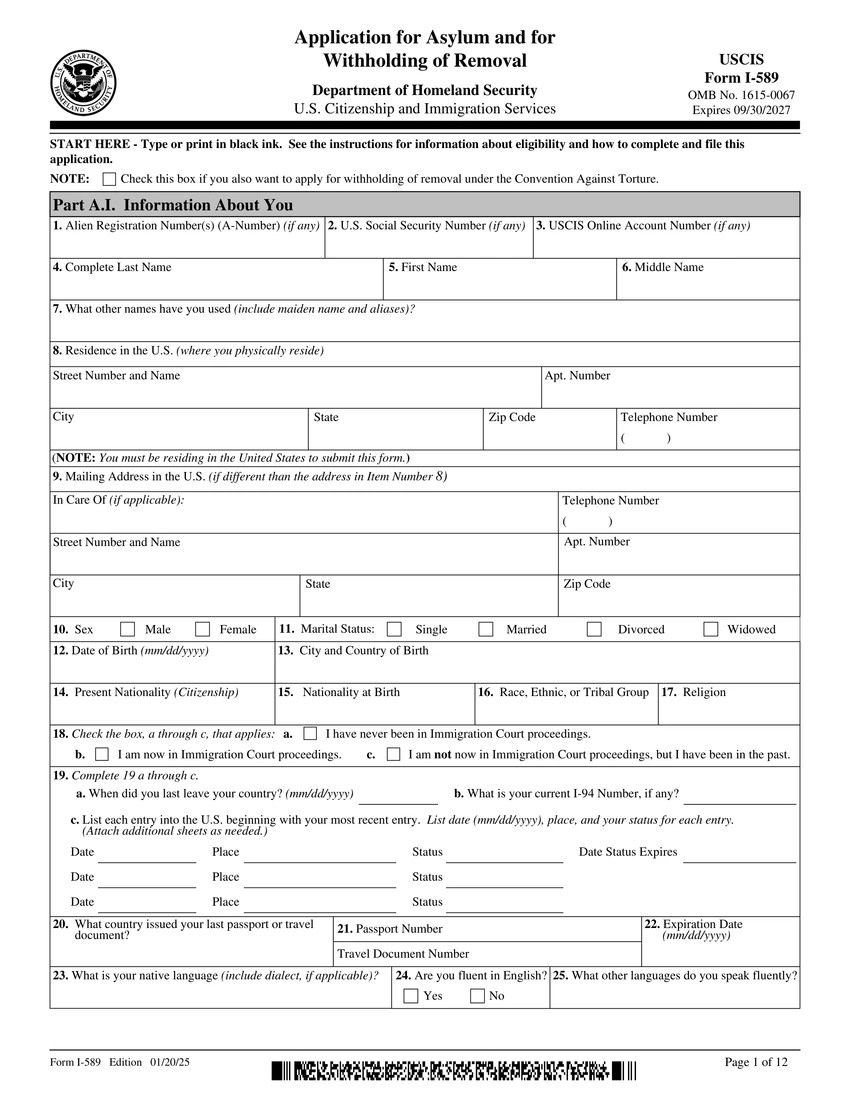
First page of I-589 form
Source: I-589 PDF
Context and workflow
#Processing time for I-589 varies by case type and current workload — always check the official USCIS processing time tool.
Why this matters
- This form helps confirm that the application matches the program’s requirements and checklist.
- Small mismatches inside I-589 (or between I-589 and supporting evidence) can force rework later in processing.
Where it fits in the workflow
- Initiates the asylum application process with USCIS.
- Receipt Notice (a related form) is issued after submission.
- May lead to an interview or hearing to assess eligibility.
- Potentially results in protection from removal if approved.
Who uses it
This form is not intended for general public self-filing. Common filers: Affirmative Asylum, Defensive Asylum, Withholding of Removal.
When it is used
- [object Object]
- [object Object]
- Individuals physically present in the U.S. who file within 1 year of arrival. He.
- Individuals in removal proceedings before an immigration judge who raise asylum .
- Individuals who cannot meet the 1-year asylum deadline but can demonstrate a cle.
Requirements snapshot
#- Affirmative: Filed within 1 year of arrival — heard by USCIS asylum officer
- Defensive: Filed in removal proceedings — heard by immigration judge
- Withholding: Cannot meet 1-year deadline but faces persecution — higher burden of proof
- CAT: Convention Against Torture protection — fears torture by government
Failure prevention (What causes Form I-589 rejections?)
#Technical rejections
- Submitting forms in a language other than English.
- Failing to file within the one-year deadline without valid reasons.
- Ensure form edition is current
Substantive weaknesses
- Omitting critical biographical or identity details.
- To avoid incomplete application or insufficient evidence: Follow instructions carefully; include all required supporting documents.
- To avoid filing after 1-year deadline without exception: File within 1 year of last arrival; document changed circumstances if filing late.
- To avoid vague or generic personal statement: Provide detailed, specific account of persecution; include country conditions evidence.
- To avoid traveling abroad without advance parole after filing: Do not travel without approved advance parole; travel can abandon the application.
What it asks for (What does Form I-589 ask for?)
#- Detailed explanation of why you fear torture.
- Basic information about you, including your Alien Registration Number (A-Number) and residential address.
- Specific questions relevant to eligibility for asylum, withholding of removal, or protection under the Convention Against Torture.
- Applicant identification information
- Supporting documentation inventory
- Eligibility or purpose details
- Declarations and signatures
- Documentation related to: Provide your Passport/ID Card Number, if any
- Documentation related to: Provide a copy of all passports or other travel documents and any U.S. immigration documents for you and each family mem
What you need (What do you need for Form I-589?)
#- You must provide your residential street address in the United States.
- Provide a copy of all passports or other travel documents and any U.S. immigration documents for you and each family member included in your application.
- Submit primary documentary evidence establishing your family relationship for each family member included in your application.
- Bring identification documents to your interview, such as a passport or Form I-94.
- Your Passport/ID Card Number, if any.
- Specific facts and evidence supporting your claim to asylum.
- All required supporting documents and evidence.
- Do not submit passport-style photos, multiple copies of the form, or multiple copies of supporting documentation.
Checklist (What is the Form I-589 checklist?)
#- Download the current I-589 and instructions from the official USCIS website
- Review the official I-589 instructions before filing
- Gather required supporting documents per the instructions
- Complete all required sections of I-589
- Confirm the form is signed and dated in all required fields
- Sign, date, and submit I-589 with all required supporting evidence
Where to file
#Online filing is available for some categories — verify on the official form page. Otherwise, file by mail to the address in the instructions.
File online
Check the official I-589 page to see if online filing is available for your category.
Submit application
Paper filing addresses vary by eligibility category and state of residence. Check the official instructions for the correct filing address.
Filing locations and procedures may change. Always verify on the official USCIS website before submitting. For related guidance, see Application for Travel Document.
Fees
#| Component | Amount |
|---|---|
| Filing FeeThe standard filing fee for form i-589. Check the current fee on the official USCIS fee schedule. | See official schedule |
| Biometrics Services FeeFailure to provide biometrics or biographical information within the time allowed. | See official schedule |
Can the Form I-589 fee be waived?
Fee waivers may be available for qualifying applicants. See official instructions for eligibility.
What happens if I submit the wrong fee?
USCIS will reject your application if the incorrect fee is submitted. Verify the current fee on the official schedule before filing.
Fee waiver: Fee waivers may be available for qualifying applicants. See official instructions for eligibility. For related guidance, see Application for Employment Authorization.
Fees change; always verify on USCIS.
Form sections (What sections does Form I-589 have?)
#Personal Information
Applicant identification.
- Full name and A-Number if applicable
- Date of birth and nationality
- Current address and contact
Eligibility
Basis for the application.
- Category or classification claimed
- Supporting evidence type
- Dates establishing eligibility
Supporting Documents
Required attachments.
- Identity and status documents
- Category-specific evidence
- Fee payment or waiver request
Choose your path
#Choose your path based on your eligibility category. Each block summarizes who qualifies, what to file, common mistakes, and typical processing time.
Affirmative Asylum
Individuals physically present in the U.S. who file within 1 year of arrival. Heard by a USCIS asylum officer in a non-adversarial interview.
File with:
- Personal declaration
- Country conditions evidence
- Identity documents
- Corroborating evidence of persecution
Common mistakes:
- Missing the 1-year filing deadline
- Insufficient country conditions documentation
- Inconsistencies between declaration and interview testimony
Typical processing: 6-18 months to interview
Defensive Asylum
Individuals in removal proceedings before an immigration judge who raise asylum as a defense against deportation.
File with:
- I-589 filed with immigration court
- Supporting evidence
- Legal brief
Common mistakes:
- Missing court filing deadlines
- Not preparing for cross-examination by government attorney
- Incomplete country conditions evidence
Typical processing: 1-4 years (court backlogs)
Withholding of Removal
Individuals who cannot meet the 1-year asylum deadline but can demonstrate a clear probability of persecution. Higher burden of proof than asylum.
File with:
- Same I-589 form with withholding arguments
- Evidence of clear probability of persecution
Common mistakes:
- Not understanding the higher burden of proof (clear probability vs well-founded fear)
- Filing withholding alone when asylum is available
Typical processing: Heard with asylum claim
Category comparison
#| Category code | Eligibility | Typical filing companion | Auto-extension? | Premium processing? |
|---|---|---|---|---|
| Affirmative | Filed within 1 year of arrival — heard by USCIS asylum officer | I-589 with supporting evidence and country conditions | N/A | No |
| Defensive | Filed in removal proceedings — heard by immigration judge | I-589 filed with immigration court | N/A | No |
| Withholding | Cannot meet 1-year deadline but faces persecution — higher burden of proof | Same form with withholding arguments | N/A | No |
| CAT | Convention Against Torture protection — fears torture by government | Same form with CAT-specific evidence | N/A | No |
Strategy tips
#Mistake severity
#| Mistake type | Severity | How to avoid |
|---|---|---|
| Incomplete application or insufficient evidence | Rejection | Follow instructions carefully; include all required supporting documents. |
| Filing after 1-year deadline without exception | Rejection | File within 1 year of last arrival; document changed circumstances if filing late. |
| Vague or generic personal statement | RFE | Provide detailed, specific account of persecution; include country conditions evidence. |
| Traveling abroad without advance parole after filing | Rejection | Do not travel without approved advance parole; travel can abandon the application. |
Examples (What are examples for Form I-589?)
#- Complete all certifications: Ensure all required official certifications are properly signed and dated.
- Verify documentation: All supporting documents must be current and properly formatted.
- Cross-reference information: Information must be consistent across all sections and supporting documents.
- [object Object]
- [object Object]
- [object Object]
Common misconceptions (What misconceptions surround Form I-589?)
#- Filing this form does not guarantee approval of the underlying case
- Requirements may differ based on your specific situation
- [object Object]
- [object Object]
Edge cases and variations
#- If you are asked to submit or update I-589, treat it as a package update: check every place the same details appear and keep them consistent.
Scenarios
#An applicant files the application with all required supporting documents and the correct fee.
Application accepted. Biometrics may be scheduled. Case proceeds to adjudication.
Follow the evidence checklist for your category. Missing documents trigger RFEs or denial.
An applicant files before the eligibility window (e.g., I-751 outside the 90 days before conditional residence expires).
Application rejected. Fee returned. Must refile when eligible.
Verify eligibility dates carefully. Filing too early is as problematic as filing late.
An applicant forgets to sign the form.
Application rejected. Must resubmit with signature. Unsigned forms are not accepted.
Sign and date the form. Review the signature block before mailing.
Key differentiators
#- Unlike Form I-765: Application for Employment Authorization: Next step after approval: Work authorization available 180 days after filing (Asylum pathway)
- Unlike Form I-131: Application for Travel Document: Next step after approval: Advance parole for urgent travel needs (Asylum pathway)
- Unlike Form I-485: Application to Register Permanent Residence or Adjust Status: Next step after approval: Adjustment of status one year after asylum grant
Why it matters
#You must file the application within 1 year of arriving in the United States unless exceptions apply.
Why it matters: Filing late without valid exceptions can result in denial of the application.
Including your spouse and children in your application can extend benefits to them if approved.
Why it matters: Ensures family members can also receive protection and benefits.
Providing false information can lead to permanent ineligibility for benefits under the INA.
Why it matters: Ensures applicants understand the seriousness of providing accurate information.
You must submit primary documentary evidence establishing your family relationship for each family member included in your application.
Why it matters: Failure to provide this evidence can result in delays or denial of the application.
Next steps
#- Receive a Receipt Notice (a related form) confirming the application was received.
- Attend an interview or hearing to discuss the asylum claim.
- Await a decision on the asylum application.
- If approved, receive protection from removal and potentially apply for work authorization.
Verification
#This guide is derived from official USCIS instructions for I-589 and is updated when form editions or filing rules change. Always verify current requirements at the official USCIS website.
FAQs
Do I need to file Form I-589 if I'm only updating my address or contact information?
Check the official instructions to see which form or process applies to your type of update. Review the official I-589 instructions for complete guidance specific to your immigration case and circumstances.
Can I include my spouse and children on my Form I-589 application?
You may include your spouse and any unmarried children under the age of 21 who are physically present in the United States.
What should I do if I have more than four children?
For applicants with more than four children, it is necessary to use Form I-589, Supplement A, to furnish details about each additional child.
What happens if I submit my application after one year of arriving in the U.S.?
you may need to demonstrate changed circumstances that materially affect your eligibility for asylum or extraordinary circumstances for the delay. The specific timing depends on your case type and circumstances. Generally, forms should be filed according to the sequence outlined in the official instructions for your immigration category.
How do I choose the correct eligibility category code on I-589?
Your eligibility category code determines your basis for filing I-589. Withholding of Removal Under Section 241(b)(3) of the INA Form I-589 Instructions 01/20/25 You should include a detailed explanation of why you fear torture in response to Part B , Question 4 of the application If you have applied for asylum, the immigration judge will first determine whether you are eligible for asylum under section 208 of the INA and for withholding of removal under section 241(b)(3) of the INA
What supporting documents do I need for I-589?
Form I-589 Instructions 01/20/25 When including family members in your asylum application, you may need to submit primary documentary evidence establishing your family relationship for each family member, as described below: 2 Provide your Passport/ID Card Number, if any. Submit primary documentary evidence establishing your family relationship for each family member included in your application.
Do I need to provide a mailing address for I-589?
You need a reliable mailing address for notices and card delivery. If you do not have a stable address, USCIS allows alternatives (e.g., a representative's address or safe mailing options) per official rules — review the instructions for your situation.
Who is eligible to file I-589?
Form I-589 serves as the application for asylum and withholding of removal within the United States. It is specifically designed for individuals who are physically present in the U.S. and are seeking protection due to persecution in their home country. For comprehensive guidance, please consult the official instructions.
What are common reasons I-589 gets rejected?
Common reasons I-589 is rejected include missing or incorrect signatures, using an outdated form edition, incomplete required fields, incorrect fee payment, missing required supporting documents, and photographs that do not meet official specifications. Carefully review the instructions and checklist before submitting.
When will I-589 be processed and what is the workflow?
Processing timing for I-589 varies depending on the filing category, processing location, and current application volume. Standard processing can range from a few weeks to several months. Before submitting, check the official USCIS processing times tool for the most current estimates. After filing, monitor your case status and consider whether expedited options are available.
VisaMind provides informational guidance only and is not a government agency. This is not legal advice. Requirements can change and eligibility depends on your specific facts. If your case is complex or high-stakes, consult a licensed immigration attorney.
Next steps
Requirements vary by nationality, purpose, timeline, and case details. Use Find My Visa to get a personalized checklist with official sources and deadlines.
Find my visa