On this page
- Quick summary
- Overview (What is Form I-751?)
- Context and workflow
- Requirements snapshot
- Eligibility Category Codes
- Failure prevention (What causes Form I-751 rejections?)
- What it asks for (What does Form I-751 ask for?)
- What you need (What do you need for Form I-751?)
- Checklist (What is the Form I-751 checklist?)
- Processing times
- Where to file
- Fees
- Form sections (What sections does Form I-751 have?)
- Choose your path
- Category comparison
- Strategy tips
- Mistake severity
- Examples (What are examples for Form I-751?)
- Common misconceptions (What misconceptions surround Form I-751?)
- Edge cases and variations
- Scenarios
- Key differentiators
- Why it matters
- Next steps
- Verification
- Related guides
- Resources
Quick summary
#The applicant may need to meet the eligibility requirements for the benefit category they are applying for. For related guidance, see the U.S. Visa Photo Requirements page. For related guidance, see the F-1 Student Visa Checklist page.
CR-1: CR-1 Conditional Resident Visa (Spouse)
Include it with your application package and follow official instructions for submission.
Names, dates of birth, and passport details on other forms Program checklist requirements Supporting documents and translations
Overview (What is Form I-751?)
#In summary, Form I-751 is a pivotal step for conditional permanent residents seeking to secure their status in the U.S, as described in the Application to Register Permanent Residence or guide, as described in the Application for Naturalization guide.
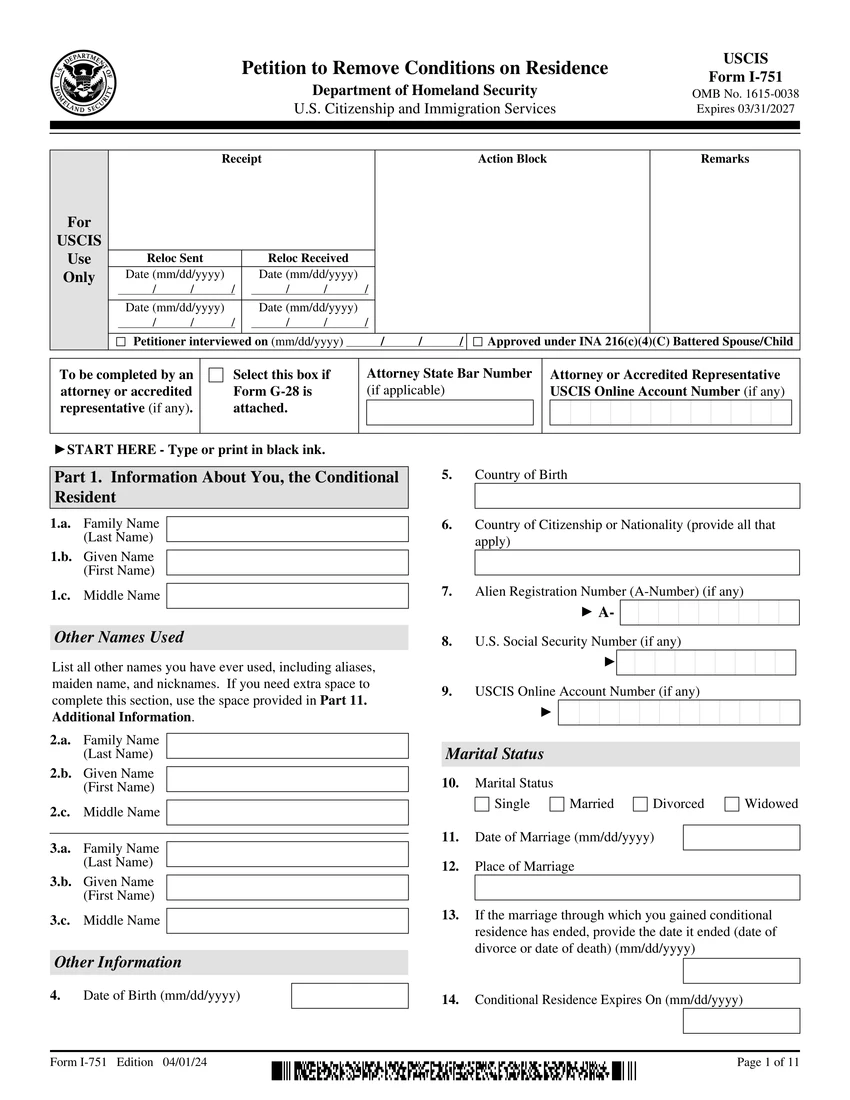
First page of I-751 form
Source: I-751 PDF
Context and workflow
#Form I-751 is used to petition for the removal of conditions on residence for individuals who obtained conditional permanent resident status through marriage to a U.S. citizen or lawful permanent resident. You must file your Form I-751 during the 90-day period immediately before your conditional residence expires. If you have dependent children who acquired conditional resident status on the same day as you or within 90 days thereafter, include their names and A-Numbers in of Form I-751.
You may file your petition at any time before your conditional permanent resident status expires if you are unable to file jointly due to circumstances such as the death of your spouse, divorce, or extreme hardship.
Why this matters
- This form acts as a cross-check point: details here must match other forms and supporting documents.
- Small mismatches inside I-751 (or between I-751 and supporting evidence) can force rework later in processing.
Where it fits in the workflow
- Initiating the process of removing conditions on residence.
- Receipt Notice (a related form) is issued after filing.
- Attend biometrics appointment (fingerprints, photo, and signature).
- Receive decision notice from USCIS.
Who uses it
The applicant may need to meet the eligibility requirements for the benefit category they are applying for. For related guidance, see the U.S. Visa Photo Requirements page. For related guidance, see the F-1 Student Visa Checklist page. Common filers: Joint Filing with Spouse, Divorce Waiver, Abuse/Battery Waiver.
When it is used
- CR-1: CR-1 Conditional Resident Visa (Spouse)
- [object Object]
- [object Object]
- [object Object]
- [object Object]
- [object Object]
Requirements snapshot
#- marriage: Conditional resident based on marriage; must prove bona fide marriage
Eligibility Category Codes
#Eligibility information for this form. Confirm your category in the official instructions before filing.
This is a shortlist of common categories. The official instructions include many more.
| Code | Who applies |
|---|---|
| General | The applicant may need to meet the eligibility requirements for the benefit category they are applying for. |
| Eligibility | If you are filing as an individual due to the death of your spouse, submit a copy of the death certificate with your petition, along with evidence of the qualifying relationship |
Failure prevention (What causes Form I-751 rejections?)
#Technical rejections
- Failure to sign the petition.
- Submitting a stamped or typewritten name instead of a handwritten signature.
- Ensure form edition is current
Substantive weaknesses
- Omitting a valid explanation for late filing.
- Failing to include a full English translation for documents in a foreign language.
- To avoid filing outside the 90-day window before conditional residency expires: File within 90 days before the 2-year anniversary of conditional residence.
- To avoid insufficient evidence of bona fide marriage (joint filing): Submit joint lease, bank accounts, tax returns, insurance, and affidavits.
- To avoid wrong fee or outdated form version: Check current fee schedule and form edition date before submitting.
What it asks for (What does Form I-751 ask for?)
#- Biographic information including ethnicity, race, height, weight, eye color, and hair color.
- Evidence of the marriage entered in good faith.
- Details of any criminal charges, arrests, or convictions.
- Applicant identification information
- Supporting documentation inventory
- Eligibility or purpose details
- Declarations and signatures
What you need (What do you need for Form I-751?)
#- The current edition of I-751
- Proof of current immigration status
- Government-issued photo identification
- Passport-style photographs meeting specifications
- Two completed Form FD-258 Fingerprint Cards for each petitioner and dependent aged 14 to 79
- Joint financial documents
- Lease or mortgage in both names
- Birth certificates of children if any
- Divorce decree
- Evidence marriage was bona fide at inception
Checklist (What is the Form I-751 checklist?)
#- Download the current I-751 and instructions from the official USCIS website
- Review the official I-751 instructions before filing
- Gather required supporting documents per the instructions
- Complete all required sections of I-751
- Confirm the form is signed and dated in all required fields
- Ensure that all pages of your Form I-751 belong to the same current edition.
- Sign, date, and submit I-751 with all required supporting evidence
Processing times
#| Category | Processing time |
|---|---|
| Removal of lawful permanent resident conditions (spouses of U.S. citizens and lawful permanent residents) | 27 to 49.5 monthsas of January 2026 |
- Processing times for I-751 vary by eligibility category and service center. Data sourced from the official USCIS processing times tool.
- Processing times differ significantly by eligibility category. Initial applications, renewals, and replacements each go through different adjudication queues, and some categories consistently take longer than others.
- Renewal filings are often processed differently than initial applications. If you are renewing, file well before your current authorization expires — some categories allow you to continue working while the renewal is pending if filed on time.
- The service center assigned to your case affects how long it takes. USCIS distributes filings across multiple centers, and each has different workloads. You cannot choose which center processes your case.
- To check your estimated timeline: visit the official USCIS processing times tool, select your form and eligibility category, and note that the tool shows the filing date of cases currently being worked on — not a countdown from when you filed.
- While pending: track your case status online with your receipt number, respond promptly to any requests for additional evidence, and update your address through your USCIS account if you move.
Where to file
#Online filing is available for some categories — verify on the official form page. Otherwise, file by mail to the address in the instructions.
File online
Create a USCIS online account if filing online.
Filing locations and procedures may change. Always verify on the official USCIS website before submitting.
Fees
#| Component | Amount |
|---|---|
| Filing FeeThe standard filing fee for form i-751. Check the current fee on the official USCIS fee schedule. | See official schedule |
| Biometrics Services FeeA biometrics fee may be required depending on your category. Check the official fee schedule. | See official schedule |
Can the Form I-751 fee be waived?
Fee waivers may be available for qualifying applicants. See official instructions for eligibility.
What happens if I submit the wrong fee?
USCIS will reject your application if the incorrect fee is submitted. Verify the current fee on the official schedule before filing.
Fee waiver: Fee waivers may be available for qualifying applicants. See official instructions for eligibility. For related guidance, see Petition for Alien Relative.
Fees change; always verify on USCIS.
Form sections (What sections does Form I-751 have?)
#Part 1. Information About You
Conditional resident biographic data.
- Common mistake: A-Number or name mismatch—use exact spelling from green card.
- Include A-Number from conditional green card.
Part 2. Information About Your Conditional Residence
Marriage and residence history.
- List all addresses during conditional residence; gaps raise questions.
- Provide date and place of marriage; divorce date if filing waiver.
Part 3. Eligibility Information
Joint filing or waiver basis.
- Joint: Explain any periods of separation; include joint evidence.
- Waiver: Explain basis (divorce, abuse) and include required evidence.
Part 6. Signature
Sign, date, and certify accuracy.
- Common mistake: Unsigned form—sign and date before submitting.
Choose your path
#Choose your path based on your eligibility category. Each block summarizes who qualifies, what to file, common mistakes, and typical processing time.
Joint Filing with Spouse
Conditional residents filing jointly with their U.S. citizen or LPR spouse within 90 days before the 2-year card expires.
File with:
- Joint financial documents
- Lease or mortgage in both names
- Birth certificates of children if any
Common mistakes:
- Filing outside the 90-day window before expiration
- Insufficient evidence of bona fide marriage
Typical processing: 12-24 months
Divorce Waiver
Conditional residents whose marriage ended in divorce and who can demonstrate the marriage was entered in good faith.
File with:
- Divorce decree
- Evidence marriage was bona fide at inception
Common mistakes:
- Not providing enough evidence the marriage was genuine
- Missing the filing window after divorce
Typical processing: 18-30 months
Abuse/Battery Waiver
Conditional residents who were subjected to battery or extreme cruelty by their U.S. citizen or LPR spouse.
File with:
- Evidence of abuse (police reports, protection orders, medical records, counselor statements)
Common mistakes:
- Insufficient documentation of abuse
- Not including personal declaration describing the abuse
Typical processing: 18-36 months
Category comparison
#| Category code | Eligibility | Typical filing companion | Auto-extension? | Premium processing? |
|---|---|---|---|---|
| marriage | Conditional resident based on marriage; must prove bona fide marriage | I-751 with joint evidence; divorce waiver if applicable | Yes (18 months with receipt) | No |
| divorce_waiver | Divorced or annulled; show marriage was bona fide at time of entry | Divorce decree, bona fide marriage evidence from marriage period | Yes | No |
| abuse_waiver | VAWA or abuse waiver; self-petition without spouse | Evidence of abuse; may file I-360 instead | Yes | No |
Strategy tips
#Mistake severity
#| Mistake type | Severity | How to avoid |
|---|---|---|
| Filing outside the 90-day window before conditional residency expires | Rejection | File within 90 days before the 2-year anniversary of conditional residence. |
| Insufficient evidence of bona fide marriage (joint filing) | RFE | Submit joint lease, bank accounts, tax returns, insurance, and affidavits. |
| Wrong fee or outdated form version | Rejection | Check current fee schedule and form edition date before submitting. |
| Forgetting to sign the petition | Delay | Sign and date all required sections before submitting. |
| Failing to include divorce decree (waiver cases) | RFE | Include certified divorce or annulment decree when filing a waiver. |
Examples (What are examples for Form I-751?)
#- Strong application: An applicant submits the form with all required documents and receives a timely decision.
- Strong application: A couple provides extensive evidence of their shared life, including joint financial accounts and affidavits from friends.
- Weak application: An applicant submits the form without any evidence of the marriage being entered in good faith, leading to a denial due to insufficient documentation.
- Strong application: Conditional residents filing jointly with their U.S. citizen or LPR spouse withi submits with required evidence; receives Employment Authorization Document (EAD) in approximately 12-24 months.
- Strong application: Conditional residents whose marriage ended in divorce and who can demonstrate th submits with required evidence; receives Employment Authorization Document (EAD) in approximately 18-30 months.
- Strong application: Conditional residents who were subjected to battery or extreme cruelty by their submits with required evidence; receives Employment Authorization Document (EAD) in approximately 18-36 months.
Common misconceptions (What misconceptions surround Form I-751?)
#- Filing this form does not guarantee approval of the underlying case
- Requirements may differ based on your specific situation
- A common misunderstanding is that once you file Form I-751, you automatically become a permanent resident; however, approval is not guaranteed and depends on meeting all requirements.
Edge cases and variations
#- If you are asked to submit or update I-751, treat it as a package update: check every place the same details appear and keep them consistent.
Scenarios
#Couple filed I-751 jointly with joint lease, taxes, bank statements.
Approved without interview; 10-year green card received.
Strong joint evidence often avoids interview.
Divorced conditional resident filed I-751 with waiver.
RFE for more bona fide marriage evidence; submitted photos and affidavits; approved.
Waiver cases need evidence from the marriage period, not just divorce decree.
Applicant filed I-751 one month after conditional residency expired.
Rejection may occur, and you might need to pursue a different process or transition to permanent resident status, depending on good cause and individual circumstances.
File within the 90-day window before expiration.
Key differentiators
#- Unlike Form I-130: Petition for Alien Relative: Required for: Original petition that led to conditional status (Family-based immigration pathway)
- Unlike Form I-485: Application to Register Permanent Residence or Adjust Status: Required for: Adjustment that resulted in conditional green card (Family-based immigration pathway)
- Unlike Form N-400: Application for Naturalization: Next step after approval: Naturalization after conditions removed (Family-based immigration pathway)
Why it matters
#Filing jointly requires submission during the 90-day period before conditional residence expires.
Why it matters: Filing outside this window without a valid reason can lead to automatic loss of status.
Evidence requirements vary if filing due to abuse or extreme hardship.
Why it matters: Providing appropriate evidence is crucial for waiver approval.
Dependent children who did not acquire status on the same day must file separately.
Why it matters: Incorrect filing can delay or prevent removal of conditions for dependents.
Evidence of good faith marriage is crucial for all filing categories.
Why it matters: Failure to provide sufficient evidence can result in denial of the petition.
Next steps
#- Receive Receipt Notice (a related form) confirming USCIS has received the form.
- Attend biometrics appointment for fingerprints, photo, and signature.
- USCIS reviews the petition and supporting documents.
- Receive a decision notice from USCIS, which may be an approval or a request for additional information.
- If approved, conditions are removed, and the individual becomes a full permanent resident.
Verification
#This guide is derived from official USCIS instructions for I-751 and is updated when form editions or filing rules change. Always verify current requirements at the official USCIS website.
FAQs
Do I need to file Form I-751 if I'm only updating my address or contact information?
Check the official instructions to see which form or process applies to your type of update. Review the official I-751 instructions for complete guidance specific to your immigration case and circumstances.
Can I file Form I-751 if my spouse has passed away?
Yes, you may file Form I-751 without your spouse if they are deceased, but you will need to provide appropriate documentation to support your case.
Do I need to include my children on my Form I-751?
Consult the official instructions for Form I-751 to understand the specific requirements relevant to your circumstances.
What supporting documents do I need for I-751?
Please consult the official instructions for comprehensive information.
Do I need to provide a mailing address for I-751?
You need a reliable mailing address for notices and card delivery. If you do not have a stable address, USCIS allows alternatives (e.g., a representative's address or safe mailing options) per official rules — review the instructions for your situation.
What happens after I submit I-751?
After submitting I-751, USCIS will issue a Confirmation of receipt confirming acceptance. You may then be scheduled for biometrics, an interview, or additional evidence requests depending on your case. You can monitor your case status online using the receipt number from your notice.
What are common reasons I-751 gets rejected?
Common reasons I-751 is rejected include missing or incorrect signatures, using an outdated form edition, incomplete required fields, incorrect fee payment, missing required supporting documents, and photographs that do not meet official specifications. Carefully review the instructions and checklist before submitting.
VisaMind provides informational guidance only and is not a government agency. This is not legal advice. Requirements can change and eligibility depends on your specific facts. If your case is complex or high-stakes, consult a licensed immigration attorney.
Next steps
Requirements vary by nationality, purpose, timeline, and case details. Use Find My Visa to get a personalized checklist with official sources and deadlines.
Find my visa