On this page
- Quick summary
- Overview (What is Form I-134?)
- Context and workflow
- Requirements snapshot
- Failure prevention (What causes Form I-134 rejections?)
- What it asks for (What does Form I-134 ask for?)
- What you need (What do you need for Form I-134?)
- Checklist (What is the Form I-134 checklist?)
- Where to file
- Fees
- Form sections (What sections does Form I-134 have?)
- Key terms
- Strategy tips
- Mistake severity
- Examples (What are examples for Form I-134?)
- Common misconceptions (What misconceptions surround Form I-134?)
- Edge cases and variations
- Scenarios
- Key differentiators
- Why it matters
- Next steps
- Verification
- Related guides
- Resources
Quick summary
#You must file a separate Form I-134 for each beneficiary Review the official instructions to confirm you meet the filing requirements for this form, as described in the Form DS-3035 guide, as described in the Form I-129 guide.
When a sponsor must document financial support obligations for an intending immigrant
Include it with your application package and follow official instructions for submission.
Names, dates of birth, and passport details on other forms Program checklist requirements Supporting documents and translations
Overview (What is Form I-134?)
#By providing comprehensive financial evidence and a commitment to support, sponsors can help beneficiaries meet the requirements for various nonimmigrant visas and applications, as described in the Why Visas Get Denied (and How guide, as described in the U.S. Visa Photo Requirements guide.
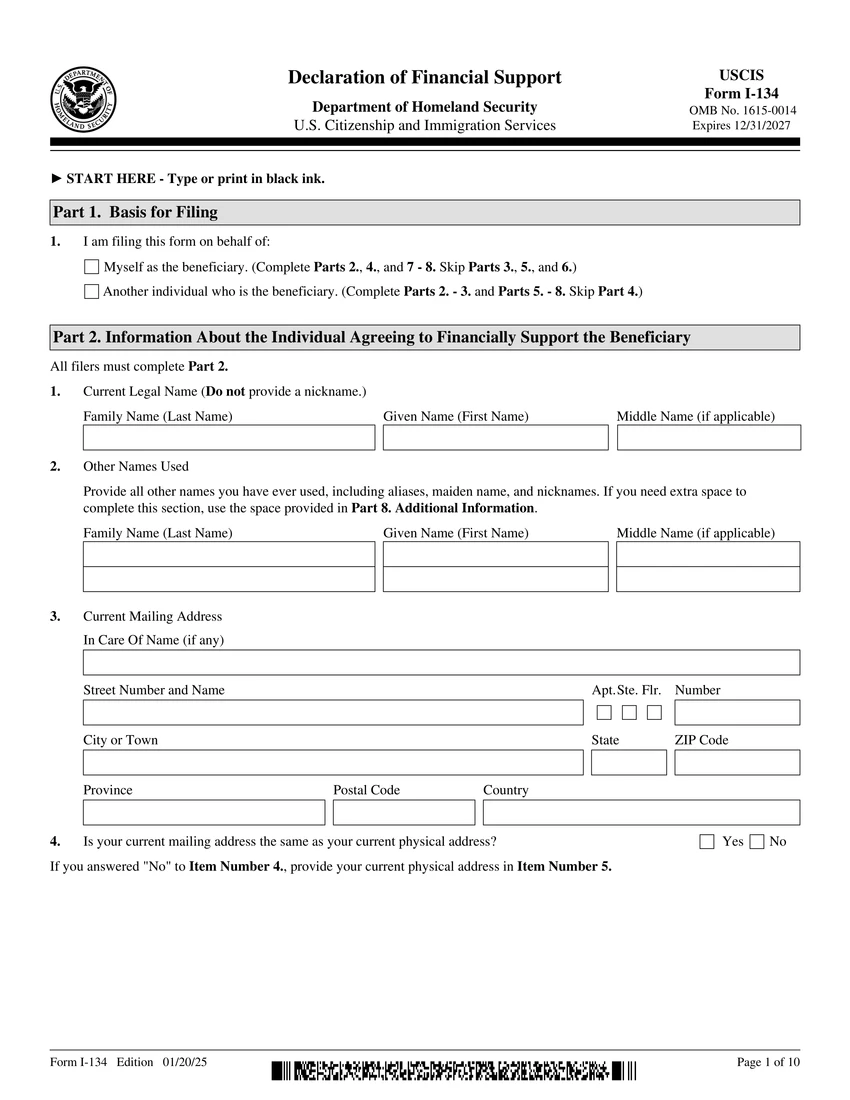
First page of I-134 form
Source: I-134 PDF
Context and workflow
#Receive a Receipt Notice (a related form) from USCIS acknowledging the form submission.
Why this matters
- Small mismatches inside I-134 (or between I-134 and supporting evidence) can force rework later in processing.
- This form helps confirm that the application matches the program’s requirements and checklist.
Where it fits in the workflow
- Processing time for I-134 varies by case type and current workload — always check the official USCIS processing time tool.
- Supporting evidence for nonimmigrant applications.
- May be used alongside applications for change of status or extensions.
- Part of the documentation reviewed before issuing a decision on nonimmigrant status.
- I-134 is commonly filed alongside Form I-129F, Form DS-160, Form I-131.
Who uses it
A separate Form I-134 must be filed for each beneficiary, including those who are applicants for a K-1 visa. This form is used by sponsors to agree to provide financial support to the beneficiary, ensuring they do not become reliant on U.S. Government welfare during their temporary stay. The sponsor must demonstrate sufficient financial resources to support the visitor, whether the beneficiary is inside or outside the United States. Review the official instructions to ensure you meet the necessary filing requirements.
When it is used
- When a sponsor must document financial support obligations for an intending immigrant
- After the underlying petition is approved and financial sponsorship is required
- As part of the immigrant visa or adjustment process where sponsorship applies
Requirements snapshot
#- Supporting evidence must demonstrate the sponsor’s ability to meet the required support level.
Failure prevention (What causes Form I-134 rejections?)
#Technical rejections
- Submitting an unsigned form.
- Using a stamped or typewritten signature instead of a handwritten one.
- Ensure form edition is current
Substantive weaknesses
- Failing to provide evidence of sufficient income or financial resources.
- To avoid insufficient income or incomplete financial evidence: Use current poverty guidelines; include all required tax and employment evidence.
- To avoid information not matching beneficiary's application: Names and details on I-134 must match DS-160 or K-1 application exactly.
- To avoid using outdated tax returns or pay stubs: Include most recent tax transcript and recent pay stubs; evidence must be current.
- To avoid unsigned affidavit: Sign and date I-134; bring original to interview if required.
What it asks for (What does Form I-134 ask for?)
#- Financial information, including income and assets available to support the beneficiary.
- Financial resources and income details of the supporter
- Biographical information of the beneficiary
- Applicant identification information
- Supporting documentation inventory
- Eligibility or purpose details
- Declarations and signatures
- You must sign and date your declaration in Part 4
- Information on the cash or assets available to you (do not include any assets from the individual named in Part 3
- Providing a stamped or typewritten name instead of a handwritten signature.
- Adjudication and determines that it has a deficient signature, USCIS will deny the request.
- Documentation related to: If you include the net value of your home, then you must include documentation demonstrating that you own the home, a re
Sources for this section
What you need (What do you need for Form I-134?)
#- The current edition of I-134
- Recent tax returns or income evidence for the sponsor and household members
- Household size documentation and supporting financial evidence
- A statement from an officer of the bank or other financial institutions with deposits
- A statement from your employer on business stationery showing employment details
- Evidence should include the name of the asset holder, a description of the asset, proof of ownership, and the basis for the owner’s claim of its net cash value
- Evidence of sufficient income or financial resources to support the beneficiary.
- Complete all required sections, sign, and submit with required evidence.
- [object Object]
- [object Object]
Sources for this section
Checklist (What is the Form I-134 checklist?)
#- To access the most recent Form I-134 and its accompanying instructions, please visit the official USCIS website.
- Review the I-134 instructions for sponsor and household requirements
- Gather sponsor income evidence and required household documentation
- Complete all required sections of I-134
- Confirm the form is signed and dated in all required fields
- Ensure that you sign and date Form I-134 before submitting it, accompanied by all necessary supporting documentation.
Sources for this section
Where to file
#Online filing is available for some categories — verify on the official form page. Otherwise, file by mail to the address in the instructions.
File online
Check the official I-134 page to see if online filing is available for your category.
Submit application
Paper filing addresses vary by eligibility category and state of residence. Check the official instructions for the correct filing address.
Filing locations and procedures may change. Always verify on the official USCIS website before submitting. For related guidance, see Online Nonimmigrant Visa Application.
Fees
#| Component | Amount |
|---|---|
| Filing FeeThe standard filing fee for form i-134. Check the current fee on the official USCIS fee schedule. | See official schedule |
Can the Form I-134 fee be waived?
Fee waivers may be available for qualifying applicants. See official instructions for eligibility.
What happens if I submit the wrong fee?
USCIS will reject your application if the incorrect fee is submitted. Verify the current fee on the official schedule before filing.
Fee waiver: Fee waivers may be available for qualifying applicants. See official instructions for eligibility. For related guidance, see Petition for Alien Fiancé(e).
Fees change; always verify on USCIS.
Form sections (What sections does Form I-134 have?)
#Sponsor Information
Petitioner or sponsor identity and status.
- Full name and citizenship or LPR status
- Current address and household size
- Relationship to beneficiary
Income and Employment
Financial capacity evidence.
- Employer name and annual income
- Tax returns for the last 3 years
- W-2s and 1099s
- Current employment letter
Assets
If using assets to meet the requirement.
- Bank statements and account balances
- Property valuations
- Evidence of ownership
- 5x shortfall rule for assets when income is insufficient
Key terms
#- Beneficiary
- The person who will receive financial support during their stay in the U.S.In this form: The individual for whom the financial support is being provided through Form I-134.
Strategy tips
#Mistake severity
#| Mistake type | Severity | How to avoid |
|---|---|---|
| Insufficient income or incomplete financial evidence | Rejection | Use current poverty guidelines; include all required tax and employment evidence. |
| Information not matching beneficiary's application | Delay | Names and details on I-134 must match DS-160 or K-1 application exactly. |
| Using outdated tax returns or pay stubs | RFE | Include most recent tax transcript and recent pay stubs; evidence must be current. |
| Unsigned affidavit | Delay | Sign and date I-134; bring original to interview if required. |
Examples (What are examples for Form I-134?)
#- Strong application: A sponsor submits Form I-134 with complete financial documentation and receives a positive decision promptly.
- Common weakness: A sponsor forgets to sign the form, resulting in it being returned for correction, causing delays.
- Scenario: A software engineer submitted their petition with all supporting documents The case was approved within the standard timeline Prepare all evidence before filing to avoid delays
- [object Object]
- [object Object]
- [object Object]
Common misconceptions (What misconceptions surround Form I-134?)
#- Filing this form does not guarantee approval of the underlying case
- Approval of this form does not grant immigration status by itself
- The financial obligation can continue after filing, depending on the case outcome
- [object Object]
Edge cases and variations
#- If you are asked to submit or update I-134, treat it as a package update: check every place the same details appear and keep them consistent.
Scenarios
#A sponsor with income at 150% of the poverty guideline completes the affidavit with 3 years of tax returns and 6 months of bank statements.
Affidavit accepted. Beneficiary's visa or adjustment application proceeds to approval.
Include complete tax documentation. IRS transcripts are preferred over photocopies of returns.
A sponsor uses a joint sponsor but the household member's Form I-864A is not signed by both parties.
RFE issued. The I-864A must be signed by both the sponsor and the household member.
All parties must sign. Household member income only counts with a properly executed I-864A.
An elderly sponsor has significant assets but low current income. The affidavit includes asset documentation exceeding 5 times the income shortfall.
Assets accepted. The 5x rule for assets applies when income is below the poverty guideline.
When using assets, the value must be 5 times the difference between your income and the poverty guideline for your household size.
Key differentiators
#- Unlike Form I-864: Form I-134 is used for nonimmigrant beneficiaries, whereas Form I-864 is for immigrants seeking permanent residency.
- Unlike Form I-129F: Petition for Alien Fiancé(e): Filed together: Financial support evidence for K-1 visa interview (K-1 Fiancé(e) pathway)
- Unlike Form DS-160: Online Nonimmigrant Visa Application: Filed together: Support evidence for tourist/visitor visa (K-1 Fiancé(e) pathway)
- Unlike Form I-131: Application for Travel Document: Filed together: Advance parole for urgent travel during processing (K-1 Fiancé(e) pathway)
Why it matters
#Separate Form I-134 must be filed for each beneficiary.
Why it matters: Filing a single form for multiple beneficiaries can lead to rejection.
Photocopied, faxed, or scanned copies of original handwritten signatures are valid.
Why it matters: Ensures that the form is accepted even if the original signature is not submitted.
Translations must include a certification of accuracy and translator's competence.
Why it matters: Non-compliant translations can result in delays or denials.
Next steps
#- Receive a Receipt Notice (a related form) from USCIS acknowledging the form submission.
- USCIS reviews the financial evidence and supporting documents.
- A decision is made based on the sufficiency of the financial support provided.
- If approved, the nonimmigrant may proceed with their application for status change or extension.
Verification
#This guide is based on official USCIS instructions for Form I-134 and is updated with any changes in form editions or filing regulations. Always check the official USCIS website for the latest requirements.
FAQs
Why does USCIS need the information requested on Form I-134?
Form I-134 serves as a sworn declaration from a third party with direct knowledge pertinent to your application. For comprehensive guidance tailored to your specific immigration case and circumstances, please consult the official I-134 instructions.
What other forms are typically filed together with Form I-134?
Review the official I-134 instructions for your specific situation. The specific forms required vary by case type. Review the instructions for your particular immigration category to determine which forms must be submitted together.
Which visa categories commonly require Form I-134?
Review the official instructions for eligibility details. Review the official I-134 instructions for complete guidance specific to your immigration case and circumstances.
Do I need to file Form I-134 if I'm only updating my address or contact information?
Consult the official instructions to determine which form or process is relevant for your specific update type.
What supporting documents do I need for I-134?
When declaring the net value of your home, you may need to provide documentation that confirms ownership, a recent appraisal conducted by a licensed appraiser, and details of any loans secured by a mortgage, trust deed, or other liens on the property. The evidence should clearly state the asset holder's name, describe the asset, include proof of ownership, and explain the basis for claiming its net cash value. Additionally, you may need to demonstrate sufficient income or financial resources to support the beneficiary.
Do I need to provide a mailing address for I-134?
You need a reliable mailing address for notices and card delivery. If you do not have a stable address, USCIS allows alternatives (e.g., a representative's address or safe mailing options) per official rules — review the instructions for your situation.
What happens after I submit I-134?
After submitting I-134, USCIS will issue a Confirmation of receipt confirming acceptance. You may then be scheduled for biometrics, an interview, or additional evidence requests depending on your case. You can monitor your case status online using the receipt number from your notice.
What are common reasons I-134 gets rejected?
Common reasons I-134 is rejected include missing or incorrect signatures, using an outdated form edition, incomplete required fields, incorrect fee payment, missing required supporting documents, and photographs that do not meet official specifications. Carefully review the instructions and checklist before submitting.
VisaMind provides informational guidance only and is not a government agency. This is not legal advice. Requirements can change and eligibility depends on your specific facts. If your case is complex or high-stakes, consult a licensed immigration attorney.
Next steps
Requirements vary by nationality, purpose, timeline, and case details. Use Find My Visa to get a personalized checklist with official sources and deadlines.
Find my visa