
On this page
- Quick summary
- Overview (What is Form I-907?)
- Context and workflow
- Failure prevention (What causes Form I-907 rejections?)
- What it asks for (What does Form I-907 ask for?)
- What you need (What do you need for Form I-907?)
- Checklist (What is the Form I-907 checklist?)
- Fees
- Processing times
- Where to file
- Key terms
- Strategy tips
- Mistake severity
- Examples (What are examples for Form I-907?)
- Common misconceptions (What misconceptions surround Form I-907?)
- Edge cases and variations
- Scenarios
- Key differentiators
- Why it matters
- Next steps
- Verification
- Related guides
- Resources
Quick summary
#For more information on eligible premium processing categories, please visit our How Do I Request Premium Processing, as described in the Visit the United States guide.
When you need the agency to take follow-up action on an already approved case
Include it with your application package and follow official instructions for submission.
Names, dates of birth, and passport details on other forms Program checklist requirements Supporting documents and translations
Overview (What is Form I-907?)
#Form I-907, Request for Premium Processing Service, is essential for individuals seeking expedited processing of certain immigration petitions or applications. This service guarantees a decision or action within a specified timeframe for eligible requests, such as Form I-129, Form I-140, certain categories of Form I-765, and specific classifications of Form I-539. To utilize this service, a separate Form I-907 must be submitted for each eligible petition or application. If filing on or after March 1, 2026, ensure to include the new fee applicable to the specific benefit requested.
For detailed information on eligible categories, please refer to the How Do I Request Premium Processing guide.
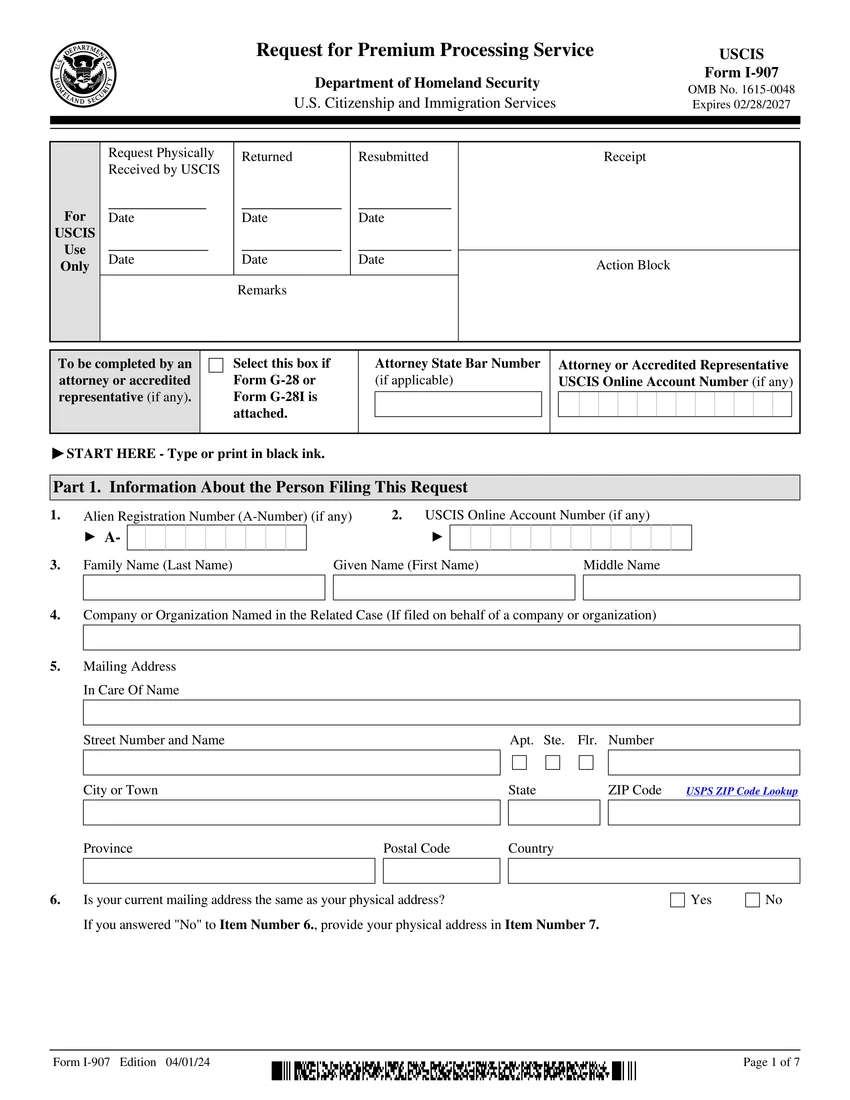
First page of I-907 form
Source: I-907 PDF
Context and workflow
#Processing time for I-907 varies by case type and current workload — always check the official USCIS processing time tool.
Why this matters
- Inconsistencies often trigger returns or follow-up requests because they create uncertainty in the case record.
- This form acts as a cross-check point: details here must match other forms and supporting documents.
Where it fits in the workflow
- Initiating faster processing for eligible applications.
- Receipt Notice (a related form) is typically issued after submission.
- May lead to quicker adjudication of the primary application or petition.
Who uses it
For detailed information on eligible premium processing categories, please visit our How Do I Request Premium Processing page.
When it is used
- When you need the agency to take follow-up action on an already approved case
- To request action related to an existing approval or record, as described in the instructions
- After a prior approval when a specific agency action is required
- H-1B — Premium processing for H-1B petition
- When supplementing G-28 — I-907 provides additional required information
Failure prevention (What causes Form I-907 rejections?)
#Technical rejections
- Submitting without a handwritten signature.
- Submitting multiple forms in the same envelope for unrelated cases.
Substantive weaknesses
- Filing for a benefit that may be eligible for premium processing.
- Leaving required fields blank, such as names and addresses.
- Ensure eligibility category is correctly identified.
- To avoid incomplete or incorrect information: Double-check all fields and include every required document per instructions.
- To avoid filing i-907 for a form that does not support premium processing: Check current fee schedule; premium processing is not available for all form types.
What it asks for (What does Form I-907 ask for?)
#- Details about the person requesting premium processing
- Information about the related immigration benefit request
- Contact information and declaration of the requestor
- Interpreter and preparer details if applicable
- Prior case identifiers (such as receipt/notice details), if available.
- Receipt numbers from any pending or prior applications
- The photocopy, fax, or scan must be of the original document containing the handwritten, ink signature
- This section must contain the signature of the person who completed your request, if other than you, the requestor
- A handwritten signature on Form I-907.
- Adjudication and determines that it has a deficient signature, USCIS may deny the request.
- Documentation related to: a referral for investigation of suspected fraud, misrepresentation, or the issuance of an approval notice, a request for
- Documentation related to: Complete all required sections, sign, and submit with required evidence
Sources for this section
What you need (What do you need for Form I-907?)
#- The current edition of I-907
- A handwritten signature on Form I-907
- A referral for investigation of suspected fraud, misrepresentation, or the issuance of an approval notice, a request for evidence, a notice of intent to deny, or a denial notice
- Complete all required sections, sign, and submit with required evidence.
- Processing timeframe will stop and will re-commence with a new applicable timeframe on the date that we receive a response to the notice of intent to deny or the request for evidence.
- Receipt numbers from any pending or previously filed applications
- Copy of your filed or approved I-129 (Premium processing for H-1B and other worker petitions)
- Copy of your filed or approved G-28 (Attorney or accredited representative (optional))
Checklist (What is the Form I-907 checklist?)
#- Download the current I-907 and instructions from the official USCIS website
- Review the I-907 instructions for the follow-up action this form covers
- Complete all required sections of I-907
- Confirm all pages are from the same current I-907 edition
- Sign, date, and submit I-907 with all required supporting evidence
Sources for this section
Fees
#| Component | Amount |
|---|---|
| Filing FeeUsing an incorrect filing fee after March 1, 2026. | See official schedule |
| Biometrics Services FeeA biometrics fee may be required depending on your category. Check the official fee schedule. | See official schedule |
| Premium Processing (Optional)Form I-907 is used to request Premium Processing Service for certain immigration petitions or applications. This service expedites the processing of eligible requests by guaranteeing a decision or action within a specified timeframe. | See official schedule |
Can the Form I-907 fee be waived?
Fee waivers may be available for qualifying applicants. See official instructions for eligibility.
What happens if I submit the wrong fee?
USCIS will reject your application if the incorrect fee is submitted. Verify the current fee on the official schedule before filing.
Fee waiver: Fee waivers may be available for qualifying applicants. See official instructions for eligibility. For related guidance, see Petition for a Nonimmigrant Worker.
Fees change; always verify on USCIS.
Processing times
#- processing timeframe.
- processing timeframe is based on the classification or category requested.
- processing timeframe, your Premium Processing Service fee will be refunded, but we will continue to process the case.
- processing timeframe if we open an investigation for fraud or misrepresentation relating to the benefit request.
- processing timeframe will stop and will re-commence with a new applicable timeframe on the date that we receive a response to the notice of intent to deny or the request for evidence.
- Processing times differ significantly by eligibility category. Initial applications, renewals, and replacements each go through different adjudication queues, and some categories consistently take longer than others.
Where to file
#Online filing is available for some categories — verify on the official form page. Otherwise, file by mail to the address in the instructions.
File online
your Form I-907 online through myUSCIS or mail a paper form
Submit application
your Form I-907 online through myUSCIS or mail a paper form
Filing locations and procedures may change. Always verify on the official USCIS website before submitting. For related guidance, see Immigrant Petition for Alien Worker.
Key terms
#- Premium Processing Service
- A service that expedites the processing of certain immigration petitions or applications.In this form: It ensures a decision or action within a specified timeframe for eligible requests.
Strategy tips
#Mistake severity
#| Mistake type | Severity | How to avoid |
|---|---|---|
| Incomplete or incorrect information | Delay | Double-check all fields and include every required document per instructions. |
| Filing I-907 for a form that does not support premium processing | Rejection | Check current fee schedule; premium processing is not available for all form types. |
| Omitting premium processing fee | Delay | Include both base form fee and separate premium processing fee when filing. |
| Mismatched receipt numbers or form references | Delay | Ensure I-907 references the correct underlying petition or application receipt number. |
Examples (What are examples for Form I-907?)
#- An applicant filed Form I-907 along with Form I-140 for a work-based immigration benefit and received a decision within the promised 15 calendar days, demonstrating a strong application.
- An applicant in the H-1B category files I-907 as part of their immigration process
Common misconceptions (What misconceptions surround Form I-907?)
#- Filing this form does not guarantee approval of the underlying case
- This form does not create a new benefit by itself
- Some applicants assume that filing Form I-907 will expedite all types of immigration benefits, but it only applies to specific eligible categories.
Edge cases and variations
#- If you are asked to submit or update I-907, treat it as a package update: check every place the same details appear and keep them consistent.
Scenarios
#An applicant files the application with all required supporting documents and the correct fee.
Application accepted. Biometrics may be scheduled. Case proceeds to adjudication.
Follow the evidence checklist for your category. Missing documents trigger RFEs or denial.
An applicant files before the eligibility window (e.g., I-751 outside the 90 days before conditional residence expires).
Application rejected. Fee returned. Must refile when eligible.
Verify eligibility dates carefully. Filing too early is as problematic as filing late.
An applicant forgets to sign the form.
Application rejected. Must resubmit with signature. Unsigned forms are not accepted.
Sign and date the form. Review the signature block before mailing.
Key differentiators
#- Unlike Form I-129: Form I-907 is specifically for requesting expedited processing of eligible petitions or applications, whereas Form I-129 is for petitioning for a nonimmigrant worker.
- Unlike Form I-129: Petition for a Nonimmigrant Worker: Filed together: Premium processing for H-1B and other worker petitions (H-1B pathway)
- Unlike Form I-140: Immigrant Petition for Alien Worker: Filed together: Premium processing for employment-based immigrant petitions (H-1B pathway)
- Unlike Form I-765: Application for Employment Authorization: Filed together: Premium processing for certain EAD categories (H-1B pathway)
Why it matters
#Next steps
#- Receive a Receipt Notice (a related form) confirming the premium processing request.
- USCIS reviews the request and the associated application or petition.
- Receive a decision on the expedited application or petition.
Verification
#This guide is based on official USCIS instructions for Form I-907 and is updated in response to changes in form editions or filing rules. Always confirm current requirements on the official USCIS website.
FAQs
What does filing Form I-907 actually accomplish?
The agency reviews whether you meet all requirements for the requested benefit category. Review the official I-907 instructions for complete guidance specific to your immigration case and circumstances.
What other forms are typically filed together with Form I-907?
Review the official I-907 instructions for your specific situation. The specific forms required vary by case type. Review the instructions for your particular immigration category to determine which forms must be submitted together.
What happens to my case if Form I-907 is denied?
Ensure the prior case details and supporting documentation match the follow-up action you are requesting. Review the official I-907 instructions for complete guidance specific to your immigration case and circumstances.
Do I need to file Form I-907 if I'm only updating my address or contact information?
Consult the official instructions to determine the appropriate form or process for your specific update type.
What supporting documents do I need for I-907?
If there is a referral for investigation due to suspected fraud or misrepresentation, or if an approval notice, request for evidence, notice of intent to deny, or denial notice is issued, you may need to complete all necessary sections, sign the form, and include the required evidence. The processing timeline will pause and will resume with a new timeframe upon receipt of your response to the notice of intent to deny or the request for evidence.
Who is eligible to file I-907?
Submitting more than one Form I-907 can cause delays in processing your request. For Religious Workers under the Form I-129 R-1 classification, note that USCIS previously mandated a completed on-site inspection before a petitioner could apply for premium processing. Be sure to consult the instructions relevant to your eligibility category before you begin.
When will I-907 be processed and what is the workflow?
Processing timing for I-907 varies depending on the filing category, processing location, and current application volume. Standard processing can range from a few weeks to several months. Before submitting, check the official USCIS processing times tool for the most current estimates. After filing, monitor your case status and consider whether expedited options are available.
What are common mistakes when filing I-907?
Common mistakes include submitting incomplete forms, missing required signatures, paying incorrect fees, and failing to include all required supporting documents. Even minor errors can cause significant delays or outright rejection of your application. Double-check every section, verify fee amounts on the official USCIS schedule, and review the instructions thoroughly before submitting.
VisaMind provides informational guidance only and is not a government agency. This is not legal advice. Requirements can change and eligibility depends on your specific facts. If your case is complex or high-stakes, consult a licensed immigration attorney.
Next steps
Requirements vary by nationality, purpose, timeline, and case details. Get a personalized plan with official sources and deadlines.
Get my plan