On this page
- Quick summary
- Overview (What is Form G-28?)
- Context and workflow
- Failure prevention (What causes Form G-28 rejections?)
- What it asks for (What does Form G-28 ask for?)
- What you need (What do you need for Form G-28?)
- Checklist (What is the Form G-28 checklist?)
- Where to file
- Fees
- Form sections (What sections does Form G-28 have?)
- Key terms
- Strategy tips
- Mistake severity
- Examples (What are examples for Form G-28?)
- Common misconceptions (What misconceptions surround Form G-28?)
- Edge cases and variations
- Scenarios
- Key differentiators
- Why it matters
- Next steps
- Verification
- Related guides
- Resources
Quick summary
#This form is not intended for general public self-filing, as described in the Form I-129F guide, as described in the Form I-751 guide.
To authorize a representative to act on your behalf with the agency
Include it with your application package and follow official instructions for submission.
Names, dates of birth, and passport details on other forms Program checklist requirements Supporting documents and translations
Overview (What is Form G-28?)
#Form G-28 is used to establish the eligibility of an attorney or accredited representative to represent a client in an immigration matter before the U.S. Department of Homeland Security. It is required for attorneys or representatives appearing before USCIS, CBP, or ICE. Attorneys must provide licensing authority information and bar numbers for all jurisdictions in which they are admitted to practice, as defined in 8 CFR 1.2. Accredited representatives must provide the name of their recognized organization and the date of accreditation.
Each Form G-28 must be properly signed and filed, with the original document containing handwritten, ink signatures. This form is essential for ensuring that individuals have qualified legal representation when dealing with USCIS.
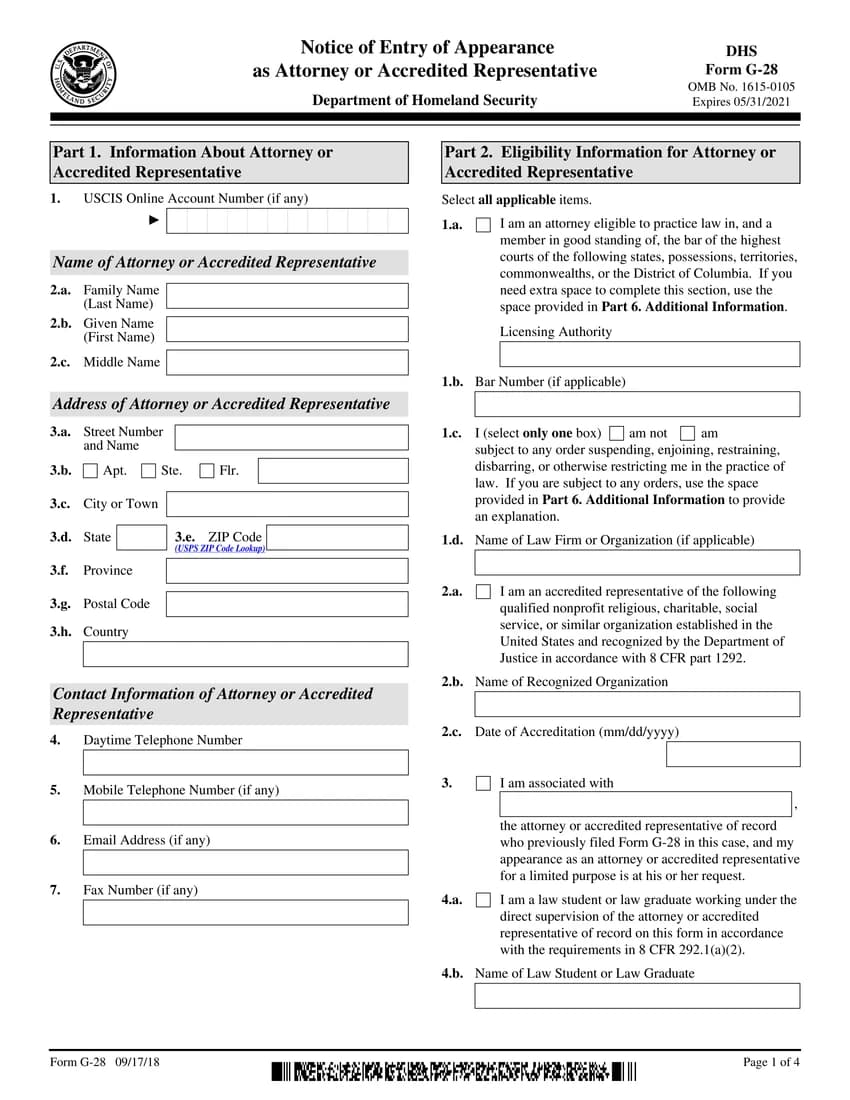
First page of G-28 form
Source: G-28 PDF
Context and workflow
#Supporting document for various immigration applications and petitions. Part of the initial submission package to establish representation. Receipt Notice (a related form) acknowledging the form submission.
Why this matters
- This form acts as a cross-check point: details here must match other forms and supporting documents.
- This form helps confirm that the application matches the program’s requirements and checklist.
Where it fits in the workflow
- Processing time for G-28 varies by case type and current workload — always check the official USCIS processing time tool.
- Supporting document for various immigration applications and petitions.
- Part of the initial submission package to establish representation.
- Ensures communication from USCIS is directed to the representative.
Who uses it
Form G-28 is intended for use by an attorney or accredited representative to establish their eligibility to represent a client in immigration matters before the U.S. Department of Homeland Security, including USCIS, CBP, or ICE. Attorneys must provide licensing authority information and bar numbers for all jurisdictions where they are admitted to practice, as defined in 8 CFR 1.2. Accredited representatives must include the name of their recognized organization and the date of their accreditation. This form is not intended for general public self-filing.
When it is used
- To authorize a representative to act on your behalf with the agency
- When you want an attorney or accredited representative to handle your case
- To allow someone else to receive official correspondence about your case
- [object Object]
Failure prevention (What causes Form G-28 rejections?)
#Technical rejections
- Submitting an unsigned form.
- Using a stamped or typewritten name instead of a handwritten signature.
- Both representative AND client signatures are present
Substantive weaknesses
- Failing to provide required eligibility information in Part 2.
- Case identification (receipt number or A-Number) is correct
- To avoid incomplete or incorrect information: Double-check all fields and include every required document per instructions.
- To avoid missing attorney or representative credentials: Include bar number, accreditation, or registration as required per instructions.
- To avoid g-28 not signed by attorney and client: Both attorney and client must sign; representative must be authorized.
What it asks for (What does Form G-28 ask for?)
#- Details about the client, including name, contact information, and consent to representation.
- Eligibility and licensing information of the attorney or representative
- Contact information for both the attorney and the client
- Applicant identification information
- Supporting documentation inventory
- Eligibility or purpose details
- Declarations and signatures
- The photocopy, fax, or scan must be of the original document containing the handwritten, ink signature
- The full name, mailing address, and contact information of the attorney or accredited representative Form G-28 Instructions 09/17/18 Page 2 of 5 Draft Not for Production 03/05/2018 Part 2
- Any additional information within this form, use the space provided in Part 6
- Using a stamped or typewritten name instead of a handwritten signature.
- Failing to provide required eligibility information in Part 2.
Sources for this section
What you need (What do you need for Form G-28?)
#- The current edition of G-28
- Contact information for both representative and client
- Proof of eligibility to practice law, such as bar membership details or accreditation documentation
- Original handwritten signatures for both the attorney or representative and the client
- Complete all required sections, sign, and submit with required evidence.
- [object Object]
Sources for this section
Checklist (What is the Form G-28 checklist?)
#- Download the current G-28 and instructions from the official USCIS website
- Review the official G-28 instructions before filing
- Gather required supporting documents per the instructions
- Complete all required sections of G-28
- Confirm the form is signed and dated in all required fields
- Confirm all pages are from the same current G-28 edition
- Confirm your mailing address is current and correct
- Ensure that Form G-28 is signed and dated in black ink, and submit it along with all necessary supporting documentation.
Sources for this section
Where to file
#Online filing is available for some categories — verify on the official form page. Otherwise, file by mail to the address in the instructions.
File online
Check the official G-28 page to see if online filing is available for your category.
Submit application
Paper filing addresses vary by eligibility category and state of residence. Check the official instructions for the correct filing address.
Filing locations and procedures may change. Always verify on the official USCIS website before submitting. For related guidance, see Application to Register Permanent Residence or.
Fees
#There is no USCIS filing fee for Form G-28.
Form sections (What sections does Form G-28 have?)
#Personal Information
Applicant identification.
- Full name and A-Number if applicable
- Date of birth and nationality
- Current address and contact
Eligibility
Basis for the application.
- Category or classification claimed
- Supporting evidence type
- Dates establishing eligibility
Supporting Documents
Required attachments.
- Identity and status documents
- Category-specific evidence
- Fee payment or waiver request
Key terms
#- Accredited Representative
- A person authorized to represent clients in immigration matters, recognized by the Department of Justice.In this form: Must provide organization name and accreditation date on Form G-28.
Strategy tips
#Mistake severity
#| Mistake type | Severity | How to avoid |
|---|---|---|
| Incomplete or incorrect information | Delay | Double-check all fields and include every required document per instructions. |
| Missing attorney or representative credentials | Rejection | Include bar number, accreditation, or registration as required per instructions. |
| G-28 not signed by attorney and client | Delay | Both attorney and client must sign; representative must be authorized. |
| Using G-28 for consular/NVC matters (use G-28I) | Delay | Use G-28I for matters at NVC or consulate; G-28 for domestic USCIS matters. |
Examples (What are examples for Form G-28?)
#- An attorney admitted to practice in California submits a complete Form G-28 with all required signatures and bar membership details, resulting in successful representation authorization.
- A law student working under supervision submits Form G-28 without obtaining permission from DHS officials, leading to rejection of the form.
- An accredited representative from a recognized organization provides incomplete accreditation details on Form G-28, resulting in a request for additional information.
- [object Object]
Common misconceptions (What misconceptions surround Form G-28?)
#- Filing this form does not guarantee approval of the underlying case
- Having a representative does not change the eligibility requirements for your case
- The representative cannot make decisions that require your consent
Edge cases and variations
#- If you are asked to submit or update G-28, treat it as a package update: check every place the same details appear and keep them consistent.
Scenarios
#An applicant files the application with all required supporting documents and the correct fee.
Application accepted. Biometrics may be scheduled. Case proceeds to adjudication.
Follow the evidence checklist for your category. Missing documents trigger RFEs or denial.
An applicant files before the eligibility window (e.g., I-751 outside the 90 days before conditional residence expires).
Application rejected. Fee returned. Must refile when eligible.
Verify eligibility dates carefully. Filing too early is as problematic as filing late.
An applicant forgets to sign the form.
Application rejected. Must resubmit with signature. Unsigned forms are not accepted.
Sign and date the form. Review the signature block before mailing.
Key differentiators
#- Unlike Form EOIR-27: Form G-28 is used for representation before DHS, while Form EOIR-27 is for the Board of Immigration Appeals.
- Unlike Form I-485: Application to Register Permanent Residence or Adjust Status: Supporting form: Attorney representation for adjustment of status
- Unlike Form I-130: Petition for Alien Relative: Supporting form: Attorney representation for family petition
- Unlike Form I-129: Petition for a Nonimmigrant Worker: Supporting form: Attorney representation for work petition
Why it matters
#Law students or graduates must obtain permission from DHS officials to appear.
Why it matters: Ensures that only authorized individuals represent clients in immigration matters.
Foreign attorneys must use Form G-28I for representation outside the U.S.
Why it matters: Prevents unauthorized practice of law within the U.S. immigration system.
Next steps
#- Receipt Notice (a related form) acknowledging the form submission.
- USCIS communicates directly with the representative regarding the case.
- Representative receives updates and notices about the case.
Verification
#This guide is based on official USCIS instructions for Form G-28 and is updated with changes in form editions or filing rules. Always confirm current requirements on the official USCIS website.
FAQs
With which applications or petitions is G-28 commonly filed?
Consult the official G-28 instructions for comprehensive guidance tailored to your specific immigration case and circumstances.
What are the most common errors when completing G-28, and what happens if it is rejected?
Common issues with G-28 include: • Representative credentials not matching official records • Failing to specify the scope of representation • Missing signatures from either the representative or client • Using an outdated form edition Ensure all credentials are accurate and both parties sign in the correct locations.
When should G-28 be filed relative to my main application?
Forms should be submitted following the sequence specified in the official instructions relevant to your immigration category.
Who is eligible to file G-28?
As an attorney authorized to practice law, and in good standing with the bar of the highest courts in specified states, possessions, territories, commonwealths, or the District of Columbia, it is important to review the instructions pertinent to your eligibility category prior to beginning the process.
When will G-28 be processed and what is the workflow?
Processing timing for G-28 varies depending on the filing category, processing location, and current application volume. Standard processing can range from a few weeks to several months. Before submitting, check the official USCIS processing times tool for the most current estimates. After filing, monitor your case status and consider whether expedited options are available.
What are common mistakes when filing G-28?
Common mistakes include submitting incomplete forms, missing required signatures, paying incorrect fees, and failing to include all required supporting documents. Even minor errors can cause significant delays or outright rejection of your application. Double-check every section, verify fee amounts on the official USCIS schedule, and review the instructions thoroughly before submitting.
VisaMind provides informational guidance only and is not a government agency. This is not legal advice. Requirements can change and eligibility depends on your specific facts. If your case is complex or high-stakes, consult a licensed immigration attorney.
Next steps
Requirements vary by nationality, purpose, timeline, and case details. Use Find My Visa to get a personalized checklist with official sources and deadlines.
Find my visa