On this page
- Quick summary
- Overview (What is Form I-956G?)
- Context and workflow
- Eligibility Category Codes
- Failure prevention (What causes Form I-956G rejections?)
- What it asks for (What does Form I-956G ask for?)
- What you need (What do you need for Form I-956G?)
- Checklist (What is the Form I-956G checklist?)
- Where to file
- Fees
- Form sections (What sections does Form I-956G have?)
- Strategy tips
- Common mistakes (What mistakes are common with Form I-956G?)
- Examples (What are examples for Form I-956G?)
- Common misconceptions (What misconceptions surround Form I-956G?)
- Edge cases and variations
- Scenarios
- Key differentiators
- Why it matters
- Next steps
- Verification
- Related guides
- Resources
Quick summary
#Check the form instructions for category-specific requirements, as described in the Form I-129 guide, as described in the Form I-129F guide.
This form is used by approved regional centers to provide required information, certifications, and evidence to support their continued eligibility for regional center designation.
Include it with your application package and follow official instructions for submission.
Names, dates of birth, and passport details on other forms Program checklist requirements Supporting documents and translations
Overview (What is Form I-956G?)
#By meticulously completing and submitting this form annually, regional centers can demonstrate their compliance with USCIS requirements and continue to facilitate foreign investments that contribute to economic growth and job creation in the United States.
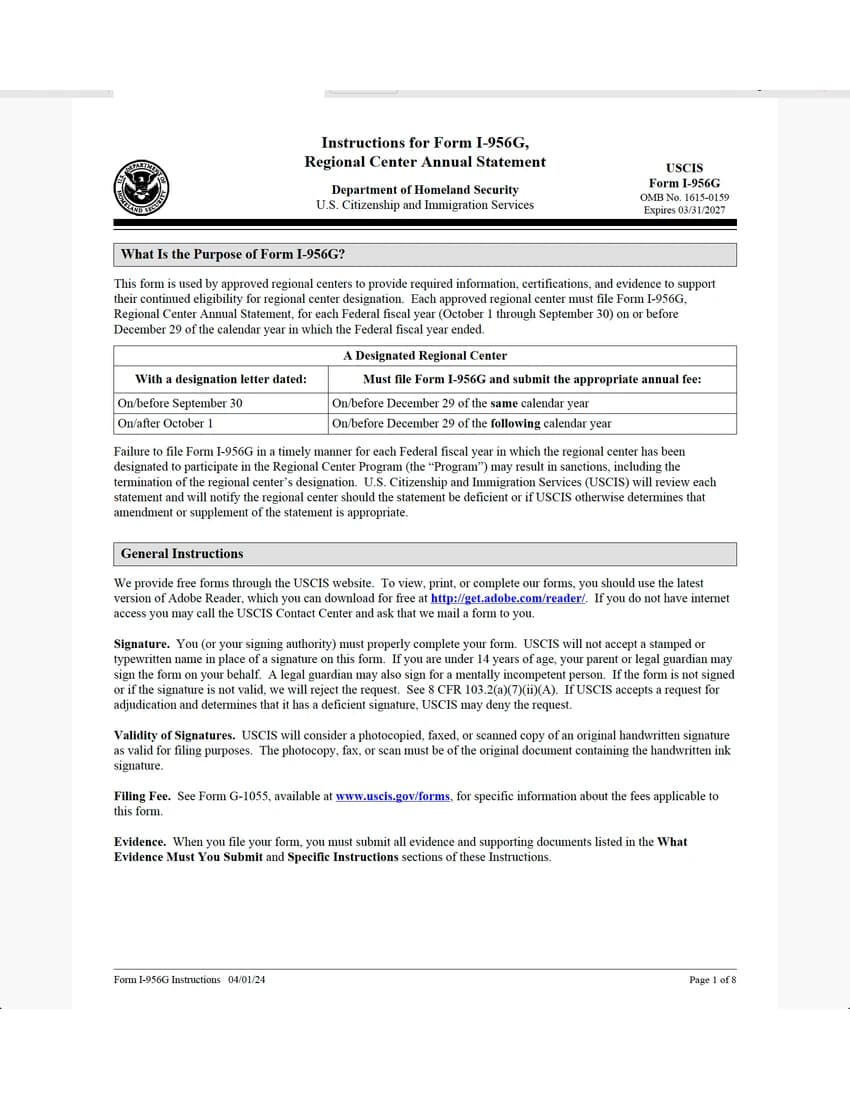
First page of I-956G form
Source: I-956G PDF
Context and workflow
#Processing time for I-956G varies by case type and current workload — always check the official USCIS processing time tool.
Why this matters
- This form helps confirm that the application matches the program’s requirements and checklist.
- Inconsistencies often trigger returns or follow-up requests because they create uncertainty in the case record.
Where it fits in the workflow
- Receipt Notice (a related form)
- Annual compliance review by USCIS
- Potential follow-up actions based on submission
Who uses it
Check the form instructions for category-specific requirements.
When it is used
- This form is used by approved regional centers to provide required information, certifications, and evidence to support their continued eligibility for regional center designation.
- [object Object]
- [object Object]
Eligibility Category Codes
#Eligibility information for this form. Confirm your category in the official instructions before filing.
This is a shortlist of common categories. The official instructions include many more.
| Code | Who applies |
|---|---|
| General | Check the form instructions for category-specific requirements. |
| Eligibility | A qualified certifier must complete the certification section, confirming the accuracy of information after a due diligence investigation. |
Failure prevention (What causes Form I-956G rejections?)
#Technical rejections
- Failure to submit the form on time
- Ensure form edition is current
Substantive weaknesses
- Inaccurate financial reporting
What it asks for (What does Form I-956G ask for?)
#- Accounting of alien investor capital and job creation
- Information about new commercial enterprises and capital investment projects
- Certifications from authorized individuals
- Evidence supporting continued eligibility
- Compliance with federal labor laws
What you need (What do you need for Form I-956G?)
#- The current edition of I-956G
- Identifying information about the regional center and its management
- Documentation of compliance with federal labor laws
- Evidence of job creation or preservation resulting from the capital investment
- Certification by a qualified certifier confirming the accuracy of all provided information
Checklist (What is the Form I-956G checklist?)
#- Download the current I-956G and instructions from the official USCIS website
- Review the I-956G instructions for the follow-up action this form covers
- Complete all required sections of I-956G
- Confirm all pages are from the same current I-956G edition
- Confirm the form is signed and dated in all required fields
- Sign, date, and submit I-956G with all required supporting evidence
Where to file
#Online filing is available for some categories — verify on the official form page. Otherwise, file by mail to the address in the instructions.
File online
Check the official I-956G page to see if online filing is available for your category.
Submit application
Paper filing addresses vary by eligibility category and state of residence. Check the official instructions for the correct filing address.
Filing locations and procedures may change. Always verify on the official USCIS website before submitting.
Fees
#| Component | Amount |
|---|---|
| Filing FeeIf you qualify for an exemption from the requirement to use an electronic payment method, you will need to complete and file Form G-1651, Exemption for Paper Fee Payment, along with submitting the correct payment | See official schedule |
| Biometrics Services FeeNot attending a required biometric services appointment may result in denial of the form. | See official schedule |
Can the Form I-956G fee be waived?
Fee waivers may be available for qualifying applicants. See official instructions for eligibility.
What happens if I submit the wrong fee?
USCIS will reject your application if the incorrect fee is submitted. Verify the current fee on the official schedule before filing.
Fee waiver: Fee waivers may be available for qualifying applicants. See official instructions for eligibility.
Fees change; always verify on USCIS.
Form sections (What sections does Form I-956G have?)
#Part 2. Information About the Regional Center
Complete this section as described in the official instructions.
- Information about new commercial enterprises and capital investment projects
- Documents that support the specific follow-up action you are requesting
- Contact information tied to the prior case
- Failure to file Form I-956G in a timely manner may result in sanctions, inclu...
- Submitting the form without a valid signature will result in rejection.
- Failure to submit all required evidence may lead to rejection or the need to ...
- USCIS verifies identity documents.
Part 8. Additional Information
Complete this section as described in the official instructions.
- Evidence supporting continued eligibility
- Failure to file Form I-956G in a timely manner may result in sanctions, inclu...
- Submitting the form without a valid signature will result in rejection.
- Failure to submit all required evidence may lead to rejection or the need to ...
- USCIS verifies this section.
Strategy tips
#Common mistakes (What mistakes are common with Form I-956G?)
#- Neglecting to submit Form I-956G within the required timeframe can lead to sanctions, which may include the termination of the regional center's designation.
- Failure to include a valid signature on the form can lead to processing delays or even rejection.
- Failure to submit all required evidence may lead to rejection or the need to amend the form.
- Failure to attend a mandatory biometric services appointment can lead to delays or even denial of the form.
- Submitting original documents when not specifically requested can lead to their destruction.
- Submitting forms with pages from different form editions.
- Using outdated form editions.
- Incomplete evidence of job creation
Examples (What are examples for Form I-956G?)
#- A regional center submits Form I-956G with complete documentation of alien investor capital and job creation evidence, resulting in successful maintenance of their designation.
- A regional center fails to provide evidence of compliance with federal labor laws in their Form I-956G submission, leading to a request for additional information from USCIS.
Common misconceptions (What misconceptions surround Form I-956G?)
#- Filing this form does not guarantee approval of the underlying case
- This form does not create a new benefit by itself
Edge cases and variations
#- If you are asked to submit or update I-956G, treat it as a package update: check every place the same details appear and keep them consistent.
Scenarios
#A regional center submits its annual statement with detailed documentation of all investments and job creation metrics.
The submission is accepted without issues, and the center maintains its designation.
Providing thorough and accurate documentation helps ensure compliance and avoids delays.
Key differentiators
#- Unlike Form I-956: Application for Regional Center Designation: Required for: Required annually after regional center designation (EB-5 Investor pathway)
- Unlike Form I-129: Petition for a Nonimmigrant Worker: Part of employment-based immigration process (EB-5 Investor pathway)
Why it matters
#The form must be filed annually for each Federal fiscal year.
Why it matters: Failure to file on time can result in termination of the regional center's designation.
A valid handwritten signature is required; photocopied, faxed, or scanned copies are acceptable.
Why it matters: Submitting without a valid signature will result in rejection.
Next steps
#- Receive Receipt Notice (a related form) confirming submission
- USCIS reviews the submitted information for compliance
- Potential request for additional evidence if needed
Verification
#This guide is derived from official USCIS instructions for I-956G and is updated when form editions or filing rules change. Always verify current requirements at the official USCIS website.
FAQs
What does filing Form I-956G actually accomplish?
Review the official instructions to understand how it applies to your situation. Review the official I-956G instructions for complete guidance specific to your immigration case and circumstances.
What other forms are typically filed together with Form I-956G?
Review the official I-956G instructions for guidance specific to your immigration category and circumstances. The specific forms required vary by case type. Review the instructions for your particular immigration category to determine which forms must be submitted together.
What is I-956G?
Form I-956G, known as the Regional Center Annual Statement, is an official document required by USCIS. To ascertain its relevance to your circumstances, consult the official instructions.
How do I choose the correct eligibility category code on I-956G?
The eligibility category code you select dictates the basis for filing Form I-956G. This form requires detailed information about each New Commercial Enterprise (NCE) and capital investment project sponsored by the regional center. Specifically, it covers projects involving active EB-5 investors—those either pursuing classification under INA 203(b)(5) or who have obtained conditional permanent resident status but have not yet filed for the removal of conditions—during the relevant reporting period.
What supporting documents do I need for I-956G?
Regional centers are required to submit an annual statement to USCIS, detailing specific information, evidence, and certifications that demonstrate compliance with applicable requirements for the Federal fiscal year in question, as outlined in Part 1. This includes evidence of job creation or preservation by the capital investment project. Ensure all evidence and supporting documents are provided as specified in the 'What Evidence Must You Submit' and 'Specific Instructions' sections.
Who is eligible to file I-956G?
If you are eligible for an exemption from using an electronic payment method, you may need to complete and submit Form G-1651, Exemption for Paper Fee Payment, along with the appropriate payment. Additionally, provide detailed information about each New Commercial Enterprise (NCE) sponsored by the regional center and each capital investment project undertaken by such NCE. This includes projects with active EB-5 investors—those pursuing classification under INA 203(b)(5) or those who have obtained conditional permanent resident status but have not yet filed for removal of conditions—during the relevant reporting period.
What happens after I submit I-956G?
After submitting I-956G, USCIS will issue a Confirmation of receipt confirming acceptance. You may then be scheduled for biometrics, an interview, or additional evidence requests depending on your case. You can monitor your case status online using the receipt number from your notice.
What are common reasons I-956G gets rejected?
Common reasons I-956G is rejected include missing or incorrect signatures, using an outdated form edition, incomplete required fields, incorrect fee payment, missing required supporting documents, and photographs that do not meet official specifications. Carefully review the instructions and checklist before submitting.
Can I request a fee waiver for I-956G?
Please consult the official instructions for comprehensive details.
VisaMind provides informational guidance only and is not a government agency. This is not legal advice. Requirements can change and eligibility depends on your specific facts. If your case is complex or high-stakes, consult a licensed immigration attorney.
Next steps
Requirements vary by nationality, purpose, timeline, and case details. Use Find My Visa to get a personalized checklist with official sources and deadlines.
Find my visa