On this page
- What the A-1 Diplomat Visa Covers
- Eligibility Requirements
- Application Process
- Submitting Your Application
- Required Documents
- Tips and Common Mistakes
- Fees and Processing Times
- When to Consult a Professional
- Conditions of Stay
- What Consular Officers Evaluate
- Fees
- Required forms
- Related visa types
- Related goals
- Next steps
What the A-1 Diplomat Visa Covers
#The A-1 Diplomat Visa is for foreign government officials and diplomats traveling to the United States for official government business.
Your travel purpose must be limited strictly to duties performed on behalf of your national government.
Who the visa is for
You qualify for the A-1 Diplomat Visa if you represent your national government and travel to the United States solely for official government functions.
Eligibility requires you to:
- Travel on behalf of your national government
- Engage only in official activities
- Apply for and receive the appropriate visa before entering the United States
The U.S. Department of State issues A-1 visas through embassies and consulates.
You typically complete the Form DS-160 Online Nonimmigrant Visa Application as part of the consular process.
| Requirement | What You Must Show |
|---|---|
| Government Representation | You act on behalf of your national government |
| Purpose of Travel | Official duties only |
| Visa Classification | A-1 (if eligible under diplomatic category) |
| Processing Authority | U.S. Department of State |
If your activities don’t fall strictly within official government duties, you may not qualify under this classification.
Permitted activities
Your stay in the United States must focus entirely on official government responsibilities.
The A-1 visa doesn’t cover personal, commercial, or private employment activities.
Permitted activities include:
- Performing official diplomatic functions
- Carrying out government assignments
- Representing your national government in official matters
You can’t use this visa category for anything outside your official role.
The U.S. Department of State handles visa issuance.
If you later seek an immigration benefit inside the United States, U.S. Citizenship and Immigration Services (USCIS) oversees that separate process.
At the port of entry, U.S. Customs and Border Protection makes the final decision on your admission.
Eligibility Requirements
#You must provide specific personal and professional information and have a valid passport for travel to the United States.
Eligibility depends on the accuracy of your official details and the validity of your travel document.
Basic eligibility
You must clearly state your personal and professional details, including the purpose and nature of your official duties in the United States.
The information you provide has to match your government role and assignment.
When completing Form DS-160, you will enter:
- Your full legal name and biographic details
- Your official position or title
- A description of your diplomatic or government duties
- The specific purpose of your travel
Your application must reflect the official nature of your work.
Inconsistent or incomplete information can delay visa processing by the U.S. Department of State.
Before starting the DS-160, review the instructions for your specific eligibility category.
If you later apply for related immigration benefits inside the United States, USCIS will review the consistency of your records.
| Required Information | What You Must Provide |
|---|---|
| Identity details | Full legal name and personal data |
| Professional role | Official title and government position |
| Purpose of travel | Clear description of official duties |
Passport and identity details
You must have a passport valid for travel to the United States.
Your passport must remain valid for at least six months beyond your intended period of stay.
Check your passport expiration date before submitting the DS-160.
If your passport expires too soon, you’ll need to renew it before your visa can be issued.
Your passport details must match the information entered on the DS-160 exactly, including:
- Full name spelling
- Date of birth
- Passport number
- Issuance and expiration dates
Discrepancies between your passport and application can result in delays or refusal at the visa stage.
The U.S. Department of State reviews these details during consular processing, and U.S. Customs and Border Protection confirms them at entry.
Application Process
#
You must complete Form DS-160, attend a visa interview at a U.S. Embassy or Consulate, and submit required documentation.
The U.S. Department of State manages visa interviews and issuance.
USCIS does not handle A-1 visa issuance.
Complete the online form
Submit Form DS-160, Online Nonimmigrant Visa Application.
This form applies to all nonimmigrant visa categories, including the A-1 diplomat visa.
Complete every required section accurately.
Provide consistent information that matches your passport and diplomatic documentation.
After submitting the form:
-
Print the DS-160 barcode confirmation page.
-
Keep the confirmation page for your interview.
-
Sign and submit the application electronically.
You cannot schedule your interview without the DS-160 confirmation page.
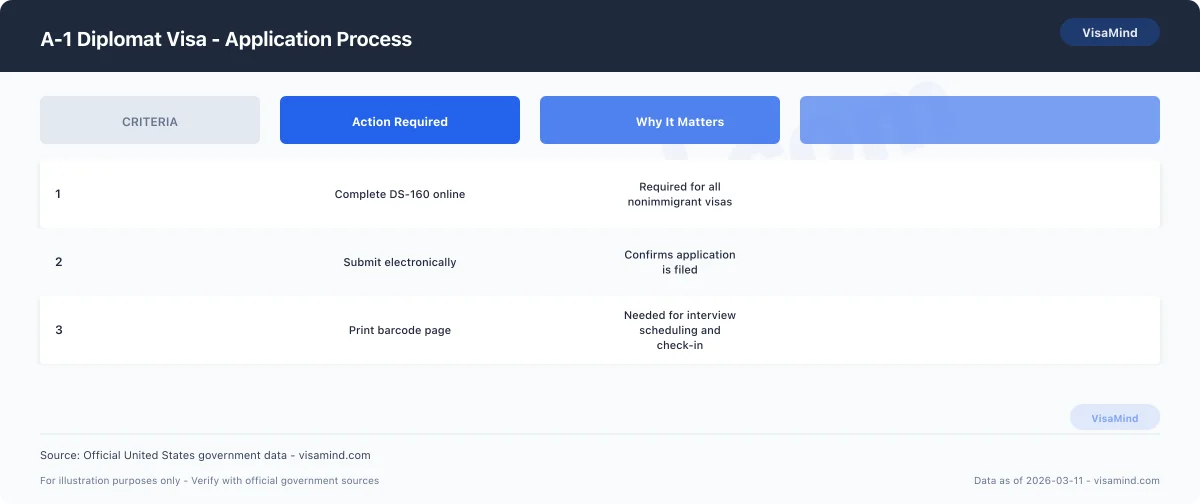
| Step | Action Required | Why It Matters |
|---|---|---|
| 1 | Complete DS-160 online | Required for all nonimmigrant visas |
| 2 | Submit electronically | Confirms application is filed |
| 3 | Print barcode page | Needed for interview scheduling and check-in |
Schedule and attend interview
After completing the DS-160, schedule a visa interview at a U.S. Embassy or Consulate.
Interviews are handled by the U.S. Department of State.
Bring your DS-160 barcode confirmation page to the appointment.
Arrive prepared with all required documentation.
At the interview, a consular officer will review your application and supporting documents.
The officer determines whether you qualify for the A-1 visa classification.
If your visa is approved, the consular post will issue the visa.
Final admission into the United States is determined by U.S. Customs and Border Protection at the port of entry.
Submit supporting evidence
You must submit required documentation at the time of your interview.
Missing documents can delay processing.
Prepare the following:
- Valid passport
- Diplomatic note issued by your government
- DS-160 barcode confirmation page
- Any additional evidence requested by the consular post
The diplomatic note confirms your official status and the purpose of your travel.
Ensure that all documents are consistent with the information listed on your DS-160.
Discrepancies can result in processing delays or refusal.
Submitting Your Application
#You must complete the correct forms through the proper agency and keep proof of submission.
Most A-1 applicants work with the U.S. Department of State for visa issuance.
USCIS handles certain filings made inside the United States.
Accuracy, document retention, and following official instructions from both USCIS and the Department of State determine whether your application moves forward without delay.
DS-160 confirmation & saving your work
Complete Form DS-160, Online Nonimmigrant Visa Application, through the Consular Electronic Application Center (CEAC) before your visa interview.
Save your application ID immediately.
The system allows you to retrieve your saved form for up to 30 days.
Complete the form in one session when possible to reduce errors and lost data.
After submitting the DS-160:
- Print the confirmation page
- Save a digital copy
- Upload or provide the confirmation page as required with your visa application
- Bring the confirmation page to your visa interview
Do not leave the CEAC system without saving your confirmation page.
The U.S. Department of State requires this document to verify that you properly submitted the form.
If you are applying in a category that requires an approved petition, such as Form I-129, wait until approval before completing the DS-160.
The consular officer will verify petition status during processing.
| Step | Action Required | Why It Matters |
|---|---|---|
| Start DS-160 | Record application ID | Retrieve saved form |
| Submit DS-160 | Print confirmation page | Required for interview |
| Petition-based cases | Obtain approval first | Consular verification |
USCIS forms and instructions
If your case requires filing with U.S. Citizenship and Immigration Services (USCIS), download the current version of the form directly from the official USCIS website.
Use only the most recent edition.
USCIS rejects outdated forms.
Before filing:
- Read the full form instructions
- Confirm eligibility requirements listed in the instructions
- Prepare all required supporting documentation
- Follow mailing and submission guidance exactly as written
USCIS updates forms and filing instructions periodically.
If you file with USCIS, keep copies of:
- The completed form
- All supporting documents
- Proof of delivery or submission confirmation
USCIS manages immigration benefits and petition approvals inside the United States.
The U.S. Department of State handles visa interviews and issuance abroad.
Submit your materials to the correct agency based on your location and case type.
Required Documents
#You must present specific government-issued documents that confirm your diplomatic status and official purpose of travel.
Accuracy matters, especially for your diplomatic note, passport, and Form DS-160 confirmation.
Document checklist
Prepare and submit the following items to the U.S. embassy or consulate handling your A-1 visa application:
- Diplomatic note issued by your government
- DS-160 confirmation page
- Valid passport
- Passport-style photo (if not successfully uploaded during DS-160 submission)
Your diplomatic note must confirm your official title or position and clearly state the purpose of your travel to the United States.
It must come directly from your government authority.
Complete the Online Nonimmigrant Visa Application (Form DS-160) and print the confirmation page.
You must bring that confirmation to your visa appointment.
The U.S. Department of State manages visa interviews and issuance.
| Document | Key Requirement | Issuing Authority |
|---|---|---|
| Diplomatic note | Confirms status and official purpose | Your government |
| DS-160 confirmation | Proof of completed online application | U.S. Department of State system |
| Passport | Valid travel document | Your country |
| Photo | Meets official specifications | You |
Photo and passport requirements
Your passport must be valid and issued by your country.
It must allow you to travel internationally and be presented at your visa interview.
Your photo must meet official U.S. visa photograph standards.
Non-compliant photos delay processing.
Follow these rules:
- Use a recent passport-style photo.
- Ensure the photo matches official size and format requirements.
- Upload the photo during the DS-160 process when prompted.
- Bring a compliant printed photo if the upload fails.
Many delays happen because applicants skip the photo upload step or bring an incorrect printed image.
Prepare your photo before you begin the DS-160 to avoid technical issues.
If you need exact technical photo specifications, review the Department of State’s official photo guidance before submitting your application.
Tips and Common Mistakes
#Small errors on your Form DS-160 or supporting documents can delay or derail an A-1 diplomat visa application.
Focus on complete answers, correct visa classification, and strict compliance with photo rules set by the U.S. Department of State.
Answering questions and consistency
You must answer every security and background question on the DS-160 fully and accurately.
Do not leave fields blank or provide partial explanations.
Incomplete sections often lead to delays, requests for additional information, or refusal.
Consistency matters.
Your answers must match your diplomatic assignment details and any supporting documents submitted to the U.S. Department of State or, where applicable, to USCIS.
Use this checklist before you submit:
- Confirm every security and background question has a clear answer.
- Review all dates, titles, and government affiliations for accuracy.
- Ensure your stated visa category reflects your official purpose.
- Re-read the confirmation page before final submission.
| Area to Review | What to Check | Why It Matters |
|---|---|---|
| Security questions | No blanks or vague answers | Prevents delays or refusal |
| Employment details | Matches official assignment | Avoids credibility issues |
| Visa classification | Correct diplomatic category | Prevents rejection |
Photo and category errors to avoid
Poor-quality or non-compliant photos frequently cause processing delays.
Follow the U.S. Department of State photo specifications exactly.
Use a professional service or a validated photo tool to reduce the risk of rejection.
Do not crop or edit the image in a way that changes required dimensions or clarity.
Selecting the wrong visa category also leads to refusal.
Choose the visa type that matches your official diplomatic purpose.
An incorrect selection, even if accidental, can result in rejection and require you to restart the process.
Before submitting, verify:
- The photo meets current State Department standards.
- The selected visa category reflects your diplomatic status.
- All uploaded documents align with your stated purpose.
Fees and Processing Times
#There’s no standard visa application fee for an A-1 diplomat visa. processing times shift depending on the embassy or consulate and how busy they are.
Application fee
The Machine Readable Visa (MRV) fee for the A-1 diplomat visa is $0 as of March 2026.
You still need to complete and submit Form DS-160, Online Nonimmigrant Visa Application, through the U.S. Department of State. The Department of State—not U.S. Citizenship and Immigration Services (USCIS)—handles visa interviews and issuance.
| Fee Type | Amount (USD) | Paid To |
|---|---|---|
| MRV (A-1 visa) | $0 | U.S. Department of State |
Even without an MRV fee, you’re still required to:
- Accurately complete the DS-160
- Schedule your visa interview, if it’s needed
- Follow instructions from the embassy or consulate
If you have a petition or benefit request filed inside the U.S., check directly with USCIS for any separate filing fees that might apply.
Processing times and variability
A-1 visas usually process in about 2 to 8 weeks. Timing varies by location and case volume.
DS-160 processing times also differ across visa categories and embassies. As of February 2026, reported ranges include:
| Visa Category (DS-160) | Reported Time Range |
|---|---|
| Visitor (B1/B2) | 0.5 to 23 months |
| Student/Exchange (F, M, J) | 0.5 to 7.5 months |
| Petition-based (H, L, O, P, Q) | 0.5 to 4.5 months |
| Crew and Transit (C, D, C1/D) | 0.5 to 14 months |
A-1 processing times depend on:
- The U.S. embassy or consulate you choose
- Appointment availability
- Any required security or administrative processing
Check with the U.S. Department of State at the specific embassy or consulate managing your case for the most current wait times.
When to Consult a Professional
#Issues with documentation, eligibility, or official status can delay or block an A-1 diplomat visa application. Guidance from a qualified attorney is important if you run into questions that could affect approval.
Situations that may need help
Filing an A-1 application isn’t a guarantee. If your government doesn’t give you a clear diplomatic note confirming your official status and the purpose of your travel, consult an experienced immigration attorney before you submit Form DS-160 or attend your interview with the U.S. Department of State.
You should also get help if:
- Your diplomatic assignment is temporary, unclear, or has changed recently
- Your trip’s purpose might be seen as personal rather than official
- You’re including a spouse in a same-sex marriage and want to be sure your documentation is correct
- You’ve had a visa refusal before
U.S. authorities review same-sex marriages the same way as opposite-sex marriages. Still, documentation mistakes can cause delays.
If you’re filing any related benefit request with USCIS, a professional review can help avoid inconsistent information between agencies.
| Issue | Why Legal Guidance Matters |
|---|---|
| Missing diplomatic note | May result in denial or delay |
| Unclear official duties | Could affect A-1 eligibility |
| Prior visa refusal | Requires careful explanation |
| Marital documentation | Must meet U.S. recognition standards |
Relevant authorities to check
Different agencies handle different steps. Confirm which authority controls your particular step before acting.
-
U.S. Department of State – Manages Form DS-160, visa interviews, and visa issuance.
-
U.S. Citizenship and Immigration Services (USCIS) – Handles immigration benefits filed inside the U.S.
-
U.S. Customs and Border Protection (CBP) – Determines admission at the port of entry.
If your case involves more than one agency, inconsistencies can create delays. Review the official guidance from the correct agency before submitting documents or attending your interview.
Conditions of Stay
#A-1 status is directly tied to your official diplomatic assignment. These rules also affect your household staff, and some applicants must apply for visas outside the U.S.
Compliance with the visa classification and consular processing rules is required to maintain lawful status.
A-3 and accompanying staff
Personal employees, attendants, or domestic workers may qualify for A-3 visas if you hold valid A-1 status.
Only people serving in a personal or domestic capacity for an A-1 or A-2 official qualify. They can’t use another visa category for this purpose.
Eligible A-3 applicants include:
- Personal employees
- Attendants
- Domestic workers
- Staff employed by an A-1 or A-2 principal
A-3 visa issuance is managed by the U.S. Department of State through consular processing. Each applicant must complete Form DS-160, Online Nonimmigrant Visa Application, and attend a visa interview if required.
| Role | Visa Classification | Who Issues the Visa |
|---|---|---|
| A-1 Principal | A-1 | U.S. Department of State |
| Personal employee of A-1 | A-3 | U.S. Department of State |
USCIS handles immigration benefits inside the U.S., but the Department of State remains responsible for visa issuance.
Reapplication and location rules
A-3 visa holders have to apply for their visas outside the United States. They can’t obtain or renew A-3 status domestically.
The reapplication process generally involves:
-
Completing Form DS-160
-
Scheduling a consular appointment
-
Attending the visa interview abroad
The Department of State decides on visa issuance. CBP determines admission at the port of entry.
If you employ A-3 staff, make sure they keep valid visa documentation at all times.
What Consular Officers Evaluate
#Consular officers are focused on accuracy and completeness. Your Form DS-160 responses are checked against your passport and supporting documents, and they review your answers to security and background questions.
Information matching and consistency
Every detail on your DS-160 must match your passport and supporting records. Officers look at names, dates of birth, passport numbers, and travel dates line by line.
Even minor differences can cause delays or refusals. Inconsistencies across multiple DS-160 sessions can raise concerns.
Double-check these areas before submission:
| Item to Verify | What Officers Check |
|---|---|
| Full legal name | Spelling matches passport exactly |
| Passport number | No missing or transposed digits |
| Date of birth | Matches passport format and entry |
| Travel dates | Consistent with official documents |
| Prior answers | No changes between saved sessions |
You’re responsible for these details. Use what’s printed in your passport and official documents.
Before you submit:
- Review every page of the DS-160.
- Confirm dates and numbers against your passport.
- Make sure repeated fields are identical throughout the form.
Background and security questions
Answer every security and background question completely. Don’t leave blanks.
Officers review these responses closely. Skipped or incomplete answers can trigger extra review or requests for evidence.
If a question doesn’t apply, write “None” or “N/A” where allowed. Don’t assume the officer will guess your intent.
Focus on accuracy. Double-check:
- All yes/no responses
- Any explanations tied to a “Yes” answer
- Consistency between security responses and the rest of your DS-160
The U.S. Department of State runs visa interviews and issuance, and officers treat the DS-160 as a sworn statement. Treat every answer as final.
Fees
#| Component | Amount |
|---|---|
| Application fee (MRV)No fee for A-1 diplomatic visas | $0 |
Fees change; always verify on USCIS.
Required forms
#Next steps
#Use Find My Visa to build a sequenced plan with official sources and deadlines.
FAQs
Does a visa guarantee entry into the United States?
No.
A visa lets you travel to a U.S. port of entry. CBP decides if you can enter when you arrive.
Who is eligible for an A-1 visa?
Diplomats and foreign government officials traveling to the United States to engage solely in official duties or activities on behalf of their national government must obtain an A-1 (or A-2) visa prior to entering the United States.
Can personal employees or domestic workers of diplomats come to the U.S. with them?
Personal employees, attendants, or domestic workers for diplomats and government officials holding a valid A-1 or A-2 visa may be issued A-3 visas; A-3 visa holders must reapply for their visas outside the United States.
What online form must I complete to apply?
Applicants must submit a completed Form DS-160, the Online Nonimmigrant Visa Application. After completing the DS-160, print and keep the DS-160 barcode page and the confirmation page.
What documents should I prepare before applying?
Gather required documentation including a passport valid for travel to the United States, a diplomatic note (to confirm status and purpose of travel), and any other required documents specified for A visas. Prepare passport-style photos that meet the photograph requirements.
What are common photo-related application mistakes?
Common mistakes include submitting photos that do not meet the photograph requirements and failing to upload the photo during the Form DS-160 or bringing an incorrect printed photo; poor-quality or non-compliant photos cause delays.
How much is the application fee for this visa?
The application fee (MRV) is $0 (as of 2026-03).
How long does visa processing take?
processing times vary by visa category and processing location. Examples of Form DS-160 processing windows (as of February 2026) range across categories, and a general processing time is noted as 2–8 weeks; verify current processing times with the issuing authority.
Does filing the A-1 application guarantee approval?
No. Filing an A-1 does not guarantee approval.
What do consular officers look for when assessing my application?
Consular officers evaluate whether the information matches supporting documents and the passport; inconsistent information across Form DS-160 sessions or with the passport, and incomplete security/background questions, are common red flags.
Are same-sex marriages treated differently in adjudication?
Applications based on a same-sex marriage are adjudicated in the same way as applications for opposite-sex spouses.
Official sources referenced
Last reviewed: 2026-03-11
VisaMind provides informational guidance only and is not a government agency. This is not legal advice. Requirements can change and eligibility depends on your specific facts. If your case is complex or high-stakes, consult a licensed immigration attorney.
Next steps
Every United States visa case depends on your nationality, purpose, and timeline. Get a personalized plan with official sources and deadlines.
Find my visa