On this page
- What the E-3 Australian Specialty Occupation Visa Covers
- What Your Employer Must Do
- When to Get Professional Help
- Extending Your Work Visa
- Bringing Your Spouse and Children
- Fees and Processing Times
- Path to Permanent Residence
- Changing Employers
- Eligibility Requirements
- How to Apply
- Common Petition Challenges
- Prepare Your Application Materials
- Fees
- Required forms
- Related visa types
- Related guides
- Related goals
- Next steps
What the E-3 Australian Specialty Occupation Visa Covers
#The E-3 visa allows Australian citizens to work in the United States in a qualifying specialty occupation. It provides temporary, nonimmigrant classification tied to professional employment.
Who it's for
The E-3 classification applies only to Australian citizens seeking to work in the United States.
You must pursue employment in a specialty occupation, meaning a role that requires specialized knowledge and professional-level skills. The position must qualify as professional work, not general or unskilled labor.
Key eligibility points include:
- You are an Australian citizen
- You intend to work in the United States
- The job qualifies as a specialty occupation
- You seek temporary, nonimmigrant status
This visa does not apply to permanent immigration. It’s for professionals planning to work in the United States for a defined, temporary period under U.S. immigration law.
| Requirement | E-3 Standard |
|---|---|
| Citizenship | Australian citizen only |
| Type of role | Specialty occupation |
| Purpose | Temporary employment in the U.S. |
| Immigration category | Nonimmigrant |
USCIS oversees immigration classifications. The U.S. Department of State manages visa issuance through consular processing.
What it allows
The E-3 visa lets you work in the United States in the approved specialty occupation.
You may perform professional services for the employer and position tied to your E-3 classification. The visa doesn’t authorize open-ended employment in unrelated roles.
To apply through a U.S. embassy or consulate, you must complete Form DS-160, Online Nonimmigrant Visa Application, as required by the U.S. Department of State. A consular officer determines visa issuance.
Your E-3 visa permits you to:
- Enter the United States for approved specialty occupation work
- Engage in temporary professional employment
- Hold a recognized U.S. nonimmigrant classification
Customs and Border Protection (CBP) makes the final decision on admission at the port of entry.
Duration and classification
The E-3 falls under U.S. nonimmigrant visa classifications.
Your stay in the United States is temporary and tied to authorized employment in a specialty occupation. The E-3 does not grant permanent resident status.
Your authorized period of stay depends on the approved classification and admission record. For current rules on stay periods or extensions, consult the USCIS website and Department of State guidance.
| Feature | E-3 Visa |
|---|---|
| Classification type | Nonimmigrant |
| Nature of stay | Temporary |
| Employment basis | Specialty occupation |
| Governing agencies | USCIS (classification), U.S. Department of State (visa issuance) |
You must maintain valid E-3 status while working in the United States and comply with the terms of your admission.
What Your Employer Must Do
#Your employer plays a central role in starting and supporting your E-3 process. They must file the required nonimmigrant petition materials with USCIS and follow compliance rules tied to your employment.
Employer filing duties
Your employer must take formal action before you can begin work in the United States. This includes preparing and submitting the required nonimmigrant petition documentation to USCIS.
At a minimum, your employer must:
- Complete the appropriate nonimmigrant petition form required by USCIS
- Provide supporting documentation requested in the form instructions
- Sign all required employer attestations
- Submit the filing to USCIS following current form instructions
Only your employer can complete and sign the employer portions of the petition. You cannot file those sections on their behalf.
If USCIS requests additional evidence, your employer must respond within the deadline listed in the notice.
USCIS forms and filings
USCIS handles nonimmigrant petition filings. The U.S. Department of State handles visa issuance at a U.S. embassy or consulate.
Your employer files the petition with USCIS. You separately complete Form DS-160 when applying for the visa through consular processing.
The process generally involves:
-
Employer submits the required nonimmigrant petition materials to USCIS.
-
USCIS reviews the filing and issues a decision or request for evidence.
-
You submit Form DS-160 to the U.S. Department of State.
-
A consular officer determines visa eligibility.
-
CBP determines admission at the port of entry.
| Agency | Role in E-3 Process |
|---|---|
| USCIS | Reviews and adjudicates nonimmigrant petition filings |
| U.S. Department of State | Conducts visa interviews and issues visas |
| CBP | Decides admission at entry |
Your employer must follow the current USCIS form instructions.
Compliance basics
Your employer must ensure that your employment matches what was presented in the petition. You may only work under the terms described in the approved filing.
Employers must:
- Maintain accurate petition records
- Ensure consistency between the petition and your actual job
- Cooperate with any lawful government inquiry
If your employment changes in a way that affects the original petition, your employer must review USCIS requirements before you continue working.
USCIS oversees petition compliance. The U.S. Department of State controls visa issuance, and CBP controls entry into the United States.
When to Get Professional Help
#Certain problems require more than routine form completion. Denials, government questions, incomplete answers on the Form DS-160, and employer-related filing issues can put your ability to work in the United States at risk.
When petitions get denied or questioned
If USCIS denies or questions a petition connected to your E-3 status, you should speak with an attorney immediately.
A denial can affect your ability to continue work or reapply without delays. You need to understand whether the issue involves missing information, unanswered security questions, or inconsistencies in your forms.
Pay close attention to how you completed:
- The DS-160 online nonimmigrant visa application
- Any petition or supporting documents filed with USCIS
- Security and background sections
Leaving blanks, skipping background questions, or providing partial answers often triggers scrutiny. You must answer every question fully and use “None” or “N/A” where appropriate.
An attorney can:
| Issue | Why Legal Help Matters |
|---|---|
| Denial notice | Identify the exact reason and next steps |
| Government questions | Prepare a focused, documented response |
| Inconsistent answers | Correct the record before further filings |
If your case involves visa issuance, the U.S. Department of State controls interviews and visa decisions. USCIS handles petitions and status matters.
RFEs and complex proof
A Request for Evidence (RFE) means the government needs more documentation before making a decision. Do not treat it as routine paperwork.
RFEs often focus on incomplete answers, missing documentation, or unclear background information. Even small omissions in security sections can lead to delays or denial.
You should seek professional help if:
- You are unsure how to respond to a specific question.
- You left parts of the DS-160 incomplete.
- You cannot clearly document required facts.
- The RFE questions your eligibility to work in the offered position.
Responding to an RFE requires precision. You must:
-
Address every issue listed.
-
Provide organized, labeled evidence.
-
Avoid introducing contradictions.
An attorney can review your full filing history, correct errors, and prepare a structured response. That reduces the risk of a second RFE or a denial.
When employer issues complicate filing
E-3 status depends on a qualifying job offer and proper documentation tied to your employment. If your employer makes errors, your case suffers.
Problems often arise when:
- Your employer provides incomplete paperwork.
- Job details differ across documents.
- Filing responsibilities are unclear.
- Work start dates conflict with visa timing.
Inconsistent information between your employer’s documents and your DS-160 can trigger government concerns. That can delay your ability to begin work.
You should involve counsel if:
| Employer Issue | Potential Risk |
|---|---|
| Conflicting job details | Credibility concerns |
| Missing documentation | RFE or refusal |
| Late or incorrect filing | Work interruption |
Legal guidance helps align your employer’s documentation with your visa application. It also protects your ability to work lawfully while your case is pending or under review.
Extending Your Work Visa
#You extend your E-3 status by refiling the required forms and updating your employment evidence. You must show that your specialty occupation role and employment authorization continue to qualify under the E-3 rules.
When to refile
Begin preparing your extension before your current period of authorized stay ends. Review your approval documents and confirm your expiration date so you do not fall out of status.
You refile when:
- Your current E-3 period is approaching expiration
- You continue working in a qualifying specialty occupation
- You remain employed or have a qualifying job offer
If you apply through USCIS, download the most current E-3 form and instructions directly from the USCIS website. Follow the eligibility category that matches your situation.
If you apply for a new visa abroad, you must complete Form DS-160 and follow the U.S. Department of State process for visa issuance. The Department of State manages visa interviews and issuance.
| Scenario | Agency Involved | Key Action |
|---|---|---|
| Extension in the United States | USCIS | File the current E-3 form with supporting evidence |
| Visa application abroad | U.S. Department of State | Submit DS-160 and attend visa interview |
Documents to update
You must provide current evidence that your position remains a specialty occupation and that you have valid employment authorization. Do not reuse outdated documents.
Prepare updated:
- Evidence that your role qualifies as a specialty occupation
- Documentation confirming your employment or job offer
- Any required E-3 form and supporting materials listed in the current instructions
Download the latest version of the E-3 form from the USCIS website before you file. USCIS regularly updates forms, and you must use the edition listed as valid on its site.
Review the instructions carefully for your eligibility category. The instructions explain required signatures, filing locations, and whether you must include additional evidence.
| Document Type | What It Should Show |
|---|---|
| Specialty occupation evidence | Your role requires specialized knowledge |
| Employment documentation | You have qualifying employment in the United States |
| Current E-3 form | Accurate, complete, and signed application |
Where to find official instructions
You must rely on official government sources for current forms and filing guidance. Do not use outdated third-party versions of forms.
For extensions filed in the United States, visit the USCIS website and download:
-
The current E-3 form
-
The official form instructions
-
Any related guidance for your eligibility category
For visa issuance abroad, consult the U.S. Department of State for instructions on completing Form DS-160 and scheduling your interview.
If you have questions about filing procedures, fees, or required evidence, check the official agency website before submitting your application. Forms, filing addresses, and procedural steps can change, and you must follow the most recent published instructions.
Bringing Your Spouse and Children
#
You can include your spouse and children in your E-3 stay, but each family member must qualify independently and follow the correct application process. Pay close attention to eligibility, work authorization rules, and required documentation.
Who qualifies as a dependent
Your dependents must meet the definition recognized by U.S. immigration authorities. Only certain family members qualify.
Eligible dependents include:
- Your legally married spouse
- Your unmarried children who meet the age requirements listed on the USCIS website
Each dependent must apply for a visa through the U.S. Department of State if they are outside the United States. They must submit Form DS-160, Online Nonimmigrant Visa Application, and attend a visa interview unless exempt.
If your spouse or children are already in the United States, review the USCIS webpage for your classification to determine what filing steps apply to them.
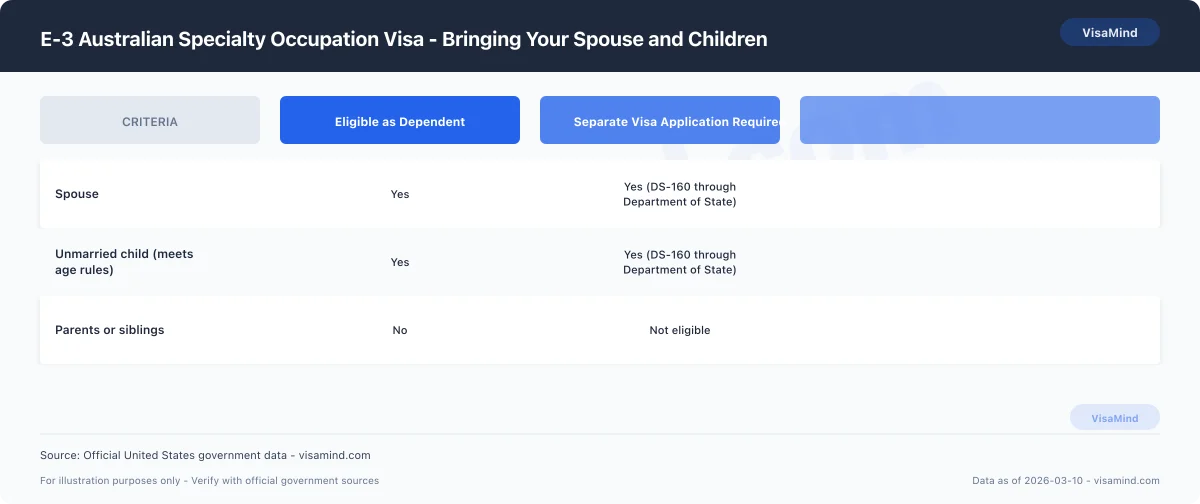
| Family Member | Eligible as Dependent | Separate Visa Application Required |
|---|---|---|
| Spouse | Yes | Yes (DS-160 through Department of State) |
| Unmarried child (meets age rules) | Yes | Yes (DS-160 through Department of State) |
| Parents or siblings | No | Not eligible |
Admission to the United States is determined by CBP at the port of entry.
Work authorization for family
Employment rules depend on the dependent’s classification. Confirm work eligibility before your spouse starts any job.
Certain E and L dependent spouses are considered employment authorized incident to status. If their classification qualifies, they may work without first applying for separate authorization.
Children in dependent status are not authorized to work.
If employment authorization is required, your spouse must receive approval from USCIS before beginning employment. Starting work without authorization can violate status.
| Dependent | May Work Automatically | Must Apply with USCIS Before Work |
|---|---|---|
| Qualifying E spouse | Yes, if authorized incident to status | No, if incident to status applies |
| Other dependents | No | Yes, if eligible |
| Children | No | Not eligible |
Documenting relationships
You must prove your family relationship when applying for dependent visas or status. Prepare clear, official documents that establish the legal connection.
Typical evidence includes:
- Government-issued marriage certificate for your spouse
- Government-issued birth certificates for your children
- Certified English translations if documents are not in English
Each dependent submits documentation during the DS-160 process and at the visa interview with the U.S. Department of State. If applying inside the United States, include relationship evidence with the filing submitted to USCIS.
Documents must be consistent with the information listed on all forms. Discrepancies can delay processing or lead to denial.
Keep copies of everything you submit. You may need to present the same documents again at a visa interview or at the port of entry.
Fees and Processing Times
#You pay a government filing fee and then wait for consular processing to schedule your interview and issue the visa. Costs are fixed, but wait times vary by location and visa category.
Filing fees
You must pay the Machine Readable Visa (MRV) application fee of $315 to apply for the E-3 visa. The U.S. Department of State sets this fee, and you pay it before scheduling your visa interview.
This fee covers:
- Processing of your Form DS-160 online nonimmigrant visa application
- Scheduling of your consular interview
- Visa adjudication by a U.S. consulate or embassy
| Fee Type | Amount (USD) | Paid To | When You Pay |
|---|---|---|---|
| MRV Application Fee | $315 | U.S. Department of State | Before interview scheduling |
The MRV fee is separate from any employer expenses related to prepare your job offer. If your employer files anything with U.S. Citizenship and Immigration Services (USCIS) for a change of status inside the United States, separate USCIS filing fees apply.
DS-160 / consular processing timelines
You begin the E-3 process by submitting Form DS-160 online. After submission and fee payment, you schedule a visa interview at a U.S. embassy or consulate.
processing times depend on the visa category and the specific consular post. As of February 2026, published interview wait ranges are:
| Visa Category (Interview Wait) | Reported Range |
|---|---|
| Visitor (B1/B2) | 0.5 to 23 months |
| Student/Exchange (F, M, J) | 0.5 to 7.5 months |
| Petition-based (H, L, O, P, Q) | 0.5 to 4.5 months |
| Crew and Transit (C, D, C1/D) | 0.5 to 14 months |
The E-3 is not listed in these specific groupings, so actual wait times depend on the post where you apply. In many cases, total processing from application to visa decision falls within 2 to 8 weeks, but this varies.
After visa issuance, U.S. Customs and Border Protection (CBP) decides admission at the port of entry.
Check current times
You must verify current interview wait times directly with the U.S. Department of State. Processing speeds change based on:
- Consulate workload
- Staffing levels
- Local demand for nonimmigrant visas
If you apply for a change of status from within the United States instead of consular processing, review posted timelines on the USCIS website. USCIS processing times differ from consular interview wait times and follow separate procedures.
Path to Permanent Residence
#The E-3 Australian visa allows you to work in the United States on a temporary basis. It does not provide direct permanent residence, so you must understand how nonimmigrant status affects long-term plans.
Nonimmigrant status overview
The E-3 Australian visa falls under U.S. nonimmigrant classifications. You receive authorization to live and work in the United States temporarily, not permanently.
You apply for the visa through the U.S. Department of State using Form DS-160 and attend a consular interview. If approved, a Customs and Border Protection (CBP) officer determines your admission at the port of entry.
Your status allows you to:
- Work in the United States for the approved employer
- Remain in the United States for a temporary period
- Maintain lawful nonimmigrant status as long as you meet visa conditions
Because this classification is temporary, it does not automatically convert into permanent resident status. Any long-term immigration strategy requires a separate process handled by U.S. Citizenship and Immigration Services (USCIS) or the Department of State, depending on the path.
| Feature | E-3 Visa |
|---|---|
| Classification type | Nonimmigrant |
| Purpose | Temporary employment |
| Work authorization | Yes, for approved employment |
| Direct path to green card | No |
You must keep your nonimmigrant status valid while exploring any permanent options.
Temporary vs. immigrant intent
The E-3 visa supports temporary employment in the United States. By definition, nonimmigrant classifications focus on short-term stay rather than permanent settlement.
When you apply using Form DS-160, you request a nonimmigrant visa. The U.S. Department of State evaluates your eligibility under that category.
Permanent residence, often called a green card, requires a separate immigrant process. That process involves different forms, eligibility standards, and review procedures through USCIS or the Department of State.
You cannot assume that holding an E-3 visa grants you immigrant benefits. You must qualify independently under an immigrant category and follow the required procedures.
- Nonimmigrant status: Temporary stay for specific purposes, such as work
- Immigrant status: Lawful permanent residence
- Different applications, forms, and adjudicating agencies apply
Plan carefully before taking steps toward permanent residence to avoid conflicts with your current status.
Where to check long-term options
If you want permanent residence, consult official government sources rather than relying on assumptions.
Use these agencies for accurate information:
-
U.S. Citizenship and Immigration Services (USCIS) – for immigrant petitions and adjustment of status processes
-
U.S. Department of State – for immigrant visa processing at U.S. consulates
-
Customs and Border Protection (CBP) – for admission decisions at entry
Review eligibility requirements, filing procedures, and current fees directly on the USCIS website or through Department of State resources. If you plan to continue working in the United States while pursuing permanent residence, confirm that your employment authorization remains valid throughout the process.
You control the timing and strategy. Start by verifying which immigrant category fits your situation and confirm the official requirements before filing.
Changing Employers
#You cannot move to a new employer on an E-3 Australian visa unless that employer takes formal action on your behalf. Your ability to continue to work depends on a properly filed nonimmigrant petition and maintaining valid status.
New employer petition requirements
Before you begin working for a new company, that employer must file a nonimmigrant petition with U.S. Citizenship and Immigration Services (USCIS) on your behalf.
You cannot self-petition. The responsibility rests entirely with the prospective employer.
At a minimum, you should confirm that your new employer:
- Files the required nonimmigrant petition with USCIS
- Waits for proper filing before placing you on payroll
- Understands that you cannot begin work until the petition requirement is satisfied
If you are outside the United States and applying for a visa stamp, you must complete Form DS-160 and attend a visa interview with the U.S. Department of State after the petition process is addressed.
| Scenario | Action Required |
|---|---|
| Changing employers inside the U.S. | New employer files petition with USCIS |
| Applying for new visa abroad | Employer files petition; you complete DS-160 and attend interview |
Timing and risks
You should not resign from your current position until you confirm that the new employer has properly filed the required petition.
If the petition is not filed, you have no authorization to work for that employer. Simply receiving a job offer does not protect your status.
Changing employers without a filed petition creates immediate risk to your lawful stay. USCIS evaluates whether a valid petition supports your employment at all times.
You also face practical risks:
- Payroll delays
- Gaps in work authorization
- Problems at future visa interviews
If you plan to travel, confirm that your petition situation is resolved before departing. The U.S. Department of State will review your eligibility at the visa interview, and U.S. Customs and Border Protection determines admission at entry.
What happens if petition not filed
If your prospective employer fails to file the required nonimmigrant petition, you are not authorized to work for that company.
Unauthorized employment can affect:
- Your current immigration status
- Future petitions filed with USCIS
- Future visa applications processed by the U.S. Department of State
USCIS may determine that you violated the terms of your status if you begin work without a properly filed petition.
You must maintain valid authorization at all times. If no petition is filed, you cannot lawfully continue working for the new employer.
Confirm filing directly with the employer and review official guidance on the USCIS website before making any employment change.
Eligibility Requirements
#You must prove that your position qualifies as a specialty occupation and that you meet all basic screening standards before you apply. You also need to follow the correct filing and visa procedures with USCIS and the U.S. Department of State.
Specialty-occupation proof
USCIS requires clear evidence that your job qualifies as a specialty occupation. You must show that the role requires specialized knowledge and that you have the background to perform that work.
Prepare documentation that supports both the position and your qualifications.
Common evidence includes:
- A detailed job description outlining duties and required skills
- Proof of your education or training related to the position
- Records that confirm your prior professional experience
- Employer documentation describing the nature of the work
Present organized, consistent records. USCIS reviews whether the job itself requires specialized expertise and whether your background matches those requirements.
You should avoid submitting vague job descriptions. If the role’s duties appear general or unrelated to specialized knowledge, USCIS may question whether it qualifies.
| Evidence Type | What It Should Show |
|---|---|
| Job description | Specific, specialized duties |
| Education records | Direct connection to the field of work |
| Experience letters | Relevant prior work history |
| Employer support | Nature and scope of the position |
Other basic eligibility checks
You must also meet standard eligibility requirements before you can work in the United States under this visa category.
Expect authorities to review:
- Your identity and biographic information
- Your immigration history
- Your admissibility to the United States
- The accuracy of all statements made in your application
If you apply through consular processing, you will complete Form DS-160 with the U.S. Department of State. The Department of State handles visa issuance, while USCIS handles petitions and immigration benefits.
Customs and Border Protection (CBP) determines whether to admit you at the port of entry. Approval of a visa does not guarantee admission.
Provide truthful and consistent information across all forms and interviews. Discrepancies can delay or negatively affect your case.
Review instructions before applying
Before you file anything, review the most current instructions from U.S. Citizenship and Immigration Services (USCIS) and the U.S. Department of State.
Follow these steps:
-
Confirm which agency handles your stage of the process (petition vs. visa issuance).
-
Review the official form instructions carefully.
-
Check the USCIS website for current filing guidance.
-
Verify DS-160 procedures with the U.S. Department of State.
Do not rely on outdated forms or unofficial summaries. Agencies update requirements and procedures.
If you are unsure about documentation or eligibility, consult the official government sources by name to confirm current standards before you apply.
How to Apply
#You apply for the E-3 visa by completing the required online application, preparing supporting evidence, and following the correct filing path. You will work with both U.S. Citizenship and Immigration Services (USCIS) and the U.S. Department of State, depending on where and how you file.
Dual-track filing explained
The E-3 process brings two government agencies into play, each with a distinct role.
- U.S. Citizenship and Immigration Services (USCIS) handles immigration petitions and related benefits inside the United States.
- U.S. Department of State manages visa applications, interviews, and visa issuance at U.S. embassies and consulates abroad.
- U.S. Customs and Border Protection (CBP) decides admission at the port of entry.
If you apply for a visa abroad, you’ll complete the online nonimmigrant visa application and attend a consular interview handled by the Department of State.
If you’re seeking an immigration benefit from within the United States, USCIS manages that request.
You have to use the right agency for your situation.
| Step | Agency Responsible | What You Do |
|---|---|---|
| Online visa application | U.S. Department of State | Complete Form DS-160 |
| Immigration benefit filing (if applicable) | USCIS | Submit required forms and evidence |
| Admission decision | CBP | Present documents at entry |
Completing required forms
You’ll need to complete Form DS-160, Online Nonimmigrant Visa Application, for an E-3 visa.
Here’s how to approach it:
-
Fill out every required field in the DS-160 online.
-
Double-check your answers for accuracy.
-
Electronically sign and submit the form.
-
Print and keep the DS-160 barcode confirmation page.
That barcode confirmation page is key for your visa appointment and records.
Make sure all required sections are complete before submitting. Incomplete or missing information often leads to delays or having to start over.
If you’re applying for an immigration benefit through USCIS rather than consular processing, follow the official USCIS form instructions and confirm you’re using the current edition.
Submitting evidence
Supporting evidence must go in with your signed application.
At minimum, you should:
- Sign and submit all required forms.
- Include supporting documentation as the instructions specify.
- Bring the DS-160 barcode confirmation page to your visa interview.
Missing documents can cause delays or a refusal under Department of State procedures.
For document checklists, filing requirements, and fee information, refer to the U.S. Department of State for visa processing and USCIS for immigration benefit filings. Always use the most recent official instructions before filing.
Common Petition Challenges
#Meeting the basic E-3 requirements doesn’t always mean you’ll avoid delays or denial. Most issues come from inconsistent information, document errors, or wrong assumptions about approval.
Approval is not guaranteed
Submitting an E-3 petition or completing the visa process doesn’t guarantee approval. USCIS reviews petitions, and the Department of State reviews visa applications—each case gets its own scrutiny.
Your information must be complete, accurate, and consistent across all forms and supporting documents.
Discrepancies can lead to processing delays or denial.
Prior U.S. travel, a reputable employer, or a clean record doesn’t ensure approval. Officers focus on whether your documents support your eligibility to work in the specialty position described.
If your paperwork doesn’t clearly align, approval becomes less likely.
Document mismatches
Document inconsistencies are a frequent reason for rejection or delay. Even minor differences between your passport and your application forms can cause problems.
Every detail needs to match exactly across:
- Your passport
- Your Form DS-160 confirmation
- Any supporting documents submitted to USCIS or brought to your visa interview
Pay special attention to:
- Full legal name (including middle names)
- Passport number
- Date of birth
- Travel history and dates
| Document Item | Must Match Exactly With |
|---|---|
| Full legal name | Passport biographic page |
| Passport number | Current valid passport |
| Date of birth | Passport and identity documents |
| Travel dates | Prior entries and passport stamps |
Even something like abbreviating a middle name in one place but not another can trigger delays. Review every document before submission and fix errors before filing.
Information inconsistencies
Filing different answers in separate DS-160 sessions is a common mistake. If you restart the form and change details without updating prior records, officers may question your credibility.
Use the same biographical and travel information every time you complete or update the DS-
- That information must also match your passport and all supporting documents.
Before you submit:
-
Review every answer for accuracy.
-
Confirm dates match your passport exactly.
-
Make sure employment and travel details are consistent.
Inconsistent answers create doubt about the reliability of your application. Officers rely on precise, matching information when deciding whether to approve your request for E-3 status.
Prepare Your Application Materials
#Organize your documents before you start the Form DS-160 and schedule your visa interview. Save confirmations right away, stick to photo standards, and make sure every form matches your E-3 work purpose.
Saving and printing confirmations
Complete the DS-160 Online Nonimmigrant Visa Application carefully and pick the correct visa category for your travel purpose. Choosing the wrong category can lead to delays or refusal.
Save your application ID as soon as you start. The system lets you retrieve your form for a limited time, but it’s best to complete it in one session if possible.
Before you exit the Consular Electronic Application Center (CEAC), print and save the DS-160 confirmation page. You’ll need this at your visa interview with the Department of State.
Checklist:
- DS-160 application ID saved
- DS-160 confirmation page printed and saved as PDF
- Correct visa classification selected for E-3 work
- All answers reviewed for consistency
If your E-3 process included a petition filed with USCIS, confirm that it’s approved before completing the DS-
- The consulate will verify petition status during processing.
Keep digital and paper copies of every confirmation page.
Photos and technical compliance
Prepare your passport-style photo before you start the DS-
- Photo errors often cause delays.
Follow the U.S. Department of State photo specifications exactly. If your photo doesn’t meet size, background, or clarity standards, the consulate may require a new one.
Use a professional photographer or a validated photo tool that checks compliance. Don’t crop or edit the image manually unless you know the technical requirements.
| Requirement Area | What You Must Do |
|---|---|
| Format | Follow Department of State digital photo rules |
| Quality | Use high-resolution, clear image |
| Background | Meet official background standards |
| Review | Verify compliance before uploading |
Bring a printed photo to your interview if the consulate instructs you to do so.
Always confirm current photo requirements with the U.S. Department of State before your appointment.
Uploads, IDs and extra tips
Upload documents as instructed in the DS-160 system. Incomplete or inconsistent uploads will slow things down.
Personal details must match across all documents:
- Full legal name
- Passport number
- Employment information for your E-3 work
- Petition details, if applicable
Keep your passport valid and accessible while completing the form. Enter numbers carefully to avoid typos.
If USCIS approved a related petition, make sure the approval information matches what you enter on the DS-
- The Department of State will verify petition data during visa processing.
It’s smart to store digital backups of:
-
DS-160 confirmation page
-
Photo file
-
Any USCIS approval notice, if applicable
Accurate, consistent information lowers the risk of delays at the interview stage and makes for a smoother E-3 work visa process.
Fees
#| Component | Amount |
|---|---|
| Application fee (MRV)MRV fee (E-1/E-2/E-3 treaty visas) | $315 |
Fees change; always verify on USCIS.
Required forms
#Next steps
#Use Find My Visa to build a sequenced plan with official sources and deadlines.
FAQs
Where can I check current fees and processing times?
Fee amounts and processing times change often.
Refer to the USCIS for immigration benefit filing fees.
The U.S. Department of State provides visa application fees and consular processing details.
Who is eligible to apply for this visa?
Australian citizens seeking to work in the U.S. in a specialty occupation (E-3 classification) are the eligible applicants.
Is this visa temporary or immigrant?
This classification allows for temporary employment and is part of the U.S. nonimmigrant visa categories.
Do I need to complete the DS-160 to apply?
Applicants must submit a completed Form DS-160, and after completing it you should print and keep the DS-160 barcode/confirmation page.
Does my prospective employer have to file anything for me?
A prospective employer must file a nonimmigrant petition on your behalf; there are nonimmigrant petition requirements employers must follow.
If I file, am I guaranteed approval?
Filing an E-3 does not guarantee approval.
Can my spouse or children work in the U.S.?
Check employment authorization requirements; certain dependent spouses (E and L) are considered employment authorized incident to status. Refer to USCIS guidance to determine whether employment authorization is required before beginning work.
How much is the visa application (MRV) fee?
The machine-readable visa (MRV) application fee is $315 (as of 2026-02).
How long does DS-160/visa processing take?
processing times vary by application category and location. Examples (as of February 2026): Visitor (B1/B2) 0.5–23 months; Student/Exchange (F, M, J) 0.5–7.5 months; Petition-based (H, L, O, P, Q) 0.5–4.5 months; Crew/Transit 0.5–14 months. Verify current processing times with the issuing authority.
What commonly triggers RFEs, delays, or rejections?
Incomplete or skipped security/background questions, inconsistent information across forms and with passports, and mismatches between documents commonly trigger RFEs, delays, or rejections.
Any expert tips to avoid preventable delays?
Save your application ID and complete the form in one sitting if possible; upload the Form DS-160 confirmation; prepare compliant passport-style photos; and ensure all information exactly matches your passport and supporting documents.
Official sources referenced
Last reviewed: 2026-03-10
VisaMind provides informational guidance only and is not a government agency. This is not legal advice. Requirements can change and eligibility depends on your specific facts. If your case is complex or high-stakes, consult a licensed immigration attorney.
Next steps
Every United States visa case depends on your nationality, purpose, and timeline. Get a personalized plan with official sources and deadlines.
Find my visa