On this page
- What the I Media Visa Covers
- Eligibility Requirements
- The Dual-Track Application
- Prepare Your Documents
- Fees and Processing Times
- When to Get Professional Help
- Common Petition Challenges
- Bringing Your Spouse and Children
- What Your Employer Must Do
- Fees
- Required forms
- Related visa types
- Related guides
- Related goals
- Next steps
What the I Media Visa Covers
#The I visa allows you to enter the United States to perform professional media work for a foreign-based organization.
Your activities must be temporary, informational, and directly tied to news gathering or reporting on current events.
Who this covers
The I visa applies to representatives of foreign media organizations with a home office outside the United States.
You may qualify if you work in:
- Press
- Radio
- Film
- Print media
Your role must involve professional media functions.
You must travel to the United States temporarily to perform that work.
The main requirement is your employment relationship.
You must work for a media organization that operates primarily outside the United States.
Independent activity not tied to a qualifying foreign media entity doesn’t meet this standard.
| Requirement | What It Means for You |
|---|---|
| Foreign media employer | Your organization’s main office must be outside the U.S. |
| Professional capacity | You must work in a recognized media role |
| Temporary stay | You enter the U.S. for a limited period tied to your assignment |
| Informational purpose | Your work must relate to news or educational reporting |
USCIS determines eligibility standards.
The U.S. Department of State processes visa applications abroad, including the Form DS-160 online application.
Allowed activities
Your work in the United States must be informational in nature and generally connected to the news-gathering process.
Qualifying activities include:
- Reporting on current events
- Collecting information for news coverage
- Producing content tied to foreign media distribution
- Engaging in educational media assignments connected to your profession
Your assignment must relate directly to reporting or informational media functions.
The focus is on news and current events, not entertainment or unrelated commercial projects.
You must perform the same type of professional media work you normally do for your foreign employer.
The visa does not authorize open-ended employment in the U.S. labor market.
Admission to perform this work is ultimately determined by U.S. Customs and Border Protection at the port of entry.
Organization requirements
Your media organization must have its home office outside the United States.
This requirement is central.
The visa classification depends on your employment being tied to a foreign-based media entity rather than a U.S. company.
The organization must:
- Operate as a media outlet (press, radio, film, or print)
- Maintain its principal office abroad
- Assign you to the United States for professional media duties
Your activities in the United States must directly support that foreign media operation.
If your work doesn't serve the foreign organization’s informational objectives, it falls outside I visa coverage.
For filing procedures and adjudication standards, see guidance from USCIS.
For visa issuance steps, including the DS-160, refer to the U.S. Department of State.
Eligibility Requirements
#You must show that you represent foreign media, your employer operates outside the United States, and you personally qualify as a journalist.
USCIS and the U.S. Department of State review these elements through your petition and Form DS-160 application to confirm your eligibility to work in a media capacity.
Representative status
You must travel to the United States as a representative of foreign media.
Your purpose must be to work in your professional media role, not to engage in unrelated business or commercial entertainment activities.
You qualify if:
- You represent a foreign press, radio, film, or other information media organization.
- You will perform duties that are consistent with your profession.
- Your activities in the United States directly relate to your media assignment.
Your role must reflect professional media functions, such as reporting, filming, editing, or producing content for distribution abroad.
If your activities shift into commercial entertainment rather than news gathering or journalistic production, you may not qualify under this category.
USCIS evaluates the nature of your assignment.
The U.S. Department of State reviews the same information during visa processing after you submit Form DS-160.
Home office requirement
Your employer must maintain a home office outside the United States.
The organization you represent cannot be principally based in the United States.
This requirement means:
- The media company’s main office is located abroad.
- Editorial control and operations occur outside the United States.
- Your work product is intended for a foreign audience or distribution through a foreign media outlet.
| Requirement | What You Must Show |
|---|---|
| Employer location | Main office outside the United States |
| Operational control | Managed and directed from abroad |
| Media distribution | Content tied to foreign media operations |
You cannot use this visa classification to work for a U.S.-based media company as a regular domestic employee.
Your assignment in the United States must connect directly to the foreign home office that employs or contracts you.
Journalist credentials
You must demonstrate that you are a qualified journalist.
If you work under contract, you must hold credentials from a foreign professional journalistic association, unless your activities fall outside commercial entertainment.
You should be prepared to show:
- Proof of employment or a contract with the foreign media organization.
- Professional identification or press credentials.
- Membership or certification from a recognized foreign journalistic association, if applicable.
These credentials confirm that you perform legitimate journalistic work rather than promotional or entertainment-based activities.
During consular processing, the U.S. Department of State reviews your DS-160 and supporting documents to confirm your professional standing before issuing the visa.
The Dual-Track Application
#You complete two separate but connected processes: a petition with USCIS and a visa application with the U.S. Department of State.
Each step has its own forms, evidence, and review authority.
Employer petition vs. visa application
Your U.S. employer starts the process by filing the required I classification petition with USCIS.
Download the current form and instructions directly from USCIS and review the instructions for your specific eligibility category before you begin.
USCIS decides whether your employment qualifies under the I visa category.
You must:
- Complete all required sections of the form
- Sign where required
- Submit supporting evidence listed in the instructions
USCIS handles the petition review.
The U.S. Department of State handles the visa application and interview.
| Step | Agency | Purpose |
|---|---|---|
| Employer files petition | USCIS | Determines eligibility for I classification |
| You apply for visa | U.S. Department of State | Determines visa issuance |
Approval of the petition doesn’t issue the visa.
It allows you to move to the consular stage.
Completing the DS-160
After the petition stage, you must complete Form DS-160, Online Nonimmigrant Visa Application.
This form is required for all nonimmigrant visa categories, including the I visa.
Complete the DS-160 carefully and in full.
You must submit it electronically before you can schedule your visa interview.
Follow these steps:
-
Access the DS-160 through the Consular Electronic Application Center (CEAC).
-
Complete every required field.
-
Submit the form electronically.
-
Print the DS-160 confirmation page.
Save your application ID.
The system allows you to retrieve your application for a limited time, but it’s best to complete it in one sitting.
Upload or present the DS-160 confirmation page as required for your interview.
If you leave the CEAC site without printing it, you may delay your process.
Visa interview steps
After submitting the DS-160, you must schedule a visa interview with the U.S. Department of State.
Prepare your documentation before the appointment.
At minimum, you should bring:
- Your DS-160 confirmation page
- Any required supporting documents listed for your visa category
- Petition-related documentation, if applicable
During the interview, a consular officer reviews your application and asks questions about your work as a media representative.
The officer determines whether to issue the visa.
Visa issuance falls under the authority of the U.S. Department of State.
Admission to the United States is decided later by U.S. Customs and Border Protection (CBP) at the port of entry.
Prepare Your Documents
#
Gather complete and accurate documents before you submit any forms or attend your interview.
Your passport details, photographs, confirmation pages, and payment records must match exactly across all filings with USCIS and the U.S. Department of State.
Passport & travel documents
Your passport must be valid for travel to the United States.
Check the expiration date before you complete Form DS-160 or file anything with USCIS.
All information you enter on forms must match your passport exactly.
Even small differences in spelling, dates, or passport numbers can delay processing or lead to denial.
If you are already in the United States, include proof of your lawful admission.
This may include:
- An admission stamp in your passport
- Form I-94, Arrival/Departure Record
Keep copies of every page that shows biographical data, admission stamps, or prior entries.
Bring the original passport to your visa interview with the U.S. Department of State.
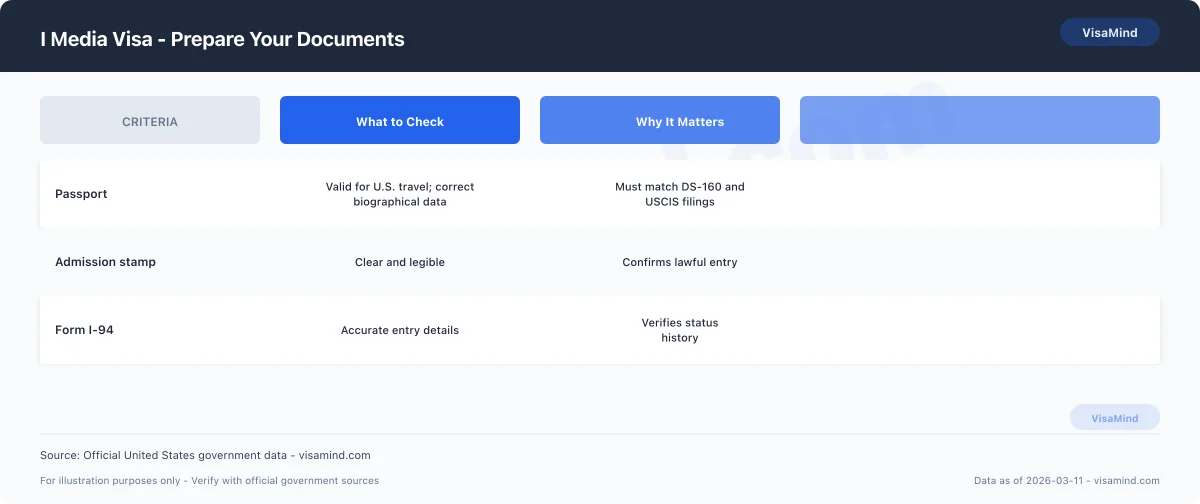
| Document | What to Check | Why It Matters |
|---|---|---|
| Passport | Valid for U.S. travel; correct biographical data | Must match DS-160 and USCIS filings |
| Admission stamp | Clear and legible | Confirms lawful entry |
| Form I-94 | Accurate entry details | Verifies status history |
Photos & identity requirements
You must submit a passport-style photo in the required format.
Prepare compliant photos before you start the application process to avoid delays.
The photo must meet official specifications.
If it doesn’t meet the format requirements, the government may reject your filing or require a replacement.
Ensure your photo matches your current appearance.
Use the same biographical details across:
- Your passport
- Form DS-160
- Any USCIS forms related to your I visa work authorization or status
Inconsistent identity details create processing problems.
Review all spellings, dates of birth, and passport numbers before submission.
If you upload a photo electronically, confirm the file meets the technical requirements listed on the relevant government form instructions.
Confirmation pages & payment receipts
After completing Form DS-160, print the confirmation page.
You must bring this page to your visa interview with the U.S. Department of State.
If you pay an application fee before your interview, keep the payment receipt.
Bring a printed copy if required.
For filings with USCIS, include any required confirmation notices or receipt documentation in your submission package.
Maintain an organized file that includes:
- DS-160 confirmation page
- Application fee payment receipt (if paid in advance)
- USCIS receipt notices, if applicable
Fees and Processing Times
#You must pay a fixed government fee and plan for several stages of processing before you can travel.
Timing depends on the visa category selected on your Form DS-160 and the U.S. embassy or consulate handling your case.
Application fees
You must pay a Machine Readable Visa (MRV) fee of $185 to apply for an I visa as a media representative.
This fee applies to visa processing by the U.S. Department of State.
Key points:
- Amount: $185
- Form required: DS-160 Online Nonimmigrant Visa Application
- Paid to: U.S. Department of State
- Purpose: Visa application processing (not work authorization through USCIS)
You pay the MRV fee before scheduling your visa interview.
The fee covers application processing only.
It does not guarantee visa approval, and it is generally non‑refundable.
Typical processing timelines
processing times vary by visa classification and by U.S. consulate.
After you submit your DS-160, you must wait for interview availability and case review.
The following ranges reflect recent reported timelines:
| DS-160 Visa Category | Reported Processing Range |
|---|---|
| Visitor (B1/B2) | 0.5 to 23 months |
| Student/Exchange (F, M, J) | 0.5 to 7.5 months |
| Petition-based (H, L, O, P, Q) | 0.5 to 4.5 months |
| Crew and Transit (C, D, C1/D) | 0.5 to 14 months |
Although the I visa is a distinct classification for foreign media, processing speed depends on the specific post handling your case.
In many cases, applicants report total processing periods of 2 to 8 weeks, but this can vary significantly by location.
Pickup and delivery timing
After your visa interview, the consulate needs to finalize your case before returning your passport with the visa stamp. This step usually falls within the broader 2 to 8 week processing window, though timing depends on the post.
Your passport will either be made available for in-person pickup or sent through the designated courier service.
You should monitor the consulate’s tracking system to see when your passport is ready. Don’t book international travel until you have your passport with the visa in hand.
If your case needs additional review, delivery could take longer. Confirm pickup or courier procedures directly with the issuing U.S. embassy or consulate.
When to Get Professional Help
#You don’t need a lawyer for every I visa media journalist case, but some situations call for one. Approval isn’t automatic, and errors can delay or derail your ability to work in the United States.
When the employer usually handles it
In many I visa cases, your U.S.-based employer or media organization leads the paperwork and coordination.
They typically prepare and file the required petition with U.S. Citizenship and Immigration Services (USCIS), track case status, and respond to basic agency notices.
Employers confirm petition approval before you complete Form DS-160. They also coordinate timing for your visa interview with the U.S. Department of State.
For petition-based categories like H-1b visa or L-1, wait until USCIS approves Form I-129 before submitting the DS-
- The consulate will check that approval during visa processing.
If your case is straightforward, your employer’s legal or HR team may handle everything without outside counsel.
| Task | Usually Handled By |
|---|---|
| Filing petition with USCIS | Employer or employer’s counsel |
| Confirming petition approval | Employer |
| Completing DS-160 | You (with employer guidance) |
| Visa interview | You |
Situations that often need a lawyer
Consider hiring an immigration attorney if your case has complications your employer doesn’t routinely handle.
Examples include a prior denial of an I visa or related petition, a complex employment structure, concerns about how USCIS will evaluate your petition, or questions about documenting your marital relationship, including same-sex marriages.
USCIS evaluates visa applications based on same-sex marriage the same way it evaluates those based on opposite-sex spouses. If you expect scrutiny or confusion about your documentation, an attorney can help you present clear evidence.
A lawyer helps you assess risk before filing. Filing doesn’t guarantee approval, and you should understand potential weaknesses before proceeding.
Responding to RFEs and denials
If USCIS issues a Request for Evidence (RFE), respond fully and on time. An RFE means the agency needs more documentation before making a decision.
Incomplete or inconsistent responses increase the chance of denial. Consider legal help if USCIS questions your eligibility to work in the stated role, the RFE challenges the underlying petition, or you receive a denial after filing.
If your petition is denied, don’t immediately submit a new DS-160 or schedule another interview without understanding the reason. An attorney can review the decision, identify the issue, and advise whether to refile or try another approach.
Common Petition Challenges
#Most delays and denials come from avoidable errors in your forms, passport, photo, or visa category selection. You can control these factors by reviewing every entry, confirming document validity, and answering all questions completely before submission.
Incomplete or inconsistent applications
Complete the Form DS-160 fully and consistently. Leaving blanks, skipping security questions, or submitting partial information often leads to a request for evidence (RFE) or denial.
Answer every security and background question. If a question doesn’t apply, enter “None” or “N/A” where permitted instead of leaving it empty.
Inconsistencies are a separate problem. If the information on your DS-160 doesn’t match your passport details or prior entries, the U.S. Department of State may treat it as inaccurate or misleading.
Common issues include different passport numbers across sessions, mismatched travel dates, variations in name spelling, or changing answers between saved DS-160 sessions.
Use the exact information shown in your passport. Review every page of the DS-160 before submitting.
| Risk Factor | What Happens | How You Avoid It |
|---|---|---|
| Skipped security questions | RFE or denial | Answer every question fully |
| Blank fields | Processing delay | Enter “None” or “N/A” if allowed |
| Inconsistent data | Possible rejection | Match passport and prior entries exactly |
If you file a petition with USCIS, make sure your information matches your DS-160 to avoid credibility concerns.
Passport and photo quality issues
Your passport must be valid at the time of filing and visa processing. Submitting an expired passport will stop your case.
Photo errors also cause delays. The U.S. Department of State enforces strict photograph requirements for visa applications.
Common photo problems include incorrect size, poor lighting, improper background, or low-resolution images.
Use a professional service or a validated photo tool that follows Department of State standards. Don’t crop or edit the image yourself unless you understand the technical requirements.
If the photo fails review, you’ll need to upload a compliant replacement. That delay can push back your interview and your ability to start work in the United States.
Security/background and category errors
Selecting the wrong visa category is a frequent and serious mistake. If your purpose is media-related work, choose the correct visa type.
Choosing a visitor category like B-1/B-2 instead of the appropriate media classification can result in refusal. You can’t fix this error at the interview without restarting parts of the process.
Security and background questions also require full disclosure. Incomplete responses often trigger additional review or denial.
You reduce risk by confirming your visa category matches your purpose of travel, reviewing all background answers before submission, and ensuring your petition with USCIS and your DS-160 reflect the same purpose of work.
Accuracy and consistency protect your credibility throughout the process.
Bringing Your Spouse and Children
#Your spouse and unmarried children may apply to accompany or follow you based on your I visa status. U.S. immigration authorities review qualifying marriages equally, and consular processing follows U.S. Department of State procedures.
Eligible dependents
You may include the following family members as derivatives:
- Your legally married spouse
- Your unmarried children
U.S. immigration authorities evaluate a same-sex marriage the same way they evaluate an opposite-sex marriage. The validity of the marriage depends on whether it was legally recognized where it was performed.
| Family Member | Must Be Legally Married to You | Marital Status Requirement |
|---|---|---|
| Spouse | Yes | Must remain married |
| Child | No (must be your child) | Must be unmarried |
You must maintain valid I visa status for your dependents to qualify. If your status ends, their eligibility ends as well.
For documentary standards and relationship evidence, review the U.S. Citizenship and Immigration Services (USCIS) policy guidance.
Dependent interview & documentation
Each dependent must complete a Form DS-160, Online Nonimmigrant Visa Application, through the U.S. Department of State system.
The Department of State manages visa interviews and issuance at U.S. embassies and consulates. Interview scheduling procedures vary by location. In some situations, an interview may not be scheduled.
Prepare documentation that clearly proves the family relationship. Typical categories include a government-issued marriage certificate for your spouse, birth certificates for your children, valid passports, and the confirmation page of the submitted DS-160.
The consular officer determines visa eligibility. Visa issuance does not guarantee admission; U.S. Customs and Border Protection (CBP) makes the final decision at the port of entry.
For current interview procedures, review instructions from the U.S. Department of State.
Rights and work authorization
Your dependents receive status tied directly to your I visa classification. They must maintain that status while you remain in valid I status.
Employment eligibility depends on the specific derivative classification granted. If employment authorization is available, your dependent must follow the required process before starting any Work in the United States.
For employment authorization procedures, filing requirements, and eligibility rules, consult the USCIS website. Do not begin work until you confirm authorization under the applicable status.
Your dependents must follow all terms of admission and comply with U.S. immigration laws during their stay.
What Your Employer Must Do
#Your employer plays a central role in documenting your eligibility for an I visa as a media journalist. Personal statements alone won’t suffice. USCIS and the U.S. Department of State expect clear proof of your employment relationship and professional qualifications.
Provide contracts and credentials
Your employer must supply evidence that you’re coming to the United States to work as a media representative.
At a minimum, this includes a written employment contract or formal assignment letter, proof of your professional credentials as a journalist or media worker, and documentation confirming the nature of your media activities.
If USCIS or a consular officer reviewing your Form DS-160 can’t verify your contract or credentials, they may delay or refuse the case.
The documents should clearly show:
| Document Type | What It Must Demonstrate |
|---|---|
| Employment contract | Active working relationship with a qualifying media organization |
| Assignment letter | Specific purpose of your U.S. work |
| Professional credentials | Your role and qualifications as a journalist |
Your employer must ensure these documents are complete, signed where appropriate, and consistent with the information listed in your application.
Incomplete or missing proof of contract or credentials creates problems. Officers expect documentary evidence, not just general job descriptions.
Confirm foreign home office status
Your employer must show that you work for a media organization based outside the United States.
The documentation should confirm that the organization maintains a foreign home office, your employment is tied to that foreign entity, and your work in the United States supports that foreign media operation.
Officers reviewing your application look for a clear link between you and a qualifying foreign media outlet.
If your employer can’t demonstrate a legitimate foreign home office, your eligibility for I visa classification is in doubt. The burden is on your employer to document the organization’s structure and location.
Consistency matters. The details provided to USCIS and those reflected in your DS-160 must align with the employer’s supporting documents.
Maintain compliance
Your employer must continue to support your authorized activities during your stay in the United States.
This means ensuring your work matches the purpose described in your contract or assignment, keeping accurate records of your employment, and avoiding material changes that conflict with your stated media role.
If your actual work differs from what was documented, it can affect your status.
Your employer should monitor compliance carefully. Any failure to provide required proof of contract or credentials when requested can result in delays, denials, or future immigration complications.
Fees
#| Component | Amount |
|---|---|
| Application fee (MRV)MRV fee (non-petition) | $185 |
Fees change; always verify on USCIS.
Required forms
#Next steps
#Use Find My Visa to build a sequenced plan with official sources and deadlines.
FAQs
Who is eligible for the I (Media) visa?
The I visa is for representatives of foreign media (members of the press, radio, film, print) who are traveling temporarily to the U.S. to work in their profession for a foreign media organization with a home office outside the United States; activities must be informational and generally tied to news gathering and reporting on current events.
Can a journalist under contract or a freelancer get an I visa?
A journalist working under contract with a credential from a foreign professional journalistic association can qualify, except when the work is for commercial entertainment.
What forms do I need to start the I visa application?
Applicants must complete the Online Nonimmigrant Visa Application (Form DS-160) and follow the DS-160 instructions; after completing the DS-160 you should print and keep the DS-160 barcode/confirmation page.
What documents should I bring to the visa interview?
Bring a passport valid for travel to the United States, a photo in the required format, the Form DS-160 confirmation page (barcode page), and an application fee payment receipt if required to pay before the interview.
How much is the I visa application fee?
The Machine Readable Visa (MRV) application fee is $185 (as of 2026-03).
How long does processing take for a nonimmigrant visa application?
processing times vary by visa category and processing location; published Form DS-160 ranges include category-specific examples, and a general processing time guidance is listed as 2–8 weeks.
Does filing the application guarantee approval?
No — filing an application does not guarantee approval.
What are common mistakes that cause delays, RFEs, or denials?
Common issues include submitting an incomplete Form DS-160, filing with an expired passport, failing to present required proof of contract or credentials when required, uploading a non-compliant photo, inconsistencies across DS-160 sessions or with passport data, wrong visa category selection, and incomplete security/background question responses.
Are same-sex marriages treated differently for visa adjudication?
Visa applications based on a same-sex marriage are adjudicated in the same way as applications for opposite-sex spouses.
Official sources referenced
Last reviewed: 2026-03-11
VisaMind provides informational guidance only and is not a government agency. This is not legal advice. Requirements can change and eligibility depends on your specific facts. If your case is complex or high-stakes, consult a licensed immigration attorney.
Next steps
Every United States visa case depends on your nationality, purpose, and timeline. Get a personalized plan with official sources and deadlines.
Find my visa