
On this page
- What the P-2 Reciprocal Exchange Performer Visa Covers
- Eligibility Requirements
- Application Process
- Required Documents
- Sponsor Requirements
- Bringing Your Spouse and Children
- Filing Fees and Wait Times
- Processing Times by Category
- Review Processing Times — Additional Categories
- Common Petition Challenges
- When to Get Professional Help
- Fees
- Required forms
- Related visa types
- Related guides
- Related goals
- Next steps
What the P-2 Reciprocal Exchange Performer Visa Covers
#The P-2 classification allows you to enter the United States temporarily to perform through a formal reciprocal exchange program.
It provides work authorization tied directly to that exchange arrangement and to the approved petition filed with U.S. Citizenship and Immigration Services (USCIS).
Who uses this classification
You use the P-2 visa if you are an individual performer or part of a performing group coming to the United States under a reciprocal exchange program.
The exchange must involve U.S. performers and performers from another country participating in comparable activities.
This classification applies to entertainers participating in structured, internationally recognized cultural exchange programs.
It does not cover general employment outside the exchange framework.
You may qualify if:
- You are entering the United States to perform under a reciprocal exchange program
- The exchange involves U.S. performers and foreign performers
- A U.S. petitioner files Form I-129, Petition for a Nonimmigrant Worker, on your behalf with USCIS
Your eligibility depends on the existence of a valid exchange arrangement, not on independent job offers outside that program.
Work authorization and duration
The P-2 visa grants temporary work authorization limited to the approved reciprocal exchange program.
You may only perform activities described in the petition approved by USCIS.
Your U.S. employer or sponsoring organization must file Form I-129 with USCIS before you apply for a visa.
After USCIS approves the petition, you apply for the visa through the U.S. Department of State.
U.S. Customs and Border Protection (CBP) determines your admission at the port of entry.
Your stay remains temporary and tied to the exchange program’s approved period.
| Aspect | What It Means for You |
|---|---|
| Work authorization | Limited to the approved reciprocal exchange performances |
| Petition required | Form I-129 filed with USCIS |
| Visa issuance | Handled by the U.S. Department of State |
| Admission to U.S. | Determined by CBP at entry |
| Length of stay | Temporary and connected to the exchange program |
Program eligibility basics
You must participate in a reciprocal exchange program that allows performers from the United States and another country to exchange roles or opportunities.
The classification focuses on balanced cultural exchange, not standard employment.
To qualify, you must meet these basic criteria:
- You are a performer, either solo or part of a group
- You are entering the United States under a formal reciprocal exchange program
- A U.S. petitioner submits Form I-129 to USCIS on your behalf
- Your activities in the United States match the approved exchange program
The P-2 is distinct from an Exchange Visitor classification.
It does not function as a general exchange visitor program; it specifically covers performers working through reciprocal arrangements.
Eligibility Requirements
#You must show that you qualify under a recognized reciprocal exchange program and that a U.S. petitioner properly files on your behalf.
USCIS reviews the petition and supporting evidence before you can seek a visa from the U.S. Department of State.
Who qualifies
You qualify for P-2 classification only if you participate in a reciprocal exchange program between an organization in the United States and one in another country.
You must meet all of the following:
- You are entering the United States to perform under a qualifying reciprocal exchange program.
- A U.S. petitioner files Form I-129, Petition for a Nonimmigrant Worker, with U.S. Citizenship and Immigration Services (USCIS) on your behalf.
- You comply with the terms and scope of the approved exchange program.
USCIS will not approve a petition if you fail to show actual participation in a reciprocal exchange arrangement.
If you hold another status, confirm whether you need separate employment authorization before beginning work.
Some nonimmigrant categories require specific authorization from USCIS before you can perform services.
Documentation required to show eligibility
Your eligibility depends on the strength of the evidence submitted with Form I-129.
The petitioner should include documentation that clearly establishes:
- Proof that a reciprocal exchange program exists.
- Evidence that you are a participant in that specific program.
- Details describing the terms of the exchange arrangement.
If you do not provide evidence of participation in the reciprocal exchange program, USCIS may deny the petition.
Use the following checklist as a guide:
| Requirement | What You Must Show |
|---|---|
| Reciprocal exchange | Written proof of a qualifying exchange agreement |
| Individual participation | Documentation confirming you are selected under that agreement |
| Petition filing | Properly completed and filed Form I-129 |
After USCIS approval, you apply for a visa through the U.S. Department of State if you are outside the United States.
Visa issuance and admission at the port of entry remain separate steps.
Limits and disclaimers
Filing a P-2 petition does not guarantee approval.
USCIS evaluates each petition based on the evidence submitted.
If the documentation does not establish eligibility, USCIS may deny the case.
You cannot begin work unless you are authorized to do so under your approved classification or another status that permits employment.
- Approval of Form I-129 does not guarantee visa issuance by the U.S. Department of State.
- A visa does not guarantee admission; U.S. Customs and Border Protection makes the final decision at entry.
- You must continue to comply with the terms of the approved exchange program.
Application Process
#You start the P-2 visa process by filing a petition with U.S. Citizenship and Immigration Services (USCIS).
Accuracy, correct form usage, and complete documentation determine whether USCIS accepts or rejects your filing before review even begins.
Preparing and submitting the petition
You must file Form I-129, Petition for a Nonimmigrant Worker, with USCIS to request P-2 classification.
Only certain Form I-129 classifications qualify for online filing, so confirm eligibility on the USCIS website before you choose a filing method.
Download the current edition of Form I-129 and its instructions directly from USCIS.
Using an outdated edition leads to rejection.
Complete every required section and sign the form.
USCIS rejects unsigned petitions.
Use this checklist before filing:
| Requirement | What You Must Do |
|---|---|
| Correct form | Download the current Form I-129 from USCIS |
| Complete pages | Include all pages from the same form edition |
| Signature | Sign the petition before submission |
| Filing method | Confirm whether online filing is allowed for your classification |
Submit the petition according to the official filing instructions.
Check the USCIS website for the correct filing address and current fee information.
USCIS handles the petition stage.
If approved, visa issuance abroad is handled by the U.S. Department of State.
Filing rules and common rejections
USCIS rejects many P-2 petitions for preventable technical errors.
Most rejections occur before an officer reviews eligibility.
Common rejection reasons include:
- Submitting an unsigned Form I-129
- Using the wrong edition of the form
- Omitting pages from the same edition
- Filing an incomplete petition
You must keep all pages consistent.
Mixing pages from different editions results in rejection.
USCIS does not overlook missing signatures or incorrect forms.
If USCIS rejects your petition, it returns the filing without adjudication, and you must correct the issue and refile.
Confirm that you are using the correct nonimmigrant worker classification on Form I-129.
Do not confuse the P-2 category with an Exchange Visitor classification, which follows a different process and authority.
Careful preparation prevents delays and repeat filings.
Adjudication steps
After USCIS accepts your petition, it moves to adjudicative review.
An officer evaluates whether the filing meets P-2 requirements under immigration law.
USCIS may take one of the following actions:
| Possible Action | What It Means |
|---|---|
| Approval | USCIS approves the petition |
| Denial | USCIS denies the petition |
| Request for Evidence (RFE) | USCIS asks for additional documentation |
| Notice of Intent to Deny (NOID) | USCIS identifies deficiencies and gives you a chance to respond |
| Referral for investigation | USCIS sends the case for further review |
If USCIS issues an RFE or NOID, respond within the stated deadline with complete supporting evidence.
Failure to respond results in denial.
An approved petition allows the beneficiary to apply for a visa with the U.S. Department of State, if outside the United States.
Admission at a port of entry is determined by U.S. Customs and Border Protection.
Required Documents
#You must document your role in a reciprocal exchange program and submit the correct signed forms to U.S. Citizenship and Immigration Services (USCIS).
Missing signatures or omitted approvals can delay or result in rejection of your petition.
Proof of program participation
You must show that you are taking part in a reciprocal exchange program.
This evidence confirms that your P-2 classification is based on a qualifying exchange arrangement.
Provide documentation that clearly identifies:
- The name of the reciprocal exchange program
- The participating organizations
- Your role as an exchange visitor under that program
Your evidence should directly connect you to the approved exchange arrangement.
General promotional materials or unrelated contracts do not meet this requirement.
If USCIS cannot confirm that a valid reciprocal exchange program exists and that you are participating in it, the petition will not satisfy the core P-2 standard.
| Document Type | What It Must Show |
|---|---|
| Program documentation | Existence of a reciprocal exchange program |
| Individual confirmation | Your participation in that specific program |
Forms and signatures
You must submit the required petition forms with valid signatures that comply with the form instructions.
USCIS rejects filings that lack proper signatures.
The primary petition is Form I-129, Petition for a Nonimmigrant Worker.
Follow the official instructions for signature placement and format.
If your case involves Form I-129S, you must include a properly signed version where required.
An unsigned or incorrectly signed form can lead to rejection at intake.
Always review the most current form instructions on the USCIS website before filing.
USCIS updates signature rules and formatting requirements periodically.
What to include with your filing
Your filing must include all required supporting documents at the time you submit the petition to USCIS.
Do not assume you can provide key evidence later.
Include:
- Evidence of participation in a reciprocal exchange program
- A properly signed Form I-129
- Your previously approved Form I-129S, if applicable
- An approved Form I-129S, when required, along with supporting evidence
If Form I-129S applies to your case, you must submit the approved version together with the rest of your petition package.
Organize your documents clearly.
Place approval notices and supporting evidence in a logical order so USCIS can verify eligibility without searching through unrelated materials.
Sponsor Requirements
#You must meet specific filing and documentation standards before U.S. Citizenship and Immigration Services (USCIS) will approve a P-2 petition.
Most rejections stem from missing prerequisite approvals or incomplete wage documentation.
Employer pre-filing obligations
You file Form I-129, Petition for a Nonimmigrant Worker, with USCIS on behalf of the P-2 beneficiary.
USCIS will reject or deny the petition if you skip required preliminary steps or omit required evidence.
Before filing, confirm that you have completed any category-specific approvals that apply to your situation.
Submitting a petition without mandatory supporting documentation is a common and avoidable error.
Use this checklist before mailing Form I-129:
- Complete and sign Form I-129 and all required supplements.
- Include all required initial evidence listed in the form instructions.
- Confirm that any required labor-related certifications or approvals are already issued.
- Verify that the filing fee is correct by checking the USCIS website.
If you are filing on behalf of multiple beneficiaries, ensure each individual is properly identified and supported by documentation.
Incomplete packages often result in outright rejection rather than a request for evidence.
Wage and labor documentation
Some employment-based filings require certified labor condition or prevailing wage documentation before you submit the petition.
When required, you must secure certification first and include proof with the filing.
Failure to attach certified wage documentation, when applicable, leads to rejection.
USCIS does not approve petitions that lack mandatory labor evidence.
Use the table below to track wage-related requirements where they apply:
| Requirement Type | What You Must Do Before Filing | What to Include With I-129 |
|---|---|---|
| Labor condition certification (if required) | Obtain official certification | Copy of certified document |
| Prevailing wage documentation (if required) | Secure wage determination | Evidence of wage determination |
If you are unsure whether wage documentation applies to your case, review the Form I-129 instructions on the USCIS website.
Do not assume a document is optional.
Avoiding sponsor mistakes
Most filing errors are within your control. Simple omissions can delay your case and increase your costs.
Avoid these common mistakes:
-
Filing Form I-129 before securing required labor certifications.
-
Leaving out certified wage documentation when it’s needed.
-
Sending unsigned forms or missing supplements.
-
Not including all required initial evidence.
Set up a final review before you submit. Check your packet against the Form I-129 instructions, line by line.
If USCIS rejects your petition, you’ll need to fix the problem and refile.
Careful preparation lowers that risk and helps keep your P-2 case moving.
Bringing Your Spouse and Children
#You can include your spouse and unmarried children as dependents when seeking P-2 classification. USCIS may review their applications at the same time as your petition or separately, depending on your filing method.
Filing for dependents
Request P-2 status by filing Form I-129 with U.S. Citizenship and Immigration Services (USCIS).
If your spouse or unmarried children want dependent status, you’ll file Form I-539 for each eligible family member.
To include dependents with your petition:
-
Prepare Form I-129 for your P-2 classification.
-
Prepare Form I-539 for your spouse and each qualifying child.
-
Submit all forms together in the same package, using the filing location listed in the official instructions.
Dependents must be:
- Your legally married spouse
- Your unmarried children
If you want to extend or change status for your dependents, file Form I-539 with Form I-129 so USCIS can review everything together.
When dependents are adjudicated together
USCIS will review your dependents’ applications with your Form I-129 if you:
- File Form I-539 at the same time
- Include it in the same package
- Send it to the same filing location
Meeting these conditions means USCIS processes the dependent request as part of your overall case.
| Filing Method | USCIS Review Process |
|---|---|
| I-129 and I-539 filed together | Reviewed together |
| I-539 filed separately | Reviewed separately |
If USCIS approves your P-2 petition, it can decide on your spouse’s and children’s applications during the same review.
You’ll need to make sure all forms are complete and signed. Missing signatures or filing at the wrong location can separate the cases.
When dependents are adjudicated separately
USCIS will handle your dependents’ applications separately if Form I-539 is not:
- Filed with Form I-129
- Packaged together
- Sent to the same filing location
Separate adjudication means each dependent application becomes its own case.
This happens if you file Form I-539 after Form I-129 or send forms to different locations. Each case then follows its own timeline.
If your dependents apply later, USCIS reviews their eligibility apart from your original petition’s timeline.
Filing Fees and Wait Times
#You must pay the correct government fees and follow USCIS rules to avoid delays. Premium processing is available in limited cases and needs a separate request with its own fee.
Required government fees
File Form Form I-129, Petition for a Nonimmigrant Worker, with USCIS to request P-2 classification.
As of February 2026, standard government fees are:
| Fee Type | Amount (USD) | Who Pays |
|---|---|---|
| Form I-129 filing fee | $780 | Petitioner |
| Biometrics services fee | $85 | Beneficiary, if required |
USCIS may require biometrics for some applicants. If so, include the $85 fee or USCIS will reject or delay the filing.
USCIS rejects petitions with incorrect payment amounts or outdated forms.
If you request premium processing, pay a separate premium fee in addition to the base I-129 fee. Do not combine payments unless USCIS instructions allow it.
The Department of State charges separate visa application fees for consular processing. USCIS does not control those fees.
Premium processing rules
Premium processing can speed up certain employment-based petitions, if available.
To request it, you must:
-
File Form I-907, Request for Premium Processing Service
-
Submit the required premium processing fee
-
Use the correct fee amount in effect when USCIS receives your request
If USCIS receives a premium processing request postmarked on or after March 1, 2026, include the updated premium processing fee for your petition type.
Premium processing needs its own fee, separate from the $780 I-129 filing fee. Paying only the base fee will not trigger premium processing.
Petitioners often file Form I-907 with Form I-
- If you file I-907 later, USCIS won’t start premium processing until it accepts the request and fee.
Fee-related mistakes that delay processing
Fee errors often cause USCIS to reject or delay P-2 petitions.
Common mistakes include:
- Sending the wrong filing fee amount
- Using an outdated edition of Form I-129
- Forgetting the $85 biometrics fee when needed
- Sending a premium processing request without the separate premium fee
- Using an outdated premium processing fee after a fee change
A rejection means you have to refile, losing your place in line.
Reduce risk by:
- Checking the current fee schedule
- Confirming you’re using the latest form edition
- Keeping standard and premium processing fees separate
- Reviewing payment instructions before mailing
Accurate fee preparation helps prevent unnecessary delays and protects your requested start date.
Processing Times by Category
#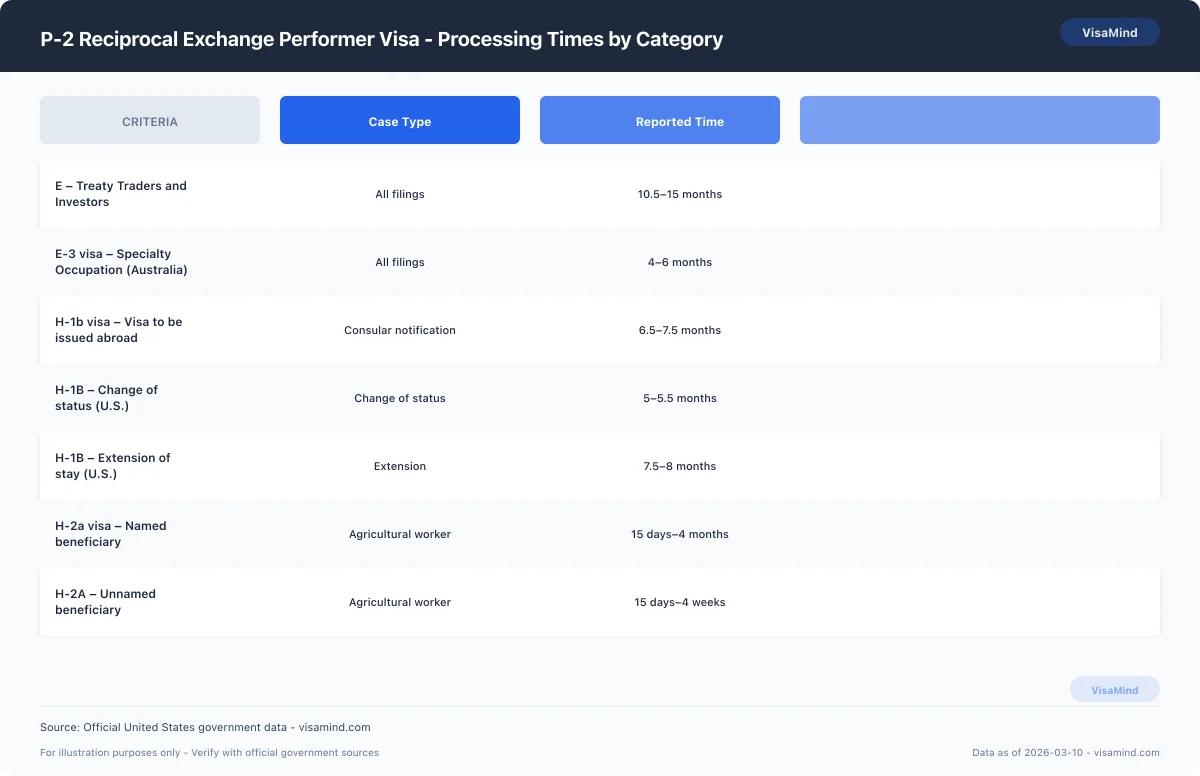
USCIS processing times for Form I-129 vary by visa classification and case type. Some petitions move in a few months; others take more than a year.
You’ll need to review the exact category on your I-129 receipt notice and compare it to the USCIS processing time tool. Small differences—like change of status versus consular processing—can shift timelines by months.
E, H and H-2A categories
USCIS reports the following Form I-129 processing ranges as of January 2026:
| Classification | Case Type | Reported Time |
|---|---|---|
| E – Treaty Traders and Investors | All filings | 10.5–15 months |
| E-3 visa – Specialty Occupation (Australia) | All filings | 4–6 months |
| H-1b visa – Visa to be issued abroad | Consular notification | 6.5–7.5 months |
| H-1B – Change of status (U.S.) | Change of status | 5–5.5 months |
| H-1B – Extension of stay (U.S.) | Extension | 7.5–8 months |
| H-2a visa – Named beneficiary | Agricultural worker | 15 days–4 months |
| H-2A – Unnamed beneficiary | Agricultural worker | 15 days–4 weeks |
| H-2b visa – Temporary nonagricultural | All filings | 4.5–6.5 months |
There’s a notable difference between H-2A named and unnamed beneficiaries. Petitions without named workers often move faster.
For H-1B, processing depends on whether you’re requesting a change of status inside the U.S. or plan to apply for a visa abroad.
H-3, O and P snapshots
For H-3 visa Temporary Trainee petitions, USCIS reports processing times of 12.5 to 16.5 months. This is slower than most H-1B and H-2B cases.
USCIS posts processing data for O and P classifications separately in its online tool. P-2 falls under the broader P category, so select the right P classification when checking timelines.
USCIS processing time covers only the I-129 petition stage.
Visa issuance abroad is handled by the U.S. Department of State.
Admission at the port of entry is determined by U.S. Customs and Border Protection (CBP).
If you’re changing from exchange visitor status to a P classification, you’ll need to consider any requirements tied to your prior status.
How to interpret USCIS processing data
USCIS processing times are a range, not a promise. The lower number reflects faster cases; the higher number covers those that took longer.
To use the range:
-
Identify your exact classification and case type.
-
Compare the “receipt date for a case inquiry” listed by USCIS.
-
File an inquiry only if your receipt date is earlier than the posted date.
Processing time does not include:
- Visa interviews by the U.S. Department of State.
- Administrative processing after a consular interview.
- Travel and admission decisions by CBP.
Always verify your category directly on the USCIS website before making travel or performance plans tied to your P-2 petition.
Review Processing Times — Additional Categories
#USCIS processing times for Form I-129 change by classification and service center. Some categories move in a few months, others extend well over a year, which can affect when you schedule a visa interview with the U.S. Department of State.
Intracompany, Q and R categories
Transferring to a U.S. office through an L classification (including blanket L) takes about 6 to 8 months for Form I-129 adjudication.
Religious workers in the R category move faster, with cases generally taking about 5 to 6.5 months.
Q cultural exchange visitors face much longer timelines. USCIS lists roughly 19.5 to 33 months for Form I-129 in the Q category, which can impact program planning and employer sponsorship.
| Classification | Form I-129 Processing Time (Approx.) | Key Consideration |
|---|---|---|
| L (Intracompany transferee) | 6–8 months | Employer must file petition before you apply for a visa |
| Q (Cultural exchange visitor) | 19.5–33 months | Long adjudication period may delay program start |
| R (Religious occupation) | 5–6.5 months | Typically shorter than most employment-based categories |
Processing times reflect only petition review. After approval, you’ll need to complete visa processing through the U.S. Department of State if you’re outside the United States.
TN and other professional classifications
If you qualify under the United States-Mexico-Canada Agreement (USMCA) as a TN professional, USCIS shows about 3.5 to 6 months for Form I-129 when your employer files.
This makes TN one of the faster I-129 categories right now.
Other employment-based categories take longer. For example:
| Classification | Form I-129 Processing Time (Approx.) |
|---|---|
| TN (USMCA Professional) | 3.5–6 months |
| O (Extraordinary ability) | 9.5–14 months |
| P (Athletes, artists, entertainers) | 9–12.5 months |
If you work in athletics or entertainment, expect timelines similar to the P category. These ranges affect contract planning, travel, and start dates when your employer needs approval before you can begin work.
Check the USCIS processing times tool for current estimates, as timelines vary by service center.
Overall processing-time guidance
USCIS processing times for Form I-129 depend on:
- The nonimmigrant classification
- The assigned USCIS service center
- Current agency workload
Treat posted ranges as estimates, not guarantees. Processing may be faster or slower than the published window.
After USCIS approves your petition, you must complete visa issuance through the U.S. Department of State if you’re abroad. The Department of State controls interview scheduling and visa issuance, while U.S. Customs and Border Protection determines admission at the port of entry.
Check both USCIS and Department of State processing updates before finalizing travel or employment dates.
Common Petition Challenges
#P-2 petitions often fail because of preventable technical errors. You must align the classification, dates, forms, and supporting documents before filing Form I-129 with U.S. Citizenship and Immigration Services (USCIS).
Classification mismatches and RFEs
USCIS issues Requests for Evidence (RFEs) when your chosen classification doesn’t match the facts in your petition. This can happen if you select the wrong classification on Form I-129 or attach the wrong supplement.
Each nonimmigrant category uses its own supplement. Using a supplement meant for a different classification may lead to outright rejection.
Problems also arise if your job description doesn’t align with the requested classification. USCIS checks the selected classification on Form I-129, the job duties in your support letter, and any other supporting documentation.
If these materials don’t describe the same role and purpose, USCIS may question whether the beneficiary qualifies. Titles, duties, and classification language need to remain consistent across all documents.
| Risk Area | What Goes Wrong | Result |
|---|---|---|
| Wrong supplement | Incorrect classification selected | Rejection |
| Inconsistent job duties | Duties do not match classification | RFE |
| Mixed terminology | Different role descriptions in packet | RFE |
Date and validity inconsistencies
USCIS examines the requested validity period closely. If the dates on Form I-129 are different from those in your contracts or support letters, you’re more likely to get an RFE.
Common issues include petition validity dates that don’t match event or engagement dates, support letters referencing a period that isn’t the same as the one requested, or typographical errors in start or end dates.
Even minor inconsistencies can raise doubts about your filing’s accuracy. USCIS may ask for clarification about the intended period of stay.
Every document should show the same start and end date. The requested validity period needs to match the actual services or events described in your evidence.
Fee and form-version pitfalls
USCIS rejects petitions filed with the wrong edition of Form I-
- You have to use the current version listed by USCIS before submitting.
Filing errors also crop up when petitioners submit incorrect fee amounts, omit required signatures, or mix outdated forms with current supplements.
USCIS won’t process incomplete filings. Instead, they’ll reject and return the entire package.
Before you mail your petition:
-
Verify the current form edition listed by USCIS.
-
Confirm the correct fee using the USCIS fee schedule.
-
Check all signature lines for completion.
These details determine whether USCIS will accept your petition for processing.
When to Get Professional Help
#Some P-2 visa cases move smoothly through an employer or sponsoring organization. Others involve legal or strategic issues that require a closer look.
Many employer-sponsored cases the employer can handle
In most P-2 cases, your U.S. employer or sponsoring organization files Form I-129, Petition for a Nonimmigrant Worker, with U.S. Citizenship and Immigration Services (USCIS).
If your case fits standard eligibility criteria and your organization regularly files P classifications, the employer’s in-house team or regular counsel usually manages the process.
Employers typically handle preparing and filing Form I-129, gathering required supporting documents, responding to basic USCIS correspondence, and coordinating with you for visa processing through the U.S. Department of State.
You’re still responsible for accurate information. Review every form before submission and check that your name, passport details, and classification request are correct.
| Task | Usually Handled By |
|---|---|
| Filing Form I-129 with USCIS | Employer or sponsor |
| Providing personal documents | You |
| visa interview scheduling | You (through the Department of State process) |
| Admission decision at port of entry | U.S. Customs and Border Protection (CBP) |
If your employer has managed similar P-2 petitions without complications, you probably don’t need separate legal representation.
When to consult an immigration professional
You should consult an immigration attorney if your case involves legal complexity or potential risk.
Seek help if you’ve previously overstayed or violated status in the United States, changed from another status such as an Exchange Visitor and face restrictions, received a Request for Evidence (RFE) from USCIS, plan frequent travel or multiple U.S. entries, or have dependents with status concerns.
An attorney can review your immigration history and spot issues that may not appear obvious on Form I-129.
If USCIS questions eligibility or documentation, professional guidance helps you respond completely.
You should also seek advice if you intend to change employers, extend stay, or transition to another classification. Small errors in timing or documentation can affect your lawful status.
For current filing requirements or procedural updates, consult directly with qualified counsel or refer to the latest USCIS guidance.
What information to avoid sharing publicly
You must protect your personal and case-related information throughout the P-2 process.
Do not share your receipt number from USCIS, passport number, date of birth, copies of Form I-129, or details of prior immigration violations.
Public forums and social media groups often discuss visa timelines and experiences. Limit participation to general questions.
Never post scanned approval notices, visa stamps, or travel documents.
If you need case-specific advice, speak directly with your employer, a licensed immigration attorney, USCIS for petition matters, or the U.S. Department of State for visa issuance questions.
Fees
#| Component | Amount |
|---|---|
| Filing fee (I-129)Filing fee (I-129): $780 (as of 2026-02). Verify the current fee on the official schedule before filing. | $780 |
| BiometricsBiometrics: $85 (as of 2026-02). Verify the current fee on the official schedule before filing. | $85 |
Fees change; always verify on USCIS.
Required forms
#Next steps
#Use Find My Visa to build a sequenced plan with official sources and deadlines.
FAQs
Does filing a P-2 petition guarantee approval?
No. Filing a P-2 does not guarantee approval. For example, not providing evidence of participation in a reciprocal exchange program can be a reason for denial or rejection.
What filing mistakes commonly cause rejection or delays?
Common problems include submitting an unsigned form (rejection), using an incorrect form edition (rejection), failing to include all pages from the same form edition (rejection), and using incorrect fees or an outdated form edition (delays).
What are the standard government fees I should expect?
As of February 2026, the Form I-129 filing fee is $780 and the biometrics services fee is $85. Note that premium processing fee rules can change, and filings postmarked on or after March 1, 2026 must include the new premium-processing fee for the specific benefit requested.
Are there any unusual required payments mentioned for premium or other filings?
One fact notes that an item dated '21, 2025,' must be accompanied by an additional $100,000 payment as a condition of eligibility (this is part of the provided fee-related facts).
How long does USCIS typically take to process P-category I-129 petitions?
processing times vary by category and service center. For the P category (athletes, artists, and entertainers) the Form I-129 processing time was reported as 9 to 12.5 months (as of January 2026).
Can my spouse or child be adjudicated together with my I-129?
Yes. You can have your dependent spouse or child adjudicated together with your Form I-129 if the dependent’s Form I-539 is packaged together and properly filed at the same time and in the same location as your Form I-129; otherwise, USCIS may adjudicate them separately and may issue adjudicative actions (approval, denial, RFE, NOID, or referral for investigation).
Official sources referenced
Last reviewed: 2026-03-10
VisaMind provides informational guidance only and is not a government agency. This is not legal advice. Requirements can change and eligibility depends on your specific facts. If your case is complex or high-stakes, consult a licensed immigration attorney.
Next steps
Every United States visa case depends on your nationality, purpose, and timeline. Get a personalized plan with official sources and deadlines.
Find my visa