Visa-Free or Visa Required?
#Vietnam offers visa exemptions for citizens of 24 countries, allowing short stays of up to 15 to 90 days depending on nationality. For those not eligible for visa-free entry, several visa options are available, including the convenient e-Visa, processed entirely online by Vietnam's Immigration Department.
Visa-Free Entry
- Countries Eligible: Citizens from countries such as Japan, South Korea, and several ASEAN member states can enter Vietnam without a visa for short stays. The duration varies:
- 15 days: Japan, South Korea, Russia, and several European countries
- 30 days: ASEAN countries
- 90 days: Chile (for diplomatic passport holders)
- Conditions: Ensure your passport is valid for at least six months from your date of entry.
When Is an e-Visa Required?
The e-Visa is a popular option for travelers who do not qualify for visa-free entry. It allows for single or multiple entries and is valid for 30 days. The application is straightforward and can be completed through the Vietnam Immigration Department's online portal.
- Eligibility:
- You must be outside Vietnam when applying.
- A valid passport or international travel document is required.
- Ensure you do not fall under any entry suspension as per Vietnam’s immigration laws.
- Entry and exit must be through designated international border gates.
Additional Visa Requirements
For longer stays or specific purposes, such as business or family visits, you might need other types of visas like the Tourist Visa (DL Symbol) or Visa on Arrival. These visas often require an invitation or sponsorship from a Vietnamese entity.
Important: Always verify the latest visa requirements and fees on the official website of the Immigration Department of Vietnam, as they can change without prior notice.
Applying for an e-Visa
- Gather Documents: Prepare a scanned copy of your passport data page and a passport-sized photograph.
- Submit Online: Enter the required information and upload your documents on the e-Visa portal.
- Payment: Pay the e-Visa fee through the e-payment gateway.
- Check Status: Use your registration code, email, and date of birth to check your application status.
For more detailed guidance on the application process, visit the How To Apply page.
Your Visitor Visa Options
#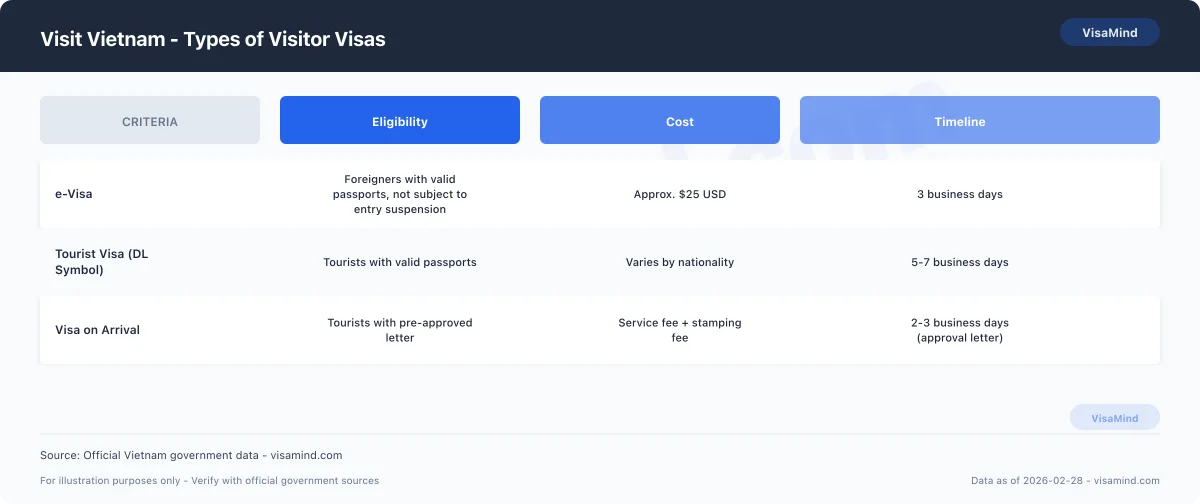
It's important to understand the different types of visitor visas available. Here’s a comparison of the main visitor visa options to help you determine which is most suitable for your travel needs.
| Visa Type | Eligibility | Cost | Timeline |
|---|---|---|---|
| e-Visa (Electronic Visa) | Available to foreigners outside Vietnam with a valid passport. Must not be under entry suspension per Article 21. | $25 (as of 2023) | Processing typically takes 3 working days. |
| Tourist Visa (DL Symbol) | Open to travelers visiting for tourism purposes. Requires a passport valid for at least 6 months beyond the visa expiration. | Varies by nationality and visa duration. Verify on the official website. | Can range from 5 to 7 working days. |
| Visa on Arrival | For travelers arriving by air. Requires pre-approval through a travel agency or a visa service. | $25 for a single entry; $50 for multiple entries (as of 2023). | Approval letter typically takes 2-3 working days. |
Understanding Your Visitor Visa Options
Each visa type has distinct requirements and processes. The e-Visa is convenient for those who prefer an entirely online application process. It allows for both single and multiple entries through designated international border gates. However, it’s crucial to ensure that all application details are accurate to avoid delays or rejections.
The Tourist Visa (DL Symbol) is suitable for extended stays or multiple visits, but it demands more preparation time. This visa type is typically processed by the Vietnam Embassy or Consulate in your country, and the cost varies depending on the length of stay and the number of entries.
Lastly, the Visa on Arrival is an option for those flying into Vietnam. This visa requires obtaining an approval letter beforehand, which is typically arranged through a Vietnamese travel agency.
Important: Ensure you are entering and exiting Vietnam through designated border gates if you are using an e-Visa. Failure to do so may result in entry denial.
Which Visa Should You Choose?
- Choose the e-Visa if you want a straightforward, online process and plan to enter through designated gates.
- Opt for the Tourist Visa if your stay exceeds the e-Visa’s duration or if you require multiple entries.
- Consider the Visa on Arrival if you are flying into Vietnam and prefer handling visa arrangements upon arrival.
For more detailed information on each visa type, visit the respective links and ensure you have the latest updates by checking the How To Apply and Documents Checklist guides.
What You Need to Apply
#To visit Vietnam, especially through the e-Visa process, it is crucial to have the necessary documents and meet the specific requirements outlined by the Immigration Department of Vietnam. Here's a detailed look at what you'll need to prepare.
Passport and Photograph Requirements
- Valid Passport: Your passport must have at least six months of validity remaining from your planned date of entry into Vietnam. Ensure that it has at least two blank pages.
- Passport Data Page Image: A clear, scanned copy of the passport's data page is needed. Make sure the details are legible and the scan is of high quality.
- Photograph: Provide a recent passport-sized photograph. The image must be front-facing, without glasses, and should meet the specific size and clarity standards set by the Immigration Department.
Important: Failure to upload a photograph that meets the specified criteria will result in your application being rejected.
Financial and Travel Proof
- Proof of Financial Means: While not always explicitly required for short-term stays, it's wise to have evidence of financial means to cover your stay in Vietnam. This may include bank statements or a letter from your employer.
- Travel Itinerary: Although not mandatory for the e-Visa, having a travel itinerary or proof of onward travel can be beneficial, especially at the border.
Special Considerations and Additional Documents
- International Travel Document: If you are using an international travel document instead of a passport, ensure it is recognized by the Vietnamese authorities.
- Previous Visa Information: If applicable, have any previous Vietnam visa information ready, particularly if you are applying for a new visa while in Vietnam under special circumstances.
Application Process and Tips
- Online Application: Applications for an e-Visa must be completed through the Vietnam Immigration Department's online portal.
- Payment: Be prepared to pay the visa fee via the e-payment gateway. The fee is non-refundable, even if the visa is not granted.
- Checking Results: After submission, use your registration code, registration email, and date of birth to check the status of your application in the E-visa search menu.
Tip: Double-check all information before submission. Any incorrect or incomplete data can lead to delays or denial.
For further information on the types of visas available, you might consider exploring options like the Tourist Visa (DL Symbol) or comparing e-Visa Vs Visa On Arrival to determine what best suits your travel needs.
How to Apply Step by Step
#Determine Your Eligibility
Before starting the application process, ensure you meet the eligibility criteria for a Vietnam e-Visa. You must be a foreigner located outside Vietnam with a valid passport or international travel document. Additionally, confirm that you do not fall under any entry suspension as outlined in Article 21 of the Law on Foreigners' Entry, Exit, Transit, and Residence in Vietnam.
Choose Your Application Method
Vietnam offers multiple ways to apply for a visit visa, depending on your preference and circumstances:
-
Online Application (e-Visa): This is the most convenient option, allowing you to apply remotely through the Vietnam Immigration Department's portal. The e-Visa permits single or multiple entries and is valid at designated international border gates.
-
Embassy or Consulate: If you prefer or require a more traditional method, you can apply for a visa through a Vietnamese Embassy or Consulate in your country. This may be necessary if specific visa types or longer stays are needed.
-
VFS Centers: In some countries, Visa Facilitation Services (VFS) centers act as intermediaries for visa applications. Check if this service is available in your region for added convenience.
Prepare Necessary Documentation
Ensure you have all required documents ready for your application. For the e-Visa, you will need:
- A clear image of your passport data page.
- A recent photograph of yourself (straight looking, without glasses).
Tip: For a smooth application process, double-check that your photograph meets the specified requirements to avoid delays due to incorrect submissions.
Submit Your Application
If opting for the e-Visa, follow these steps:
- Access the Vietnam Immigration Department's e-Visa portal.
- Fill in the required personal and travel information accurately.
- Upload your passport image and photograph as per specifications.
- Pay the e-Visa fee via the e-payment gateway.
For embassy applications, contact the nearest Vietnamese Embassy or Consulate to understand their specific submission process, as it may involve scheduling an appointment or submitting documents in person.
Monitor Your Application Status
After submission, keep track of your application status. For e-Visas, you can check the result by entering your registration code, email, and date of birth in the E-visa search menu on the portal.
Important: Ensure all entered information is accurate when checking your application status to avoid errors in retrieving your visa result.
Receive and Print Your Visa
Upon approval, print your e-Visa directly from the portal. It's crucial to have a physical copy when you travel to Vietnam, as it will be required at the border.
For other visa types obtained through an embassy or VFS center, follow their guidance on how and when you'll receive your visa.
Entry into Vietnam
Ensure you enter and exit Vietnam through the designated international border gates as specified for e-Visa holders. This compliance is necessary to avoid any entry issues.
For more information on visa options and related procedures, consider reviewing our guides on E Visa Vs Visa On Arrival and Documents Checklist.
Pitfalls That Get Applications Denied
#It's important to be aware of common pitfalls that can lead to application denial. Understanding these can help ensure your application process proceeds smoothly.
Common Application Mistakes
-
Incorrect Information: Providing missing, incorrect, or unverified information can result in your application being rejected. Double-check all details before submission.
-
Registration Errors: Not entering the registration code, registration email, and date of birth correctly when checking your application status can lead to confusion and delays.
-
Photo Specifications: Failure to upload a photograph that meets the required specifications (straight looking without glasses) is a common reason for rejection.
Important: Always use the E Visa portal to check your application status with the correct credentials.
Visa Misuse and Overstaying
-
Overstaying the Visa: Staying beyond the permitted duration of your visa can lead to fines and future entry bans. Make sure to leave the country before your visa expires.
-
Working on a Tourist Visa: Engaging in employment or business activities on a tourist visa is strictly prohibited. If you intend to work, consider applying for a Business Dn or Work Ld visa.
Financial Requirements
- Insufficient Funds: Demonstrating financial capability is essential. Having insufficient funds can lead to visa denial. Refer to the Financial Requirements guide to ensure you meet the financial criteria necessary for your stay.
Tip: Maintain a clear record of your financial status and prepare to present evidence if requested during the application process.
Understanding these pitfalls can help you avoid common mistakes that lead to application denial. Always refer to the official guidelines by the Immigration Department of Vietnam for the most accurate and up-to-date information.
At the Border
#Upon your arrival in Vietnam, you will need to go through immigration procedures at the border. This process is managed by the Immigration Department of Vietnam, which is part of the Ministry of Public Security. Understanding what to expect can help facilitate a smoother entry into the country.
What to Expect at Immigration
When you arrive at the border, you will be required to present your passport and visa documentation. If you are using an e-Visa, ensure you have a printed copy readily available. The immigration officers will verify your documents and confirm your eligibility to enter Vietnam.
Key Procedures:
-
Fingerprinting: All visitors are typically required to provide fingerprints upon entry. This is a standard security measure to ensure the safety and security of the country.
-
Interviews: While not always mandatory, be prepared to answer questions about the purpose of your visit, your intended length of stay, and your accommodations while in Vietnam. This is part of the officer’s routine check to verify your travel intentions.
-
E-Gates: Some international airports in Vietnam have e-gates to expedite the immigration process for e-Visa holders. If you are eligible, you can use these automated systems to reduce wait times.
Tips for a Smooth Entry
Important: Ensure your passport is valid for at least six months from your date of entry into Vietnam. Failure to meet this requirement could result in denial of entry.
-
Designated Border Gates: If you are entering with an e-Visa, make sure you are using a designated international border gate. Entry through non-designated gates may not be permitted.
-
Document Readiness: Keep all your travel documents, including your e-Visa printout, passport, and any other supporting documents, easily accessible.
-
Communication: If you encounter any issues or have questions during the process, seek assistance from the immigration officers. They are there to help and can provide guidance if needed.
For more information on different visa types and their requirements, you can explore the Visa On Arrival and Business Dn pages. Additionally, the Documents Checklist can help ensure you have all necessary paperwork in order before your trip.
Can You Stay Longer?
#For those looking to extend their stay in Vietnam, the Immigration Department of Vietnam provides options to apply for a visa extension. If you entered the country on an e-Visa, you might be eligible to apply for a new visa if you have an invitation or guarantee from a Vietnamese authority, organization, or individual. This process is in accordance with the Law on Foreigners' Entry, Exit, Transit, and Residence in Vietnam.
How to Apply for an Extension
To apply for a visa extension, you will generally need to visit an immigration office in Vietnam. Key documents typically include your passport, a completed application form, and proof of your current visa status. An extension application may also require a letter of invitation or guarantee. The process can vary based on your current visa type and the intended length of your extended stay. For precise details, refer to the Visa Extension Guide for step-by-step instructions.
Eligibility Considerations
It's essential to understand that not all visas are eligible for extension. For instance, if you initially entered Vietnam on a Tourist Visa (DL Symbol), the extension options might differ compared to other visa types like the Business Dn or Student Dh visas. Ensure that your current visa type allows for an extension before proceeding with your application.
Important: Always check the specific requirements and timelines for visa extensions on the Immigration Department's official website to ensure you have the most up-to-date information.
Processing and Timelines
The processing time for visa extensions can vary. It is advisable to apply well in advance of your visa expiration date to avoid any potential overstays, which could result in penalties or difficulties with future entries into Vietnam. For more details on processing times, visit the Processing Times guide.
By understanding these processes and preparing your documents accordingly, you can increase the likelihood of a successful visa extension application.
Real Scenarios
#A business consultant based in Singapore was invited to attend a conference in Ho Chi Minh City. She applied for a Vietnam e-Visa through the online portal managed by the Immigration Department of Vietnam. Her main concern was ensuring she entered Vietnam through a designated international border gate, as required for e-Visa holders. After consulting the list of approved entry points, she decided to fly directly to Tan Son Nhat International Airport. Her application was processed smoothly, and she received her e-Visa within three days. On arrival, she presented her printed e-Visa and passport, and was granted entry without any issues. The entire process, from application to entry, took less than a week.
Scenario: Frequent Traveler Needing Visa Extension
An English teacher in Hanoi, initially in Vietnam on an e-Visa, found that his stay needed to be extended due to a new job opportunity. He was aware that e-Visa holders can apply for a new visa if invited by a local organization. His new employer provided the necessary invitation letter and guaranteed his stay. He approached the Immigration Department of Vietnam to apply for a new Work Ld Visa. This required a visit to the local immigration office, where he lodged his application along with supporting documents. Within two weeks, he received approval for his new visa, allowing him to continue working in Vietnam for an extended period.
Scenario: Tourist's Application Error
A Canadian tourist planned a month-long backpacking trip across Vietnam. While applying for the e-Visa, he mistakenly uploaded a photograph that did not meet the specifications—he was wearing glasses. As a result, his application was initially rejected by the Vietnam Immigration Department. Learning from this, he reapplied, this time ensuring the photo met the requirement of being straight-faced and without glasses. He also double-checked all personal information before submission. This time, his application was accepted, and he received his e-Visa in five days. His trip proceeded as planned, and he entered Vietnam through Noi Bai International Airport.
FAQs
Can I switch from an e-Visa to a Tourist Visa while in Vietnam?
What documents are required to visit Vietnam with an e-Visa?
What are the pitfalls that could lead to an e-Visa application denial for visiting Vietnam?
Can I enter Vietnam with an e-Visa at any border gate?
What should I do if my e-Visa application is denied when trying to visit Vietnam?
How can I check the status of my e-Visa application for visiting Vietnam?
Is it possible to combine business and tourist activities on a Vietnam Tourist Visa?
VisaMind provides informational guidance only and is not a government agency. This is not legal advice. Requirements can change and eligibility depends on your specific facts. If your case is complex or high-stakes, consult a licensed immigration attorney.
Next steps
Requirements vary by nationality, purpose, timeline, and case details. Use Find My Visa to get a personalized checklist for Vietnam with official sources and deadlines.
Find my visa