Official sources referenced
Is This Comparison for You?
#Applying for a Vietnam e-Visa can be a straightforward option for many travelers, providing the convenience of completing the process entirely online. This electronic visa, managed by the Immigration Department of Vietnam, is available to eligible foreigners outside Vietnam. In 2023, it typically requires you to upload a passport data page image and a photograph (straight on without glasses) and pay an E-visa fee. The processing time can vary, but it often takes around three working days.
On the other hand, the Visa on Arrival (VOA) option is suitable for those who may not have had the opportunity to apply in advance. This option is available at major airports in Vietnam, but you must have an approval letter issued by the Immigration Department before you arrive. The VOA process might involve longer waiting times upon arrival, and it is generally considered less convenient than the e-Visa for those seeking a hassle-free entry.
Who Benefits from This Comparison?
This comparison is particularly useful for travelers planning a visit to Vietnam who are unsure of the most convenient visa option for their needs. If you value the convenience of pre-arranged travel documents, the e-Visa might suit you best. Conversely, if unforeseen travel plans arise, the Visa on Arrival allows for last-minute adjustments. Understanding the differences between these options can save you time and stress, ensuring a smoother entry into Vietnam.
Tip: Applying for an e-Visa well ahead of your travel date can help you avoid unexpected delays, especially during peak travel seasons.
For more detailed information on the Visa on Arrival process and how it compares to other visas like the Tourist Dl, make sure to explore our related resources.
At a Glance
#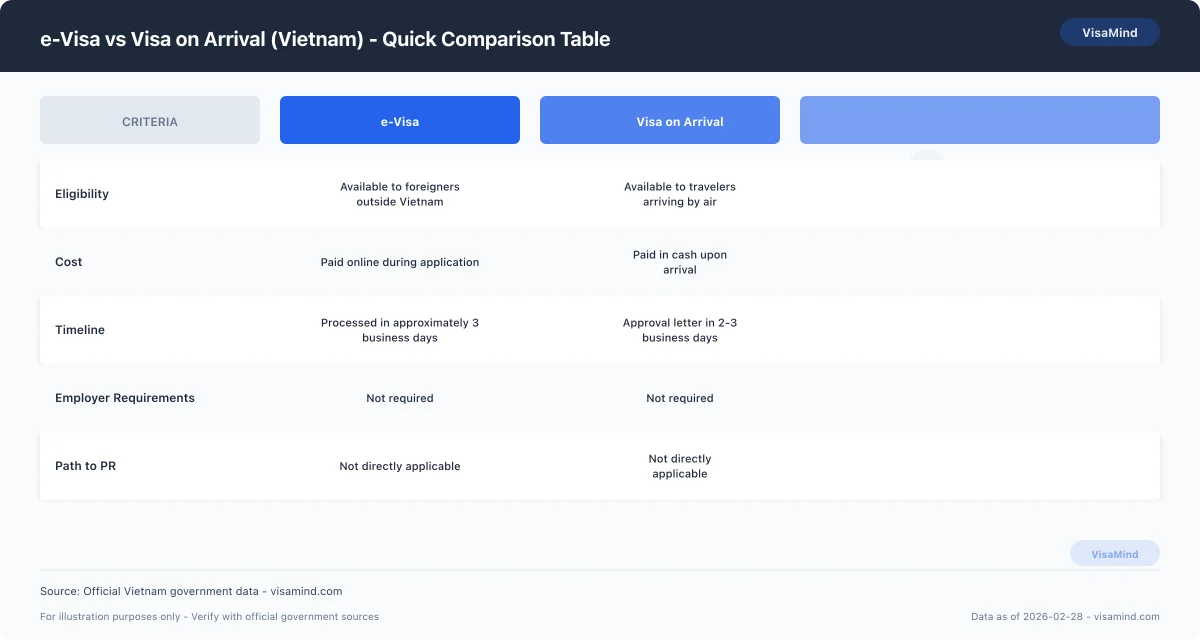
You have two primary visa options: the e-Visa and the Visa on Arrival. Each has distinct eligibility criteria, costs, and timelines, making it essential to choose the one that best fits your needs. Below is a comparison of these visa types to help you make an informed decision.
Overview
The e-Visa is an electronic visa option that allows eligible foreigners to apply online before traveling to Vietnam. Managed by the Immigration Department of Vietnam, this process is straightforward and can be completed entirely online. In contrast, the Visa on Arrival is obtained upon arrival at certain Vietnamese airports, requiring pre-arranged approval through an authorized travel agency.
At a Glance
| Feature | e-Visa | Visa on Arrival |
|---|---|---|
| Eligibility | Foreigners outside Vietnam apply online | Travelers must have pre-arranged approval via an agency |
| Cost | Typically around $25 USD (verify on the official website) | Service fee + stamping fee (~$25 USD) (verify on the official website) |
| Timeline | Processing takes 3 working days | Approval letter in 2-3 working days; visa on arrival |
| Employer Requirements | Not applicable | Not applicable |
| Path to PR | No direct path to Permanent Residency | No direct path to Permanent Residency |
Eligibility
For the e-Visa, eligibility is fairly straightforward: it is available to foreigners outside Vietnam who meet the basic requirements. You must have a passport with at least six months of validity, and your photograph must be straight-looking without glasses.
The Visa on Arrival requires a pre-approval process that must be arranged through an authorized travel agency. This is suitable for travelers who may need a visa on short notice but is only available at specific entry points such as international airports.
Cost and Timeline
The e-Visa generally costs around $25 USD, though fees can vary slightly, so it's wise to verify on the official website. Processing time is usually about three business days, making it a quick option for those planning ahead.
For the Visa on Arrival, you'll need to pay a service fee to the travel agency for the approval letter, plus a stamping fee of approximately $25 USD upon arrival. The total cost can vary based on the agency's fees, and the approval process typically takes 2-3 working days.
Path to Permanent Residency
Neither the e-Visa nor the Visa on Arrival provides a direct path to Permanent Residency in Vietnam. If you're considering a longer stay or residency, you may need to explore other options like a Temporary Residence Card or an Investor Visa.
Important: Missing or incorrect information during the application process can result in delays or rejections. Ensure all documents meet the specified requirements.
For more detailed guidance, you can refer to the How To Apply section on our site, which provides step-by-step instructions for both the e-Visa and Visa on Arrival.
Option A Is Better When...
#A digital nomad planning to explore Vietnam for a few weeks while continuing their remote work needs a straightforward way to enter the country without the hassle of lengthy visa processes. They choose to apply for an e-Visa, which is managed by the Immigration Department of Vietnam. This option suits their needs as it allows them to apply online from their current location outside Vietnam, avoiding the need to visit an embassy or consulate.
The nomad accesses the official portal, uploads the necessary documents including a passport data page and a photograph that meets the specified criteria, such as a straight-looking pose without glasses. After paying the e-Visa fee, they use their registration code and email to track the application status. Within three business days, their e-Visa is approved. They print the e-Visa and present it upon arrival at a Vietnamese airport, ensuring a quick and efficient entry into the country.
Scenario: Frequent Business Traveler
A business consultant who frequently visits Vietnam for short-term projects finds that applying for an e-Visa is the most efficient option. This consultant often has tight travel schedules and needs a visa process that aligns with their dynamic itinerary. The e-Visa application, which can be completed entirely online, fits well into their busy schedule.
The consultant completes the e-Visa application by logging onto the Immigration Department’s website, ensuring all information is correct to avoid rejection due to missing or incorrect details. They upload a passport photo under 200KB and a compliant photograph. Once the visa is approved, they print it out and carry it with them for their trips. The ability to handle everything electronically and quickly check visa status online means they can focus on preparing for their business meetings without worrying about visa logistics.
Scenario: Tourist Planning Ahead
A tourist planning a two-week vacation in Vietnam decides that an e-Visa is a perfect choice for their travel plans. They appreciate being able to handle the visa process well in advance of their departure date. The tourist logs onto the Immigration Department's portal, fills in the required information, and submits the necessary documents, including the passport image and a photograph that adheres to the specified guidelines.
After paying the e-Visa fee, they receive a registration code to monitor the application's progress. With an average processing time of three business days, they receive approval swiftly and print the e-Visa to take with them. This preparation ensures they have everything ready for a smooth entry into Vietnam, allowing them to focus on the enjoyment of their upcoming adventure.
Tip: Apply for your e-Visa well in advance to avoid last-minute stress and ensure all document uploads meet the size requirements to prevent delays.
When to Pick the Second Option
#A project manager was informed of a last-minute business trip to Vietnam to finalize a contract. Given the urgency, the project manager did not have time to apply for an e-Visa, which requires the application to be submitted and processed online before departure. Instead, the project manager opted for a Visa on Arrival. Upon arrival at the Tan Son Nhat International Airport in Ho Chi Minh City, they presented the necessary documents, including the approval letter obtained through a travel agency, passport, and photographs, at the Visa on Arrival counter. Within 30 minutes, they received the visa and proceeded with their business engagements without delay.
Scenario: Frequent Changes in Travel Plans
A travel blogger known for spontaneous trips was planning to explore Vietnam. Given their unpredictable schedule and frequent changes in travel plans, the blogger found the flexibility of a Visa on Arrival more suitable than an e-Visa. With an e-Visa, changes in travel dates or entry points require additional steps and potential delays. By choosing the Visa on Arrival, the blogger could adjust their itinerary as needed, obtaining the visa upon arrival at any of Vietnam’s designated international airports. This flexibility allowed them to enjoy a more fluid travel experience without the constraints of fixed entry points or dates.
Scenario: Technical Issues with Online Application
A photographer preparing for a photo shoot in Vietnam encountered technical issues while attempting to apply for an e-Visa through the Immigration Department of Vietnam’s online portal. Despite several attempts, the application could not be completed due to repeated errors in uploading required documents — the photograph and passport image exceeded the size limits. Facing a tight timeline, the photographer decided to use the Visa on Arrival option instead. They secured an approval letter from a reputable agency and arrived at Noi Bai International Airport in Hanoi, where they obtained the visa efficiently. This timely decision ensured that their professional commitments were met without disruption.
What Really Sets Them Apart
#You might find yourself choosing between an e-Visa and a Visa on Arrival. Each option has distinct advantages and limitations, making it crucial to understand the differences to ensure a smooth entry into the country. Let's explore what truly sets these two visa types apart.
Application Process
The e-Visa is an entirely online process managed by the Immigration Department of Vietnam. You can apply from anywhere outside Vietnam by providing a scanned image of your passport's data page and a recent photograph without glasses. After fulfilling the required information and paying the e-Visa fee, you can track your application status online using a registration code, registration email, and date of birth.
In contrast, the Visa on Arrival requires you to first obtain an approval letter from a travel agency prior to arriving in Vietnam. Upon arrival at one of Vietnam's international airports, you will need to present this letter, along with two passport-sized photos and the visa stamping fee, to receive your visa.
Important: Ensure your photograph and passport image for the e-Visa do not exceed 50KB and 200KB respectively, as larger files can lead to application rejection.
Entry Points
A significant difference lies in where you can enter Vietnam. With an e-Visa, you have the flexibility to enter through any of the designated international border checkpoints, including airports, land borders, and seaports. This option provides convenience for travelers who may arrive by various modes of transportation.
On the other hand, the Visa on Arrival is strictly limited to entry through international airports such as Noi Bai in Hanoi, Tan Son Nhat in Ho Chi Minh City, or Da Nang. If you plan to enter via land or sea, the Visa on Arrival is not a suitable option.
Time and Cost Considerations
The processing time for an e-Visa is typically around three working days. This quick turnaround can be advantageous for travelers planning last-minute trips. The fee is paid online during the application process, and there's no additional cost upon arrival.
Conversely, while the Visa on Arrival's initial approval letter can take a day or more to process, you must also budget time upon arrival to complete the visa stamping process. Additionally, the Visa on Arrival involves two payments: a service fee for the approval letter and a stamping fee at the airport.
| Feature | e-Visa | Visa on Arrival |
|---|---|---|
| Application | Online | Letter and airport process |
| Entry Points | Airports, land, sea | Airports only |
| Processing Time | ~3 days | Approval letter + airport time |
| Cost Structure | Single online payment | Two payments (service + stamping) |
Tip: For faster processing and reduced hassle, consider using the E Visa if your travel itinerary aligns with its entry points.
Understanding these key differences can help you choose the most suitable visa option for your travel needs. Whether you prioritize convenience, flexibility, or cost, Vietnam offers options to accommodate various traveler preferences.
Common Misconceptions
#-
e-Visa Eligibility: Some people mistakenly believe that anyone can apply for an e-Visa while already in Vietnam. However, you must apply for an e-Visa from outside the country. The application is meant for foreigners who are not yet in Vietnam.
-
Photograph Requirements: A common error is assuming that any passport photo will suffice. In reality, the photograph must be straight looking and without glasses. Additionally, the photo file size should not exceed 50KB.
-
Passport Image Upload: It's a misconception that any size of passport image can be uploaded. The passport image should not exceed 200KB. Failing to adhere to these specifications can result in the rejection of your application.
Tip: Double-check the file sizes of your uploaded documents to avoid processing delays.
Misunderstandings About the Visa on Arrival Process
-
Pre-Approval Requirement: Many think that they can just arrive at the airport in Vietnam and receive a Visa on Arrival without any prior steps. In fact, you need a pre-approval letter from the Immigration Department of Vietnam before you can obtain the visa at the airport.
-
Visa on Arrival Locations: There's a misconception that Visa on Arrival is available at any entry point in Vietnam. It is only available at designated international airports such as Noi Bai, Tan Son Nhat, and Da Nang. For land or sea entries, other visa options like the e-Visa must be considered.
Other Key Misconceptions
-
Application Process Complexity: Some believe that the e-Visa application process is more complex than it is. In reality, the process is entirely online, requiring you to fill in personal information and upload necessary documents, such as a passport data page image and a photograph.
-
Duration and Validity: Another common misunderstanding is thinking that the e-Visa offers multiple entries or long-term stay options. In fact, the e-Visa is a single-entry visa valid for 30 days. For longer stays or multiple entries, other visas such as the Tourist Dl or Business Dn might be required.
Important: Always verify the most current visa requirements and processes on the official website of the Immigration Department of Vietnam, as policies may change.
Converting Between Options
#Converting between an e-Visa and a Visa on Arrival in Vietnam is not a straightforward process. Each visa type has its own set of requirements and is processed through different channels. Here’s how you can navigate the transition between these two options:
Can You Switch From an e-Visa to a Visa on Arrival?
If you have already applied for an e-Visa but need to switch to a Visa on Arrival, you generally need to start the Visa on Arrival process separately. The e-Visa is processed entirely online through the official portal managed by the Immigration Department of Vietnam. Meanwhile, the Visa on Arrival requires a pre-approval letter that you must obtain through a travel agency or visa service before arriving in Vietnam.
Important: You cannot convert an e-Visa into a Visa on Arrival at the point of entry. Ensure you have the correct visa type before travel.
Steps to Obtain a Visa on Arrival
- Apply for a Pre-Approval Letter: Contact a licensed travel agency in Vietnam to request a pre-approval letter.
- Receive the Pre-Approval Letter: This document must be presented upon arrival in Vietnam.
- Arrive in Vietnam: At the airport, proceed to the Visa on Arrival counter with your pre-approval letter.
- Submit Required Documents: Provide your passport, two passport-sized photos, and fill out an entry/exit form.
- Pay the Stamping Fee: Fees vary based on the visa type and duration.
Can You Change From a Visa on Arrival to an e-Visa?
Switching from a Visa on Arrival to an e-Visa while in Vietnam isn't possible. The e-Visa is intended for those applying from outside Vietnam. If you need to extend your stay, consider applying for a Visa Extension Guide or a Temporary Residence Card.
Tip: Always check the latest visa requirements and procedures on the official Immigration Department of Vietnam website to ensure compliance.
Real Scenarios
#A marketing consultant frequently traveled to Vietnam for business meetings. On one occasion, she needed to visit on short notice due to an urgent client request. Knowing that obtaining a Visa on Arrival could involve potential delays at the airport, she opted to apply for an e-Visa through the Vietnam Immigration Department's online portal. She carefully uploaded the required passport data page and a compliant photograph, ensuring the file sizes met the specified limits to avoid rejection. Within three business days, her e-Visa was approved. She printed it and carried it with her to Vietnam, allowing her to bypass the waiting times associated with obtaining a visa at the airport.
Scenario: Tourist Planning a Last-Minute Trip
An architect planning a spontaneous vacation to Vietnam wanted to explore the country’s rich cultural heritage. With only a week before his intended departure, he had to decide between an e-Visa and a Visa on Arrival. Concerned about the processing time for an e-Visa, he decided to apply for a Visa on Arrival. He contacted a Vietnam-based travel agency to expedite the pre-approval letter necessary for entry. Upon arrival at the airport in Vietnam, he presented the pre-approval letter along with his passport to the Immigration Department's counter, paid the stamping fee, and collected his visa within an hour. This approach allowed him to navigate the process efficiently, albeit with a slightly higher cost due to the agency fee.
Scenario: Tech Entrepreneur with Changing Plans
A tech entrepreneur frequently traveled to Southeast Asia for networking and potential business ventures. Initially planning a mere two-week stay in Vietnam, he applied for an e-Visa due to its simplicity and lower upfront cost. However, during his trip, he decided to extend his stay to explore more business opportunities. Since an e-Visa is typically valid for 30 days, he needed an extension. He visited the local immigration office in Ho Chi Minh City to apply for a visa extension. By presenting his business intentions and a letter from a local contact, he successfully extended his stay, allowing him to continue his exploratory endeavors without leaving the country.
FAQs
What is the fee for a Vietnam e-Visa as processed by the Immigration Department of Vietnam?
Is a photograph required for the Vietnam e-Visa application?
Can you apply for both a Vietnam e-Visa and a Visa on Arrival simultaneously?
What happens if I upload a passport image larger than 200KB for my Vietnam e-Visa application?
Can I extend my stay in Vietnam if I initially enter on an e-Visa?
What specific information do I need to check the status of my Vietnam e-Visa application?
Is it easier to apply for a Vietnam e-Visa or a Visa on Arrival if I'm already in Vietnam?
Sources
Last reviewed: March 1, 2026
VisaMind provides informational guidance only and is not a government agency. This is not legal advice. Requirements can change and eligibility depends on your specific facts. If your case is complex or high-stakes, consult a licensed immigration attorney.
Next steps
Requirements vary by nationality, purpose, timeline, and case details. Use Find My Visa to get a personalized checklist for Vietnam with official sources and deadlines.
Find my visa