On this page
- Paths to Working Legally
- Does Your Employer Need to Do Anything?
- The Application Process
- Your Rights as a Worker
- Transitioning to Permanent Residence
- Why Work Visa Applications Fail
- Skills and Qualifications
- Salary and Cost Considerations
- Your Tax Situation Abroad
- Real-World Work Visa Stories
- Visa options for this goal
- Guides for Vietnam
- Other goals for Vietnam
Paths to Working Legally
#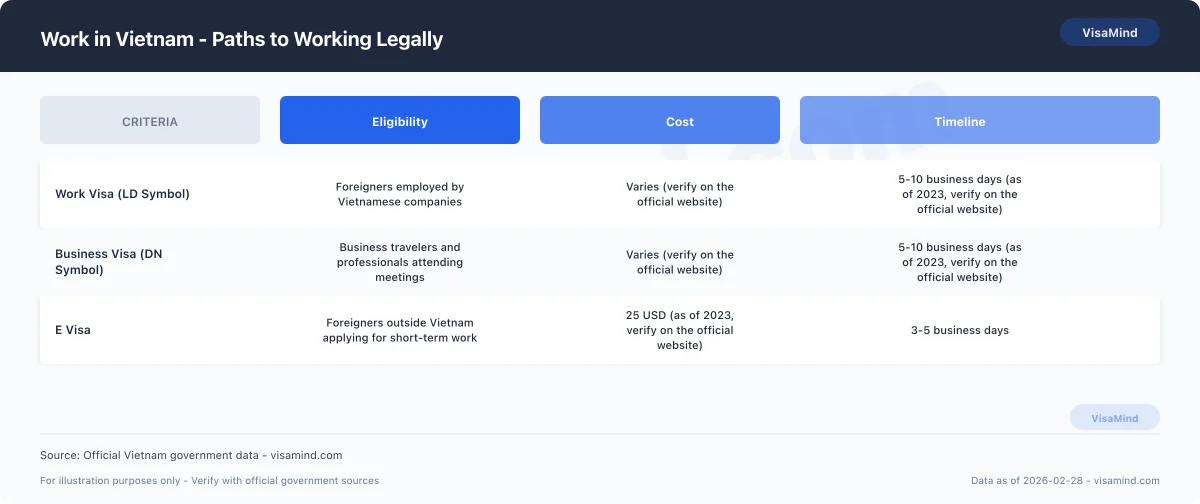
To work legally in Vietnam, foreign nationals can apply for various visa categories, each designed to accommodate different employment needs. As of 2023, understanding these options is crucial for ensuring compliance with Vietnamese immigration laws. Below is an overview of the main work visa categories available:
Overview of Work Visa Categories
| Visa Type | Eligibility | Cost | Processing Time |
|---|---|---|---|
| Work Visa (LD Symbol) | Foreign nationals with a valid work contract in Vietnam | Varies by nationality; verify on the official website | Approximately 5-7 working days |
| Business Visa (DN Symbol) | Individuals entering Vietnam for business-related purposes without labor contracts | Varies by nationality; verify on the official website | Approximately 5-7 working days |
| E-Visa | Foreigners applying from outside Vietnam for short-term work assignments | USD 25 | 3 working days |
Work Visa (LD Symbol)
The Work Visa (LD Symbol) is intended for individuals who have secured employment in Vietnam with a local company. Applicants must provide a valid employment contract and, in most cases, a Work Permit. This visa is generally valid for up to two years and can be extended.
For more detailed information about the Work Visa, including application requirements, visit the Work Ld page.
Business Visa (DN Symbol)
The Business Visa (DN Symbol) is suitable for those who intend to conduct business activities in Vietnam but do not have a formal employment relationship with a Vietnamese company. This visa allows for activities such as attending meetings, signing contracts, or exploring business opportunities. Note that this does not permit actual employment at a local organization.
For further guidance on the Business Visa, consult the Business Dn section.
E-Visa
The E-Visa is a convenient option for those planning short-term work-related visits to Vietnam, such as attending a conference or meeting. It allows a single entry and is valid for 30 days. The application process is entirely online, requiring an image of the passport data page and a recent photograph.
For a detailed guide on the E-Visa application, please see the E Visa section.
Important: Ensure that all documentation, especially photographs, meet the specific size and quality requirements to avoid processing delays. Missing or incorrect information may lead to application rejection.
Key Considerations
- Work Permit Requirement: For the Work Visa, obtaining a Work Permit is typically necessary unless you fall into an exempt category. Explore the Work Permit page for more details.
- Timeline and Costs: Processing times and fees are subject to change, and it's advisable to verify these details on the official Immigration Department website before submitting your application.
- Visa Extensions: If you need to extend your stay, consider the options available for extending your visa or transitioning to a Temporary Residence Card. More information can be found on the Visa Extension Guide.
For anyone considering working in Vietnam, it's essential to choose the right visa category that aligns with your employment situation and to ensure all required documentation is accurately prepared and submitted. By understanding the available visa options, you can navigate the process efficiently and legally begin your work activities in Vietnam.
Does Your Employer Need to Do Anything?
#Employers play a significant role in facilitating their employees' ability to work in Vietnam. For foreign workers, obtaining a work visa or permit, such as the Work Visa (LD Symbol), often involves specific actions and commitments from the employer. Here's what you need to know about these requirements.
Employer Responsibilities
Before a foreign employee can start working in Vietnam, the employer must fulfill certain responsibilities. These typically involve obtaining necessary approvals and certifications that demonstrate the need for hiring foreign labor.
-
Work Permit Application: Employers must initiate the Work Permit process. This entails gathering and submitting documents that justify the employment of a foreign national, such as proof of the employee’s qualifications and an explanation of the job role.
-
Approval from the Labor Department: Employers are required to seek permission from the local Department of Labor, Invalids, and Social Affairs (DoLISA). This step ensures that employing a foreign worker will not negatively impact the local labor market.
-
Notification of Vacancies: Before applying for a work permit for a foreign national, employers might need to demonstrate that they have advertised the job locally and were unable to fill the position with a Vietnamese candidate.
Documents Employers Need to Provide
Employers must prepare and submit several documents as part of the work permit application process. These documents help verify both the necessity and legitimacy of hiring a foreign worker.
- Detailed job description
- Evidence of recruitment efforts for local candidates
- Company's business registration certificate
- Letter of support or explanation from the company
Tip: Ensure all documents are translated into Vietnamese and notarized, as this is often a requirement for processing.
Additional Considerations for Employers
Employers should remain aware of additional obligations that may arise once a foreign worker is employed:
-
Visa Extensions and Renewals: Employers might need to assist with extending the employee's E Visa or Work Visa (LD Symbol) as necessary. More details can be found in the Visa Extension Guide.
-
Compliance with Regulations: It is crucial for employers to stay informed of any changes in labor laws or immigration policies to ensure compliance and avoid potential penalties.
-
Regular Reporting: Employers may be required to periodically report to Vietnamese authorities about the status and employment of their foreign workers.
By understanding and fulfilling these responsibilities, employers can facilitate a smoother transition for their foreign employees working in Vietnam.
The Application Process
#Gather Required Documents
To start your application for a Vietnam Work E-visa, ensure you have all the necessary documents ready. You will need:
- A clear image of your passport’s data page.
- A recent photograph of yourself (straight looking, without glasses). Ensure the portrait photo is smaller than 50KB and the passport photo is smaller than 200KB.
Important: Missing or incorrect information can lead to application rejection. Double-check that all details are accurate before proceeding.
Apply Online
Visit the official portal managed by the Immigration Department of Vietnam to apply for the Vietnam Work E-visa. You will be required to enter your personal and passport information and upload the necessary documents.
- Access the E Visa application page.
- Complete the online form with accurate details.
- Upload your passport data page and photograph as instructed.
Payment of E-visa Fee
After submitting your application, you will be directed to pay the E-visa fee. The fee must be paid online, and the amount will be specified during the application process. Keep a digital receipt of your payment for future reference.
Tip: Apply online to receive a receipt number immediately, which can be useful for tracking your application.
Check Your Application Status
Once your application is submitted and the fee is paid, you can track the status of your application online. Use your registration code, registration email, and date of birth to access the E-visa search menu on the official portal.
- Enter your details to verify the status.
- If the application is approved, you will be able to download and print your E-visa.
Print Approved E-visa
If your application is successful, print the E-visa document. You need to present this printed E-visa upon arrival in Vietnam.
Note: Ensure your printed E-visa is clear and legible, as it will be verified by immigration officers upon entry.
By following these steps, you can efficiently apply for a Vietnam Work E-visa. For more detailed guidance on the application process, you might also find the How To Apply guide helpful. Always refer to the Immigration Department’s official website for the most current information and updates.
Your Rights as a Worker
#As a foreign worker in Vietnam, changing employers is possible, but it involves specific steps. Your current work visa or permit is tied to your employer, so changing jobs requires obtaining a new work permit sponsored by the new employer. Here's what you need to consider:
- Obtain a New Work Permit: Your new employer must apply for a work permit on your behalf. This involves submitting necessary documents to the Immigration Department of Vietnam.
- Cancel the Old Work Permit: Ensure that your previous employer cancels your old work permit to prevent any legal complications.
- Update Your Visa Status: You may need to update your visa type, such as switching from a Work Visa (LD Symbol) to a new one relevant to your employment situation.
Important: Failing to secure a new work permit before starting a new job can lead to fines or deportation.
Can Family Join You?
If you hold a valid work visa in Vietnam, your immediate family members can join you. Here are the key points:
- Dependent Visas: Family members can apply for dependent visas, such as the Family Tt Visa, allowing them to stay in Vietnam while you work.
- Temporary Residence Cards: For longer stays, consider applying for a Temporary Residence Card for your family members, which typically offers a more stable residency status.
Can You Study While Working?
As a foreign worker in Vietnam, you can pursue educational opportunities alongside your job. Here’s how:
- Enrolling in Courses: You can enroll in short-term courses or professional training programs without changing your visa status.
- Full-Time Studies: If you plan to undertake full-time academic programs, you might need to switch to a Student Dh Visa to align with your new educational status.
Tip: Always consult with the educational institution and immigration authorities to ensure compliance with visa regulations when planning to study while working.
Transitioning to Permanent Residence
#Foreigners working in Vietnam often see their work visa as a stepping stone towards permanent residence. Transitioning from a work visa to permanent residence involves meeting specific requirements and understanding the timeline set by the Immigration Department of Vietnam.
How Work Visas Can Lead to Permanent Residence
If you're working in Vietnam on a Work Visa (LD Symbol), you may be eligible to apply for a Permanent Residence Card. This path is particularly relevant for those who have maintained a stable employment history and intend to continue contributing to the Vietnamese economy.
To transition to permanent residence, consider the following steps:
- Maintain Legal Employment: Ensure your work visa is valid and you comply with all employment regulations.
- Secure a Temporary Residence Card: Often, holding a Temporary Residence Card helps demonstrate your long-term commitment to living in Vietnam.
- Meet Residency Requirements: Typically, applicants must have resided in Vietnam for a certain number of years without significant legal issues. The exact duration may vary, so verify on the official website.
Timeline for Transitioning
The timeline for transitioning from a work visa to permanent residence can vary based on your situation. Generally, applicants should expect a multi-year process. Here’s an approximate timeline to guide you:
| Step | Estimated Duration |
|---|---|
| Hold a valid work visa | Ongoing |
| Obtain a Temporary Residence Card | 1-2 months |
| Fulfill residency requirement | 3-5 years |
| Apply for Permanent Residence Card | 6-12 months |
Important: Ensure all documents are accurate and complete to avoid processing delays or application rejections.
Key Considerations for Permanent Residence Applications
- Documentation: Gather your work history, financial statements, and proof of residence. Refer to the Documents Checklist for detailed requirements.
- Financial Stability: Demonstrating financial stability is crucial. Review the Financial Requirements for specific guidelines.
- Legal Compliance: Maintain a clean legal record. Any infractions could impact your eligibility for permanent residence.
For more detailed guidance, visit the How To Apply section, which outlines the necessary steps and provides additional resources to assist you in transitioning from a work visa to permanent residence in Vietnam.
Why Work Visa Applications Fail
#Important: Missing or incorrect information on your work visa application can lead to rejection by the Immigration Department of Vietnam. Double-check each detail to avoid delays.
Common Reasons for Application Rejection
-
Incomplete Documentation:
- Missing passport data page or photograph.
- Images that do not meet size requirements (portrait photo must be smaller than 50KB, passport photo smaller than 200KB).
-
Inaccurate Information:
- Errors in personal details, such as name or passport number.
- Incorrect entry of registration code, email, or date of birth when checking status in the E-visa search menu.
-
Non-Compliance with Visa Type:
- Applying for the wrong visa type, such as using an E-visa for work purposes without a corresponding Work Permit.
- Misunderstanding the difference between a Work Visa (LD) and a Business Visa (DN).
How to Avoid Application Pitfalls
-
Verify Document Compliance:
- Ensure all uploaded documents meet the specified size and format requirements.
- Use clear, straight-looking photographs without accessories like glasses.
-
Double-Check Information:
- Review all entered details before submission, focusing on passport information and personal data.
- Use the E-visa search menu to confirm details by entering your registration code, email, and date of birth.
-
Understand Visa Requirements:
- Choose the correct visa type based on your intended activities in Vietnam. For work, ensure you have both a Work Visa and a Work Permit.
- Refer to guides such as the Visa Refusal Reasons for insights on common mistakes to avoid.
Tip: Keep a checklist of required documents and information to ensure nothing is missed during your application process. This can help streamline your preparation and reduce the risk of rejection.
Skills and Qualifications
#When seeking employment in Vietnam, it's crucial to ensure that your skills and qualifications are recognized by potential employers and relevant authorities. The process of skills assessment can vary depending on your profession. Here are some key considerations:
-
Professional Qualifications: Certain professions, such as engineering or medicine, may require validation of your qualifications. This could involve having your degrees and certificates certified by the issuing institution or a recognized body in Vietnam.
-
Language Requirements: Proficiency in Vietnamese may be necessary for some roles. You might need to demonstrate your language skills through tests or certifications, especially if the position involves direct interaction with local clients or teams.
Tip: Engage with professional associations in Vietnam related to your field. They can provide guidance on the recognition of foreign qualifications and the necessary steps for certification.
Qualification Recognition
The recognition of foreign qualifications is a significant step for those intending to work in Vietnam. Here’s how you can navigate the process:
-
Validation by Authorities: Your academic qualifications might need to be validated by the Ministry of Education and Training in Vietnam. This is particularly relevant if your degree is essential for the job position.
-
Equivalency Statements: In some cases, obtaining an equivalency statement from a recognized Vietnamese educational institution may be required to establish the comparability of your foreign degree to a local one.
-
Documentation: Ensure that you have all necessary documents, such as transcripts and degree certificates, translated into Vietnamese and notarized. A comprehensive Documents Checklist can help ensure you gather all required paperwork.
Degree and Experience Requirements
Employers in Vietnam often have specific requirements regarding educational background and work experience. Here's what you should know:
-
Educational Background: A bachelor's degree is commonly required for many professional roles. However, certain industries might demand a higher level of education, such as a master's or a specialized qualification.
-
Work Experience: Practical experience in your field is highly valued in Vietnam. Employers typically look for candidates with a minimum of two to three years of relevant experience, although this can vary by industry.
-
Additional Training: Some positions may require additional training or certification. For example, IT professionals might need certifications in specific software or technology.
Important: Ensure that all translations of your documents are certified by a recognized translation service to avoid delays or rejections in your application.
By understanding these aspects of skills and qualifications, you can better prepare for your employment journey in Vietnam. Be sure to consult the How To Apply guide for more detailed information on the application process.
Salary and Cost Considerations
#Vietnam's work visa regulations require you to meet specific salary and cost considerations to work legally. Here's a comparison table and detailed breakdown of the core elements involved:
Salary and Cost Considerations
| Visa Type | Minimum Income Requirement | Application Fee (USD) | Typical Processing Time |
|---|---|---|---|
| Work Visa (LD Symbol) | No specific threshold | $135 (as of 2023) | 5-7 business days |
| Business Visa (DN Symbol) | No specific threshold | $25 for single entry, $50 for multiple entries (as of 2023) | 3-5 business days |
| Work Permit | $500/month minimum salary (as of 2023) | Varies by service provider | 10-15 business days |
Minimum Income Requirements
For obtaining a Work Permit, Vietnam mandates a minimum monthly salary of $500. This threshold ensures that foreign workers can sustain themselves while residing in the country. It's important to verify this figure on the official website, as it may be subject to change.
Important: Not meeting the minimum income requirement could lead to rejection of your work permit application.
Application Fees
The application fees vary depending on the type of visa. For instance, the Work Visa application costs $135, whereas the Business Visa fees are lower, ranging from $25 to $50 depending on the entry type. These fees are non-refundable, so ensure all requirements are met before applying.
Processing Times
Processing times differ by visa type. Work Visas typically need 5-7 business days, while Business Visas are processed faster, in about 3-5 business days. The processing time for a Work Permit is generally longer, taking 10-15 business days.
Tip: Start your application process early, especially if you need a Work Permit, to accommodate potential processing delays.
For more information on the distinct requirements and processes, you can explore the Work Permit and Business Visa (DN Symbol) sections. Additionally, consider visiting the Financial Requirements guide for a comprehensive overview of financial obligations.
Your Tax Situation Abroad
#When working in Vietnam as a foreigner, understanding your tax obligations and social security contributions is essential. Here’s a breakdown of what you need to know about your tax situation abroad.
Income Tax Obligations
Foreign employees in Vietnam are subject to personal income tax (PIT). The PIT rates can range from 5% to 35% based on your income level. As of 2023, the following are the progressive tax rates you might encounter:
| Annual Income (VND) | Tax Rate |
|---|---|
| Up to 60 million | 5% |
| 60 - 120 million | 10% |
| 120 - 216 million | 15% |
| 216 - 384 million | 20% |
| 384 - 624 million | 25% |
| 624 - 960 million | 30% |
| Over 960 million | 35% |
Tip: Ensure accurate reporting of your income to avoid penalties. Always verify the latest rates on the official website of the General Department of Taxation in Vietnam.
Social Security Contributions
Foreign workers in Vietnam are often required to contribute to social insurance, health insurance, and unemployment insurance, depending on their employment status and agreements between Vietnam and their home countries. As of 2023:
- Social Insurance: 8% of the gross salary
- Health Insurance: 1.5% of the gross salary
- Unemployment Insurance: Generally not required for foreign workers unless specified in specific agreements
Important: Contribution rates and requirements may differ if there are bilateral agreements between Vietnam and your home country. Verify these details with your employer or the Immigration Department of Vietnam.
Double Taxation Treaties
Vietnam has signed Double Taxation Avoidance Agreements (DTAs) with numerous countries to prevent double taxation. These treaties can provide tax relief if you are liable to pay tax both in Vietnam and your home country. Key benefits may include:
- Tax credits
- Tax exemptions on certain types of income
Resources for Further Information
For detailed guidance on your tax obligations, consider consulting resources like the Documents Checklist to ensure you're prepared with the necessary paperwork. Additionally, exploring the Visa Extension Guide might offer insights into maintaining compliance with your visa requirements during your stay in Vietnam.
Understanding these elements of your tax situation abroad will help you navigate your responsibilities while working in Vietnam, ensuring compliance with local regulations and optimizing your financial obligations.
Real-World Work Visa Stories
#An IT professional, seeking to join a tech startup in Ho Chi Minh City, decided to apply for a Vietnam Work E-Visa while still in his home country. Concerned about the digital application process, he diligently gathered his passport data page and a compliant portrait photo, ensuring the images met the strict file size requirements—smaller than 200KB for the passport photo and 50KB for the portrait photo. He used the Immigration Department of Vietnam's online portal to submit his application, carefully entering his personal and passport details. After paying the E-visa fee, he received a registration code, which he used to track the status of his application. Within three business days, his E-visa was approved, and he printed it out for his upcoming move to Vietnam.
Tip: Ensure your photos meet the size requirements to avoid rejection.
Scenario: English Teacher Converts to a Long-Term Work Visa
A certified English teacher, initially arriving in Vietnam on a Tourist DL visa, found a job opportunity at a language school in Hanoi. To transition from a tourist visa to a legitimate work status, she needed to apply for a Work Visa (LD Symbol). The school assisted by providing necessary documentation and liaising with the Immigration Department of Vietnam. She also explored the Work LD Vs Work Permit guide to understand the differences and requirements. After submitting her documents, including her employment contract and qualifications, she received her work visa approval within four weeks, enabling her to legally work in Vietnam and eventually apply for a Temporary Residence Card.
Scenario: Business Consultant Utilizes E-Visa for Short-Term Projects
A business consultant required a quick entry into Vietnam to oversee a short-term project with a local firm. Opting for the Vietnam Work E-Visa due to its efficiency, he applied online from his home country. He meticulously checked each entry on the application to avoid pitfalls such as missing or incorrectly identified information. After submitting the required passport and portrait photos, he paid the E-visa fee. The consultant received approval in just two business days, thanks to the streamlined process, allowing him to commence his project on schedule without any hitches.
FAQs
Can I switch from a Business Visa (DN Symbol) to a Work Visa (LD Symbol) in Vietnam?
What documents are required for a Work Visa in Vietnam?
Can I check my Work Visa application status online in Vietnam?
What should I do if my Work Visa application for Vietnam is rejected?
Can I work in Vietnam while holding a Business Visa (DN Symbol)?
Is it possible to transition from a Work Visa to permanent residence in Vietnam?
What are common reasons for Work Visa application rejections in Vietnam?
Sources
Last reviewed: March 1, 2026
VisaMind provides informational guidance only and is not a government agency. This is not legal advice. Requirements can change and eligibility depends on your specific facts. If your case is complex or high-stakes, consult a licensed immigration attorney.
Next steps
Requirements vary by nationality, purpose, timeline, and case details. Use Find My Visa to get a personalized checklist for Vietnam with official sources and deadlines.
Find my visa