Official sources referenced
Who This Helps
#Vietnam processes over 300,000 work permits annually, catering to the increasing demand for foreign professionals. Understanding the differences between a Work LD Visa and a Work Permit is crucial for anyone planning to work in Vietnam. This comparison is particularly helpful for foreigners navigating the Vietnamese immigration system, as it clarifies which option aligns best with their employment situation and residency plans.
Who Benefits from This Comparison?
Foreign professionals who intend to work in Vietnam will find this comparison invaluable. The distinction between a Work LD Visa and a Work Permit can impact both the application process and the length of stay permitted. For instance, the Work LD Visa is often the first step for those entering Vietnam for employment, while a Work Permit is essential for legally working within the country for an extended period. Knowing the requirements and processes of each can help applicants avoid common pitfalls, like incorrect document submissions, which can lead to application rejection.
Employers and HR Departments
Vietnam-based employers and HR departments also benefit from understanding these differences, as they are often responsible for sponsoring foreign employees. Employers must ensure compliance with the Immigration Department's regulations to avoid any legal issues that could arise from employing foreigners without the correct documentation. Familiarity with the visa and permit requirements enables employers to better assist their foreign employees in navigating the immigration process.
Tip: Employers should keep a checklist of required documents to streamline the process for their foreign employees and avoid delays.
For detailed guidance on application processes and document checklists, refer to the Documents Checklist and How To Apply resources. Understanding these nuances ensures both employees and employers can effectively prepare for working in Vietnam without unnecessary complications.
Quick Comparison Table
#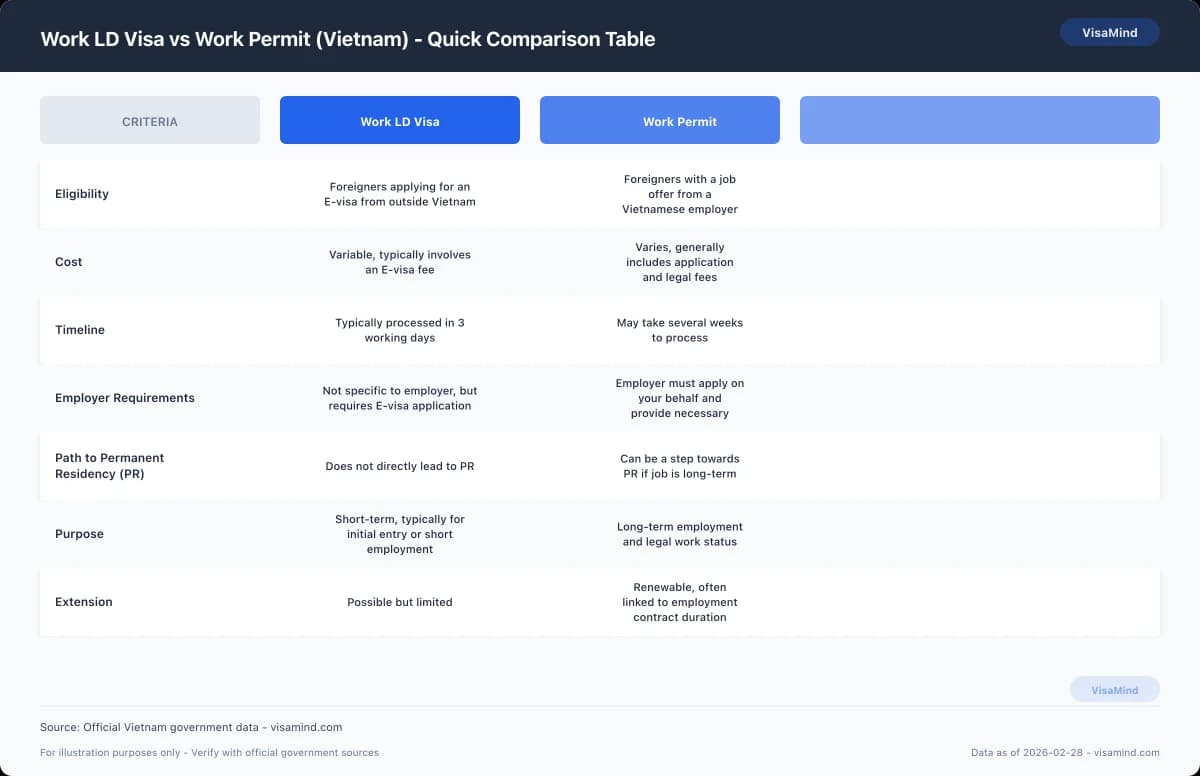
To help you understand the differences between a Work LD Visa and a Work Permit in Vietnam, here is a quick comparison table outlining key dimensions such as eligibility, costs, timelines, and more.
| Dimension | Work LD Visa | Work Permit |
|---|---|---|
| Eligibility | Foreigners outside Vietnam applying for an E-visa to enter Vietnam. | Foreigners intending to work in Vietnam for more than 3 months. |
| Cost | Varies by nationality and processing time; typically around $25 to $50 USD. Confirm the exact fee on the official website. | Employer generally covers the cost; fee can vary based on service provider. |
| Timeline | Standard processing time is 3 working days. | Typically processed within 7-10 working days after submission of all documents. |
| Employer Requirements | No direct employer requirements for visa application; however, the purpose of visit must be work-related. | Employer must prove the necessity of hiring a foreign worker; involves obtaining approval from the Department of Labor, Invalids, and Social Affairs. |
| Path to Permanent Residence (PR) | The Work LD Visa by itself does not lead directly to PR. | Holding a Work Permit can be a step towards a Temporary Residence Card, which may eventually lead to PR. |
What Are the Costs Involved?
The Work LD Visa involves a fee that varies depending on the applicant’s nationality and processing time. Generally, it ranges from $25 to $50 USD. Make sure to verify the exact fee on the Immigration Department of Vietnam's website.
In contrast, the Work Permit costs are usually covered by the employer. Fees can differ based on the service provider handling the application.
How Long Does It Take?
The processing time for a Work LD Visa is relatively quick, taking about 3 working days. This is ideal if you need to enter Vietnam swiftly for work purposes.
On the other hand, obtaining a Work Permit can take a bit longer, typically processing within 7-10 working days once all required documents are submitted.
Tip: To avoid delays, ensure all documentation is accurate and complete before submission. Errors or missing information can lead to rejection or prolonged processing times.
Employer Responsibilities
While the Work LD Visa does not impose direct requirements on employers, it is essential for the applicant to have a work-related purpose for entering Vietnam. For the Work Permit, employers must demonstrate the necessity of hiring a foreign worker. This involves obtaining approval from the Department of Labor, Invalids, and Social Affairs, which can be a detailed process.
Understanding these differences can guide you in selecting the right path, whether you’re entering Vietnam temporarily for work or considering a longer-term employment arrangement. For more detailed guidance on applying for these visas, refer to the How To Apply and Documents Checklist sections.
Choose Option A If...
#A software developer working for a multinational company was assigned to a project in Vietnam. He needed to stay for more than 90 days, making the Work LD Visa a suitable option. To start, the developer's company collaborated with the Immigration Department of Vietnam to apply for the visa, ensuring he could begin work upon arrival. They used the Work LD Visa application process, which required detailed project documentation and proof of employment. Within two weeks, the visa was approved, allowing him to work legally in Vietnam for the duration of the project.
Scenario: English Teacher Navigating Work Permit Requirements
An English teacher secured a job offer from a language school in Ho Chi Minh City. To work legally, she needed a Work Permit. The school assisted her with the Work Permit application through the Immigration Department. This involved submitting her degree certificates, professional qualifications, and a health check certificate. The process took approximately one month, after which she received her permit, enabling her to teach legally for the contract term.
Scenario: Business Consultant Opting for a Short-Term Project
A business consultant was contracted for a short-term project in Vietnam lasting 45 days. Instead of a Work Permit, he opted for an E-Visa, as it was more suitable for his brief stay. He applied online through the official portal, uploading his passport and a photo, and paid the necessary fee. By using the E-Visa system, he could track his application status with a registration code. Within three business days, he received his E-Visa, which was valid for 30 days, allowing him to complete his consultancy work efficiently.
Option B Is Better When...
#A software developer from India received a job offer from a Vietnamese tech company. The company required the developer to relocate and start work as soon as possible. Initially, the developer considered applying for a Work LD Visa, as it seemed straightforward for entering Vietnam. However, after consulting with the HR department and reviewing Vietnam's immigration regulations, they decided that obtaining a Work Permit would be more advantageous for long-term employment stability.
The developer navigated the process by submitting the necessary documents to the Immigration Department of Vietnam and received guidance from their employer throughout the application process. The company helped by providing the required sponsorship paperwork, including a detailed job description and proof of business registration. Within two months, the developer successfully obtained their Work Permit, allowing them to work legally in Vietnam for up to two years, with the possibility of renewal. This decision facilitated not only a smooth transition into the company but also ensured compliance with local employment laws.
Scenario: Transitioning from Short-term to Long-term Employment
An English teacher working in Vietnam on a Tourist DL Visa found a permanent teaching position at an international school. To transition from short-term visits to a more stable arrangement, they initially considered extending their Tourist DL Visa. However, the school recommended applying directly for a Work Permit to secure a long-term stay and avoid frequent visa renewals.
The teacher gathered the necessary documents, which included a contract from the school, proof of qualifications, and a health check certificate. They submitted these to the Immigration Department of Vietnam, which required the teacher to first obtain a Temporary Residence Card as part of the Work Permit application process. After a detailed review and assistance from the school's administrative staff, the teacher successfully received their Work Permit within three months. This allowed them to focus on their career without the constant worry of visa expiration.
Important: When transitioning from a tourist visa to a work permit, ensure your employer is familiar with Vietnam's immigration regulations to avoid unnecessary delays.
Scenario: Expanding a Business Operation
A French entrepreneur looking to expand their digital marketing agency into Vietnam initially considered entering the country on a Business DN Visa. However, given the need to hire local staff and establish a physical presence, applying for a Work Permit was deemed more appropriate for long-term operational stability.
The entrepreneur coordinated with local partners and utilized the services of a Vietnamese immigration consultant to navigate the application process. They submitted a detailed business plan, proof of business registration in Vietnam, and other required documents to the Immigration Department. Within four months, the entrepreneur received their Work Permit, allowing them to hire local employees and ensure compliance with Vietnam's labor laws. This strategic move facilitated smoother business operations and growth within the Vietnamese market.
The Critical Differences
#To effectively navigate Vietnam's immigration system for work, understanding the differences between a Work LD Visa and a Work Permit is crucial. Here, we delve into the critical distinctions that define these two immigration pathways.
Purpose and Scope
The Work LD Visa is specifically designed for foreign workers intending to enter Vietnam for employment purposes. It is a temporary visa that allows you to stay in Vietnam while you work for a local employer. This visa is closely tied to your employment status and is often a prerequisite for obtaining a longer-term work permit.
In contrast, a Work Permit provides a more stable and extended authorization for employment in Vietnam. It is essential for foreigners who plan to work in Vietnam for more than three months. The work permit is issued by the Department of Labor, Invalids and Social Affairs (MoLISA) and is a critical document for those looking to establish a more permanent work arrangement in the country.
Application Process
The application processes for these documents differ significantly, both in terms of requirements and responsible authorities.
-
Work LD Visa:
- Authority: Handled by the Immigration Department of Vietnam.
- Documents Needed: Passport, photographs, and employer support letters.
- Process: Apply for the visa before entering Vietnam and check the application status online using your registration code.
-
Work Permit:
- Authority: Issued by MoLISA.
- Documents Needed: Passport, health certificate, criminal background check, and educational qualifications.
- Process: Typically requires in-person submissions and coordination with your employer in Vietnam.
Important: Missing or incorrect information during the application process for either document can lead to rejection. Ensure all documents are accurate and complete.
Validity and Renewal
The Work LD Visa generally offers a shorter validity period compared to a work permit. It usually aligns with the length of your employment contract but typically does not exceed two years.
The Work Permit, however, can be valid for up to two years and is renewable. This makes it a more suitable option for long-term employment in Vietnam. Renewing a work permit involves resubmitting several documents and requires advance planning to avoid any interruption in your employment.
Tip: Start the renewal process early to ensure your work permit remains valid without lapse.
Summary Table
| Aspect | Work LD Visa | Work Permit |
|---|---|---|
| Authority | Immigration Department | MoLISA |
| Purpose | Temporary work entry | Long-term work authorization |
| Validity | Up to 2 years | Up to 2 years, renewable |
| Application | Requires employer's support | Involves detailed documentation |
Understanding these critical differences will help you choose the right pathway for your employment needs in Vietnam. Be sure to consult the Documents Checklist and How To Apply guides for more detailed information on the applications.
Myths and Misunderstandings
#-
Confusing the Work LD Visa with a Work Permit: Many believe that a Work LD Visa and a Work Permit are interchangeable, but they serve different purposes. The Work LD Visa allows you to enter Vietnam for employment purposes, while a Work Permit is a separate document that grants the legal right to work in Vietnam after entry.
-
Assuming the Visa Covers All Employment Needs: It’s a common misconception that once you have a Work LD Visa, you do not need anything else to start working. In reality, you must also obtain a Work Permit from the Immigration Department of Vietnam to legally work in the country.
Myths About the Application Process
-
Belief that the E-Visa Is the Same as the Work LD Visa: Some applicants mistakenly think that the E Visa can be used interchangeably with the Work LD Visa for employment purposes. However, an E-Visa is primarily for short-term visits, like tourism or business meetings, and not for employment.
-
Misunderstanding Document Requirements: There is a myth that the application process is cumbersome and requires excessive documentation. In fact, for the Work LD Visa, you mainly need to upload your passport data page and a photograph. Be mindful of the file size requirements: the portrait photo must be smaller than 50KB and the passport photo smaller than 200KB.
Important: Incomplete or incorrect information can lead to application rejection. Double-check your entries before submitting.
Financial and Legal Misconceptions
-
Assuming No Fees: Some believe obtaining a Work LD Visa is free. However, there is a fee involved in the application process. It's crucial to verify the current fee structure on the official website, as costs can change.
-
Thinking the Visa Grants Permanent Residency: Another common misconception is that holding a Work LD Visa automatically leads to permanent residency. While the visa allows for temporary residency linked to employment, it does not by itself lead to Permanent Residence Card eligibility.
By understanding these common myths, you can better navigate the work permit process in Vietnam and ensure that your application is accurate and complete.
Changing Your Mind After Applying
#Changing your mind after initially applying for either a Work LD Visa or a Work Permit in Vietnam is possible, but it requires careful navigation of the process. Understanding the steps to switch between these options can help ensure a smoother transition.
Switching from a Work LD Visa to a Work Permit
If you've entered Vietnam on a Work LD Visa and later decide to stay longer for employment, you may need to obtain a Work Permit. This transition generally involves:
- Employer Sponsorship: Your employer in Vietnam must sponsor your work permit application. This involves submitting necessary documents to the Immigration Department.
- Required Documents: Gather essential documents, such as your passport, a health certificate, and proof of professional qualifications.
- Application Process: Your employer will apply for the work permit on your behalf, which includes submitting the application to the local Department of Labor, Invalids and Social Affairs.
Important: You must apply for a work permit before your Work LD Visa expires to avoid overstaying penalties.
Switching from a Work Permit to a Work LD Visa
Conversely, if you've secured a Work Permit but need to change to a Work LD Visa for travel or other specific reasons, consider these steps:
- Visa Application: You must apply for a new Work LD Visa through the Immigration Department. This requires documentation such as a valid work permit and proof of employment.
- Processing Times: Visa processing can take several weeks, so it is advisable to apply well in advance of your planned travel.
Key Considerations
| Factor | Work LD Visa | Work Permit |
|---|---|---|
| Initial Purpose | Short-term work or projects | Long-term employment |
| Validity | Up to 2 years | 1-2 years, renewable |
| Application Entity | Individual | Employer |
Tip: Consult the Visa Extension Guide if your current visa or permit is nearing its expiration while you are in the process of switching.
For comprehensive details on the application process, refer to the Immigration Department's guidelines and ensure all requirements are met to prevent any disruptions in your ability to work or reside in Vietnam.
Decision Scenarios
#A software engineer from India aimed to work in Vietnam for a tech company in Ho Chi Minh City. He initially applied for a Work LD Visa to enter Vietnam, planning to stay for a few months while finalizing employment details. Upon arrival, he needed to transition to a Work Permit to legally work long-term. The engineer consulted with his employer, who assisted in submitting the necessary documents to the Immigration Department of Vietnam. This included a signed employment contract and proof of professional qualifications. Within two months, the engineer successfully obtained his Work Permit, allowing him to continue his career in Vietnam without interruption.
Scenario: English Teacher Facing Document Upload Issues
An English teacher from Australia planned to teach at a language school in Hanoi. She applied for an E-Visa through the Vietnam immigration portal to enter the country. However, during the application process, she encountered issues uploading her passport and portrait photos, as the files exceeded the specified size limits—passport photo larger than 200KB and portrait photo larger than 50KB. After resizing the images using online tools, she successfully uploaded them and completed her application. By continuously checking her application status using the registration code provided, she received her E-Visa approval within three working days. Upon arrival in Vietnam, she coordinated with her employer to apply for a Work Permit through the Immigration Department, ensuring her ability to teach legally.
Scenario: Business Consultant Transitioning from Short-Term to Long-Term Stay
A business consultant from Singapore entered Vietnam on a Business DN Visa for a three-month consulting project. As the project expanded, requiring a longer presence, he needed to switch from a short-term visa to a long-term Work Permit. To do so, he coordinated with his client in Vietnam, who supported his application by providing necessary documentation, including a business invitation letter and proof of project extension. The consultant submitted these documents to the Immigration Department and, after approximately four weeks, secured a Work Permit, enabling him to fulfill the extended project requirements without any legal hindrances.
FAQs
What happens if my Work LD Visa application is rejected due to incorrect information?
How do I check the status of my Work LD Visa application in Vietnam?
What are the critical document requirements for a Work LD Visa application in Vietnam?
Can I apply for a Work LD Visa and a Work Permit at the same time in Vietnam?
Is it possible to work in Vietnam with just a Work LD Visa?
What should I do if I change my mind after applying for a Work LD Visa?
Can the work permit application be done online in Vietnam?
Sources
Last reviewed: March 1, 2026
VisaMind provides informational guidance only and is not a government agency. This is not legal advice. Requirements can change and eligibility depends on your specific facts. If your case is complex or high-stakes, consult a licensed immigration attorney.
Next steps
Requirements vary by nationality, purpose, timeline, and case details. Use Find My Visa to get a personalized checklist for Vietnam with official sources and deadlines.
Find my visa