Official sources referenced
When to Read This
#Understanding the nuances between the Skilled Independent Visa (subclass 189), Skilled Nominated Visa (subclass 190), and Skilled Work Regional (Provisional) Visa (subclass 491) is crucial for anyone aiming to migrate to Australia as a skilled worker. Each of these visas targets different applicant profiles and offers distinct pathways to live and work in Australia.
Why Compare These Visas?
These visa options play a significant role for skilled workers considering a move to Australia. The Skilled Independent Visa (subclass 189) allows skilled workers to live anywhere in Australia without needing a sponsor or nominator, making it ideal for those who want maximum flexibility. On the other hand, the Skilled Nominated Visa (subclass 190) requires nomination by an Australian state or territory, often leading to faster processing and additional points in the points test. Meanwhile, the Skilled Work Regional (Provisional) Visa (subclass 491) serves those willing to live and work in regional Australia, offering a pathway to permanent residence after three years.
Who Benefits from This Comparison?
This comparison is particularly beneficial for applicants who meet the basic eligibility criteria, such as having a suitable skills assessment and scoring at least 65 points on the points test. If you're under 45 and proficient in English, understanding the differences between these visas will assist in choosing the right one that aligns with your long-term residency goals. Additionally, if you are a New Zealand citizen or hold a Hong Kong or British National (Overseas) passport, specific streams under subclass 189 may apply to you.
Important: Before making a decision, review the Skilled Independent Visa (subclass 189), Skilled Nominated Visa (subclass 190), and Skilled Work Regional (Provisional) Visa (subclass 491) details to understand their unique requirements and benefits.
Key Considerations
When deciding between these visas, consider factors such as your willingness to commit to a specific region, the availability of state nominations, and your long-term residency plans. Each visa has its own set of requirements and advantages that can significantly impact your migration journey.
Side-by-Side Comparison
#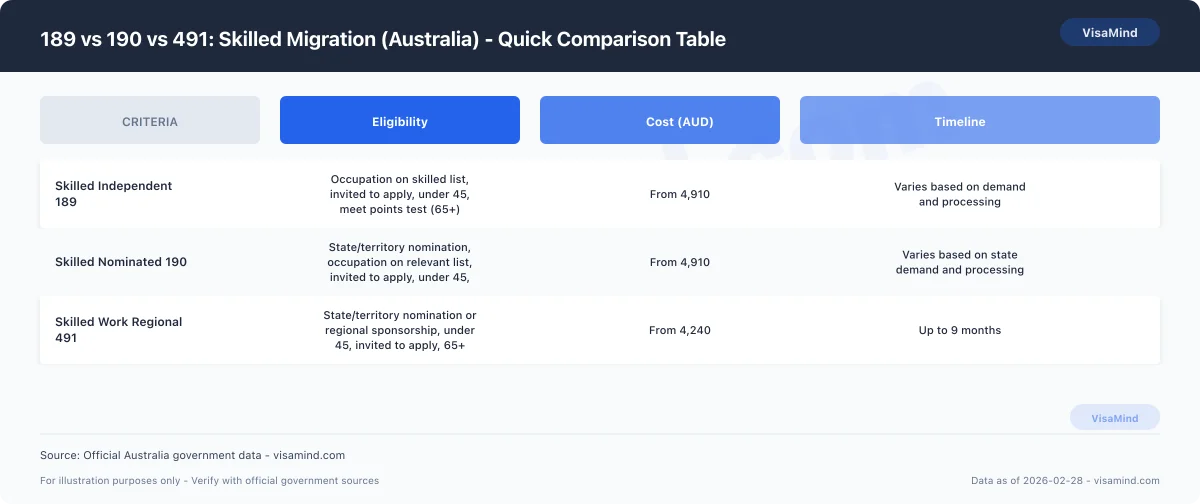
Understanding the differences between the Skilled Independent Visa (subclass 189), Skilled Nominated Visa (subclass 190), and Skilled Work Regional (Provisional) Visa (subclass 491) is critical. Below is a side-by-side comparison of these visa options across key dimensions:
| Visa Type | Eligibility Requirements | Cost | Processing Timeline | Employer Requirements | Path to Permanent Residency |
|---|---|---|---|---|---|
| Skilled Independent Visa (subclass 189) | - Must have an occupation on the relevant skilled list<br>- Suitable skills assessment<br>- Invitation to apply<br>- Under 45 years<br>- Competent English | From AUD 4,910 | Approximately 8 months as of 2023, verify on the official website | No employer sponsorship required | Direct path to permanent residency |
| Skilled Nominated Visa (subclass 190) | - Must be nominated by a state or territory<br>- Occupation on the relevant list<br>- Invitation to apply<br>- Under 45 years<br>- Competent English | From AUD 4,045 | Approximately 7 months as of 2023, verify on the official website | Requires state or territory nomination | Direct path to permanent residency |
| Skilled Work Regional (Provisional) Visa (subclass 491) | - Nomination by a state or sponsorship by an eligible relative<br>- Occupation on the relevant list<br>- Invitation to apply<br>- Under 45 years<br>- Competent English | From AUD 4,240 | Approximately 10 months as of 2023, verify on the official website | Requires regional nomination or sponsorship | May lead to permanent residency via subclass 191 after specific conditions |
Key Considerations
Eligibility
For all three visa types, you must meet several common criteria. This includes having an occupation on the relevant skilled occupation list, a suitable skills assessment, and meeting the English language requirements. You must also be invited to apply and be under 45 at the time of invitation.
Cost and Processing Timeline
While the Skilled Independent Visa (subclass 189) generally has the highest application fee, it offers the advantage of not requiring state nomination, unlike the Skilled Nominated Visa (subclass 190) and Skilled Work Regional (Provisional) Visa (subclass 491). Processing times can vary, so it’s important to check the Processing Times Guide for the most current estimates.
Path to Permanent Residency
Both the Skilled Independent (subclass 189) and Skilled Nominated (subclass 190) visas offer direct paths to permanent residency. For the Skilled Work Regional (Provisional) Visa (subclass 491), you must meet certain conditions before applying for permanent residency, typically through the Skilled Regional Visa (subclass 191).
Tip: To maximize your chances of receiving an invitation, ensure your Expression of Interest (EOI) is accurate and up-to-date. You can check your application status using the SkillSelect Expression of Interest system.
Understanding these distinctions can help you decide which visa aligns best with your personal circumstances and long-term goals in Australia.
When to Pick the First Option
#-
"As a skilled professional with a background in software engineering, I was unsure if the Skilled Independent Visa (subclass 189) was the right choice for me due to the competitive nature of the points test. My main concern was whether I could achieve the required score of 65 points or more. I focused on enhancing my English proficiency, as I knew that scoring higher on the language test could boost my points. I also ensured my skills assessment was up-to-date and relevant to the occupation list. After receiving an invitation to apply, I was thrilled to learn that my meticulous preparation paid off. I was able to lodge my application confidently, knowing I met all the necessary criteria."
-
"Living in New Zealand for several years, I developed a strong commitment to Australia and aimed to transition permanently. I was particularly anxious about proving my contribution and commitment to Australia, as required for the Skilled Independent Visa (subclass 189) New Zealand stream. To address this, I gathered evidence of my employment and community involvement in Australia, emphasizing my professional achievements and social contributions. This thorough documentation helped convey my dedication. When my visa was granted, it validated my efforts and allowed me to continue my professional journey permanently in Australia."
-
"As a Hong Kong passport holder, I was eager to apply for the Skilled Independent Visa (subclass 189) Hong Kong stream, but worried about meeting the specific visa and residence requirements. To ensure I was prepared, I thoroughly researched the requirements and double-checked that all my documents were in order, including proof of residence and my skills assessment. Additionally, I paid close attention to the deadlines for applying after receiving an invitation, as missing these could jeopardize my chances. This careful preparation resulted in a successful application, allowing me to secure permanent residency in Australia."
Choose Option B If...
#Important: If you're considering the Skilled Nominated Visa (subclass 190), be aware that a nomination from a state or territory government is a key requirement. Ensure you understand the specific criteria of the region you are interested in before proceeding with your application.
Choosing the Skilled Nominated Visa (Subclass 190) If...
- I Wanted to Live in a Specific State or Territory
- I had always dreamed of living in Victoria due to its vibrant culture and job opportunities in my field. I discovered that the Skilled Nominated Visa (subclass 190) required a state nomination, which aligned perfectly with my plans. I researched Victoria's specific nomination criteria, tailoring my application to meet their requirements. By focusing on demonstrating how my skills matched their needs, I successfully secured a nomination. This not only increased my chances of receiving an invitation to apply but also provided the added benefit of having a pathway to permanent residency.
When Points Boost is Needed
- I Needed to Increase My Points Score
- Initially, I was concerned because my points score was on the lower end of the competitive range for skilled migration. However, I learned that obtaining a state nomination through the 190 Visa could add an additional 5 points to my overall score. This was a significant boost, bringing me above the threshold required for a stronger application. I focused on compiling a comprehensive skills assessment and fulfilling the English language requirements to enhance my profile further. By strategically leveraging the nomination points, I successfully improved my chances and ultimately received an invitation to apply.
Tied to a Specific Occupation List
- My Occupation Was Only on the State List
- My occupation as an environmental engineer was not listed on the national skilled occupation list, but it was in high demand on Queensland's state list. This initially worried me, as I feared my options might be limited. I chose to apply for the 190 Visa, which allowed me to target Queensland specifically. By aligning my application with their regional needs and demonstrating my commitment to settling there, I was able to secure a nomination. This not only met my professional goals but also enabled me to contribute to an area actively seeking my expertise.
Tip: Always check the latest occupation lists and nomination criteria for the specific state or territory you're interested in. These can change and may impact your eligibility significantly.
Key Differences Explained
#The Skilled Migration visas, namely the Skilled Independent Visa (subclass 189), Skilled Nominated Visa (subclass 190), and Skilled Work Regional (Provisional) Visa (subclass 491), each offer distinct pathways for skilled workers to live and work in Australia. Understanding the key differences between these visas can help you determine which might be most suitable for your situation.
Invitation and Sponsorship Requirements
One of the most significant differences between these visas is related to invitation and sponsorship:
-
Skilled Independent Visa (subclass 189): This visa does not require sponsorship by a state, territory, or family member. However, you must receive an invitation to apply through the SkillSelect system. This makes it a highly competitive option as it relies solely on your personal attributes and ability to score high on the points test.
-
Skilled Nominated Visa (subclass 190): In contrast, the subclass 190 visa requires nomination by a state or territory government. This means applicants must meet both the federal requirements and those specific to the nominating state or territory. This can be beneficial if your occupation is in demand in a particular region.
-
Skilled Work Regional (Provisional) Visa (subclass 491): This visa allows for sponsorship by either a state or territory or an eligible relative living in a designated regional area. It's designed to encourage skilled workers to settle in regional areas, offering a pathway to permanent residency.
Residency and Work Conditions
Another key difference is the residency and work conditions imposed by these visas:
-
189 Visa: Offers the most flexibility, allowing you to live and work anywhere in Australia with permanent residency status.
-
190 Visa: While it also grants permanent residency, you are expected to live and work in the nominating state or territory for a designated period, typically two years, to fulfill any obligations of your nomination.
-
491 Visa: This is a provisional visa, requiring you to live and work in a designated regional area for at least three years before you can be eligible to apply for a permanent visa, such as the Skilled Regional Visa (subclass 191).
| Visa Type | Sponsorship Required | Residency Requirement | Pathway to PR |
|---|---|---|---|
| 189 | No | None | Immediate |
| 190 | Yes (State/Territory) | Nominate state/territory | Immediate |
| 491 | Yes (State/Territory or Relative) | Regional area | After 3 years |
Points and Eligibility Criteria
All three visas require a minimum of 65 points on the points test, yet how you achieve these points may vary:
-
189 Visa: Points are solely based on individual criteria such as age, English language ability, and work experience. There is no additional state or territory influence.
-
190 Visa: You may receive additional points through the nomination by a state or territory, enhancing your total score.
-
491 Visa: Similar to the 190 visa, this visa offers additional points if nominated by a state, territory, or sponsored by a relative, which can be crucial in meeting the points threshold.
Important: Ensure that your occupation is on the relevant skilled list for the visa you apply for. This is a fundamental eligibility requirement for all three visas.
By understanding these key differences, you can better align your application strategy with your long-term goals of living and working in Australia. For further assistance on visa processes, consider checking the Documents Checklist to ensure you have all necessary paperwork ready for your application.
What People Get Wrong
#Understanding the differences between the Skilled Independent Visa (subclass 189), Skilled Nominated Visa (subclass 190), and Skilled Work Regional (Provisional) Visa (subclass 491) is crucial for applicants. Each visa caters to different circumstances and requirements, and misconceptions can lead to errors or delays in the application process. Let's clarify some common misunderstandings:
General Misconceptions
-
Invitation Requirement: Many applicants assume they can apply directly for any of these skilled visas without an invitation. In reality, you must submit an Expression of Interest (EOI) through SkillSelect and receive an invitation to apply.
-
Points Test: It's a common belief that meeting the minimum 65 points guarantees an invitation. However, higher scores are often needed due to competition. It's wise to aim for as high a score as possible to increase your chances.
Visa-Specific Misconceptions
-
Subclass 189: Some believe this visa requires a sponsor. However, the Skilled Independent Visa (subclass 189) does not require a sponsor or nominator, making it appealing for those wishing to live anywhere in Australia. This visa is available to invited workers, eligible New Zealand citizens, and eligible Hong Kong or British National (Overseas) passport holders.
-
Subclass 190: There is confusion about the need for state or territory nomination. Unlike the 189, the Skilled Nominated Visa (subclass 190) requires nomination by a state or territory government, which also involves additional criteria set by the nominating body.
-
Subclass 491: Many applicants do not realize that this is a provisional visa, not permanent residency. The Skilled Work Regional (Provisional) Visa (subclass 491) is designed for skilled workers who want to live and work in regional Australia and requires either state or territory nomination or family sponsorship.
Application Process Misconceptions
- Document Submission: Some applicants incorrectly assume that all supporting documents can be submitted after lodging the application. However, gathering all necessary documents beforehand is crucial to avoid processing delays or refusals.
Important: Submitting an incomplete application or failing to attach all required documents can significantly delay the processing of your visa application. Make sure to check the Documents Checklist to ensure all necessary paperwork is in order.
By understanding these nuances and preparing accordingly, you can improve your chances of a successful application. For more detailed procedural guidance, you might find the How To Apply guide useful.
Can You Switch Later?
#Switching between the various skilled migration visas in Australia can be a complex process, but it is possible under certain circumstances. Whether you wish to transition from a provisional to a permanent visa, or switch between different types of skilled visas, understanding the requirements and processes involved is crucial.
Transitioning from the Subclass 491 to a Permanent Visa
The Skilled Work Regional (Provisional) Visa (subclass 491) allows you to live and work in designated regional areas of Australia for up to five years. After meeting specific requirements, you may be eligible to apply for the Skilled Regional Visa (subclass 191), which offers permanent residency. Key requirements include:
- Living and working in a regional area for at least three years.
- Earning a minimum taxable income each year (as of 2026, the minimum income threshold is AUD 53,900, but verify on the official website).
- Meeting health and character requirements.
Tip: Keep thorough records of your residence and work in regional areas, as this will be crucial when applying for the subclass 191.
Switching from Subclass 190 to Subclass 189
If you hold a Skilled Nominated Visa (subclass 190) and wish to switch to the Skilled Independent Visa (subclass 189), it is generally not a straightforward process. The subclass 189 does not require a state or territory nomination, which can offer more freedom in terms of where you live and work in Australia. Switching would typically require you to:
- Submit a new Expression of Interest (EOI) through SkillSelect.
- Receive an invitation to apply for the subclass 189.
- Satisfy all the requirements of the subclass 189, including the points test and skills assessment.
Considerations for Switching Visas
- Points Test: Ensure you continue to meet the points test criteria for the visa you wish to switch to. Your points can change over time due to factors such as age and work experience.
- Skills Assessment: Maintain a valid skills assessment for your occupation. It must be obtained within three years before your invitation to apply for the new visa.
- State/Territory Nomination: If you switch from a subclass 190 or 491, be aware of the implications on your state or territory nomination obligations.
Important: Switching visas often requires starting a new application process. Ensure you meet all eligibility criteria and gather necessary documents before proceeding.
For more guidance on specific processes, refer to our How To Apply and Documents Checklist guides. These resources can provide detailed information tailored to your visa application journey.
Who Chose What and Why
#I was initially overwhelmed by the options available under the Skilled Migration program. My occupation was listed on the eligible skilled occupation list, and I had a strong skills assessment, but the decision between the Skilled Independent Visa (subclass 189), the Skilled Nominated Visa (subclass 190), and the Skilled Work Regional Visa (subclass 491) was daunting. I worried about choosing a visa that best aligned with my career goals and personal circumstances. To address this, I carefully analyzed each visa type, considering factors such as the necessity of state nomination for the 190 visa, and the regional work requirement for the 491 visa. After careful consideration, I decided on the 189 visa due to its flexibility in allowing me to live and work anywhere in Australia. My preparation paid off, and I received the invitation to apply, which felt like a significant step forward in my journey toward permanent residence.
Another applicant, Alex, faced a different set of challenges. Interested in the Skilled Work Regional Visa (subclass 491), they were concerned about the requirement to live and work in a designated regional area. Alex had family in Sydney, and the thought of living away from them was difficult. However, after researching the benefits, such as additional points for regional nomination, Alex decided the potential long-term advantages outweighed the temporary inconvenience. Alex took the proactive approach of contacting several regional employers and eventually secured a job offer in a thriving community that matched their profession. This preparation ensured not only the successful submission of their visa application but also a smooth transition to their new life in regional Australia.
Meanwhile, Priya was tempted by the Skilled Nominated Visa (subclass 190) because of the stability that a state nomination promised. Her main concern was meeting the specific requirements of her chosen state. Priya's preparation involved thoroughly researching the nomination criteria of several states and territories, and she tailored her expression of interest to align with those requirements. Her meticulous approach resulted in a nomination from a state that not only matched her professional skills but also offered a vibrant community where she could thrive personally and professionally.
FAQs
What are the application fees for the 189 vs 190 vs 491: Skilled Migration (Australia) at Home Affairs?
Is it possible to switch between 189 vs 190 vs 491: Skilled Migration (Australia) after applying?
How do I get invited to apply for 189 vs 190 vs 491: Skilled Migration (Australia)?
What is the difference between 189 vs 190 vs 491: Skilled Migration (Australia) in terms of nomination?
What are the common pitfalls when applying for 189 vs 190 vs 491: Skilled Migration (Australia)?
Can I include family members in my 189 vs 190 vs 491: Skilled Migration (Australia) application?
What is the processing time for 189 vs 190 vs 491: Skilled Migration (Australia) by Home Affairs?
VisaMind provides informational guidance only and is not a government agency. This is not legal advice. Requirements can change and eligibility depends on your specific facts. If your case is complex or high-stakes, consult a licensed immigration attorney.
Next steps
Requirements vary by nationality, purpose, timeline, and case details. Use Find My Visa to get a personalized checklist for Australia with official sources and deadlines.
Find my visa