On this page
- The Appeal of Moving Here
- Bringing Your Family
- Routes for Skilled Workers
- The Permanent Residence Process
- The Path to Citizenship
- Common Challenges
- Investment and Business
- Retirement Pathways
- Cost and Financial Requirements
- Real Scenarios
- Visa options for this goal
- Guides for Australia
- Other goals for Australia
The Appeal of Moving Here
#Australia is home to more than 25 million people and is a highly sought-after destination for skilled migrants, families, investors, and retirees. With a diverse and vibrant culture, a robust economy, and a high standard of living, Australia is an attractive option for those looking to relocate. The Department of Home Affairs is responsible for managing Australia's immigration system, offering a variety of pathways for different types of applicants.
Skilled Migration
Australia's demand for skilled workers continues to grow, particularly in industries such as healthcare, engineering, and information technology. The Skilled Independent Visa (subclass 189) is a popular option for individuals who possess skills that are in demand and wish to live and work in Australia permanently without requiring a sponsor. Alternatively, the Employer Nomination Scheme (subclass 186) allows Australian employers to sponsor skilled workers for permanent residence. For those interested in regional opportunities, the Skilled Work Regional (subclass 491) visa offers a pathway to live and work in designated regional areas.
Tip: Use the SkillSelect Expression of Interest to express your interest in a skilled visa and potentially receive an invitation to apply.
Family and Partner Visas
Family reunification is a significant part of Australia's immigration policy. If you have a spouse or partner who is an Australian citizen or permanent resident, the Partner Visa (subclasses 820/801) allows you to live in Australia. For parents wanting to join their children, the Parent Visa (subclass 103) provides a pathway for permanent residency, provided that you meet the balance of family test and are sponsored by an eligible child or relative.
Investment and Business Opportunities
Australia encourages investment and business ventures through visas such as the Business Innovation and Investment Visa (subclass 188). This visa offers provisional residency for investors and business owners who wish to contribute to the Australian economy. Successful applicants may eventually apply for permanent residency via the Business Innovation and Investment (Permanent) Visa (subclass 888).
Retirement Pathways
For retirees, Australia offers specific pathways, though they require careful planning and adherence to visa conditions. As a retiree, you might have held a specific retirement visa before 8 May 2018, such as the Investor Retirement (subclass 405). It is important to ensure you maintain adequate health insurance and meet the financial requirements to qualify for any retirement-based migration options.
Australia's immigration system offers diverse pathways tailored to meet the needs of various applicants. Whether you are a skilled worker, looking to reunite with family, interested in business opportunities, or planning your retirement, understanding the specific requirements and pathways is crucial to making your move successful. To further explore your options, visit the Department of Home Affairs website or consult with a registered migration agent.
Bringing Your Family
#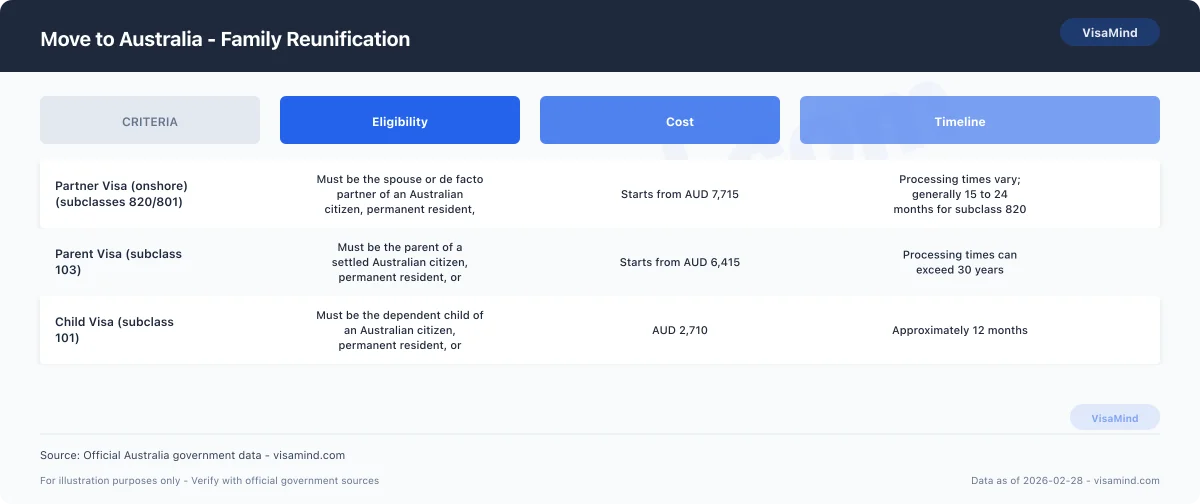
Bringing your family to Australia is an important step for many who are considering making Australia their new home. The Department of Home Affairs offers various visa options to facilitate this process, ensuring that you and your loved ones can reunite and start your life together in Australia. Below is a comparison of the main visa pathways for family reunification:
| Visa Type | Eligibility | Cost (AUD) | Timeline |
|---|---|---|---|
| Partner Visa (subclasses 820/801) | Must be the spouse or de facto partner of an Australian citizen, permanent resident, or eligible New Zealand citizen. | From $7,850 | 12 to 24 months |
| Parent Visa (subclass 103) | Must have an eligible child who is a settled Australian citizen, permanent resident, or eligible New Zealand citizen. | From $6,415 | Up to 30 years |
| Child Visa (subclass 101) | Must be a dependent child of an Australian citizen, permanent resident, or eligible New Zealand citizen. | From $2,710 | 8 to 12 months |
| Contributory Parent Visa (subclass 143) | Must meet the balance of family test and have an eligible sponsor. | From $47,825 | 2 to 4 years |
What Are the Key Requirements for Family Visas?
Each visa type has specific requirements, but there are common elements across these pathways:
- Sponsorship: You need an eligible sponsor, ordinarily an Australian citizen, permanent resident, or eligible New Zealand citizen.
- Proof of Relationship: Documents such as marriage certificates, birth certificates, and evidence of cohabitation or dependency are necessary.
- Health and Character: You and your family members must meet health and character requirements. This often involves medical examinations and police checks.
- Assurance of Support: For certain visas like the Parent Visa, an assurance of support may be required to ensure you don't rely on government assistance.
How Does the Process Work?
- Check Eligibility: Ensure you meet the eligibility criteria for the specific visa type.
- Gather Documents: Collect all required documents, including proof of identity and relationship, sponsor documents, and any health or character evidence.
- Lodge Application: Applications can be lodged online through the Immi Account, where you can also pay the required fees.
- Await Decision: Processing times vary significantly depending on the visa type; you may need to wait from several months to several years.
Tip: To avoid delays, ensure all information is accurate and all documents are certified copies. Missing documents can lead to application refusal.
Are There Any Pitfalls to Avoid?
- Incomplete Documentation: Failing to include all necessary documents is a common reason for application delays or refusal.
- Balance of Family Test: For parent visas, failing to meet the balance of family test can result in ineligibility.
- Sponsored Parent Visa Conflict: You cannot apply if you hold or have applied for a Sponsored Parent (Temporary) Visa (subclass 870).
For more guidance on family visa applications, you can explore the Parent Visa situation page or consult the Documents Checklist to ensure you have everything in order before applying.
Routes for Skilled Workers
#Australia offers several routes for skilled workers to obtain permanent residency, each with unique eligibility criteria and processes. Here, we compare three popular pathways: the Skilled Independent Visa (subclass 189), the Skilled Nominated Visa (subclass 190), and the Employer Nomination Scheme (subclass 186).
| Visa Type | Eligibility | Cost | Timeline |
|---|---|---|---|
| Skilled Independent Visa (subclass 189) | Points-based system, no sponsorship required, must be invited to apply via SkillSelect | AUD 4,240 as of 2023 | Processing times vary; generally 6-11 months |
| Skilled Nominated Visa (subclass 190) | Points-based, requires nomination by an Australian state or territory government | AUD 4,240 as of 2023 | Processing typically takes 6-11 months |
| Employer Nomination Scheme (subclass 186) | Requires employer sponsorship, includes three streams: Direct Entry, Labour Agreement, and Temporary Residence Transition | AUD 4,240 as of 2023 | 5-10 months, depending on the stream |
Points-Based Routes
The Skilled Independent Visa (subclass 189) and Skilled Nominated Visa (subclass 190) are both part of the General Skilled Migration program. These visas use a points-based system to evaluate applicants based on factors such as age, English language proficiency, and work experience.
-
Skilled Independent Visa (subclass 189): This visa does not require sponsorship or nomination, giving you the flexibility to live and work anywhere in Australia. You must first submit an Expression of Interest (EOI) through the SkillSelect portal and be invited to apply.
-
Skilled Nominated Visa (subclass 190): This option requires nomination by a state or territory government. Each region has its own list of occupations and eligibility criteria, which you can find on their respective websites. Nomination often provides additional points towards your application, potentially increasing your chances of receiving an invitation.
Tip: Consider the 189 Vs 190 Vs 491 guide for a detailed comparison of these visas.
Employer-Sponsored Route
The Employer Nomination Scheme (subclass 186) is designed for skilled workers who are sponsored by an Australian employer. This visa provides a pathway to permanent residency and includes three streams:
- Direct Entry Stream: Suitable for workers who have never, or only briefly, worked in Australia.
- Labour Agreement Stream: For those nominated under a labour agreement.
- Temporary Residence Transition Stream: For current holders of a Temporary Skill Shortage (subclass 482) visa.
Each stream requires a valid job offer and specific qualifications or experience related to the nominated position.
Key Considerations
-
Eligibility: Ensure you meet all criteria before applying, including health and character requirements. Each visa type has specific eligibility factors, so review them carefully.
-
Costs and Processing Times: The cost for each visa is AUD 4,240 as of 2023. Processing times can vary significantly, so consult the Processing Times guide for the most current estimates.
Important: Always verify costs and timelines on the official Department of Home Affairs website to ensure you have the most up-to-date information.
For those seeking to move to Australia as a skilled worker, understanding these visa routes is crucial to navigating the immigration process effectively.
The Permanent Residence Process
#Determining Eligibility for Permanent Residence
To apply for permanent residence (PR) in Australia, you must meet specific eligibility criteria. Essential requirements include being a permanent resident or a New Zealand citizen holding a Special Category (subclass 444) visa at the time of application and decision. You must also meet residency requirements, having lived in Australia on a valid visa for four years immediately before applying, with at least 12 months as a permanent resident. Additionally, ensure you have not been absent from Australia for more than 12 months in total during the four years, with no more than 90 days in the 12 months immediately before applying.
Gathering Required Documentation
Before lodging your application, gather all necessary documentation to support your eligibility. This includes:
- Valid passports for all applicants.
- Proof of identity, such as a national identity card.
- Sponsorship documents, if required.
- Proof of permanent residency or Special Category visa status.
- Police certificates to meet character requirements.
- Health insurance coverage, especially if applying as a retiree.
- Evidence of residence in Australia for required periods.
Important: Not providing accurate or complete documentation may lead to application refusal. Ensure all documents are certified copies, not originals.
Lodging Your Application
Applications for permanent residence are lodged through the Department of Home Affairs. You can do this via your Immi Account, where you apply and pay online. Make sure to create or log into your existing Immi Account and import your application using your application ID and relevant personal information. Once your application is lodged, you will receive a receipt number.
Tip: Apply online to avoid mail delays and to receive immediate confirmation of your application.
Meeting Conditions and Timelines
After lodging your application, you need to fulfil certain conditions while awaiting a decision. You must maintain your residence in Australia and continue to meet health and character requirements. The processing time for PR applications varies, so check the Processing Times guide for the most current estimates.
For a seamless path to permanent residency, consider exploring additional pathways such as the Skilled Independent Visa (subclass 189) or the Partner Visa (onshore) (subclasses 820/801) if applicable to your situation.
The Path to Citizenship
#Australia offers a path to citizenship that allows you to fully integrate into the community and enjoy the rights and responsibilities of being an Australian citizen. Here's what you need to know about the path to citizenship, including the years required, tests, and rules on dual citizenship.
How Long Does It Take to Become a Citizen?
To apply for Australian citizenship, you must meet the general residence requirement. This involves living in Australia on a valid visa for four years immediately before applying. During the last 12 months of this period, you must hold a permanent visa or a Special Category (subclass 444) visa (SCV). Additionally, you should not have been absent from Australia for more than 12 months in total in the past four years, including no more than 90 days in the 12 months immediately before applying.
What Tests Are Involved?
Part of the citizenship application process includes understanding Australian values and the privileges and responsibilities of citizenship:
-
Citizenship Test: If you are 18 years or older, you must pass a citizenship test. This test assesses your knowledge of Australia and your understanding of the responsibilities and privileges of citizenship.
-
Interview: In some cases, attending an interview may be necessary to assess your eligibility and understanding of what it means to be an Australian citizen.
Tip: Prepare for the citizenship test by studying the "Australian Citizenship: Our Common Bond" booklet, which contains all the information you need.
Can You Hold Dual Citizenship?
Australia permits dual citizenship, allowing you to retain your original citizenship while becoming an Australian citizen. However, it's crucial to check whether your country of origin permits dual citizenship, as some countries may require you to renounce your previous citizenship upon acquiring a new one.
Steps to Citizenship
- Ensure Eligibility: Verify that you meet all the residence and character requirements.
- Gather Documents: Collect all necessary documents, such as proof of residency and identity.
- Lodge Application: Apply for citizenship through the Australian Citizenship page.
- Attend Test/Interview: Complete the citizenship test and attend any required interviews.
- Participate in Ceremony: After approval, attend a citizenship ceremony to officially become an Australian citizen.
For a detailed guide on the application steps, check out the How To Apply guide. Remember, the path to citizenship is a significant step towards becoming a part of the Australian community and embracing the shared values and responsibilities.
Common Challenges
#One common challenge is the processing time. Depending on the type of visa you apply for, processing times can vary significantly. For instance, the Parent Visa (subclass 103) can take several years due to high demand and limited places. On the other hand, more straightforward visas like the Visitor Visa (subclass 600) might be processed more quickly.
Important: Check the Processing Times guide regularly, as times can change based on application volumes and other factors.
Financial Requirements
Meeting financial requirements is crucial for a successful application. You may need to demonstrate that you have enough funds to support yourself and any dependents during your stay. This is particularly important for visas such as the Business Innovation and Investment visa (subclass 188), where significant financial commitments are expected.
- Ensure you have documented proof of your financial status, such as bank statements or evidence of income.
- Be prepared to show that you meet the financial thresholds specified for your visa type.
To understand more about the specific financial expectations, consider reviewing the Financial Requirements guide.
Language Tests
For many visas, demonstrating proficiency in English is a key requirement. You might need to take an approved language test such as the IELTS or PTE Academic. This requirement is often applicable for skilled visas like the Skilled Independent Visa (subclass 189), where a certain level of competency in English is necessary to accrue points.
- Check which tests are accepted by the Department of Home Affairs and ensure your scores meet the required levels.
- Prepare ahead for these tests, as obtaining the desired scores may take time and practice.
Tip: Begin preparing for language tests early to ensure you meet the required proficiency levels by the time you lodge your application.
Investment and Business
#Australia offers several pathways for investors and business owners seeking to migrate, each with specific criteria and benefits. These visas typically cater to individuals willing to invest significantly in the Australian economy or those who wish to establish and operate a business within the country.
Investor Visa Options
One of the key visa categories is the Business Innovation and Investment (subclass 188) visa, which is designed to attract successful business people and investors. This visa requires applicants to demonstrate a successful business or investment track record and meet the minimum investment amounts, which vary based on the chosen stream.
Streams under the Business Innovation and Investment (subclass 188) Visa:
- Business Innovation Stream: For individuals who want to own and manage a new or existing business in Australia.
- Investor Stream: Requires a minimum investment of AUD 1.5 million in an Australian state or territory.
- Significant Investor Stream: Involves an investment of at least AUD 5 million in complying investments in Australia.
- Premium Investor Stream: By invitation only, requiring an investment of at least AUD 15 million.
Each stream has its specific requirements and benefits, and applicants should carefully assess which stream aligns best with their investment capacity and business goals.
Business Visas for Entrepreneurs
For those interested in starting or developing a business, the Business Innovation and Investment (Permanent) (subclass 888) visa offers a pathway to permanent residence. To qualify, you must hold a provisional subclass 188 visa and meet the business or investment criteria. This visa allows you to continue business operations and investments in Australia indefinitely.
Tips for Successful Applications
Tip: Consult the Business Innovation 888 page to understand the transition from a provisional to a permanent visa.
When preparing your application, ensure that all documentation is complete and accurately reflects your business or investment history. This includes financial records, proof of business ownership, or investment management experience.
Common Pitfalls to Avoid
- Incomplete Documentation: Double-check that all required documents are submitted, including certified copies of business records and financial statements.
- Inadequate Investment: Verify that your investment meets the specific threshold for the chosen visa stream.
- Failure to Demonstrate Genuine Intent: Clearly articulate your business plan or investment strategy in Australia.
By understanding these visa options and preparing thoroughly, you can effectively navigate the pathways available for investors and business owners looking to contribute to Australia's dynamic economy. For more information, consider exploring the Business Investment situation page.
Retirement Pathways
#Australia offers several pathways for retirees seeking to enjoy their golden years amidst its sunny shores. The Retirement Pathways primarily revolve around the Investor Retirement (subclass 405) visa and the Retirement (subclass 410) visa. However, it's important to note that these visas are not available for new applicants but continue to accommodate existing holders.
Eligibility for Retirees
If you held either the Investor Retirement (subclass 405) or Retirement (subclass 410) visa as of 8 May 2018 and have not held any other substantive visa since, you may continue to renew your visa. This ensures you can remain in Australia under the same conditions as before. As a retiree, you must maintain adequate health insurance and an assurance of support to guarantee that you will not rely on government assistance.
Assurance of Support
An assurance of support is a legal commitment made by a sponsor, often a family member, to financially support the retiree. This is crucial as it assures the Australian government that you will not become a financial burden on the country's welfare system. If your child is an eligible sponsor, they must demonstrate their ability to meet this requirement.
Important: Ensure your health insurance remains valid throughout your stay, as inadequate coverage can lead to complications with your visa status.
Transition to Permanent Residency
While the existing retirement visas do not directly lead to permanent residency, retirees may explore other available pathways. For instance, if you have children who are Australian citizens or permanent residents, you might consider options like the Parent Visa (subclass 103) or the Contributory Parent Visa (subclass 143).
Linking to Other Options
Retirees interested in potentially shifting from a retirement visa to a more permanent status might benefit from exploring the Australian Citizenship pathway if they meet the criteria. Additionally, understanding the balance of family test is crucial, as it impacts eligibility for parent-related visas.
Navigating the retirement pathway in Australia requires careful consideration of your current visa status, financial capabilities, and long-term plans. Remaining informed about potential transitions to other visas will help ensure a smooth and enjoyable retirement in Australia.
Cost and Financial Requirements
#Important: Ensure you have the necessary funds for your intended visa category before applying. Failing to meet financial requirements can result in application refusal.
When planning your move to Australia, understanding the financial aspects of the visa process is crucial. Below is a comparison of some key financial requirements associated with various Australian visas. These include settlement funds, income thresholds, and investment amounts necessary for eligibility.
Financial Comparison of Visa Types
| Visa Type | Settlement Funds | Minimum Income Threshold/Investment Amount | Notes |
|---|---|---|---|
| Partner Visa (subclasses 820/801) | Not required | Assurance of support may be needed | You may need a sponsor to provide financial assurance. |
| Parent Visa (subclass 103) | Evidence of support | Assurance of support required | An eligible sponsor, usually a child, must provide financial support. |
| Skilled Independent Visa (subclass 189) | Not specified | Not specified | Points-based visa, no specific financial thresholds but evidence of employability beneficial. |
| Business Innovation and Investment Visa (subclass 188) | AUD $1.5 million investment for Investor stream | Varies by stream | Different streams have varying investment and business turnover requirements. |
Key Financial Requirements
-
Settlement Funds: Some visas, like the Parent Visa (subclass 103), require evidence that sponsors can financially support the applicant. This ensures that new arrivals do not rely on government assistance.
-
Income Thresholds and Investments: For business and investor visas, specific financial commitments are necessary. For instance, the Business Innovation and Investment Visa (subclass 188) requires substantial investment or business turnover, depending on the stream.
-
Assurance of Support: This is a pledge from a sponsor to provide financial support for certain visa types, such as the Parent Visa (subclass 103). This assurance is a legal commitment to repay the government for any welfare payments made to the visa holder.
Tip: Review the Financial Requirements guide to understand the specifics of financial commitments for different visas.
Meeting financial requirements is an essential step in the visa application process. It is advisable to check the latest financial criteria on the official Department of Home Affairs website to ensure compliance with current regulations.
Real Scenarios
#I was anxious about meeting the balance of family test for my Parent Visa application. As someone with children spread across different countries, I was concerned that not having the majority of my children in Australia might disqualify me. To address this, I meticulously gathered documentation showing my children's residency status, including proof of Australian residency for those living there. I also included letters from my children explaining their circumstances and connections to Australia. This thorough preparation reassured me that I had a strong case. Ultimately, my application was successful because I demonstrated that more than half of my children were indeed settled in Australia.
Facing the citizenship test was another concern for me. While I had lived in Australia for several years, I was worried that the nuances of the country's history and government might trip me up. To prepare, I invested time in reviewing the official Australian Citizenship: Our Common Bond resource, which is provided by the Department of Home Affairs. I also joined a local study group, where we quizzed each other on potential test questions. This community support and consistent practice helped build my confidence. On the day of the test, I was able to pass comfortably, and I believe it was due to the comprehensive preparation and understanding of what it truly means to be an Australian citizen.
FAQs
What is the balance of family test for Parent Visas in the Move to Australia process?
How can I add a spouse to my application during the Move to Australia process?
What are the residence requirements for Australian Citizenship under the Move to Australia program?
Can I apply for citizenship when living outside Australia due to work commitments?
What are the application fees for the Partner Visa (subclasses 820/801) during the Move to Australia?
How can skilled workers bring their family when moving to Australia?
What steps should I follow to ensure my citizenship application is processed smoothly by Home Affairs?
VisaMind provides informational guidance only and is not a government agency. This is not legal advice. Requirements can change and eligibility depends on your specific facts. If your case is complex or high-stakes, consult a licensed immigration attorney.
Next steps
Requirements vary by nationality, purpose, timeline, and case details. Use Find My Visa to get a personalized checklist for Australia with official sources and deadlines.
Find my visa