Official sources referenced
Overview of Financial Requirements
#Australia's approach to assessing financial requirements for visa applications is a critical component of the immigration process. The Department of Home Affairs mandates that applicants for various types of visas demonstrate sufficient financial capacity to support their stay in the country. This ensures that individuals do not become a financial burden on Australia's resources during their visit or extended stay.
Understanding Financial Proof
At the core of financial requirements is the need for applicants to provide evidence of funds that are deemed adequate by the Department of Home Affairs. This typically includes bank statements, payslips, or other verifiable financial documents. The specific amount and type of documentation required can vary significantly based on the visa category and the applicant's circumstances.
For instance, a Student Visa (subclass 500) applicant must demonstrate the ability to cover tuition fees, living expenses, and travel costs. In contrast, a Skilled Independent Visa (subclass 189) applicant might need to show funds to support themselves until they secure employment in Australia.
Demonstrating Financial Sufficiency
The process of demonstrating financial sufficiency involves more than just showing a balance in a bank account. Applicants must ensure their financial documents are up-to-date and reflect the reality of their financial situation. It's crucial to understand that the Department of Home Affairs evaluates these documents to assess the applicant's financial stability and reliability.
Tip: Keep your financial documents organized and ready for submission. Ensure they are in English or accompanied by a certified translation.
Common Financial Criteria Across Visas
While financial requirements vary by visa type, some common criteria are typically considered:
- Bank Statements: Applicants may need to provide statements from the past three to six months, showing regular income and a stable balance.
- Payslips: Regular payslips from employment can help demonstrate consistent income.
- Sponsorship Documents: For certain visas, a sponsor might need to provide evidence of their financial capacity to support the applicant.
Key Considerations
Applicants should be aware that meeting the minimum financial requirements is essential, but not the only factor in the visa decision. The Department of Home Affairs assesses each application holistically, considering various aspects such as the applicant's ties to their home country, the purpose of their visit, and their overall credibility.
Important: Ensure that all financial documents are genuine and accurately reflect your financial situation. Misrepresentation can lead to visa refusal or bans.
Understanding these financial requirements is a foundational step for anyone looking to apply for an Australian visa. It is recommended to regularly check the official Department of Home Affairs website for the most up-to-date information regarding financial criteria for specific visas.
Proof of Funds by Visa Type
#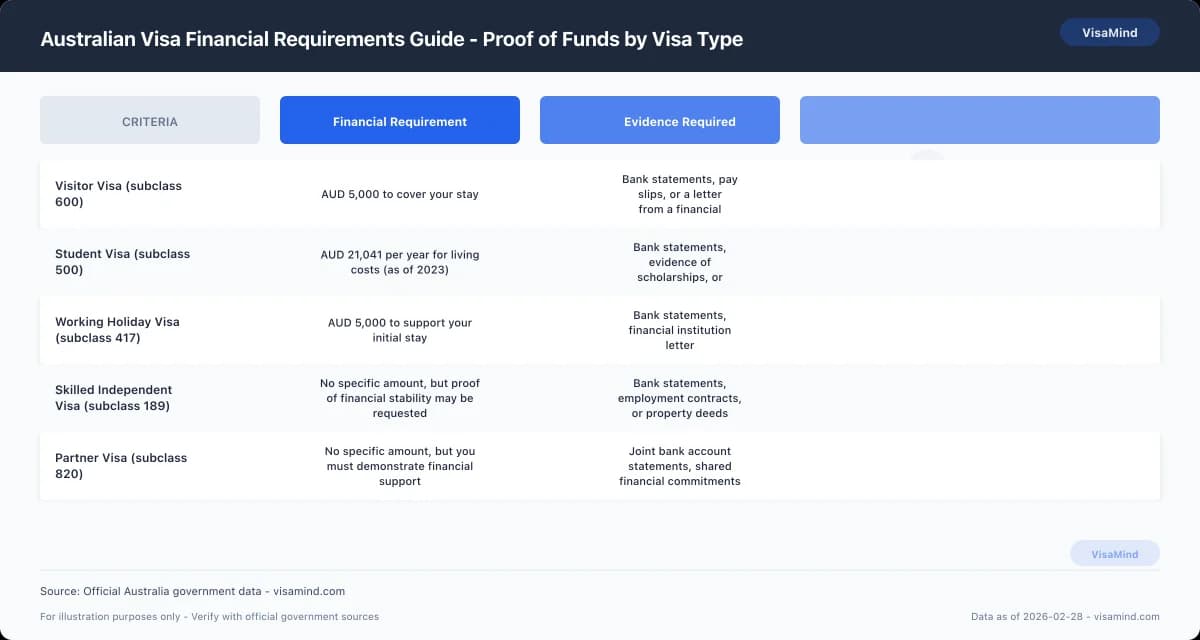
Navigating the financial requirements for Australian visas involves understanding the specific financial evidence needed for different visa categories. These requirements are crucial to demonstrate your ability to support yourself during your stay. Below is a detailed comparison of the financial requirements for various visa types, including visitor, student, work, family, and permanent residency (PR) visas.
Financial Requirements by Visa Type
| Visa Type | Financial Evidence Required | Minimum Funds (as of 2023) | Notes |
|---|---|---|---|
| Visitor Visa (subclass 600) | Proof of sufficient funds to cover the stay, return travel expenses | Varies by stay duration | Bank statements or a letter from a financial institution confirming your funds. |
| Student Visa (subclass 500) | Evidence of sufficient funds for tuition, living costs, travel | AUD 21,041/year | Includes tuition fees, travel expenses, and living costs. Documents Checklist for specifics. |
| Temporary Skill Shortage Visa (subclass 482) | Financial capacity to support oneself and any family members | Employer sponsorship often covers costs | Employers generally cover costs, but personal financial evidence may still be required. |
| Partner Visa (subclass 820/801) | Financial support from a partner in Australia | No specific amount | Financial evidence from the Australian partner, such as bank statements or employment details, is necessary. |
| Skilled Independent Visa (subclass 189) | Proof of financial means to support yourself initially | No specific amount | While no set amount is specified, demonstrating financial stability can strengthen your application. |
| Permanent Residency (PR) | Depending on the PR pathway, financial evidence may vary. Common pathways include family sponsorship and employer nomination. | Varies | Financial documentation depends on the specific PR category. Consider pathways like Skilled Work Regional (subclass 491). |
How to Prepare Your Financial Evidence
-
Gather Documentation: Collect recent bank statements, employment letters, or any financial documents that demonstrate your financial capacity.
-
Ensure Authenticity: All documents should be verifiable and up-to-date. Any fraudulent documentation can lead to visa refusal.
-
Translate Documents: If your documents are not in English, have them translated by a certified translator.
-
Consult the Documents Checklist: This will ensure you have all necessary evidence and avoid missing crucial documents.
Important: Ensure your financial documents meet the criteria specified by the Department of Home Affairs. Incomplete or inaccurate documentation can delay your visa processing.
Key Considerations
- Currency Fluctuations: Be aware of how currency fluctuations might affect your funds when converting to Australian dollars.
- Sponsor Letters: For some visas, a letter of support from an Australian sponsor can be an asset. This is particularly relevant for family and partner visas.
- Verification: Always verify the current financial requirements on the official website of the Department of Home Affairs as they are subject to change.
Understanding the specific financial requirements for your visa type is essential to a successful application. Ensure that all financial evidence is comprehensive and clearly demonstrates your ability to support yourself and any dependents during your time in Australia.
Bank Statement Rules
#Providing evidence of your financial capacity is crucial. This section outlines the key rules for bank statements, which are a common form of financial evidence.
Duration of Bank Statements
- Minimum Period: You typically need to provide bank statements for the last three months. This duration helps demonstrate consistent financial stability.
- Longer Periods: Some visa categories, like the Student Visa (subclass 500), may require longer periods, so verify the specific requirements for your visa type.
Balance Requirements
- Minimum Balance: While there is no universal minimum balance, you should show enough funds to cover your stay in Australia. For a student, this might include tuition fees and living expenses for a year, often totaling AUD 20,000 or more as of 2023. Always verify on the official website for up-to-date figures.
- Average Balance: In addition to a minimum balance, some visas might require you to demonstrate a stable average balance over the statement period, indicating ongoing financial support.
Eligible Accounts
- Savings and Checking Accounts: Statements from checking and savings accounts are commonly accepted. Ensure they are in your name and show regular transactions.
- Fixed Deposits: These can be used as evidence if they are accessible during your stay. Provide supporting documentation showing maturity dates and terms.
- Joint Accounts: If you provide a joint account, ensure you can prove your access to the funds, typically through a letter from the other account holder.
Joint Accounts
- Access Proof: When using a joint account, you must demonstrate authority over the funds. A signed statement or affidavit from the co-holder, confirming your access and rights to use the funds, is often necessary.
- Shared Responsibility: If using a joint account with a partner or family member, clarify how funds will be allocated and who is responsible for various expenses.
Tip: Consistency in your financial documents is key. Ensure all details, such as your name and account number, match across documents to avoid unnecessary delays.
For more on how to prepare your financial documentation, consider reviewing the How To Apply guide. Understanding these bank statement rules can significantly enhance your visa application's success.
What Qualifies as Proof
#Providing evidence of your financial capacity is a crucial component when applying for an Australian visa. The Department of Home Affairs requires applicants to demonstrate they have sufficient funds to support themselves, and potentially their dependents, while in Australia. Here are the categories of financial evidence that are generally accepted and those that are not.
Acceptable Proof of Financial Capacity
Cash Savings
- Bank Statements: Recent statements showing a history of savings in your account. This demonstrates consistent saving habits and financial stability.
- Term Deposits: Documentation showing funds held in a fixed-term deposit account.
Investments
- Shares and Bonds: Provide official documentation or statements showing ownership and value.
- Managed Funds: Evidence of investments in managed funds, including statements outlining the current value and ownership.
Property
- Real Estate: Property ownership documents, including title deeds and property valuation reports.
Loans
- Approved Loans: Documentation of approved personal loans specifically taken for funding your stay in Australia. This must include loan agreements and repayment terms.
Scholarships
- Scholarship Letters: Official confirmation of scholarships awarded, detailing the amount and duration of the scholarship.
What Does NOT Count as Proof
- Non-Liquid Assets: Items such as cars or jewelry cannot be used as proof since they are not liquid assets.
- Unapproved Loans or Credit Limits: Loans that have not been officially approved and credit limits on credit cards are not considered acceptable.
- Potential Income: Future earnings or promised salary increases do not qualify as proof of current financial capacity.
Important: Ensure all documents are in English or have a certified translation attached. Incorrect or incomplete documentation can lead to delays or refusals.
For those interested in the Skilled Independent Visa (subclass 189) or Skilled Work Regional (Provisional) Visa (subclass 491), submitting an Expression of Interest (EOI) is a critical step. Remember, failing to submit an EOI can lead to missed opportunities for skilled visas.
Additional Resources
- For a complete list of required documents, refer to our Documents Checklist.
- Explore more about different visa options and their specific financial requirements by visiting our guide on How To Apply.
Money Mistakes That Sink Applications
#Important: A common pitfall in Australian visa applications is failing to provide consistent and comprehensive financial documentation. Ensuring your financial evidence meets all criteria is crucial to avoid delays or refusals.
Last-Minute Deposits
- Avoid Sudden Large Deposits: Sudden large deposits in your bank account can raise red flags. The Department of Home Affairs may question the source and legitimacy of such funds. Ensure that any significant deposits are well-documented and justified with supporting evidence, such as a sales contract or inheritance documentation.
- Establish Financial Stability: Demonstrate a stable financial history over several months. For example, if you are applying for a Student Visa (subclass 500), consistent monthly inflows can help substantiate your ability to support yourself during your studies.
Insufficient Financial History
- Demonstrate a Consistent History: A common mistake is not showing a consistent financial history. Ensure that your bank statements reflect regular income or savings over at least three to six months. This is particularly important for visas like the Skilled Independent Visa (subclass 189), where proof of financial stability is essential.
- Provide Comprehensive Documentation: It's not enough to just show account balances. Include several months of transaction histories to provide a comprehensive view of your financial situation.
Wrong Currency
- Convert to AUD: All financial evidence must be presented in Australian Dollars (AUD). Failing to convert your financial statements into AUD can lead to confusion and delays. Use a reliable currency conversion and provide evidence of the conversion rate used at the time of application.
- Include Currency Conversion Rate Proof: Attach a printout or screenshot showing the official conversion rate used on the date of conversion, as this will support the accuracy of your financial evidence.
Missing Explanations
- Explain All Financial Sources: Clearly explain the sources of your funds. Vague or missing explanations can lead to doubts about the legitimacy of your finances. This is crucial for applications involving business or investment visas such as the Business Innovation and Investment (Provisional) Visa (subclass 188).
- Provide Supporting Documents: For any large transactions, provide corresponding documentation such as loan agreements, gift letters, or sale receipts. This additional evidence helps substantiate the source and purpose of funds.
Tip: For more guidance on preparing your financial documentation, refer to the Documents Checklist and ensure all required documents are included in your application.
Avoiding these common financial mistakes can significantly increase the chances of a successful visa application. Always double-check your documentation against the requirements provided by the Department of Home Affairs and consult with immigration experts if needed.
Sponsor Financial Evidence
#A sponsor or guarantor may need to provide financial evidence to support the application. This section will guide you on what types of financial documentation are acceptable and how to present them effectively.
What Financial Evidence Is Required?
Sponsors or guarantors must demonstrate their financial capacity to support the visa applicant. This is crucial for visas that require evidence of financial support, such as the Student Visa (subclass 500) or Skilled Nominated Visa (subclass 190).
Typical financial documents include:
- Proof of Income: This could be recent payslips, a letter from the employer, or bank statements showing regular income deposits.
- Tax Returns: Providing the last two years of tax returns can show consistent income levels.
- Affidavit of Financial Support: A legal document where the sponsor pledges to support the applicant financially.
How to Present Financial Evidence
When submitting financial documents, ensure they are clearly organized and easy to interpret. Here’s how you can arrange them:
-
Income Evidence:
- Attach recent payslips (at least six months).
- Include an employment letter detailing salary and position.
-
Tax Documentation:
- Provide full copies of the last two years' tax returns.
- Ensure all pages are included, and personal details are visible.
-
Affidavit:
- The affidavit should be notarized.
- Clearly state the intention to support the applicant, including the duration of support.
Tip: Always provide documents in English or with a certified translation if they are in another language.
Common Mistakes to Avoid
While gathering financial evidence, be cautious of common pitfalls that could delay processing or lead to refusal:
- Incomplete Documentation: Missing pages in tax returns or partial bank statements can raise questions about the sponsor's financial stability.
- Outdated Information: Ensure all financial documents are recent. Documents older than six months may not be considered valid.
- Unsubstantiated Claims: If you claim a certain level of income or assets, be prepared to back it up with clear, official documentation.
Additional Resources
For more detailed guidance, consider checking out the Documents Checklist or the How To Apply guide available on our website. These resources provide further clarity on document preparation and submission processes.
Important: Always verify the latest financial requirements and guidelines on the official Department of Home Affairs website, as these can change periodically.
Getting Your Finances Application-Ready
#-
Start Early and Stay Organized
Begin gathering your financial documentation well ahead of when you plan to lodge your visa application. The Department of Home Affairs requires detailed financial evidence, such as bank statements, income records, and other relevant documents, for many visa types, including the Skilled Independent Visa (subclass 189) and the Temporary Skill Shortage Visa (subclass 482). By starting early, you can ensure all information is current and complete, minimizing last-minute stress and potential delays.
-
Keep Consistent Financial Records
Maintaining consistent and accurate financial records is crucial for demonstrating your financial stability. Regularly update and review your financial statements to ensure they reflect your current situation. This includes tracking income, expenses, savings, and any investments. Consistency in your financial records helps establish credibility and can be critical when applying for visas that require proof of financial capability, like the Business Innovation and Investment (Provisional) Visa (subclass 188).
-
Explain Unusual Financial Patterns
If your financial records show any unusual patterns, such as large deposits or irregular income, include a cover letter to explain these anomalies. Clearly articulate the reasons behind such patterns to prevent misunderstandings or assumptions by immigration officers. This is particularly important if applying for visas with stringent financial scrutiny, such as the Skilled Nominated Visa (subclass 190).
Tip: Including a detailed cover letter can clarify any potential red flags in your financial history, helping to maintain the integrity of your application.
By following these steps, you can ensure your financial documentation is application-ready, enhancing your chances of a successful visa process. For more detailed guidance on the documents required, refer to the Documents Checklist specific to your visa category.
FAQs
What financial mistakes are highlighted in the Australian Visa Financial Requirements Guide that could affect a Business Innovation and Investment Visa (subclass 188) application?
According to the Australian Visa Financial Requirements Guide, can you switch from a Skilled Nominated Visa (subclass 190) to a Skilled Independent Visa (subclass 189)?
What are the financial requirements for combining a Student Visa (subclass 500) with a part-time work goal, as per the Australian Visa Financial Requirements Guide?
How does the Australian Visa Financial Requirements Guide suggest getting your finances application-ready for a Skilled Work Regional (Provisional) Visa (subclass 491)?
What qualifies as proof of funds for the Skilled Independent Visa (subclass 189) according to the Australian Visa Financial Requirements Guide?
Does the Australian Visa Financial Requirements Guide detail how to create an Immi Account for visa applications?
What does the Australian Visa Financial Requirements Guide say about using personal savings as proof for the Skilled Nominated Visa (subclass 190)?
Sources
Last reviewed: March 1, 2026
VisaMind provides informational guidance only and is not a government agency. This is not legal advice. Requirements can change and eligibility depends on your specific facts. If your case is complex or high-stakes, consult a licensed immigration attorney.
Next steps
Requirements vary by nationality, purpose, timeline, and case details. Use Find My Visa to get a personalized checklist for Australia with official sources and deadlines.
Find my visa