Official sources referenced
Is This Comparison for You?
#Navigating the Partner Visa options in Australia begins with understanding where you should be when lodging your application. The Subclass 820 Partner visa requires that you are in Australia at the time of application, while the Subclass 309 Partner visa mandates you to be outside the country. This fundamental distinction determines not only your physical location during the application process but also impacts the visa processing times and conditions you will face.
Who Benefits from This Comparison?
If you are the partner or spouse of an Australian citizen, permanent resident, or eligible New Zealand citizen, and you intend to settle in Australia, this comparison is tailored for you. It is particularly beneficial for those deciding between the onshore and offshore application routes. Understanding these options helps you align your location with the appropriate visa subclass, ensuring compliance with the Department of Home Affairs' requirements. This decision is crucial for a smooth application process and timely processing, whether you are applying from within Australia or overseas.
Why Location Matters
Your current location dictates which partner visa subclass you can apply for. This is a critical decision point that affects everything from application logistics to your immediate living arrangements. For instance, if you're already in Australia, applying for the Partner 820 801 visa allows you to stay in the country while your application is processed. Conversely, if you are outside Australia, applying for the Partner 309 100 visa is your pathway to future residency.
Important: Ensure you lodge your application from the correct location to avoid delays or complications with your visa processing. Incorrectly applying from the wrong location can lead to unnecessary setbacks.
For further clarity and assistance on these visa types, you can explore more detailed guides like How To Apply and Documents Checklist to ensure a thorough preparation process.
At a Glance
#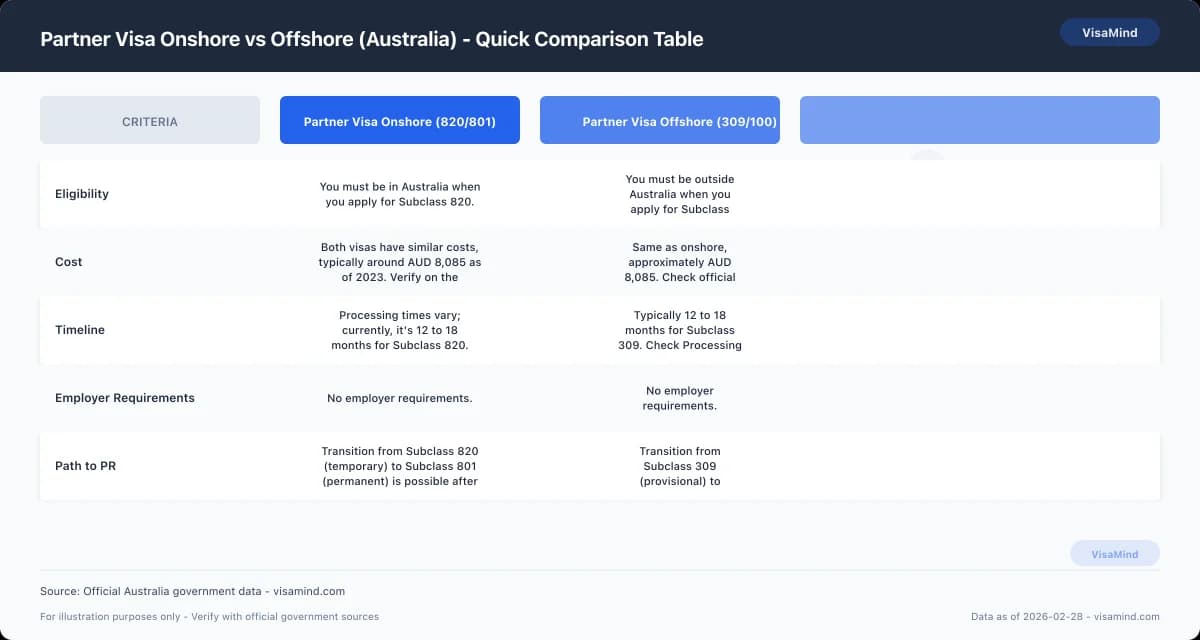
| Dimension | Partner Visa Onshore (Subclass 820/801) | Partner Visa Offshore (Subclass 309/100) |
|---|---|---|
| Eligibility | Must be in Australia to apply. | Must be outside Australia to apply. |
| Cost | The application fee is typically AUD 8,085 as of 2023. Verify on the official website. | The application fee is typically AUD 8,085 as of 2023. Verify on the official website. |
| Timeline | Processing can take from 20 to 29 months. Verify current times on the official website. | Processing can take from 17 to 24 months. Verify current times on the official website. |
| Path to Permanent Residence (PR) | You apply for both temporary and permanent visas simultaneously. Eligible for permanent residency after the temporary visa. | You apply for both temporary and permanent visas simultaneously. Eligible for permanent residency after the provisional visa. |
| Employer Requirements | Not applicable. This visa is based on your relationship with an Australian citizen, permanent resident, or eligible New Zealand citizen. | Not applicable. This visa is based on your relationship with an Australian citizen, permanent resident, or eligible New Zealand citizen. |
Key Considerations
The Partner Visa Onshore allows applicants already in Australia to apply without needing to leave the country. This is particularly beneficial if you're already settled or working in Australia under another visa such as the Student 500 or Visitor 600.
In contrast, the Partner Visa Offshore is designed for those who are outside Australia at the time of application. This could be more suitable for those waiting to move to Australia or who are currently residing in another country.
Important: Ensure you are in the correct location when applying. Being in the wrong location (inside or outside Australia) can lead to application issues.
Path to Permanent Residency
Both the onshore and offshore partner visas include applications for both temporary and permanent residency. Successfully obtaining the temporary visa (Subclass 820 or 309) is a stepping stone to the permanent visa (Subclass 801 or 100). After fulfilling certain conditions, such as maintaining a genuine relationship, applicants can transition to permanent residency. For more detailed guidance on this transition, you can refer to the PR Pathway Guide.
For more detailed information, including eligibility requirements and necessary documentation, you might want to consult the How To Apply and Documents Checklist guides.
Option A Is Better When...
#Important: Applying from the wrong location can lead to immediate application refusal by the Department of Home Affairs. Ensure you're either in Australia or overseas, depending on the visa subclass.
When Living in Australia Is Essential
-
Current Residency in Australia: As someone already in Australia on a Visitor 600 visa, I worried about the tight timeline for applying for an onshore Partner visa. I prepared by scheduling a consultation with an immigration advisor to ensure I collected all necessary documents and met the eligibility criteria. By doing so, I smoothly transitioned to a Subclass 820 visa, allowing me to remain in Australia with my partner while my permanent residency application was processed.
-
Immediate Need to Be with Family: My partner fell ill suddenly, and I needed to be by their side in Australia. I was already in Australia on a Student 500 visa, so applying for the onshore Partner visa was the best option. I gathered medical documents to support my application and highlighted the urgency. This allowed me to continue living in Australia and provide the necessary support to my partner.
When Working in Australia Is a Priority
-
Employment Prospects in Australia: I had a job offer lined up in Australia and was concerned about maintaining my work eligibility. Since I was already in Australia on a Working Holiday 417 visa, applying for the onshore Partner visa was crucial. I provided evidence of my employment offer and explained my career objectives in Australia. This approach ensured I could work without interruption, supporting both myself and my partner.
-
Career Advancement Needs: My current employer in Australia offered me a promotion, contingent on my ability to stay in the country. I was in Australia on a Tss 482 visa, and the onshore Partner visa was my best option for long-term residency. I documented my career path and potential contributions to the company, which helped secure my visa and allowed me to accept the promotion.
Tip: If you're on a temporary visa and planning to apply for an onshore Partner visa, ensure your current visa conditions do not prevent you from lodging a new application while in Australia.
When to Pick the Second Option
#Tip: If you are planning to apply for a partner visa from outside Australia, ensure to align your travel plans accordingly, as the location at the time of application is crucial.
When Being Outside Australia Is Advantageous
-
Extended Travel Plans: I was planning a long trip to Europe when my partner suggested we apply for a Partner Visa. Initially, I was concerned about how the timing of our application might interfere with my travel plans. However, applying for the Subclass 309 Partner (Provisional) visa while I was abroad turned out to be the perfect solution. Being outside Australia allowed me to continue my travel without worrying about visa conditions that might have required me to be present in Australia. We coordinated our application with my travel schedule, which gave us the flexibility we needed. This approach enabled me to enjoy my trip and simultaneously process our visa application smoothly.
-
Family Commitments Abroad: My partner and I had been living in his home country due to family commitments. We were concerned about how this might affect our ability to apply for a partner visa in Australia. After doing some research, we decided that applying from overseas was the best option for us. We lodged our application for the Subclass 309 visa while residing abroad, which allowed us to fulfill our family obligations. This option provided peace of mind, knowing we could continue our lives abroad while waiting for the visa decision.
When Offshore Processing Suits Your Timeline
-
Career Transitions: I was in the midst of transitioning jobs and was offered a short-term contract overseas. Initially, I was worried that being abroad would complicate our visa application process. However, we learned that applying for the Subclass 309 visa from outside Australia aligned perfectly with my career plans. By proceeding with the offshore application, I was able to accept the contract without interrupting the visa process. The offshore option allowed me to pursue my professional goals while staying on track for future relocation to Australia.
-
Avoiding Bridging Visas: My partner and I had concerns about the potential complications of staying in Australia on a bridging visa during the application process. We decided to apply for the Subclass 309 visa while I was still in my home country, which helped us avoid the uncertainties that can sometimes come with bridging visas. This decision provided us with a clearer timeline and reduced stress, knowing that I could continue my life as usual without any legal limbo while our application was processed.
Important: Ensure you understand the requirements and implications of applying from outside Australia to avoid unnecessary complications. Always verify current guidelines on the official Department of Home Affairs website.
What Really Sets Them Apart
#Understanding the differences between the onshore and offshore partner visas in Australia is crucial for making an informed decision. Below, we explore three key differences that set the Subclass 820/801 and Subclass 309/100 visas apart.
Location Requirements
One of the most significant distinctions between onshore and offshore partner visas is the location requirement at the time of application and visa grant:
-
Onshore (Subclass 820/801): You must be physically present in Australia when you lodge your application for the Subclass 820 (temporary) visa, and you need to remain in Australia when the temporary visa is granted. This requirement makes the onshore pathway suitable for those already residing in Australia, perhaps on a Visitor 600 or Student 500 visa.
-
Offshore (Subclass 309/100): Conversely, you must be outside Australia when you apply for the Subclass 309 (provisional) visa and remain outside Australia until the visa is granted. This option is ideal for partners who are not currently in Australia but plan to move once the visa is approved.
Important: Applying from the wrong location can lead to visa refusal, so confirm your eligibility and ensure you meet the location criteria before lodging your application.
Processing Times and Pathway to Permanent Residency
Another critical factor is the difference in processing times and the pathway to permanent residency:
-
Onshore Visa (Subclass 820/801): The processing time for the Subclass 820 visa can be lengthy, often taking several months. However, once you hold the Subclass 820 visa, you can remain in Australia and enjoy the benefits of living with your partner while waiting for the permanent Subclass 801 visa.
-
Offshore Visa (Subclass 309/100): The Subclass 309 visa typically has a shorter processing time compared to the Subclass 820 visa. This can be advantageous for applicants who are eager to join their partners in Australia more quickly. Once the provisional visa is granted, you can enter and stay in Australia while waiting for the permanent Subclass 100 visa.
Cost and Benefits
The financial aspect also plays a role in differentiating these visa options:
-
Application Fees: Both onshore and offshore visas involve significant fees. As of 2023, the total cost for applying is similar for both pathways, though you should verify the current fees on the official Department of Home Affairs website before applying.
-
Access to Benefits: Holders of the onshore Subclass 820 visa may be eligible for certain Australian government benefits and Medicare, Australia's public health care system. This access can be a considerable advantage for applicants needing medical services while awaiting their permanent visa.
In conclusion, the choice between onshore and offshore partner visas should be based on your current location, urgency to reunite with your partner, and personal circumstances. Each pathway offers distinct advantages, making it essential to evaluate which aligns best with your situation. For more detailed guidance on your visa journey, refer to the Partner 820 801 and Partner 309 100 visa categories.
Common Misconceptions
#- Many applicants believe they can apply for a Partner Visa from any location. However, you must be in Australia when applying for the Subclass 820 Partner visa (Temporary) and outside Australia when applying for the Subclass 309 Partner (Provisional) visa. Failing to apply from the correct location is a common error that can lead to application refusal.
Misunderstanding Temporary vs Permanent Visas
- There is a misconception that the Partner Visa application is for either a temporary or permanent visa. In fact, applicants simultaneously apply for both the temporary and permanent visas. The initial grant is temporary (either Subclass 820 or 309), and after meeting certain criteria, you may transition to the permanent visa (either Subclass 801 or 100).
Important: Ensure you meet all eligibility requirements for both the temporary and permanent visa stages. This can prevent delays in transitioning to permanent residency.
Relationship Evidence Misconceptions
- Some applicants mistakenly believe that providing minimal evidence of their relationship is sufficient. However, the Department of Home Affairs requires comprehensive documentation to demonstrate a genuine and ongoing relationship. Insufficient evidence is a common reason for visa refusal. For more detailed guidance, refer to our Documents Checklist.
Processing Time Assumptions
- Applicants often assume that the processing times for onshore and offshore applications are the same. However, processing times can vary significantly due to factors such as demand and individual application circumstances. While specific timelines are not always predictable, you can find more information on Processing Times.
Tip: Regularly check your application status online through your IMMIACCOUNT-PORTAL to stay updated on any requirements or decisions from Home Affairs.
Converting Between Options
#Or vice versa. This can happen due to changes in personal circumstances or misunderstandings about location requirements. Here’s how to navigate these conversions.
Can You Switch from Onshore to Offshore?
If you initially applied for an onshore Partner Visa (Subclass 820/801) but are now outside Australia, you cannot directly switch your application to an offshore one. An onshore application requires you to be in Australia both at the time of application and when the visa is granted. If you leave Australia before your visa is granted, you may need to withdraw your current application and lodge a new offshore application (Subclass 309/100) instead. This means restarting the process, including paying the application fee again.
Important: Ensure you are in the correct location (inside or outside Australia) when applying to avoid complications and additional costs.
Transitioning from Offshore to Onshore
Similarly, if you applied for an offshore Partner Visa and have since entered Australia, you cannot simply transfer your application to an onshore one. You will need to remain outside Australia for the offshore visa to be granted. Alternatively, you might consider applying for a different visa that allows you to stay in Australia temporarily, such as a Visitor Visa (Subclass 600), while awaiting your Partner Visa decision.
Steps to Address Misplaced Applications
-
Review Your Current Application: Check the status and location requirements of your current application.
-
Consider Withdrawal: If you find yourself in the wrong location, consider withdrawing the application. Consult with the Department of Home Affairs or a registered migration agent.
-
Lodge a New Application: Submit a new application that aligns with your current circumstances. Ensure all documentation is updated and accurate.
-
Monitor Communication: Keep an eye on any updates or requests from the Department of Home Affairs to ensure timely responses.
By understanding these processes and making informed decisions, you can manage your Partner Visa application effectively, regardless of changes in location or personal circumstances. For further guidance on transitioning between visa types, consider consulting the Partner Visa (onshore) (subclasses 820/801) and Partner Visa (offshore) (subclasses 309/100) information pages.
Real Scenarios
#I was really anxious about applying for the Partner Visa Onshore (subclasses 820 and 801) because my partner and I had only been living together for a few months. We decided to strengthen our application by gathering a wide array of relationship evidence, including joint financial documents and detailed statements from friends and family confirming our genuine relationship. After lodging our application, we were relieved to receive feedback that our thorough documentation helped demonstrate the authenticity of our partnership, ultimately leading to a successful temporary visa grant. We are now living together in Australia while awaiting the assessment for the permanent visa.
On the other hand, my friend opted for the Partner Visa Offshore (subclasses 309 and 100) because she was still working overseas at the time of application. Her biggest worry was the long-distance aspect and how it might impact the perception of her relationship's genuineness. She meticulously prepared by maintaining constant communication with her partner in Australia and documenting every interaction, from video calls to holiday visits. She also provided detailed evidence of her future plans to move to Australia, like job applications and housing arrangements. This proactive approach paid off when her provisional visa was approved, allowing her to join her partner in Australia and start building their life together.
Tip: When preparing for a partner visa, whether onshore or offshore, ensure you have comprehensive evidence of your relationship. Regular communication logs and future plans can be particularly persuasive in demonstrating commitment and authenticity.
FAQs
Is it possible to convert a Partner Visa Offshore to Onshore in Australia?
What role does the Department of Home Affairs play in Partner Visa Onshore vs Offshore (Australia)?
How much is the application fee for Partner Visa Onshore vs Offshore (Australia)?
What evidence is required for a Partner Visa Onshore vs Offshore (Australia) application?
How long does the Department of Home Affairs take to process a Partner Visa Onshore vs Offshore (Australia)?
What is the process to apply for a Partner Visa Onshore vs Offshore (Australia)?
Are there common pitfalls when applying for Partner Visa Onshore vs Offshore (Australia)?
Sources
Last reviewed: March 1, 2026
VisaMind provides informational guidance only and is not a government agency. This is not legal advice. Requirements can change and eligibility depends on your specific facts. If your case is complex or high-stakes, consult a licensed immigration attorney.
Next steps
Requirements vary by nationality, purpose, timeline, and case details. Use Find My Visa to get a personalized checklist for Australia with official sources and deadlines.
Find my visa