Official sources referenced
Extension Eligibility Overview
#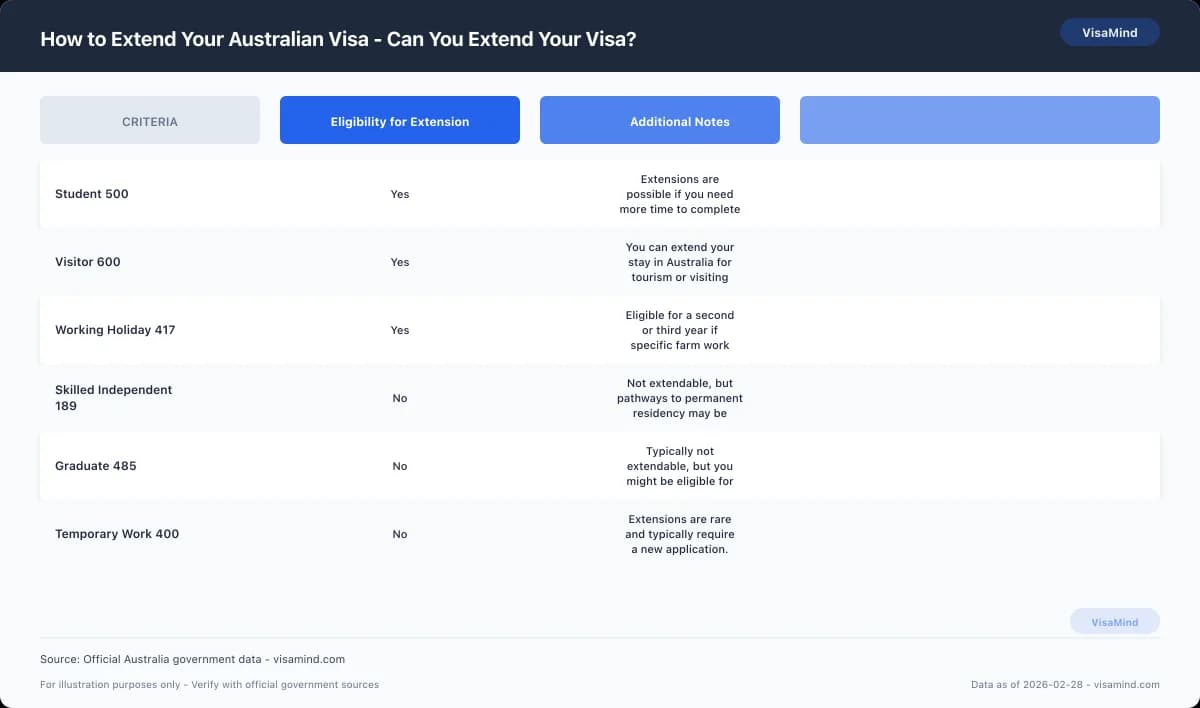
Important: Not all Australian visas can be extended. Understanding your specific visa type's eligibility is crucial to avoid overstaying.
Which Visas Can Be Extended?
In Australia, certain types of visas allow for extensions, while others do not. Understanding these distinctions is essential for planning your stay. Here's a quick overview:
| Visa Type | Eligibility for Extension | Important Notes |
|---|---|---|
| Visitor Visa (subclass 600) | Yes | Extensions are possible, but conditions apply. You may need to show that your stay is temporary and that you have sufficient funds. |
| Student Visa (subclass 500) | Yes | Extensions can be sought if you need more time to complete your course. Ensure your enrolment is current and that you maintain health insurance and financial capability. |
| Training Visa (subclass 407) | Yes | Extensions depend on the duration of your training program. Ensure your training plan is updated and endorsed by the sponsor. |
| Temporary Skill Shortage Visa (subclass 482) | Yes | Extensions are possible if your employer sponsor continues to meet eligibility criteria. You may need to demonstrate ongoing employment. |
| Temporary Graduate Visa (subclass 485) | No | Generally, this visa cannot be extended. However, you may explore other pathways like skilled visas if you wish to remain in Australia. |
Visas That Cannot Be Extended
Some visas, such as the Temporary Graduate Visa (subclass 485), typically do not allow for extensions. If you're on such a visa, you'll need to consider other options, like applying for a different visa type if you wish to remain in Australia.
What Are Your Options?
If your current visa does not allow for an extension, consider applying for a different visa category. For instance, those on a Temporary Graduate Visa might look into skilled migration pathways like the Skilled Independent Visa (subclass 189) or the Skilled Nominated Visa (subclass 190). Each of these visas has its own set of eligibility criteria and application processes.
Tip: Always review the Documents Checklist for your intended visa extension or new application to ensure all required documentation is in order.
Understanding the specific rules and options for your visa type can help you plan effectively and avoid any legal issues. Always verify the latest requirements on the official Department of Home Affairs website.
The Extension Application Process
#Create an Immi Account
The first step in extending your Australian visa is to create an Immi Account if you haven't done so already. This account is essential for accessing online services provided by the Department of Home Affairs. You can create an account by visiting the Department's website and following the instructions to register your details. Ensure you have a valid email address, as a verification code will be sent to it during the registration process.
Determine Your Visa Type and Requirements
Different visas have different extension requirements. For instance, if you're on a Student Visa (subclass 500), you might need to provide proof of ongoing study, while those on a Visitor Visa (subclass 600) may need to justify the reason for extending their stay. Review the specific guidelines for your visa category on the Department of Home Affairs website to ensure you meet all necessary criteria.
Gather Required Documents
Once you know the requirements for your specific visa type, gather all necessary documents. This may include evidence of financial support, health insurance, or confirmation of enrolment for students. It's crucial to have these documents ready before starting your application process to avoid any delays.
Lodge an Application Online
With your Immi Account set up and documents prepared, you can proceed to lodge your visa extension application online. Log into your Immi Account, navigate to the relevant section for visa extensions, and follow the guided process to enter your details. Be prepared to pay any applicable fees, which vary depending on the visa type and can be verified on the official website.
Monitor Your Application Status
After submitting your application, you can track its progress through your Immi Account. The processing time may vary, so regularly check for updates and any additional requests for information from the Department. This proactive approach ensures you respond promptly to any queries, which can help prevent delays.
Tip: Always lodge your application well before your current visa expires to avoid any complications. Applying at least 2-3 months before the expiration date is advisable.
Await Decision and Next Steps
Once your application is processed, you will receive a notification from the Department of Home Affairs regarding the outcome. If granted, ensure you understand the conditions of your visa extension. In case of any issues or if your application is refused, you may need to explore other options, such as applying for a different visa category or seeking professional advice.
For more detailed guidance on specific visa types, you may refer to resources like the Documents Checklist available on the Department's website.
What to Submit with Your Extension
#To successfully extend your Australian visa, you will need to gather and submit a variety of documents depending on your specific visa type. Below is a comprehensive list of common requirements you may need to meet when lodging your extension application with the Department of Home Affairs.
Personal Identification Documents
- Passport: A clear copy of the biographical page of your current passport.
- Visa: A copy of your current visa grant notification.
Important: Ensure your passport is valid for the entire duration of your intended stay in Australia.
Financial Evidence
- Bank Statements: Recent statements showing sufficient funds to support yourself during the extended stay.
- Pay Slips: If employed, submit recent pay slips as proof of ongoing income.
- Sponsorship Documents: If someone is sponsoring you, include evidence of their financial capacity and a formal letter of sponsorship.
Health and Character Requirements
- Health Insurance: Proof of adequate health insurance coverage for the duration of your extended stay.
- Character Documents: Police clearance certificates may be required for longer stays or certain visa types.
Specific Visa Requirements
Different visa categories may have additional requirements. Here are some examples:
Student Visa (subclass 500)
- Course Enrolment: Confirmation of Enrolment (CoE) for your continued or new course.
- Academic Transcripts: Recent transcripts to demonstrate satisfactory course progress.
Temporary Skill Shortage Visa (subclass 482)
- Employment Contract: Updated contract or offer of employment from your sponsoring employer.
- Labour Market Testing: Evidence that the position has been advertised if applicable.
How to Ensure Your Documents Are Complete
- Review Document Checklist: Use the Documents Checklist to ensure you have all necessary items.
- Verify Requirements: Check the specific requirements for your visa type on the Department of Home Affairs website.
Tip: Lodge your documents through your Immi Account for faster processing and to receive immediate confirmation.
Carefully preparing and submitting all required documents will help you avoid delays and increase the likelihood of a successful extension. Always verify the latest requirements and guidelines on the official Department of Home Affairs website, as procedures and criteria can change.
What It Costs and How Long It Takes
#Understanding the associated costs and timelines is essential. Below, you'll find an overview of the fees and processing times for different types of visa extensions managed by the Department of Home Affairs.
Visa Extension Costs and Timelines
| Visa Type | Cost (AUD) | Processing Time | Expedited Options |
|---|---|---|---|
| Visitor Visa (subclass 600) | $365 | Typically 1-2 months | Priority processing not available |
| Student Visa (subclass 500) | $630 | 6-8 weeks | Expedited processing can be requested |
| Training Visa (subclass 407) | $310 | 2-3 months | No expedited option |
| Temporary Skill Shortage Visa (subclass 482) | $2,645 | 2-3 months | Priority processing available for an additional fee |
| Temporary Graduate Visa (subclass 485) | $1,680 | 4-5 months | Expedited processing not available |
Important Considerations
Important: Processing times are subject to change, especially during peak periods. Check the Processing Times guide for the most current information.
When planning to extend your visa, factor in both the cost and the potential duration of the process. Some visas, such as the Temporary Skill Shortage Visa (subclass 482), offer priority processing options for an additional fee, which may be beneficial if your situation requires a quicker decision.
Tips for a Smooth Process
- Ensure your Immi Account is active and up-to-date: This is crucial for lodging your application and monitoring its progress.
- Double-check your documentation: Incomplete or incorrect documents can lead to delays.
- Consider your timeline carefully: Apply well in advance of your current visa's expiration to avoid any gaps in your legal status in Australia.
For more detailed guidance on how to apply, visit the How To Apply page. Remember, it's always a good idea to verify the most current information on the official Department of Home Affairs website.
The Risks of Staying Past Your Visa
#Overstaying your visa in Australia can have serious consequences. It is crucial to understand these risks to avoid future immigration difficulties.
Consequences of Overstaying
If you remain in Australia beyond your visa's validity, you may face a range of penalties. These consequences are enforced by the Department of Home Affairs and can impact your ability to apply for future visas.
-
Immediate Impacts:
- You might become unlawful, which can lead to detention or removal from Australia.
- Your current visa automatically becomes invalid, and you lose any associated work or study rights.
-
Financial Penalties:
- Overstaying can incur financial penalties. While exact amounts vary, fines can be significant. Verify current penalties on the official website.
Future Visa Applications
Overstaying your visa can severely impact your eligibility for future Australian visas. The Department of Home Affairs considers your immigration history when assessing new visa applications.
-
Three-Year Ban:
- Overstaying by more than 28 days may result in a three-year re-entry ban. This ban prevents you from applying for certain visas, including the Visitor Visa (subclass 600) and Working Holiday Visa (subclass 417).
-
Negative Record:
- Even if you overstay for a short period, it can be recorded on your immigration history, affecting your eligibility for visas such as the Skilled Independent Visa (subclass 189) or Graduate Visa (subclass 485).
Important: Always lodge an extension application before your visa expires to avoid these penalties. Consider setting reminders for key dates in your visa timeline to ensure compliance.
What to Do if You Overstay
If you realize you've overstayed your visa, it is essential to address the issue promptly.
- Contact Home Affairs: Reach out to the Department of Home Affairs to discuss your situation and possible solutions.
- Consider a Bridging Visa: You may be eligible to apply for a bridging visa, which can regularize your stay while you resolve your immigration status.
- Seek Legal Advice: Consulting with an immigration lawyer or a registered migration agent can provide guidance tailored to your specific circumstances.
By understanding these risks and taking timely action, you can mitigate the negative consequences of overstaying your visa in Australia. For more detailed information on different visa categories, check the How To Apply guide.
Visa-by-Visa Extension Rules
#It’s important to understand the specific rules for each visa category. Below is a detailed breakdown of extension rules for some common visa types: tourist, student, work, and family visas.
Visa-by-Visa Extension Rules
| Visa Type | Eligibility | Cost | Timeline |
|---|---|---|---|
| Visitor Visa (subclass 600) | Must not have "No Further Stay" condition | From AUD $365* | Processing times vary, check Processing Times |
| Student Visa (subclass 500) | Enrolled in a registered course, valid CoE required | From AUD $650* | 6 to 9 months in advance before the course ends |
| Temporary Skill Shortage Visa (subclass 482) | Employer sponsorship required, meet skill requirements | Sponsorship costs apply | Approximately 2-4 months, verify on the official website |
| Partner Visa (subclass 820/801) | Genuine ongoing relationship, meet health and character requirements | From AUD $7,850* | Processing times can exceed 2 years |
Important: Ensure your current visa does not have a “No Further Stay” condition, as this may prevent you from applying for an extension.
Tourist Visa Extensions
Those on a Visitor Visa (subclass 600) can apply for an extension if their visa allows it. Be mindful of the conditions on your visa, such as a "No Further Stay" condition, which could restrict your ability to extend.
Student Visa Extensions
Students need a valid Confirmation of Enrolment (CoE) and should apply for an extension at least 6 to 9 months before their course ends. More details on student visa requirements can be found in the Student Visa (subclass 500) section.
Work Visa Extensions
For the Temporary Skill Shortage Visa (subclass 482), you must continue to meet the skill requirements and have sponsorship from an approved employer. Check the latest costs and processing times on the Department of Home Affairs website.
Family Visa Extensions
If you are on a Partner Visa (subclass 820/801), ensuring the authenticity of your relationship is crucial for extension eligibility. Processing times can be lengthy, sometimes exceeding 2 years, so plan accordingly.
Tip: Always lodge your application well before your current visa expires to avoid unlawful status in Australia.
For more comprehensive details on each visa type, including documents needed for application, you can visit the How To Apply guide.
What Else Can You Do?
#When your visa is close to expiration, you might wonder what other options are available. Whether you're thinking about switching to a different visa type or planning to leave and re-enter Australia, here are some options and considerations.
Can You Change Your Visa Type?
If your circumstances have changed or you wish to pursue new opportunities, you may be able to switch to a different type of visa. For instance, if you have graduated from an Australian educational institution, you might consider applying for a Temporary Graduate Visa (subclass 485). Alternatively, if you have secured a job offer in Australia, the Temporary Skill Shortage Visa (subclass 482) could be an option.
To switch visas:
- Assess Eligibility: Determine if you meet the criteria for the new visa.
- Lodge an Application: Submit your application through your Immi Account.
- Await Approval: Processing times vary, so plan accordingly. Check current processing times on the official website.
Leaving and Re-entering Australia
If you choose to leave Australia and wish to return, ensure your visa allows multiple entries. Some visas, like the Visitor Visa (subclass 600), offer options for multiple entries, but you must confirm this applies to your specific situation.
Tip: Ensure your passport is valid for at least six months beyond your planned return date to avoid entry issues.
What If You Decide to Leave Australia Voluntarily?
If extending your stay isn't an option, or you decide to leave Australia, you should plan your departure carefully. Exiting Australia before your visa expires avoids complications with future visa applications.
- Notify Home Affairs: Use your Immi Account to inform the Department of Home Affairs of your intentions.
- Check Travel Restrictions: Stay updated on any travel restrictions or requirements due to global events.
Switching to Permanent Residence
For those considering a longer-term stay, transitioning to permanent residence is a possibility. Options like the Skilled Independent Visa (subclass 189) can lead to permanent residency, provided you meet the eligibility criteria and submit an Expression of Interest through SkillSelect.
Important: Ensure you've completed any required health and character assessments for permanent residency applications.
By considering these options and planning carefully, you can navigate your visa situation with confidence. Always refer to the Department of Home Affairs website for the most current information and requirements.
FAQs
Can I switch from a Student Visa (subclass 500) to a Temporary Skill Shortage Visa (subclass 482) in Australia?
What is the cost of extending a Training Visa (subclass 407) with Home Affairs?
How do I know if I am eligible to extend my Temporary Skill Shortage Visa (subclass 482) in Australia?
Can I extend my Australian visa if I have an Expression of Interest (EOI) for a Skilled visa?
What are the risks of staying past your visa in Australia?
Can I combine my goals of studying and working in Australia under different visas?
What else can you do if you're not eligible for an Australian visa extension?
Sources
Last reviewed: March 1, 2026
VisaMind provides informational guidance only and is not a government agency. This is not legal advice. Requirements can change and eligibility depends on your specific facts. If your case is complex or high-stakes, consult a licensed immigration attorney.
Next steps
Requirements vary by nationality, purpose, timeline, and case details. Use Find My Visa to get a personalized checklist for Australia with official sources and deadlines.
Find my visa