Official sources referenced
When to Read This
#Canada's Express Entry system is a critical tool for managing applications from skilled workers seeking to immigrate. It involves creating an online profile and entering a pool where candidates are ranked based on their qualifications. If you are a skilled worker with either Canadian or foreign experience, Express Entry could be your pathway to obtaining permanent residence. You might also explore the Provincial Nominee Program (PNP), which allows Canadian provinces to nominate individuals who wish to immigrate to specific provinces and territories.
Who Benefits from This Comparison?
If you are considering moving to Canada as a skilled worker, understanding the differences between Express Entry and PNP is crucial. These two pathways cater to different needs and circumstances. For instance, Express Entry is generally faster, with processing times often around six months, while PNP timelines can vary significantly depending on the province. However, PNPs can be beneficial if you have a specific provincial destination in mind or lack the points needed for Express Entry.
Why It's Important to Know the Differences
Choosing between Express Entry and PNP can impact your immigration journey significantly. Express Entry may be more straightforward if you meet the eligibility criteria and have a competitive profile. In contrast, PNPs might offer more tailored opportunities if you have connections to a specific province or if your occupation is in demand there. Each option has distinct processes, requirements, and advantages, making a detailed comparison essential for informed decision-making.
Tip: Always check the latest eligibility criteria and processing times on the IRCC website to ensure you choose the path that best aligns with your qualifications and goals.
Side-by-Side Comparison
#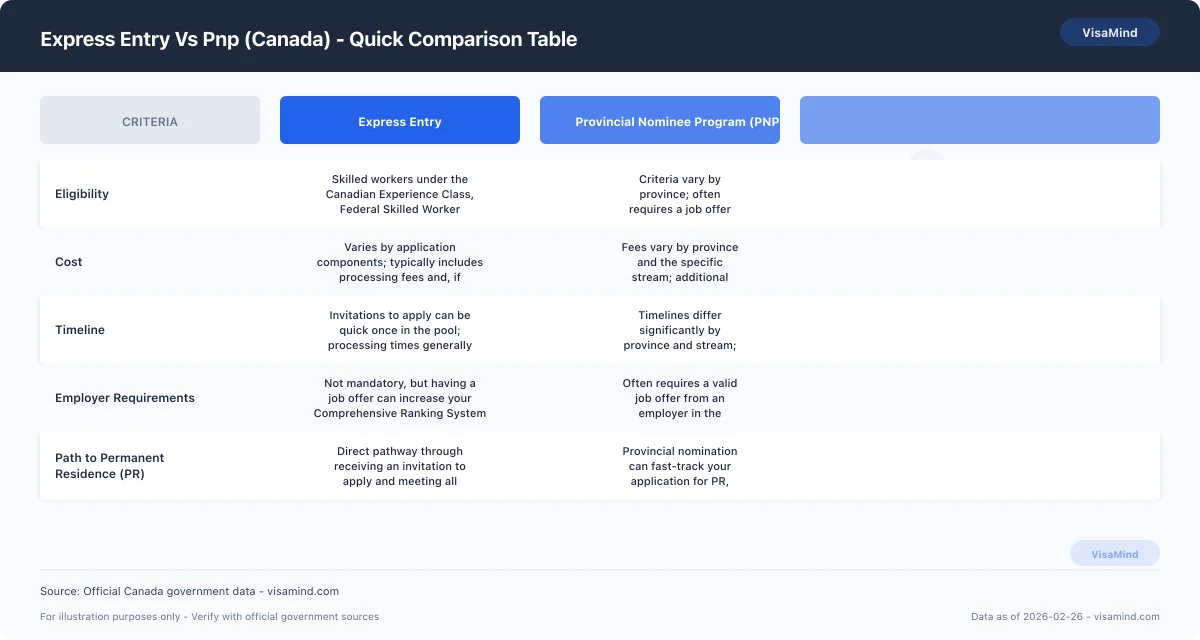
Two popular pathways are the Express Entry and the Provincial Nominee Program (PNP). Each has unique requirements and benefits. Here's how they compare across several key dimensions:
Side-by-Side Comparison
| Feature | Express Entry | Provincial Nominee Program (PNP) |
|---|---|---|
| Eligibility | Based on the Federal Skilled Worker Program, Canadian Experience Class, and Federal Skilled Trades Program. Must meet specific criteria such as age, education, work experience, and language skills. | Varies by province. Each province has its own criteria and streams that may target specific skills or occupations. |
| Cost | The processing fee is approximately CAD 1,365 as of 2023, including the right of permanent residence fee. Verify on the official website for updates. | Costs vary by province and can range from CAD 250 to CAD 1,500. Check the specific provincial website for accurate fees. |
| Timeline | Processing time is typically around 6 months after receiving an invitation to apply, but this can vary. | Timelines vary significantly. It can take several months for the nomination and additional time for federal processing. |
| Employer Requirements | No direct job offer is required, but having one can significantly increase your Comprehensive Ranking System (CRS) score. | Often requires a job offer, although some streams do not. Each province has its specific requirements regarding employer involvement. |
| Path to Permanent Residence (PR) | Direct pathway to PR if you receive an invitation to apply and your application is successful. | Requires a provincial nomination, which then allows you to apply for PR through the federal process. |
Eligibility Criteria
The Express Entry system is designed for skilled workers and evaluates candidates based on factors such as age, education, work experience, and proficiency in English or French. It includes three programs: the Canadian Experience Class, Federal Skilled Worker Program, and Federal Skilled Trades Program.
In contrast, the Provincial Nominee Program allows provinces to nominate individuals who wish to immigrate to Canada and are interested in settling in a particular province. Each province has different streams that target various groups, such as skilled workers, semi-skilled workers, or business individuals.
Costs and Timelines
The costs associated with Express Entry are generally more predictable, with a standard processing fee. However, the PNP can vary widely depending on the province. For both pathways, it's crucial to budget for additional expenses such as language tests and medical exams.
Important: Check the official IRCC and provincial websites regularly for the most current fee and processing time information.
Employer Requirements
While Express Entry does not mandate a job offer, having one can improve your CRS score, increasing your chances of receiving an invitation to apply. In the PNP, some streams require a job offer, while others focus on attracting candidates with skills in high demand in that province.
For more detailed guidance on these immigration options, explore the Express Entry Guide and the PNP Guide.
When to Pick the First Option
#A software developer working in Canada on a Work Permit wanted to transition to permanent residency. Having gained valuable experience through the Canadian Experience Class, they were eligible to apply via the Express Entry system. They carefully gathered necessary documents, such as proof of work experience in Canada, and created a profile on the IRCC portal. After entering the pool, they received an invitation to apply within a few months due to their high Comprehensive Ranking System (CRS) score. The application process was straightforward, and they received their permanent residency approval within six months, enabling them to continue their career in Canada without the constraints of a temporary permit.
Scenario: International Skilled Worker Seeking Opportunity in Canada
An engineer with extensive foreign work experience sought to move to Canada to explore better career opportunities. Understanding that their qualifications aligned with the Federal Skilled Worker Program, they decided to apply through the Express Entry system. They assessed their eligibility and created a profile, providing details of their foreign work experience and educational credentials. After a few months in the pool, they were invited to apply due to their competitive CRS score. The engineer lodged their application with supporting documents and received their permanent residency status within eight months, allowing them to relocate to Canada and pursue new job prospects.
Scenario: Skilled Tradesperson with Qualifications in High Demand
A highly skilled electrician with qualifications in a trade recognized under the Federal Skilled Trades Program aimed to immigrate to Canada. Recognizing the demand for their trade, they opted for the Express Entry route. They created a profile on the IRCC platform, ensuring all trade certification and work experience documents were in order. Their application was successful, and they were invited to apply for permanent residency within four months thanks to their specific trade skills being in demand. After completing the application process, they were granted permanent residency within seven months, opening doors to new opportunities in Canada's flourishing labor market.
Choose Option B If...
#A mechanical engineer named David had been working in the United Arab Emirates for several years. While looking to immigrate to Canada, he received a job offer from a company based in Alberta. Although David was eligible for the Federal Skilled Worker Program under the Express Entry system, his job offer made him reconsider his options.
David decided to explore the Provincial Nominee Program (PNP), which allows provinces like Alberta to nominate individuals who have the skills and experience needed in their local labor market. By applying through Alberta's PNP, David was nominated and received an additional 600 points in the Comprehensive Ranking System (CRS), significantly boosting his Express Entry profile. This led to an invitation to apply for permanent residency much faster than he anticipated. Within six months of receiving his nomination, David became a permanent resident of Canada, allowing him to work and settle in Alberta with his family.
Scenario: Recent Graduate with Canadian Experience
Priya, a recent graduate from a Canadian university, had accumulated valuable work experience through internships and part-time jobs. She was keen on becoming a permanent resident and initially considered applying through the Canadian Experience Class under Express Entry. However, she realized that her CRS score wasn't competitive enough for the next anticipated draw.
Priya then turned her attention to the PNP, specifically, the Ontario Immigrant Nominee Program (OINP), which offers streams for international graduates who have studied in Ontario. By applying through this provincial program, Priya was nominated and gained additional points for her Express Entry profile. This nomination enabled her to receive an invitation to apply for permanent residency within a few months. Priya successfully transitioned from a temporary resident to a permanent resident and continued her career in Ontario.
Scenario: Skilled Trade Worker in Demand
Carlos, a skilled electrician from Mexico, was interested in moving to Canada due to better job opportunities and quality of life. Although he qualified for the Federal Skilled Trades Program under Express Entry, his CRS score wasn't high enough to expect an immediate invitation.
Carlos discovered that the province of British Columbia was actively seeking skilled trade workers through its PNP. Applying through the BC PNP, Carlos received a provincial nomination, which added 600 points to his Express Entry profile. This nomination ensured he received an invitation to apply for permanent residency soon after. Within a year, Carlos moved to British Columbia, where his skills were in high demand, and he quickly integrated into the local workforce.
Key Differences Explained
#The Express Entry system and the Provincial Nominee Program (PNP) are two pathways for skilled workers to gain permanent residency in Canada, but they cater to different profiles and have distinct eligibility criteria.
-
Express Entry includes three federal programs:
- Canadian Experience Class (CEC): For skilled workers with Canadian work experience.
- Federal Skilled Worker Program (FSWP): For skilled workers with foreign work experience.
- Federal Skilled Trades Program (FSTP): For workers qualified in skilled trades.
-
Provincial Nominee Program (PNP): Each province and territory has its own streams and criteria to meet local labor market needs. This program allows provinces to nominate individuals for permanent residency based on specific requirements. Learn more about PNP.
Selection Process and Requirements
The selection processes for Express Entry and PNP are notably different.
Express Entry:
- Profile Creation: Applicants must create an online profile and enter the pool. Eligibility is determined based on factors such as age, education, work experience, and language skills.
- Comprehensive Ranking System (CRS): Candidates are ranked using CRS points. Those with the highest scores receive an invitation to apply for permanent residency.
- Invitation to Apply (ITA): If you receive an ITA, you'll have 60 days to submit a complete application. Missing this deadline means your profile returns to the pool.
PNP:
- Provincial Nomination: Candidates apply to a province's program directly. Each province sets its own criteria, which can include a job offer, language proficiency, or ties to the province.
- Express Entry Linked Streams: Some PNP streams are aligned with Express Entry, allowing candidates to gain additional CRS points for a provincial nomination.
Important: A provincial nomination can significantly boost your CRS score, improving your chances of receiving an ITA through Express Entry.
Processing Times and Flexibility
Processing times and the flexibility of each program can influence your decision.
-
Express Entry: Typically offers faster processing times, with most applications processed within six months after receiving an ITA. This speed is attractive for those seeking a quick transition to permanent residency.
-
PNP: Processing times vary by province and the specific stream. Some streams may take longer, depending on the demand and the complexity of the application process.
Tip: Consider your timeline and readiness to relocate. If you have a strong connection to a particular province, the PNP might offer more tailored options.
For further details on Express Entry, consult the Express Entry Guide, and for more information on PNP options, visit the PNP Guide. Each program offers unique advantages, so consider your personal circumstances and goals when choosing the best path for you.
What People Get Wrong
#-
Express Entry is a Visa: Many assume that Express Entry itself is a visa or permit. In reality, it is an online system used to manage applications for permanent residency under three federal programs: the Canadian Experience Class, Federal Skilled Worker Program, and Federal Skilled Trades Program.
-
Guaranteed Permanent Residency: Some believe that entering the Express Entry pool guarantees permanent residency. However, you must receive an invitation to apply (ITA) based on your Comprehensive Ranking System (CRS) score. Without an ITA, you cannot proceed to apply for permanent residency.
-
Only for High CRS Scores: While a high CRS score increases your chances of receiving an ITA, candidates with lower scores can still receive invitations through provincial nominations, which provide an additional 600 CRS points.
Misconceptions About the Provincial Nominee Program (PNP)
-
PNP is Faster: Many think that applying through a Provincial Nominee Program is quicker than Express Entry. In fact, processing times can vary widely between provinces and streams. Always check current timelines on the IRCC website.
-
Only for Specific Occupations: A common myth is that PNPs are limited to certain occupations. While some streams target specific skills, others are open to a wide range of professions, depending on the economic needs of the province.
Tip: For tailored advice, explore our PNP Guide to understand specific provincial criteria and opportunities.
Common Misunderstandings Between Both Systems
-
Eligibility Confusion: Some applicants mistakenly think they can apply through both systems simultaneously. While you can create an Express Entry profile and apply for a PNP, you cannot use both channels for the same application. A PNP nomination can enhance your Express Entry application, but they are distinct pathways.
-
Application Duplication: People often confuse the need to submit separate applications for Express Entry and PNPs. If nominated by a province, you must update your Express Entry profile to reflect the nomination but do not submit a new application for Express Entry.
For a more detailed understanding of the processes, visit our Express Entry Guide and explore how Express Entry integrates with PNP applications effectively.
Can You Switch Later?
#Switching between Canada's Express Entry system and the Provincial Nominee Program (PNP) is possible, but the process requires careful consideration of eligibility criteria and timing. Here's what you need to know:
Can You Switch from Express Entry to PNP?
Yes, you can switch from Express Entry to a Provincial Nominee Program if you meet the specific requirements of the province or territory. Some provinces have Express Entry streams, which allow you to remain in the Express Entry pool while you apply for a provincial nomination. If nominated, you receive an additional 600 points toward your Comprehensive Ranking System (CRS) score, significantly increasing your chances of receiving an Invitation to Apply (ITA) for permanent residence.
Important: Each province has its own criteria and streams. Research individual PNP options to find the best fit for your skills and experience.
Switching from PNP to Express Entry
If you're already nominated under a PNP, switching to Express Entry is less straightforward but still possible if you qualify for one of the Express Entry programs. Being in the Express Entry system requires meeting criteria for programs like the Canadian Experience Class, Federal Skilled Worker Program, or Federal Skilled Trades Program.
- Canadian Experience Class: Suitable for those with Canadian work experience.
- Federal Skilled Worker Program: Designed for applicants with foreign work experience.
- Federal Skilled Trades Program: For skilled trades professionals.
Steps to Transition
- Assess Eligibility: Ensure you meet the criteria for the program you wish to switch to.
- Prepare Documentation: Gather necessary documents, such as work experience and language proficiency evidence.
- Submit New Application: Apply through the chosen program, ensuring your profile is complete and accurate.
Tip: Regularly review your eligibility for different programs. Changes in your work experience or language skills may open new opportunities.
Considerations
- Switching between these pathways may affect your PR application timeline. Check the Processing Times Explained to understand potential delays.
- Each program has unique requirements, so thorough research and preparation are crucial. Visit the Express Entry Guide for detailed instructions.
By understanding these pathways and their requirements, you can make informed decisions about your immigration strategy in Canada.
Who Chose What and Why
#A software engineer with extensive work experience in India wanted to move to Canada to advance his career. He decided to use the Express Entry system because it aligned with his qualifications and work history under the Federal Skilled Worker Program. After creating a profile on the IRCC portal, he entered the pool of candidates. Within a few months, he received an invitation to apply, thanks to his high Comprehensive Ranking System (CRS) score. He meticulously gathered the required documents, including proof of work experience and language proficiency, and submitted his application. Six months later, he received his permanent residency, allowing him to work and live in Canada.
Scenario: Recent Graduate Opts for Provincial Nominee Program (PNP)
A recent graduate from a Canadian university was eager to remain in Canada but lacked significant work experience, which made his Express Entry profile less competitive. He discovered that the Provincial Nominee Program (PNP) could be a viable option. The Ontario Immigrant Nominee Program (OINP) was particularly appealing, offering pathways for international students. He applied through the OINP and received a nomination, which significantly boosted his CRS score. This nomination led to an invitation to apply for permanent residency through the Express Entry portal. Within eight months, he secured his residency status, enabling him to continue his career in Ontario.
Scenario: Skilled Tradesperson From Abroad Chooses PNP
A skilled tradesperson from Brazil specializing in carpentry sought to immigrate to Canada. Although he qualified under the Federal Skilled Trades Program within the Express Entry system, he preferred the PNP route, seeking a province that needed his specific skills. After researching, he found that Saskatchewan had a demand for carpenters and offered a stream under its PNP. He applied directly to Saskatchewan's program and received a nomination. This nomination not only facilitated his entry into Canada but also provided a sense of community and support specific to his trade. After a year of procedural steps, he successfully obtained permanent residency, allowing him to settle and work in Saskatchewan.
FAQs
Can you be in both Express Entry and a PNP pool in Canada?
What are the eligibility criteria for Express Entry vs PNP in Canada?
Can I switch from PNP to Express Entry if my situation changes?
How do processing times compare for Express Entry vs PNP in Canada?
What happens if I fill out my Express Entry profile incorrectly?
What are the key benefits of choosing Express Entry over PNP in Canada?
What are common mistakes in the Express Entry Vs PNP application process?
VisaMind provides informational guidance only and is not a government agency. This is not legal advice. Requirements can change and eligibility depends on your specific facts. If your case is complex or high-stakes, consult a licensed immigration attorney.
Next steps
Requirements vary by nationality, purpose, timeline, and case details. Use Find My Visa to get a personalized checklist for Canada with official sources and deadlines.
Find my visa