On this page
- How to Work in This Country Legally
- What Your Employer Must Provide
- Step-by-Step Work Visa Application
- Worker Rights and Restrictions
- The Long-Term Path
- Common Refusal Reasons for Work Visas
- The Financial Side of Working Abroad
- Labour Market Impact Assessment
- Tax Obligations for Workers
- What Other Workers Experienced
- Visa options for this goal
- Guides for Canada
- Other goals for Canada
How to Work in This Country Legally
#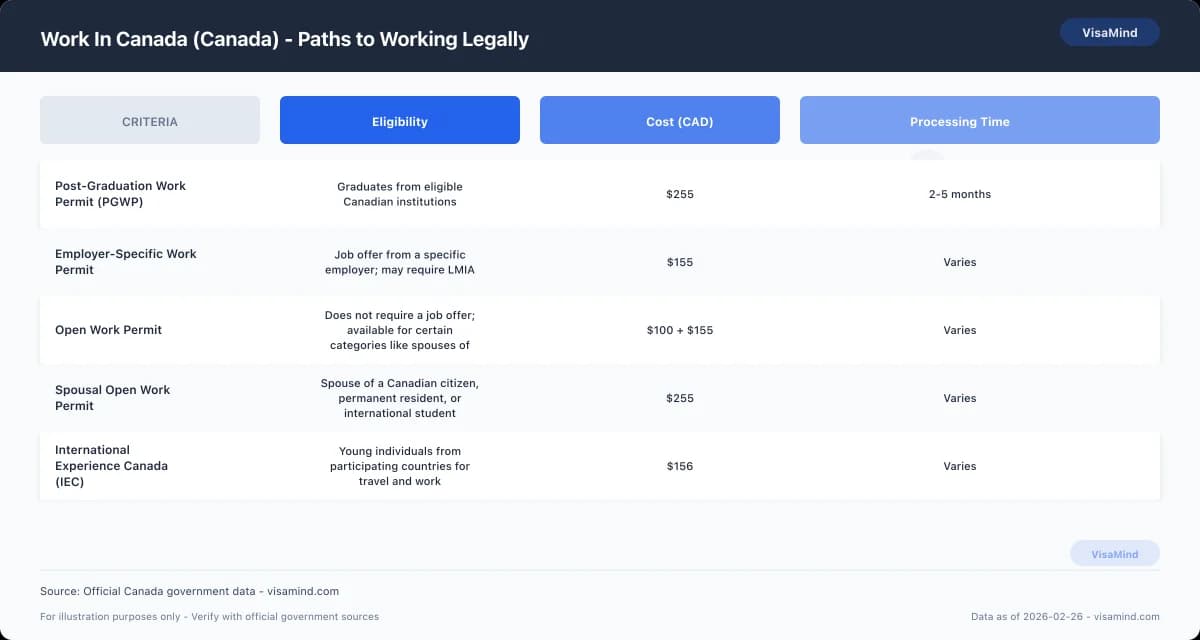
To legally work in Canada, you'll need to navigate a variety of work permit options tailored to different circumstances and work types. As of 2024, work permits are primarily managed by Immigration, Refugees and Citizenship Canada (IRCC). Here's an overview of the main work visa categories available to foreign nationals seeking to work in Canada:
Work Visa Categories
| Visa Type | Eligibility | Cost (CAD) | Timeline (Approximate) |
|---|---|---|---|
| Post-Graduation Work Permit (PGWP) | Graduates of Canadian post-secondary institutions | $255 | 2-3 months |
| Employer-Specific Work Permit | Job offer from a Canadian employer; often requires a Labour Market Impact Assessment (LMIA) | $155 | 2-4 months, depending on LMIA processing time |
| Open Work Permit | Spouses/partners of certain workers and students, or applicants under special programs | $255 | 2-3 months |
| Spousal Open Work Permit | Spouses of skilled workers or international students | $255 | 2-3 months |
| International Experience Canada (IEC) | Young adults from countries with bilateral agreements with Canada | Varies by country | Seasonal, varies by country |
Key Considerations
-
Post-Graduation Work Permit (PGWP): This permit is ideal for international students who have completed a program of study at a designated learning institution in Canada. It allows graduates to gain valuable Canadian work experience, which may contribute towards permanent residency through programs like Express Entry.
-
Employer-Specific Work Permits: Often tied to a specific job and employer, these permits usually require a positive LMIA, which demonstrates that the employment of a foreign national will not negatively impact Canadian jobs. Employers must provide a job offer and meet certain conditions. For an in-depth understanding of LMIA processes, refer to the LMIA Tfwp Guide.
Important: Ensure that your employer provides a valid job offer and, where necessary, a positive LMIA to avoid delays in your application process.
-
Open Work Permits: These permits allow you to work for any employer in Canada, except for those who are listed as ineligible on the IRCC website. Open work permits are less restrictive, giving you flexibility if you plan to switch jobs or employers.
-
Spousal Open Work Permit: Available to spouses or common-law partners of skilled workers and full-time students, this permit facilitates family accompaniment and integration into Canadian society.
-
International Experience Canada (IEC): This category provides an opportunity for young individuals from participating countries to travel and work in Canada, fostering cultural exchange and personal development.
Applying for a Work Visa
-
Create an IRCC Account: Begin your application process by creating an account on the IRCC's official website. This portal allows you to manage your application and track its status.
-
Gather Required Documents: Depending on the visa type, you will need different supporting documents, such as proof of identity, job offers, educational credentials, and LMIA results if applicable.
-
Submit Your Application: Follow the detailed instructions for your specific work permit category. Ensure that all sections are completed accurately to avoid common pitfalls in the application process.
Tip: Review the Work Permits Overview to understand eligibility criteria and application steps specific to your situation.
Navigating Canada's work permit system requires careful attention to the specifics of each visa category and a thorough understanding of the eligibility requirements. By selecting the right type of work permit, you can take an important step towards building a career in Canada.
What Your Employer Must Provide
#When hiring a foreign worker in Canada, employers must adhere to specific requirements set by Immigration, Refugees and Citizenship Canada (IRCC). Understanding these obligations is crucial to ensure compliance and facilitate a smooth application process for the prospective employee.
Labour Market Impact Assessment (LMIA)
One of the primary responsibilities of a Canadian employer looking to hire a foreign worker is to obtain a Labour Market Impact Assessment (LMIA) when necessary. An LMIA is a document that IRCC uses to assess the impact of hiring a foreign worker on the Canadian labor market.
- Purpose: Demonstrates that there is a need for a foreign worker to fill the job and that no Canadian worker is available to do so.
- Application Process: Employers must apply through Employment and Social Development Canada (ESDC).
- Cost: As of 2023, the fee for an LMIA application is CAD $1,000 per worker.
- Exemptions: Some positions, such as those under the Global Talent Stream, may be exempt from requiring an LMIA.
Important: Failing to secure a valid LMIA when required can lead to application refusal or delays.
Employer-Specific Work Permit
In cases where a foreign worker is applying for an employer-specific work permit, employers must provide a job offer through the IRCC Employer Portal. This job offer should include:
- Job Title and Description: Clearly outline the duties and responsibilities.
- Wages and Benefits: Specify the pay and any additional benefits offered.
- Employment Duration: Indicate the start date and expected duration of employment.
- Work Location: Provide the full address of the place of work.
Compliance with Canadian Laws
Employers must also ensure compliance with all relevant Canadian employment laws and standards. This includes adhering to:
- Minimum Wage Requirements: Paying at least the minimum wage as set by provincial or territorial legislation.
- Health and Safety Standards: Ensuring a safe work environment as per the Occupational Health and Safety Regulations.
- Employment Standards: Following the regulations concerning hours of work, overtime, and leave entitlements.
Nomination for Provincial Programs
For certain immigration pathways like the Provincial Nominee Program (PNP), employers may need to provide additional support:
- Nomination Support: Employers might need to submit a formal letter of support for the worker's nomination.
- Commitment to Employment: Demonstrate a genuine intent to employ the worker upon their arrival or upon receiving permanent residency.
By fulfilling these requirements, employers can effectively contribute to the success of their prospective employees' applications, whether they are pursuing temporary work permits or pathways to permanent residency in Canada. For more details on specific requirements for different work permits, refer to the Work Permits Overview.
Step-by-Step Work Visa Application
#-
Determine Your Eligibility
Before applying to work in Canada, ensure you meet the eligibility requirements for the specific type of work visa you are interested in. The eligibility criteria can differ significantly between programs. For instance, the Post-Graduation Work Permit (PGWP) is available to recent graduates of Canadian educational institutions, while the Work Permit (Employer-Specific) requires a job offer from a Canadian employer. Always check the latest updates on eligibility, as some programs, like the Home Child Care Provider and Home Support Worker Pilots, have closed to new applicants as of June 17, 2024.
-
Create an Online Account
You need to create a Permanent Residence Portal account or sign in if you already have one. This account will be necessary to manage your application and track its progress. The portal is user-friendly and allows you to complete much of the process online, including submitting required documents and paying fees.
-
Gather Required Documents
Collect all necessary documents before starting your application. These typically include proof of work experience, a valid passport, a job offer letter (if applicable), and any other documents specified by the program guidelines. It's important to review the instructions carefully for your specific category to ensure you have everything needed.
-
Submit Your Application
Complete your application by filling out all required sections accurately. Be sure to include all necessary supporting documentation. As of the latest guidelines, the application process may involve submitting your forms and documents online via the IRCC's official portal.
Tip: Ensure that your application is for an open program to avoid unnecessary delays or rejections.
-
Pay the Applicable Fees
Processing fees vary depending on the type of work permit you are applying for. It's crucial to pay the correct fee to avoid processing delays. Verify the most current fee structure on the official IRCC website, as changes can occur.
-
Wait for a Decision
After submitting your application, you will need to wait for a decision from the IRCC. Processing times can vary based on the type of application and the volume of applications being processed. You can check the status of your application through your online account.
Important: Missing documents or incorrect information can lead to delays or refusals, so double-check your submission.
For more detailed guidance on work permits, consider reviewing the Work Permits Overview and the LMIA Tfwp Guide for insights into employer-specific permits.
Worker Rights and Restrictions
#In Canada, the ability to change employers largely depends on the type of work permit you hold. If you have an employer-specific work permit, also known as a closed work permit, you are generally tied to the employer listed on your permit. To switch employers, you would need to apply for a new work permit, which may involve obtaining a new Labour Market Impact Assessment (LMIA) unless you qualify for an exemption.
On the other hand, an open work permit allows you to work for any employer in Canada, giving you the flexibility to switch jobs without needing a new permit. For more information on different types of work permits, you can explore the Open Work Permit and Work Permit (Employer-Specific) options.
Important: Always ensure your new employer is authorized to hire foreign workers and that you are complying with the conditions of your work permit.
Can Family Join You?
Family members can often accompany you to Canada while you work, but this depends on your specific situation and the type of work permit you hold. Spouses or common-law partners of skilled workers in Canada may be eligible for a Spousal Open Work Permit. Additionally, dependent children can usually attend school without a separate study permit. However, specific eligibility criteria must be met, and it is advisable to consult the Family Sponsorship Guide for detailed information.
Can You Study While Working?
If you plan to study while working in Canada, you may need to apply for a separate Study Permit. Generally, if your course of study is longer than six months, a study permit is required. However, short courses that last six months or less can be taken without a study permit. For those aiming to transition from study to permanent residency, the Study To PR pathway might be worth exploring.
Tip: Having both a work permit and a study permit can enhance your experience in Canada, allowing for both professional advancement and educational growth.
The Long-Term Path
#Navigating the long-term path to permanent residency (PR) in Canada through work opportunities involves understanding how work visas can serve as a stepping stone. Securing a work visa not only opens doors for immediate employment but can also pave the way to becoming a permanent resident.
Pathways from Work Visa to Permanent Residency
Canada offers several pathways for transitioning from a temporary work visa to permanent residency. For many temporary workers, programs like the Express Entry system become a viable option. This system manages applications for three economic immigration programs: the Federal Skilled Worker Program, the Federal Skilled Trades Program, and the Canadian Experience Class.
Here’s how a work visa can lead to PR:
- Canadian Experience Class (CEC): If you've worked in Canada for at least one year in a skilled occupation, you may qualify for the CEC, a key component of Express Entry.
- Provincial Nominee Program (PNP): Several provinces offer nomination pathways that cater to workers with specific skills, work experience, and job offers in that province. More details can be found in the PNP Guide.
- Home Care Worker Pilots: Although closed to new applicants as of June 17, 2024, these pilots were designed to help caregivers transition to PR after gaining Canadian work experience.
Timeline for Transitioning to Permanent Residency
The timeline from obtaining a work visa to becoming a permanent resident can vary based on several factors, including the immigration program you choose and your specific circumstances. Below is a typical timeline for those considering the Express Entry path:
| Step | Estimated Timeframe |
|---|---|
| Obtain a Work Visa | 2 to 6 months |
| Gain Canadian Work Experience | Minimum 1 year |
| Apply through Express Entry | Invitation within 6 months |
| Receive PR Decision | 6 months post-application |
Tip: It's crucial to maintain your legal status in Canada while your PR application is in process. Consider options like a Bridging Open Work Permit to avoid gaps in employment authorization.
Important Considerations
When planning your path to PR, consider the following:
- Eligibility Requirements: Ensure you meet the eligibility criteria for your chosen pathway. For instance, Express Entry requires you to demonstrate language proficiency and have your education credentials assessed.
- Documentation: Gather and maintain accurate records of your work experience in Canada. This is critical for proving your eligibility in programs like CEC.
- Closed Programs: Avoid applying to programs no longer accepting new applicants, such as the Live-in Caregiver Program or the Home Support Worker Pilot.
Important: Verify the latest information on program availability and eligibility on the IRCC's official website, as policies and requirements can change.
By understanding these pathways and timelines, you can effectively plan your transition from a temporary worker to a permanent resident in Canada, opening up new opportunities for you and your family.
Common Refusal Reasons for Work Visas
#Refugees and Citizenship Canada (IRCC), it's important to be aware of common refusal reasons to improve your chances of success.
Incomplete or Incorrect Documentation
-
Missing Documents: Not providing all required documentation is a frequent cause of refusal. Ensure you gather all necessary documents as specified for your visa category, such as proof of work experience or educational qualifications.
-
Incorrect Information: Double-check that all information in your application is accurate and consistent. Discrepancies or errors can lead to delays or denials.
Tip: Use the Work Permit Checklist to ensure you have all required documents before submission.
Eligibility Issues
-
Applying to Closed Programs: Some programs, like the Home Child Care Provider Pilot and Home Support Worker Pilot, are closed to new applicants. Verify program eligibility dates on the official IRCC website before applying.
-
Ineligible Work Experience: Ensure your work experience meets the requirements for the specific visa category. Incorrectly classifying your occupation can lead to a refusal.
Financial Proof Insufficiencies
-
Insufficient Funds: Demonstrating adequate financial resources is crucial. Be prepared to provide proof of funds to support yourself during your stay.
-
Inadequate Job Offer Verification: If applying for an employer-specific work permit, ensure your job offer meets IRCC's standards. Consider using resources like the Work Permit Job Offer Verification guide for more information.
Misidentifying Visa Types
- Incorrect Visa Application: Applying for the wrong type of visa is a common mistake. Carefully review options such as the Open Work Permit and Spousal Open Work Permit to determine which best suits your situation.
Important: Submitting an application for a closed or incorrect visa type can lead to automatic refusal. Always verify current program availability and eligibility criteria on the IRCC website.
The Financial Side of Working Abroad
#Important: Before applying for a work visa or permit, ensure that the program you're interested in is open to new applicants. Some pathways, such as the Home Child Care Provider Pilot, closed applications on June 17, 2024.
Financial Requirements for Work Permits
When considering working in Canada, it's crucial to understand the financial aspects, including salary thresholds, minimum income requirements, and application fees. Different types of work permits have varied financial considerations which are outlined below.
Salary Thresholds and Minimum Income
For most work permits, Canada does not impose a specific salary threshold. However, the salary offered must comply with Canadian labor standards and be aligned with the prevailing wage for the occupation in the specific region. This ensures that you are compensated fairly according to Canadian norms.
Application Fees and Costs
Here is a comparison of application fees for different types of work permits:
| Visa Type | Application Fee (CAD) | Processing Time (weeks) |
|---|---|---|
| Post-Graduation Work Permit (PGWP) | $255 | 6-8 |
| Employer-Specific Work Permit | $155 | 8-12 |
| Open Work Permit | $255 | 8-10 |
| International Experience Canada (IEC) | $156 | 4-6 |
Tip: To avoid unexpected delays, apply online. This method provides immediate confirmation and receipt numbers, which can be crucial for tracking your application status.
Considerations for Caregiver Work
While many caregiver-specific pathways have closed to new applicants, those already holding a valid permit can still pursue work opportunities in Canada. Caregivers should ensure their salary meets the minimum wage requirements in their province or territory and that any employment agreements are in compliance with local labor laws. For more information on caregiver pathways, you can visit the Caregiver Work section.
For comprehensive guidelines on work permit applications, refer to the Work Permit Checklist to ensure all required documents and criteria are met before submission.
Labour Market Impact Assessment
#Employers in Canada who wish to hire foreign workers through employer-specific work permits may need to obtain a Labour Market Impact Assessment (LMIA). This assessment is crucial to demonstrate that hiring a foreign worker will not negatively impact the Canadian labor market.
Steps to Obtain an LMIA
-
Determine LMIA Requirement: Before proceeding, verify whether the position requires an LMIA. Some work permits, like those under the International Mobility Program, may be exempt from this requirement.
-
Job Advertisement and Recruitment: Employers must advertise the job vacancy in the Canadian job market, typically for at least four weeks. This step ensures that Canadian citizens and permanent residents have an opportunity to apply first.
-
Submit the LMIA Application: After completing the recruitment efforts, employers must submit an LMIA application to Employment and Social Development Canada (ESDC). This application includes details about the job offer, recruitment efforts, and the impact of hiring a foreign worker on the Canadian labor market.
-
Await LMIA Decision: Once submitted, ESDC will assess the application. The processing time can vary, so it's advisable to check the Processing Times Explained for current estimates.
-
Receive and Share LMIA Decision: If approved, the employer receives a positive LMIA, which the foreign worker can then use to apply for a work permit. If the LMIA is negative, the employer may need to reassess their recruitment strategy or job offer.
Important: A positive LMIA does not guarantee a work permit approval. The foreign worker must still meet immigration requirements as determined by IRCC.
Employer Requirements for LMIA
Employers must comply with several requirements when applying for an LMIA:
- Wages and Working Conditions: The offered wages and working conditions must meet or exceed industry standards in Canada.
- Financial Viability: Employers need to show they have a legitimate business and can fulfill the terms of the job offer.
- Compliance History: Employers should maintain a positive compliance history with Canadian labor laws and regulations.
Tip: Employers can consult the LMIA Tfwp Guide for detailed instructions and examples of successful applications.
Linking the LMIA process with programs like the Global Talent Stream can expedite certain applications. However, eligibility criteria and processing times may differ, so it's essential to verify current guidelines on the official IRCC website.
Tax Obligations for Workers
#When working in Canada, understanding your tax obligations is crucial. As a worker, you are required to adhere to Canadian tax laws, which include filing income taxes, making social security contributions, and potentially managing double taxation treaties if applicable.
Income Tax Obligations
If you earn income in Canada, you must file an income tax return with the Canada Revenue Agency (CRA). The deadline for filing your tax return is typically April 30th of the following year. You will need to report all sources of income, including employment earnings and any other taxable benefits.
- Income Tax Return Deadline: April 30th
- Required Forms: T4 slip (provided by your employer), relevant deductions
Tip: Ensure that you maintain a record of all income and tax-related documents to simplify the filing process.
Social Security Contributions
In Canada, workers contribute to social security programs, such as the Canada Pension Plan (CPP) and Employment Insurance (EI). These contributions are typically deducted from your paycheck by your employer.
- CPP Contribution Rate (as of 2023): 5.95% of pensionable earnings
- EI Contribution Rate (as of 2023): 1.58% of insurable earnings
Double Taxation Treaties
Canada has tax treaties with many countries to prevent double taxation of income. If you are from a country with which Canada has a tax treaty, you may be able to avoid or reduce taxes in one of the countries.
- Key Documents: Tax residency certificate or equivalent documentation from your home country
- Action Required: Contact the CRA or a tax professional to understand treaty benefits
Important: Misunderstanding your tax obligations can lead to penalties. Consult with a tax advisor if you are unsure about your tax situation.
For further guidance on work permits and related obligations, consider checking out our Work Permits Overview and Caregiver Work pages.
What Other Workers Experienced
#A caregiver from the Philippines, Maria, sought to work in Canada under the Home Child Care Provider Pilot. Unfortunately, she discovered that applications had closed on June 17, 2024. Despite this setback, Maria decided to explore other options within Canada's immigration system. She learned about the Open Work Permit available for certain applicants, which could offer her the flexibility to work in various sectors. Maria created a Permanent Residence Portal account with IRCC to assess her eligibility for other programs and began gathering the necessary proof of her work experience. By pivoting her strategy, Maria successfully lodged an application under a different work permit category, securing a position in a related field within six months.
Scenario: Transitioning from Temporary to Permanent Status
John, a caregiver from Nigeria, had been working in Canada under the Live-in Caregiver Program since 2013. With the program closed to new applicants, John was concerned about his prospects for permanent residency. He had received his initial work permit based on a Labour Market Impact Assessment (LMIA) submitted before December 2014, which made him eligible to apply for permanent residency under the program's rules. John diligently submitted his proof of work experience and used the Permanent Residence Portal to monitor the status of his application. After a thorough review lasting approximately a year, John's application was approved, and he successfully transitioned to permanent resident status in Canada.
Scenario: Overcoming Application Pitfalls
Emily, a caregiver from India, was eager to apply for permanent residency through Canada's caregiver pathways. However, she realized she had mistakenly prepared to apply for a closed program. Upon consulting with an immigration consultant, Emily was advised to consider the Bridging Open Work Permit while her permanent residency application was in process. This permit allowed her to continue working without interruption. Emily used the IRCC's Visa Application Steps guide to ensure she completed her application accurately. By avoiding common pitfalls such as applying to closed programs, Emily maintained her eligibility and was able to continue her work in Canada seamlessly.
FAQs
What are the common refusal reasons for Work Visas in Canada?
How does the Labour Market Impact Assessment affect my Work Permit application in Canada?
Is it possible to apply for a Spousal Open Work Permit while in Canada on a student visa?
What financial considerations should I be aware of when working in Canada (Canada)?
Can I combine my work experience from a Work Permit with studies in Canada?
What steps are involved in the Work Visa application process with IRCC?
How does the closure of caregiver programs affect my Work In Canada (Canada) application?
Sources
Last reviewed: March 1, 2026
VisaMind provides informational guidance only and is not a government agency. This is not legal advice. Requirements can change and eligibility depends on your specific facts. If your case is complex or high-stakes, consult a licensed immigration attorney.
Next steps
Requirements vary by nationality, purpose, timeline, and case details. Use Find My Visa to get a personalized checklist for Canada with official sources and deadlines.
Find my visa