Your Work Visa Options
#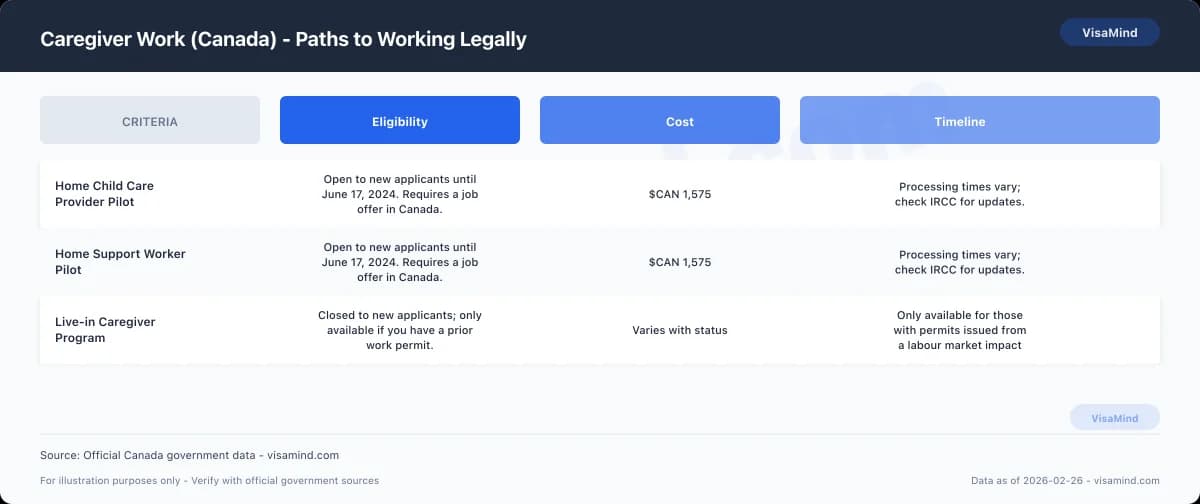
Canada offers a variety of work visa options for caregivers, each with its own set of eligibility criteria, costs, and processing timelines. As of 2023, two main pathways are available for caregivers looking to work in Canada: the Home Child Care Provider Pilot and the Home Support Worker Pilot. Here is a comparative overview of these options:
| Visa | Eligibility | Cost | Timeline |
|---|---|---|---|
| Home Child Care Provider Pilot | Must have a job offer in Canada and meet language, education, and work experience requirements. | CAD $1,050 | Processing times often vary; check the Processing Times Explained for updates. |
| Home Support Worker Pilot | Must have a valid job offer in Canada and meet specific language, education, and work experience criteria. | CAD $1,050 | Processing times may fluctuate; refer to the IRCC website for the latest details. |
Key Features of the Caregiver Visa Options
Both the Home Child Care Provider Pilot and the Home Support Worker Pilot allow caregivers to work temporarily in Canada, with the potential to apply for permanent residence after gaining the required work experience. These pilots are designed to facilitate the entry of caregivers into Canada while ensuring they meet the necessary requirements.
Important: Applications for both pilots are accepted until June 17, 2024. It's crucial to apply before this deadline to be considered.
Eligibility Criteria
For both pilot programs, you must have:
- A genuine job offer from a Canadian employer.
- At least one year of Canadian post-secondary education or its foreign equivalent.
- A minimum of 24 months of full-time work experience in Canada as a caregiver.
- Proficiency in English or French, demonstrated through standardized language tests.
Application Process
- Gather Required Documents: Collect evidence of your job offer, educational qualifications, work experience, and language proficiency.
- Create an IRCC Account: Access the Permanent Residence Portal to start your application.
- Submit Your Application: Ensure all documents are complete and submitted before the program's closing date.
Tip: Always keep copies of your application and supporting documents for your records.
Additional Work Visa Options
Aside from caregiver-specific pathways, other work visas like the Bridging Open Work Permit and LMIA Work Permit might also be relevant, depending on your situation. Each pathway has distinct requirements, so reviewing the Work Permits Overview can provide further insights into your options.
By understanding these visa options, you can better navigate the process of working as a caregiver in Canada and explore potential pathways to permanent residency. Always verify the latest information on the official IRCC website to ensure compliance with current immigration policies and deadlines.
Employer Sponsorship Requirements
#Employing a caregiver in Canada requires navigating specific sponsorship requirements. Employers must understand these obligations to ensure a smooth process for hiring foreign caregivers.
Employer Requirements
Employers looking to hire caregivers under the Home Child Care Provider Pilot or Home Support Worker Pilot need to be aware of several key requirements. Firstly, employers must demonstrate that they have made reasonable efforts to hire a Canadian citizen or permanent resident before offering the position to a foreign worker. This involves conducting a Labour Market Impact Assessment (LMIA), a process managed by Employment and Social Development Canada (ESDC).
Employers must:
- Provide a genuine job offer, detailing the caregiver's responsibilities.
- Ensure the caregiver will work in a safe environment.
- Meet provincial or territorial employment standards, including wage requirements.
What is a Labour Market Impact Assessment (LMIA)?
An LMIA is a document that an employer in Canada may need before hiring a foreign worker. It serves to verify that there is a need for a foreign worker to fill the job and that no Canadian worker is available to do so. The process involves several steps and requires employers to provide substantial evidence of their efforts to hire locally.
Key points about the LMIA:
- Cost: As of 2023, the processing fee is approximately CAD $1,000. Verify on the official website for current fees.
- Processing time: Varies, but it can take several weeks.
- Validity: Typically valid for six months after issuance.
Tip: Applying for an LMIA early helps avoid delays in hiring and ensures that all documentation is in order.
Job Offer Specifics
The job offer for a caregiver must include specific details to meet IRCC requirements. It should clearly outline the terms of employment, including wages, duties, and working conditions. This is crucial for both the LMIA process and the caregiver's subsequent application for a work permit.
Essential elements of the job offer:
- Position title and duties: Clearly defined roles such as "child care provider" or "support worker."
- Wages: Must meet or exceed the median wage in the specific province or territory.
- Work hours: Clearly state the number of hours per week.
Compliance and Monitoring
Once a caregiver begins work, employers must comply with the terms set forth in the LMIA and job offer. This includes paying the agreed wages and providing a safe workplace. Employers may be subject to inspections by ESDC to ensure compliance.
Important: Failing to comply with LMIA conditions can result in penalties and the inability to hire foreign workers in the future.
For more detailed information on work permits related to hiring caregivers, refer to the LMIA Work Permit guide. Understanding these requirements ensures both the employer and caregiver can proceed smoothly through the immigration and employment process.
How to Apply for a Work Visa
#-
Determine Your Eligibility
Before you apply for a work visa under the caregiver category in Canada, it's crucial to ensure you meet the eligibility criteria specific to your situation. The two main pilots under which you may apply are the Home Child Care Provider Pilot and the Home Support Worker Pilot. Note that new applications are accepted only until June 17, 2024. Ensure you have proof of relevant work experience as a caregiver, as this is a critical requirement.
-
Create an Account on the Permanent Residence Portal
To start your application, you need to create an account or sign in to the Permanent Residence Portal. This portal is where you will submit your application and track its status. Having an account also allows you to receive updates and communicate with the IRCC directly.
-
Gather Required Documents
Gather all necessary documents before initiating your application. This includes proof of your caregiver work experience, educational credentials, and any other documents specified in the instructions relevant to your chosen pilot. Reviewing the Work Permits Overview guide can provide additional insights into documentation and requirements.
-
Complete Your Application
Carefully complete all required sections of the application. The IRCC provides detailed instructions for each pilot, which you should review to ensure you understand the specific requirements applicable to your case. Any errors or omissions could delay the processing of your application.
Important: Submitting your application after the program closing date will result in your application not being processed. Make sure to adhere to all deadlines.
-
Pay the Application Fee
Once your application is complete, you must pay the associated fee. The fee can be paid online through the IRCC website. Keep a copy of the payment receipt, as you will need to include it with your application.
-
Submit Your Application
After completing your application and ensuring all documents and fees are in order, submit your application through the portal. Submitting online is recommended as it provides immediate confirmation and a receipt number, which helps in tracking the status of your application.
Tip: File online to avoid mail delays and get a receipt number immediately.
-
Follow Up on Your Application
After submission, use the portal to track the status of your application. The IRCC may request additional information or documents, so it's important to check your account regularly and respond promptly to any communications.
For more detailed guidance on work permits in Canada and how they fit into your permanent residence plans, consult the PR Pathways Overview.
What You Can and Cannot Do
#As a caregiver working in Canada, you may have the option to change employers, but it depends on the type of work permit you possess. If you are working under an employer-specific work permit, you are tied to the employer mentioned in your permit. To change employers, you must apply for a new work permit. On the other hand, if you hold an Open Work Permit, you have the flexibility to switch employers without applying for a new permit. For more detailed advice, you can refer to the Work Permits Overview.
Important: Always ensure your new employment complies with the conditions of your work permit to avoid any legal issues.
Can Family Join You?
Yes, your family members can accompany you to Canada, but there are several conditions. Spouses or common-law partners may be eligible to apply for an Open Work Permit, allowing them to work for any employer in Canada. Dependent children can join as well and may need to apply for a Study Permit if they wish to attend school.
Can You Study?
If you wish to study while working as a caregiver in Canada, you need to understand the conditions of your work permit. Generally, to enroll in a program that is more than six months in duration, you will need to apply for a separate Study Permit. Short courses, however, might not require a study permit.
Tip: If you're considering a transition from work to study, explore pathways like Study to PR to understand how studying in Canada might contribute to your permanent residency objectives.
Summary of What You Can and Cannot Do
Here's a quick overview of what caregivers on work permits can do in Canada:
| Action | Permissibility | Notes |
|---|---|---|
| Change Employers | Conditional | Requires a new work permit unless you have an Open Work Permit. |
| Bring Family | Yes | Family members may need separate permits (e.g., Open Work Permit, Study Permit). |
| Enroll in Long Programs | Conditional | Requires a Study Permit for programs longer than six months. |
For those aiming to transition from a caregiver work permit to permanent residency, consider exploring relevant pathways and requirements. More details can be found in the Permanent Residence guide.
From Work Visa to PR
#Navigating the pathway from a work visa to permanent residency (PR) in Canada as a caregiver involves a series of steps that align with specific programs managed by Immigration, Refugees and Citizenship Canada (IRCC). The journey is facilitated through programs such as the Home Child Care Provider Pilot and the Home Support Worker Pilot, which offer structured routes to transition from temporary work to becoming a permanent resident.
Transitioning from Work Visa to Permanent Residence
Once you begin working in Canada under one of the caregiver pilot programs, you can start planning your transition to permanent residence. The key is accumulating the required work experience and ensuring you meet all application criteria.
-
Work Experience Requirement: You must have at least 24 months of full-time work experience in Canada in an eligible caregiver occupation. This experience should align with the duties outlined in your work permit.
-
Eligibility: Check your eligibility for the Home Child Care Provider Pilot or Home Support Worker Pilot, as these are specifically designed to facilitate the transition to PR for caregivers. Ensure your work experience is relevant and documented.
Important: The Live-in Caregiver Program is closed to new applicants unless you held a work permit based on a labour market impact assessment submitted before December 2014.
The Application Process for Permanent Residency
To apply for PR, you need to follow a structured process through IRCC’s Permanent Residence Portal. Here’s a general outline:
-
Create or Sign In to Your Account: Access the Permanent Residence Portal to start your application. This portal helps streamline the process and keep track of your application status.
-
Gather Required Documents: Assemble all necessary documents, including proof of work experience, language proficiency results, and any other supporting evidence that IRCC requires for your specific category.
-
Submit Your Application: Ensure that your application is complete and submitted before the program's closing date. Late submissions will not be accepted.
-
Wait for Processing: Processing times vary, but IRCC provides estimates which you can verify on their official website. During this time, you might be required to provide additional information or attend interviews.
Timelines for Transition
The transition from a work visa to PR can take several months to years, depending on various factors such as processing times and the completeness of your application. Here’s a general timeline:
| Stage | Estimated Timeframe |
|---|---|
| Work Experience Accumulation | 24 months (full-time work) |
| PR Application Processing | 6-12 months (verify on website) |
Considerations for Caregivers
As you prepare for this transition, there are a few considerations to keep in mind:
-
Maintaining Work Status: Ensure your work permit remains valid throughout the application process. Consider applying for a Bridging Open Work Permit if necessary.
-
Program Closing Dates: Be aware of the closing dates for the caregiver pilot programs to ensure your application is submitted within the eligible timeframe.
-
Seek Assistance: Consider consulting with an immigration advisor if you need assistance navigating the process or understanding specific requirements.
Tip: Regularly check the Permanent Residence section on IRCC's official site for updates on processing times and program details.
What Goes Wrong
#Several factors can lead to a refusal. Understanding these common pitfalls can help you avoid them:
-
Insufficient Proof of Work Experience
- You must provide clear and verifiable evidence of your previous caregiving experience. This can include employment letters, pay stubs, and references from past employers.
- Ensure all your documents are translated into English or French if necessary.
-
Missing or Incomplete Documentation
- Missing documents are a frequent reason for application rejection. Carefully review the requirements for your specific eligibility category and ensure all documents are included and complete.
-
Eligibility Missteps
- Applications submitted after program deadlines, such as the Home Child Care Provider Pilot and Home Support Worker Pilot, are automatically refused. Confirm eligibility criteria and deadlines through Caregiver pathways.
Overcoming Common Pitfalls
By taking proactive steps, you can avoid common mistakes that lead to refusals.
-
Timely Submission
- Double-check submission deadlines and program closing dates. Applications received after these dates will not be processed.
-
Clear Communication
- Consistency in your application materials is crucial. Ensure all personal information matches across documents such as your passport, work permits, and references.
Tip: Use the Visa Application Steps guide to ensure you follow the correct application process.
Additional Considerations
-
Program-Specific Requirements
- Each caregiver program may have unique requirements. Make sure you review the specifics related to your application type, such as the PR Pathways Overview, to avoid unnecessary delays.
-
Language Proficiency
- Demonstrating adequate language skills in English or French may be necessary, depending on your program. Verify the language requirements for your pathway and prepare accordingly.
By ensuring all required elements of your application are complete and submitted on time, you can significantly improve your chances of success when applying through Canada's caregiver work pathways.
Salary Thresholds and Fees
#Important: Meeting the salary thresholds and fee requirements is crucial for your caregiver work application to be processed successfully.
Salary Thresholds
For those applying through caregiver programs like the Home Child Care Provider Pilot or the Home Support Worker Pilot, meeting specific salary thresholds is essential. While the exact salary thresholds can vary based on location and role, caregivers are generally expected to receive compensation that aligns with the prevailing wage for their occupation in their specific region. This ensures that caregivers are paid fairly and that the local job market is not adversely affected.
Minimum Income Requirements
In addition to salary thresholds, applicants may need to demonstrate that their prospective employer meets a certain minimum income requirement. This serves to confirm the employer's financial capacity to pay the caregiver’s salary consistently. It's important to verify these financial criteria on the official IRCC website as they can change annually.
Application Fees
Applying for a caregiver work permit involves several fees. Below is a table summarizing the fees associated with this process:
| Fee Type | Cost (CAD) as of 2023 | Purpose |
|---|---|---|
| Work Permit Processing Fee | $155 | Processing the work permit |
| Open Work Permit Holder Fee | $100 | If applying for an open work permit |
| Biometrics Fee | $85 | Required for identity verification |
Tip: Use the Work Permits Overview guide for detailed steps on how to gather and submit your documents effectively.
Special Considerations
If you are transitioning to permanent residence, additional fees may apply. These include fees for medical exams, police certificates, and possibly language tests, depending on your specific pathway. For a comprehensive understanding of permanent residence pathways, refer to the Permanent Residence section.
Ensure that all fees are paid in full at the time of your application to avoid processing delays. Always check the current fee structure on the IRCC website before submitting your application, as fees can change without notice.
The LMIA Process
#The Labour Market Impact Assessment (LMIA) is an essential step for Canadian employers looking to hire foreign caregivers. The LMIA process ensures that hiring a foreign worker will not negatively impact the Canadian labor market.
Step-by-Step LMIA Process
-
Determine LMIA Requirement
Before hiring a foreign caregiver, employers must check whether an LMIA is required. Most caregiver positions will need a positive LMIA, which demonstrates that there are no Canadians or permanent residents available to fill the position.
-
Submit LMIA Application
Employers must submit an LMIA application to Employment and Social Development Canada (ESDC). This application includes detailed information about the job offer and proof of recruitment efforts to hire a Canadian or permanent resident. Employers should ensure they meet all necessary requirements and provide complete documentation.
-
Await LMIA Decision
After submission, ESDC will assess the application to determine its impact on the Canadian labor market. A positive LMIA indicates that the employer can hire a foreign caregiver. The processing time can vary, so employers should verify the current timelines on the official website.
Tip: It's beneficial to prepare all necessary documents and ensure the job offer aligns with Canadian labor standards to facilitate a smoother LMIA process.
Employer Responsibilities
Employers must meet certain obligations when hiring a caregiver. These include offering fair wages, ensuring proper working conditions, and maintaining records of their recruitment efforts. Fulfilling these responsibilities helps in obtaining a positive LMIA.
LMIA Exemptions
In some cases, hiring a caregiver might not require an LMIA. For instance, if an employer is eligible for certain categories under the International Mobility Program, they might be exempt. Employers can refer to the LMIA Vs IMP guide for more details.
Important: Employers failing to comply with LMIA requirements and responsibilities may face penalties or restrictions on hiring foreign workers in the future.
For further insights into work permits and the caregiver visa pathway, explore the Work Permits Overview and Caregiver sections.
Tax Rules for Foreign Workers
#When working in Canada as a caregiver, you are subject to Canadian income tax laws. As a foreign worker, you must report your worldwide income and pay taxes on your earnings in Canada. The Canada Revenue Agency (CRA) requires you to file an annual tax return if you earn income in Canada. The tax year runs from January 1 to December 31, and returns must typically be filed by April 30 of the following year.
Social Security Contributions
In addition to income tax, foreign caregivers in Canada are generally required to contribute to the Canada Pension Plan (CPP) and Employment Insurance (EI). These contributions are typically deducted from your salary by your employer.
- Canada Pension Plan (CPP): Provides retirement, disability, and survivor benefits.
- Employment Insurance (EI): Offers temporary income support if you lose your job, are on maternity leave, or need to care for a family member.
Double Taxation Treaties
Canada has tax treaties with many countries to prevent double taxation, where you pay taxes on the same income in both countries. These treaties often allow you to credit taxes paid in Canada against taxes owed in your home country. Check if your home country has a treaty with Canada to understand your obligations and potential tax relief.
Tip: Consult with a tax professional to ensure compliance with both Canadian and your home country's tax requirements and to take full advantage of any applicable treaties.
Important Considerations
- Tax Residency: Your tax obligations may differ based on whether you are considered a resident or non-resident for tax purposes. This determination depends on the length of your stay and your ties to Canada.
- Filing Requirements: Even if you are a non-resident, you still need to file a tax return if you earn income in Canada.
- Document Preparation: Gather pay slips, T4 slips (issued by your employer), and any other relevant financial documents to ensure an accurate tax filing.
For more details on how to manage your tax obligations while working in Canada, consider consulting resources such as the Work In Canada Guide or the Caregiver Visa information page.
Real Scenarios
#Maria, a caregiver from the Philippines, had been working in Canada under the Live-in Caregiver Program for several years. She was eligible to apply for permanent residence through this program because she had received her work permit based on a labour market impact assessment (LMIA) submitted before December 2014. To transition from her temporary status to a permanent resident, Maria created an account on the Permanent Residence Portal to submit her application online. She ensured all necessary documents, including proof of her caregiving experience in Canada, were included. After a thorough review by Immigration, Refugees and Citizenship Canada (IRCC), Maria received confirmation of her permanent residence status within a realistic timeline of approximately 12 months.
Scenario: Applying for the Home Support Worker Pilot
Ahmed, a caregiver from Egypt, was interested in moving to Canada under the Home Support Worker Pilot. He learned that applications for this pilot were accepted until June 17, 2024. Ahmed diligently gathered all required documentation, including proof of his work experience as a caregiver, and submitted his application through the official IRCC online portal. He carefully reviewed the eligibility instructions specific to the Home Support Worker Pilot before applying. After submitting his application, Ahmed received a work permit within eight months, allowing him to begin his career in Canada. He is now on the path to applying for permanent residence after gaining the necessary Canadian work experience.
Scenario: Navigating the Home Child Care Provider Pilot
Sophia, an experienced child care provider from India, decided to apply through the Home Child Care Provider Pilot. She was aware that applications for this pilot were open until June 17, 2024, and acted promptly to ensure her eligibility. Sophia registered a profile on the IRCC's Permanent Residence Portal and uploaded all required documentation, such as her employment references and proof of work experience. By following the step-by-step guidance provided by IRCC, Sophia successfully lodged her application. Within a year, she received her work permit and began working in Canada, with the ultimate goal of transitioning to permanent residency through this pilot program.
FAQs
How do I transition from a work visa to permanent residency under Caregiver Work (Canada)?
What happens if I submit my Caregiver Work (Canada) application after the deadline?
What is the LMIA process for Caregiver Work (Canada)?
Are there specific salary thresholds for Caregiver Work (Canada) applications?
How can I combine goals of working and studying in Canada under the Caregiver Work (Canada) program?
Can I switch from the Live-in Caregiver Program to a Caregiver Work (Canada) pilot program?
What are the tax rules for foreign workers under Caregiver Work (Canada)?
Sources
Last reviewed: March 1, 2026
VisaMind provides informational guidance only and is not a government agency. This is not legal advice. Requirements can change and eligibility depends on your specific facts. If your case is complex or high-stakes, consult a licensed immigration attorney.
Next steps
Requirements vary by nationality, purpose, timeline, and case details. Use Find My Visa to get a personalized checklist for Canada with official sources and deadlines.
Find my visa