Official sources referenced
Is This Comparison for You?
#In 2022, over 600,000 temporary foreign workers were employed in Canada, highlighting the importance of understanding the options available for working in the country. If you are a caregiver, skilled worker, or employer navigating Canada's immigration pathways, it's crucial to understand the differences between the Labour Market Impact Assessment (LMIA) and the International Mobility Program (IMP). This comparison is particularly relevant for those seeking to determine the most suitable route for temporary work or permanent residency in Canada.
Who Benefits from This Comparison?
This comparison is designed for individuals and employers involved in the Canadian immigration process, specifically those considering hiring foreign workers or applying to work in Canada. Understanding the distinction between LMIA and IMP can help applicants and employers choose the appropriate pathway based on their specific situations and needs. For example, caregivers looking to work temporarily or settle permanently in Canada can explore both options to find the best fit for their circumstances. Employers interested in hiring foreign workers will gain insights into the requirements and procedures associated with each program.
Why Compare LMIA and IMP?
The LMIA is a document that an employer in Canada may need to obtain before hiring a foreign worker. It verifies that there is a need for a foreign worker to fill the job, and that no Canadian worker is available to do it. In contrast, the IMP allows employers to hire foreign workers without the requirement for an LMIA, facilitating a quicker process under certain circumstances, such as international agreements or Canadian interests. Understanding these mechanisms can streamline your application process and ensure compliance with Canadian immigration laws.
Tip: Verify the specific requirements and processing times for each program on the official IRCC website, as they can significantly impact your decision-making process.
For further insights into specific visas and permits, you might consider exploring the Caregiver, Quebec Skilled Worker, and LMIA Work Permit options. These resources provide detailed information on eligibility and procedures tailored to different categories within Canada's immigration system.
At a Glance
#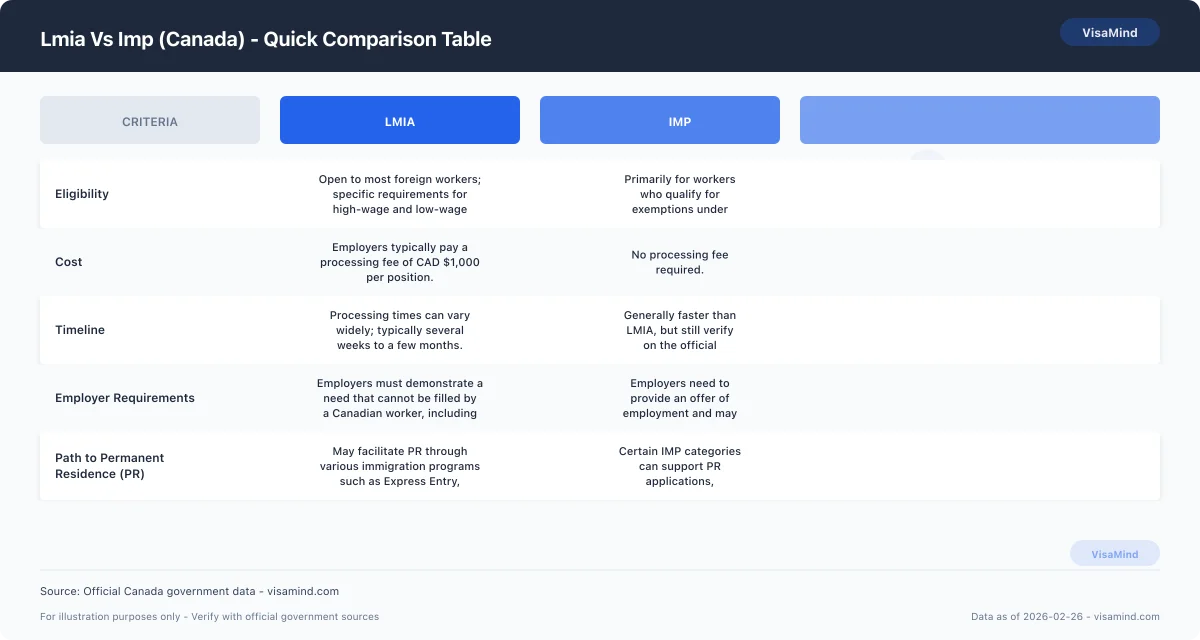
Two primary pathways stand out for employers and prospective employees: the Labour Market Impact Assessment (LMIA) and the International Mobility Program (IMP). Both serve distinct purposes and have unique requirements, making it important to understand their differences.
Key Differences at a Glance
| Aspect | LMIA | IMP |
|---|---|---|
| Eligibility | Open to most foreign workers; requires proof of job impact on Canadian labor market. | Primarily for intra-company transfers, trade agreements, and youth mobility agreements. |
| Cost | As of 2023, the processing fee is CAD $1,000 per position. Verify on the official website. | Generally, no fee for work permits under IMP. Verify specific conditions on the official website. |
| Timeline | Processing times can vary significantly; typically ranges from weeks to several months. | Often faster than LMIA, as the market impact assessment is not required. |
| Employer Requirements | Employers must demonstrate efforts to hire Canadian citizens or permanent residents first. | Employers are exempt from the LMIA process but must meet other specific program requirements. |
| Path to PR | Can lead to pathways like Express Entry if criteria are met. | May offer pathways to PR, depending on the specific category and work experience in Canada. |
Eligibility
Both the LMIA and IMP are designed to facilitate the entry of foreign workers, but their eligibility criteria differ significantly. The LMIA is typically necessary for positions where there is a need to prove that hiring a foreign worker will not negatively impact Canadian employment. On the other hand, the IMP is often used for situations where an employer can bypass this requirement, such as for intra-company transfers or under specific international agreements like NAFTA or CETA.
Cost and Timeline
The financial and time investment required for each process can be a determining factor. The LMIA has a standard fee and may take longer to process due to the detailed assessment required. Conversely, the IMP often offers a quicker turnaround as it skips the market impact assessment, and there are generally no fees involved for the permit itself. However, it's crucial to verify the specific conditions applicable to each situation on the official website.
Tip: To expedite processing, ensure all required documentation is complete and accurate before submission.
Employer Requirements
Employers opting for the LMIA must undergo a rigorous process, demonstrating that they have made genuine efforts to hire Canadian citizens or permanent residents before considering foreign workers. This includes advertising the job in Canada and providing detailed recruitment efforts. In contrast, the IMP allows for more straightforward entry, requiring employers to comply with specific program criteria but without the need for a labor market assessment.
Path to Permanent Residence
Both pathways can eventually lead to permanent residence, but the route can vary. For LMIA holders, programs like Express Entry are often pursued, given that an LMIA can significantly boost a candidate's profile. The IMP, depending on the category, might also open doors to permanent residence, particularly if the work experience gained is within an eligible stream.
When choosing between the LMIA and IMP, consider your specific circumstances, including the nature of the job offer, your long-term goals in Canada, and any existing international agreements that might apply to your situation. For more detailed guidance, explore our Work Permits Overview and the IMP Guide.
Option A Is Better When...
#A caregiver named Maria was working in Canada under a temporary work permit and wanted to transition to permanent residence. She was uncertain whether to pursue the Labour Market Impact Assessment (LMIA) route or the International Mobility Program (IMP), particularly given her specific role as a caregiver. Maria consulted the Caregiver Program guidelines provided by Immigration, Refugees and Citizenship Canada (IRCC) to better understand her options.
Maria discovered that the LMIA pathway would require her employer to demonstrate a need for her role that couldn't be filled by a Canadian. This process involved considerable paperwork and potential delays. Given her existing work experience and her goal to settle permanently in Canada, Maria opted for the IMP, which streamlined the process by allowing her to apply for permanent residence directly without needing a new LMIA. Using the Permanent Residence Portal, Maria submitted her application, along with proof of her work experience. Within eight months, Maria received confirmation of her permanent residence status.
Scenario: Quebec-Selected Skilled Worker
Jean-Paul, a software developer, was selected by the province of Quebec as a skilled worker. He was preparing to apply for permanent residence in Canada but was unsure whether to proceed through the LMIA process or leverage the IMP. After reviewing the Quebec Immigration Overview, Jean-Paul understood that he needed to apply through Quebec’s immigration system first before proceeding with his federal application.
The IMP was particularly advantageous for Jean-Paul because it provided a streamlined process that aligned with Quebec's selection criteria, bypassing the need for an LMIA. He lodged his application through the Quebec immigration portal and, after receiving the necessary approvals, transitioned smoothly to the federal application process. Within a year of his initial application, Jean-Paul successfully obtained permanent residency, allowing him to continue his career in Montreal.
Scenario: Employer-Sponsored Caregiver Transitioning to Permanent Status
A healthcare employer in Toronto sponsored a caregiver, Aisha, to work temporarily in Canada. With the employer's support, Aisha aimed to transition to permanent residence. The employer initially considered the LMIA route but found the IMP to be more beneficial due to its less cumbersome requirements.
The IMP allowed Aisha to continue working while applying for permanent residence, as it recognized her valuable contribution to the healthcare sector. By accessing the Permanent Residence Portal, Aisha submitted her application along with the necessary documentation, including proof of her work experience. This strategic choice facilitated Aisha's transition to permanent status within ten months, enabling her to secure her future in Canada without interruption to her employment.
When to Pick the Second Option
#Maria, a caregiver from the Philippines, was working in Canada on a temporary basis under the Caregiver Program. She was eager to transition to permanent residence after her work experience met the required threshold. Maria knew she could use the International Mobility Program (IMP) pathway due to her specific eligibility under the caregiver stream, which did not require a Labour Market Impact Assessment (LMIA).
To begin her transition, Maria needed to apply for permanent residence through the IRCC's Permanent Residence Portal. She ensured her application was supported by robust documentation, including proof of her work experience in Canada. After successfully lodging her application, Maria received confirmation of her eligibility and was granted permanent residence within approximately eight months. This transition allowed her to continue her career in Canada without the need for further temporary permits.
Scenario: Applying for a Work Permit Without an LMIA Requirement
John, a software developer from Australia, was offered a position with a tech company in Toronto. The company informed him that they could employ him through the Intra-Company Transfer stream, which falls under the International Mobility Program (IMP). This option was ideal because it allowed John to obtain a work permit without the need for an LMIA, which would typically require the employer to demonstrate that no Canadian worker could fill the position.
John's employer guided him through the process of applying for the work permit via the IMP, ensuring that all necessary documents were submitted to IRCC. After a processing period of around four weeks, John received his work permit and relocated to Toronto, where he began his new role. This streamlined process allowed both John and his employer to avoid the time-consuming LMIA application, facilitating a smoother transition to work in Canada.
Scenario: Navigating the Quebec Skilled Worker Program
Claire, a nurse from France, was interested in moving to Quebec to leverage her specialized skills. She learned that to apply as a Quebec-selected skilled worker, she first needed to secure a Quebec Selection Certificate (CSQ) before proceeding with her permanent residence application through IRCC. The IMP was not applicable in her case, as the Quebec Skilled Worker Program has its own distinct requirements and processes.
Claire began by applying for the CSQ through the Government of Quebec's immigration portal. Once she received her CSQ, she created a Permanent Residence Portal account to apply for permanent residence with IRCC. Claire's familiarity with both the Quebec and federal processes allowed her to seamlessly transition to permanent residence in Canada, completing the process in just over a year. Her dedication paid off, as she was able to continue her nursing career in Quebec, contributing her skills to the local healthcare system.
What Really Sets Them Apart
#Understanding the differences between the Labour Market Impact Assessment (LMIA) and the International Mobility Program (IMP) is crucial. These two pathways enable foreign workers to enter Canada, but they differ significantly in their requirements, processes, and outcomes.
Employer Requirements and Processes
One of the most significant differences between LMIA and IMP lies in employer involvement and requirements.
-
LMIA: Employers must prove that hiring a foreign worker will not negatively impact the Canadian labor market. This involves demonstrating that they have advertised the job to Canadian citizens and permanent residents first, and that no qualified candidates were found. This process can be time-consuming and involves a fee.
-
IMP: Under the IMP, employers do not need to obtain an LMIA. This program is designed to advance Canada’s broader economic and cultural interests. It includes various streams such as the Intra Company Transfer and Francophone Community Immigration. The absence of the LMIA requirement can expedite the hiring process.
Tip: Utilize the IMP Guide for specific streams that might apply to your situation, allowing for potentially quicker entry into Canada.
Work Permit Eligibility and Job Types
The type of work permit and the job opportunities available vary between the LMIA and IMP pathways.
-
LMIA Work Permit: Generally tied to specific job offers, LMIA-based permits require the job to be listed in Canada, and a positive LMIA must be obtained. These permits are often job-specific, meaning you can only work for the employer listed on your permit.
-
IMP Work Permit: These permits tend to be more flexible. For instance, the Open Work Permit under IMP allows you to change employers without requiring a new work permit. This flexibility can be advantageous for individuals seeking diverse opportunities or those whose employment circumstances change.
Pathway to Permanent Residency
Another critical differentiator is the pathway each provides towards permanent residency.
-
LMIA: Having a positive LMIA can support an application for permanent residency under pathways like Express Entry. It can provide additional points that enhance your profile in the pool.
-
IMP: While IMP-related work permits can lead to permanent residency, the pathway is often less direct. However, certain streams within IMP, such as the Quebec Skilled Worker program, offer routes to becoming a permanent resident, especially for those with specific skills or language proficiencies.
Important: Always verify the latest requirements and processes on the official IRCC website, as policies can change, impacting eligibility and application procedures.
In summary, the primary distinctions between LMIA and IMP revolve around employer obligations, work permit conditions, and pathways to permanent residency. Understanding these differences is essential for selecting the most appropriate route to work in Canada.
Common Misconceptions
#-
LMIA is Always Required: A common misconception is that a Labour Market Impact Assessment (LMIA) is necessary for all work permits in Canada. In reality, many work permits, such as those under the International Mobility Program (IMP), do not require an LMIA. The IMP allows for LMIA-exempt permits because they serve broader economic, cultural, or other competitive advantages for Canada.
-
LMIA Guarantees a Work Permit: Some believe that obtaining an LMIA automatically guarantees a work permit. However, an LMIA is just one part of the application process. You must still apply for the actual work permit through Immigration, Refugees and Citizenship Canada (IRCC), which involves meeting additional criteria and providing relevant documentation.
Important: Ensure you understand whether your specific job offer requires an LMIA or is eligible for an LMIA-exempt category under the International Mobility Program.
Misconceptions About IMP
-
IMP Is Only for High-Skilled Workers: Many people think the IMP is exclusively for high-skilled workers. While it does include programs like the Global Talent Stream, it also encompasses other categories such as intra-company transferees and some Francophone workers that may not fit the high-skilled label.
-
IMP Applications Are Less Stringent: Another misconception is that IMP applications are less rigorous than LMIA processes. Although the IMP does not require an LMIA, it still demands thorough documentation and proof of eligibility, such as work experience and job offer details.
Misconceptions About Permanent Residence Pathways
-
Caregivers Automatically Gain Permanent Residence: Some believe that caregivers working in Canada automatically qualify for permanent residence. While there are pathways under the Caregiver programs, eligibility requirements must be met, and a separate application for permanent residence is necessary.
-
Quebec-Selected Workers Apply Directly to IRCC: It's often misunderstood that Quebec-selected skilled workers apply directly to IRCC for permanent residence. These applicants must first apply through Quebec's immigration programs before proceeding to IRCC. For more information, you can review the Quebec Immigration Overview.
Tip: Always verify the latest eligibility criteria and application processes on the official IRCC website to avoid common pitfalls such as submitting incomplete applications or missing documentation.
Converting Between Options
#When considering converting between the Labour Market Impact Assessment (LMIA) and the International Mobility Program (IMP) in Canada, it's important to understand the distinct pathways and requirements each option entails. While both pathways allow temporary work permits, they serve different purposes and have unique processes.
Can You Switch from LMIA to IMP?
Switching from an LMIA-based work permit to an IMP work permit is possible, but it involves meeting specific criteria. The IMP does not require employers to obtain an LMIA, making it a more streamlined process for eligible candidates. However, this pathway is typically reserved for individuals who qualify under specific categories, such as intra-company transferees or those eligible for the Francophone Community Immigration.
- Eligibility for IMP:
- Intra-company transferees
- Participants in international trade agreements (e.g., CETA, CPTPP)
- Francophone workers
- Important: Individuals must demonstrate they meet the conditions of the IMP category they are applying under.
Requirements for Switching
When converting from LMIA to IMP, you must fulfill the eligibility criteria for the specific IMP category you are targeting. This often includes providing proof of employment history, credentials, and sometimes a job offer that fits the category requirements.
- Key Documents:
- Valid work permit under LMIA
- Proof of qualifications (e.g., employment history, credentials)
- Evidence of eligibility for the specific IMP category
Can You Convert from IMP to LMIA?
Converting from an IMP work permit to an LMIA-based permit is also feasible, though it typically requires an employer to obtain a positive LMIA. This shift might be necessary if your current employment situation changes or if you aim to transition to a permanent residence pathway that requires an LMIA.
- Steps for Transition:
- Employer applies for an LMIA.
- Await positive LMIA decision.
- Apply for a new work permit based on the LMIA.
Tip: Employers should be prepared for the LMIA process, which includes demonstrating efforts to hire Canadian citizens or permanent residents.
For more detailed information on specific eligibility and processes, you can explore the Work Permits Overview and LMIA Tfwp Guide.
Real Scenarios
#A Canadian family in Toronto needed to hire a foreign caregiver to assist with their elderly parents. They were unsure whether to obtain a Labour Market Impact Assessment (LMIA) or use the International Mobility Program (IMP) for the work permit. After consulting with an immigration consultant, they learned that the LMIA route would require them to demonstrate the need for a foreign worker and that no Canadian could fill the position. On the other hand, the IMP, which allows for certain exemptions from the LMIA, could be a quicker option if they met specific criteria, such as hiring under a government-recognized caregiver program.
The family decided to use the LMIA process and submitted their application through the IRCC's Employer Portal, providing detailed job descriptions and proof of recruitment efforts. Within three months, they received the positive LMIA and proceeded to apply for the caregiver's work permit. The caregiver was able to start working within six months, thanks to the family's diligent adherence to the requirements.
Scenario: Foreign Nurse Wanting Permanent Residence through Caregiver Pathway
A foreign nurse working in Canada on a temporary work permit was interested in transitioning to permanent residence through the Caregiver Pathway. She had accumulated over two years of work experience in Canada, which made her eligible for the permanent residence application. She created an account on the Permanent Residence Portal and began assembling the necessary documentation, including proof of her work experience and a valid job offer.
To ensure a smooth process, she carefully reviewed the instructions specific to her eligibility category and submitted her application along with the required documents. The IRCC processed her application, and within a year, she received confirmation of her permanent resident status. This transition allowed her to continue working in Canada without the limitations of a temporary work permit and provided her with greater stability and security in her career.
Tip: Utilizing the Permanent Residence Portal can streamline the application process, ensuring all documents are submitted promptly and securely.
FAQs
Is it easier to get a work permit through LMIA or IMP in Canada?
Does the LMIA Vs Imp (Canada) apply to Quebec-selected skilled workers?
What are the key eligibility requirements for LMIA vs IMP in Canada?
Can I switch from temporary work to permanent residence using LMIA vs IMP in Canada?
How does IRCC use the information from LMIA vs IMP applications?
What is the role of proof of work experience in LMIA vs IMP applications in Canada?
Are there misconceptions about the LMIA vs IMP process in Canada?
Sources
Last reviewed: March 1, 2026
VisaMind provides informational guidance only and is not a government agency. This is not legal advice. Requirements can change and eligibility depends on your specific facts. If your case is complex or high-stakes, consult a licensed immigration attorney.
Next steps
Requirements vary by nationality, purpose, timeline, and case details. Use Find My Visa to get a personalized checklist for Canada with official sources and deadlines.
Find my visa